๐Ÿ”Ž Lecture 9: Proximate Analysis

0.0(0)
Studied by 0 people
call kaiCall Kai
learnLearn
examPractice Test
spaced repetitionSpaced Repetition
heart puzzleMatch
flashcardsFlashcards
GameKnowt Play
Card Sorting

1/32

encourage image

There's no tags or description

Looks like no tags are added yet.

33 Terms

1
New cards

Proximate Analysis: Lecture Objectives

Understanding Procedures

- Understand and describe procedures used in proximate analysis

Calculations

  • Calculate different aspects of proximate analysis

  • Determine nutrient content on a dry matter (DM) basis and wet/as-fed basis

<p>Understanding Procedures</p><p>- Understand and describe procedures used in proximate analysis</p><p>Calculations</p><ul><li><p>Calculate different aspects of proximate analysis</p></li><li><p>Determine nutrient content on a dry matter (DM) basis and wet/as-fed basis</p></li></ul><p></p>
2
New cards

Proximate Analysis of Feed

Main Components and Procedures

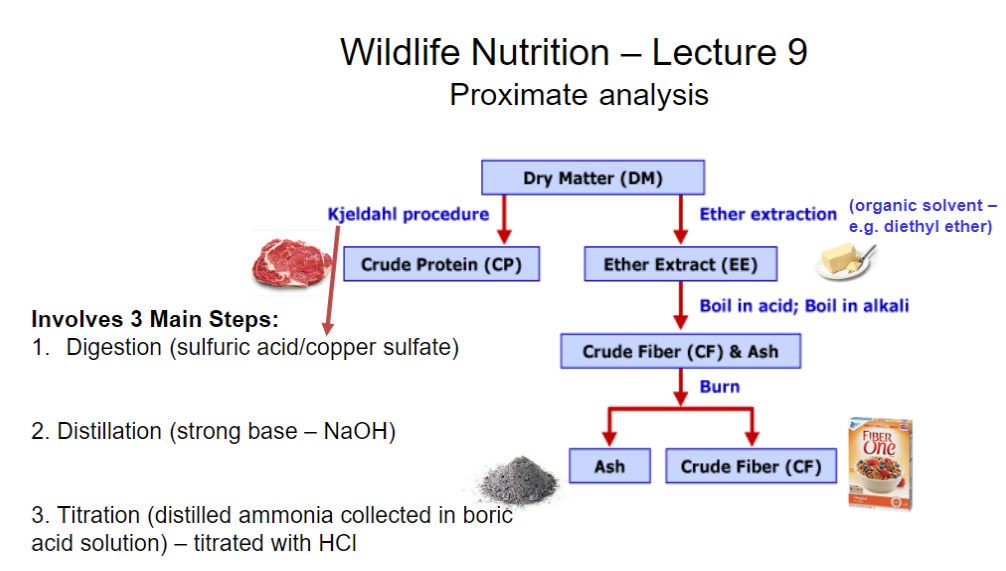
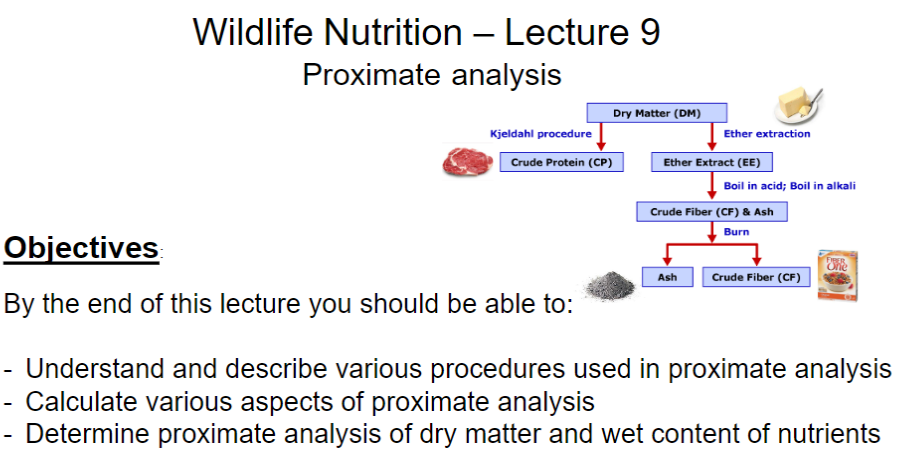
  • Dry Matter (DM) โ†’ determines moisture content by measuring what remains after water is removed

  • Crude Protein (CP) โ†’ determined using the Kjeldahl procedure

  • Ether Extract (EE) โ†’ determined using ether extraction with an organic solvent, such as diethyl ether

  • Crude Fiber (CF) โ†’ determined by boiling the sample in acid, then alkali

  • Ash โ†’ determined by burning the sample to measure inorganic residue

Kjeldahl Procedure: Measuring Crude Protein

  1. Digestion โ†’ sulfuric acid and copper sulfate

  2. Distillation โ†’ strong base (NaOH) releases ammonia

  3. Titration โ†’ distilled ammonia is collected in boric acid solution and titrated with HCl

Memory Cue

  • CP โ†’ Kjeldahl

  • EE โ†’ Ether extraction

  • CF โ†’ Acid + alkali

  • Ash โ†’ Burning


<p>Main Components and Procedures</p><ul><li><p>Dry Matter (DM) โ†’ determines moisture content by measuring what remains after water is removed</p></li><li><p>Crude Protein (CP) โ†’ determined using the Kjeldahl procedure</p></li><li><p>Ether Extract (EE) โ†’ determined using ether extraction with an organic solvent, such as diethyl ether</p></li><li><p>Crude Fiber (CF) โ†’ determined by boiling the sample in acid, then alkali</p></li><li><p>Ash โ†’ determined by burning the sample to measure inorganic residue</p></li></ul><p>Kjeldahl Procedure: Measuring Crude Protein</p><ol><li><p>Digestion โ†’ sulfuric acid and copper sulfate</p></li><li><p>Distillation โ†’ strong base (NaOH) releases ammonia</p></li><li><p>Titration โ†’ distilled ammonia is collected in boric acid solution and titrated with HCl</p></li></ol><p>Memory Cue</p><ul><li><p>CP โ†’ Kjeldahl</p></li><li><p>EE โ†’ Ether extraction</p></li><li><p>CF โ†’ Acid + alkali</p></li><li><p>Ash โ†’ Burning</p></li></ul><p></p>
3
New cards

Proximate Analysis of Feed

Definition

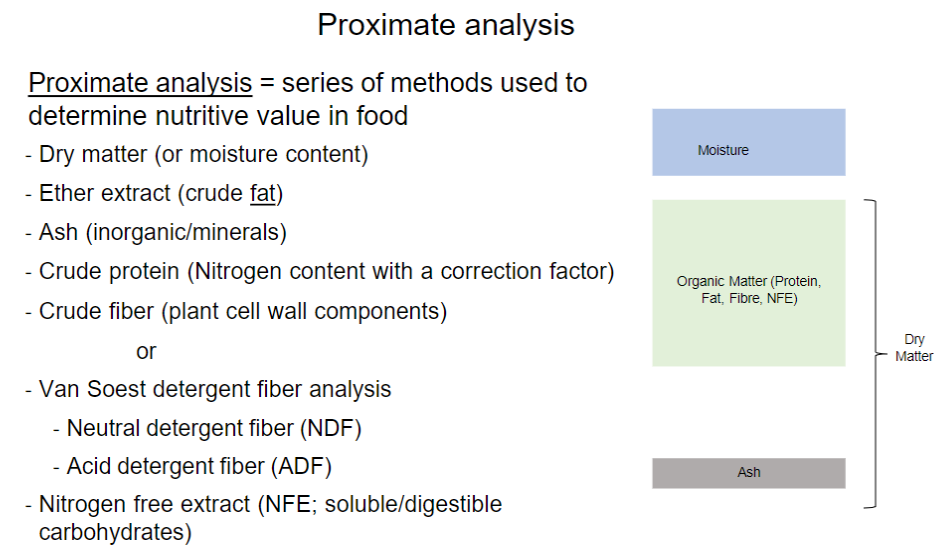
- Series of methods used to determine the nutritive value of food

Main Components

  • Dry Matter (DM) โ†’ moisture content

  • Ether Extract (EE) โ†’ crude fat

  • Ash โ†’ inorganic matter/minerals

  • Crude Protein (CP) โ†’ nitrogen content multiplied by a correction factor

  • Crude Fiber (CF) โ†’ plant cell wall components

  • Nitrogen-Free Extract (NFE) โ†’ soluble/digestible carbohydrates

Alternative Fiber Analysis: Van Soest Method

  • Neutral Detergent Fiber (NDF)

  • Acid Detergent Fiber (ADF)


<p>Definition</p><p>- Series of methods used to determine the nutritive value of food</p><p>Main Components</p><ul><li><p>Dry Matter (DM) โ†’ moisture content</p></li><li><p>Ether Extract (EE) โ†’ crude fat</p></li><li><p>Ash โ†’ inorganic matter/minerals</p></li><li><p>Crude Protein (CP) โ†’ nitrogen content multiplied by a correction factor</p></li><li><p>Crude Fiber (CF) โ†’ plant cell wall components</p></li><li><p>Nitrogen-Free Extract (NFE) โ†’ soluble/digestible carbohydrates</p></li></ul><p>Alternative Fiber Analysis: Van Soest Method</p><ul><li><p>Neutral Detergent Fiber (NDF)</p></li><li><p>Acid Detergent Fiber (ADF)</p></li></ul><p></p>
4
New cards

Proximate Analysis: Sample Processing

Sample Preparation

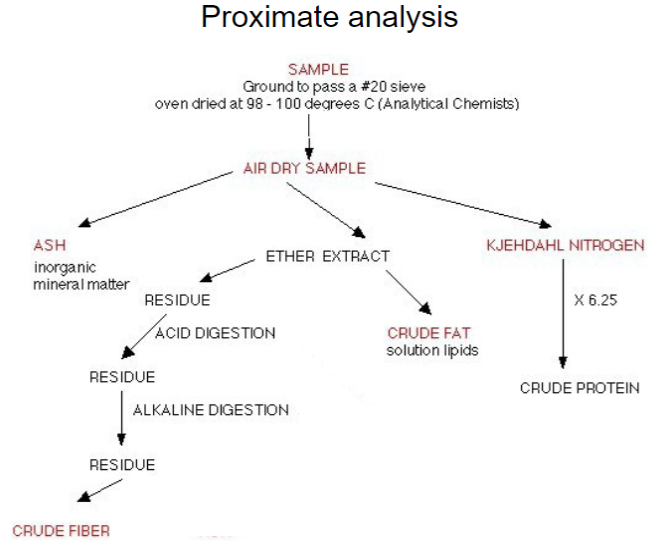
  • Sample is ground to pass a #20 sieve

  • Oven-dried at 98โ€“100ยฐC (Analytical Chemists)

  • Produces an air-dry sample for analysis

Main Analysis Procedures

- Ash

  • Measures inorganic mineral matter

- Ether Extract (EE)

  • Extracts lipids using a solvent

  • Measures crude fat

- Kjeldahl Nitrogen

  • Nitrogen content ร— 6.25 = crude protein

- Crude Fiber (CF)

  1. Acid digestion โ†’ residue remains

  2. Alkaline digestion โ†’ remaining residue is crude fiber


<p>Sample Preparation</p><ul><li><p>Sample is ground to pass a #20 sieve</p></li><li><p>Oven-dried at 98โ€“100ยฐC (Analytical Chemists)</p></li><li><p>Produces an air-dry sample for analysis</p></li></ul><p>Main Analysis Procedures</p><p>- Ash</p><ul><li><p>Measures inorganic mineral matter</p></li></ul><p>- Ether Extract (EE)</p><ul><li><p>Extracts lipids using a solvent</p></li><li><p>Measures crude fat</p></li></ul><p>- Kjeldahl Nitrogen</p><ul><li><p>Nitrogen content ร— 6.25 = crude protein</p></li></ul><p>- Crude Fiber (CF)</p><ol><li><p>Acid digestion โ†’ residue remains</p></li><li><p>Alkaline digestion โ†’ remaining residue is crude fiber</p></li></ol><p></p>
5
New cards

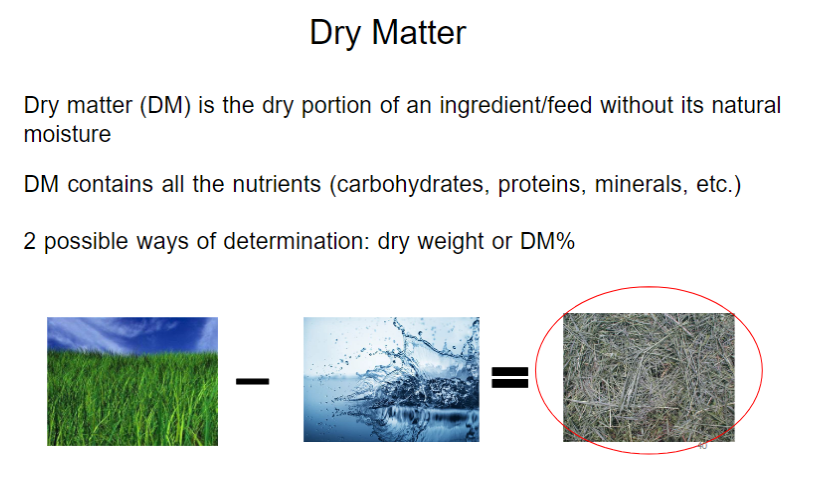
Dry Matter (DM) and Moisture Content

Definition

- Dry Matter (DM) โ†’ food material remaining after water is removed

Determining Moisture Content

  1. Weigh the sample before drying

  2. Dry sample in an oven at 100ยฐC

  3. Reweigh the sample

  4. Repeat drying and weighing until weight no longer changes

Calculation

- Moisture content = Pre-drying weight โˆ’ Post-drying weight

<p>Definition</p><p>- Dry Matter (DM) โ†’ food material remaining after water is removed</p><p>Determining Moisture Content</p><ol><li><p>Weigh the sample before drying</p></li><li><p>Dry sample in an oven at 100ยฐC</p></li><li><p>Reweigh the sample</p></li><li><p>Repeat drying and weighing until weight no longer changes</p></li></ol><p>Calculation</p><p>- Moisture content = Pre-drying weight โˆ’ Post-drying weight</p>
6
New cards

Dry Matter (DM): Maillard Reaction

Potential Problems During Drying

  • Maillard reaction โ†’ reaction between amino acids (AA) and sugars

  • Produces melanoidins, which give browned food its flavour

  • Causes amino acid loss, primarily lysine

  • Can lead to overestimation of available protein


<p>Potential Problems During Drying</p><ul><li><p>Maillard reaction โ†’ reaction between amino acids (AA) and sugars</p></li><li><p>Produces melanoidins, which give browned food its flavour</p></li><li><p>Causes amino acid loss, primarily lysine</p></li><li><p>Can lead to overestimation of available protein</p></li></ul><p></p>
7
New cards

Ash: Measuring Mineral Content

Definition

- Ash โ†’ inorganic (mineral) content of a food item

Method

  1. Weigh a portion of the dried sample

  2. Heat sample in an oven at 500โ€“600ยฐC for 8 hours

  3. Reweigh the remaining sample

Result

- Remaining ash = mineral (inorganic) content of the food item

<p>Definition</p><p>- Ash โ†’ inorganic (mineral) content of a food item</p><p>Method</p><ol><li><p>Weigh a portion of the dried sample</p></li><li><p>Heat sample in an oven at 500โ€“600ยฐC for 8 hours</p></li><li><p>Reweigh the remaining sample</p></li></ol><p>Result</p><p>- Remaining ash = mineral (inorganic) content of the food item</p>
8
New cards

STEPS ****IMPORTANT

knowt flashcard image
9
New cards

Ash: Potential Problems

  • Some trace minerals may be lost through volatilization during heating; error is small

  • Measures total inorganic content but does not identify or quantify specific minerals


<ul><li><p>Some trace minerals may be lost through volatilization during heating; error is small</p></li><li><p>Measures total inorganic content but does not identify or quantify specific minerals</p></li></ul><p></p>
10
New cards

Crude Protein (CP): Measuring Nitrogen Content

Definition

- Crude Protein (CP) โ†’ estimated from the nitrogen content of a food item

Kjeldahl Method

  1. Analyze the dried sample for nitrogen using the Kjeldahl method

  2. Determine the nitrogen content

  3. Multiply nitrogen by a conversion factor to estimate crude protein

Calculation

  • %CP = %N ร— 6.25

  • Total Kjeldahl nitrogen ร— conversion factor = crude protein


<p>Definition</p><p>- Crude Protein (CP) โ†’ estimated from the nitrogen content of a food item</p><p>Kjeldahl Method</p><ol><li><p>Analyze the dried sample for nitrogen using the Kjeldahl method</p></li><li><p>Determine the nitrogen content</p></li><li><p>Multiply nitrogen by a conversion factor to estimate crude protein</p></li></ol><p>Calculation</p><ul><li><p>%CP = %N ร— 6.25</p></li><li><p>Total Kjeldahl nitrogen ร— conversion factor = crude protein</p></li></ul><p></p>
11
New cards

Crude Protein (CP): Potential Problems

  • Not all nitrogen comes from protein โ†’ nitrogen can also come from urea, ammonia, uric acid, and DNA

  • Assumes all proteins contain 16% nitrogen โ†’ uses a conversion factor of 6.25 because 100 / 16 = 6.25


<ul><li><p>Not all nitrogen comes from protein โ†’ nitrogen can also come from urea, ammonia, uric acid, and DNA</p></li><li><p>Assumes all proteins contain 16% nitrogen โ†’ uses a conversion factor of 6.25 because 100 / 16 = 6.25</p></li></ul><p></p>
12
New cards

Ether Extract (EE): Measuring Crude Fat

Definition

- Ether Extract (EE) โ†’ crude fat content of a food item

Method

  1. Weigh the dried sample

  2. Extract sample with diethyl ether, which dissolves lipids

  3. Separate the ether from the sample and evaporate it

  4. Weigh the remaining residue

Result

- Remaining residue = Ether Extract (crude fat)

<p>Definition</p><p>- Ether Extract (EE) โ†’ crude fat content of a food item</p><p>Method</p><ol><li><p>Weigh the dried sample</p></li><li><p>Extract sample with diethyl ether, which dissolves lipids</p></li><li><p>Separate the ether from the sample and evaporate it</p></li><li><p>Weigh the remaining residue</p></li></ol><p>Result</p><p>- Remaining residue = Ether Extract (crude fat)</p>
13
New cards

Ether Extract (EE): Potential Problems

  • Assumes all dissolved lipids are fats, but may include non-nutritive lipids, such as waxes

  • Error is generally small, but can be greater in plant products


<ul><li><p>Assumes all dissolved lipids are fats, but may include non-nutritive lipids, such as waxes</p></li><li><p>Error is generally small, but can be greater in plant products</p></li></ul><p></p>
14
New cards

Crude Fiber (CF): Measuring Insoluble Carbohydrates

Definition

- Crude Fiber (CF) โ†’ insoluble carbohydrate fraction, including cellulose, hemicellulose, and lignin

Method

  1. Weigh the fat-free portion remaining after ether extraction

  2. Boil sample in dilute acid, then filter and wash

  3. Boil sample in dilute alkali, then filter and wash

  4. Weigh the remaining residue

Result

- Remaining residue = Crude Fiber (CF)

<p>Definition</p><p>- Crude Fiber (CF) โ†’ insoluble carbohydrate fraction, including cellulose, hemicellulose, and lignin</p><p>Method</p><ol><li><p>Weigh the fat-free portion remaining after ether extraction</p></li><li><p>Boil sample in dilute acid, then filter and wash</p></li><li><p>Boil sample in dilute alkali, then filter and wash</p></li><li><p>Weigh the remaining residue</p></li></ol><p>Result</p><p>- Remaining residue = Crude Fiber (CF)</p>
15
New cards

Crude Fiber (CF): Potential Problems

  • Underestimates total fiber โ†’ some fiber is solubilized and lost during analysis, especially hemicellulose

  • Does not distinguish between fiber sources

  • Considered the most unsatisfactory analytical procedure in proximate analysis


<ul><li><p>Underestimates total fiber โ†’ some fiber is solubilized and lost during analysis, especially hemicellulose</p></li><li><p>Does not distinguish between fiber sources</p></li><li><p>Considered the most unsatisfactory analytical procedure in proximate analysis</p></li></ul><p></p>
16
New cards

Nitrogen-Free Extract (NFE): Soluble Carbohydrates

Definition

- NFE โ†’ soluble carbohydrate fraction, including starch and sugars

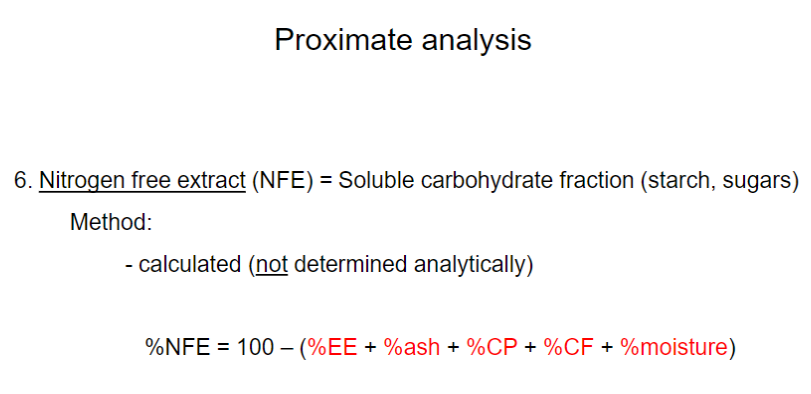
Method

- Calculated rather than measured directly through laboratory analysis

Calculation

- %NFE = 100 โˆ’ (%EE + %ash + %CP + %CF + %moisture)

<p>Definition</p><p>- NFE โ†’ soluble carbohydrate fraction, including starch and sugars</p><p>Method</p><p>- Calculated rather than measured directly through laboratory analysis</p><p>Calculation</p><p>- %NFE = 100 โˆ’ (%EE + %ash + %CP + %CF + %moisture)</p>
17
New cards

Nitrogen-Free Extract (NFE): Potential Problems

  • Accumulates errors from all other proximate analyses because NFE is calculated rather than measured directly

  • Crude fiber (CF) contributes the largest error


<ul><li><p>Accumulates errors from all other proximate analyses because NFE is calculated rather than measured directly</p></li><li><p>Crude fiber (CF) contributes the largest error</p></li></ul><p></p>
18
New cards

Van Soest Fiber Analysis

Forage Components

  • Cell Contents โ†’ protein, starch, sugars, organic acids, pectins

  • Neutral Detergent Fiber (NDF) โ†’ hemicellulose, cellulose, lignin

  • Acid Detergent Fiber (ADF) โ†’ cellulose and lignin

  • Lignin Residue โ†’ cellulose and lignin are further separated using 72% sulfuric acid, leaving lignin

Analysis Procedure

  1. Neutral detergent digestion โ†’ separates cell contents from NDF

  2. Acid detergent digestion โ†’ separates hemicellulose from cellulose and lignin

  3. 72% sulfuric acid digestion โ†’ removes cellulose, leaving lignin


<p>Forage Components</p><ul><li><p>Cell Contents โ†’ protein, starch, sugars, organic acids, pectins</p></li><li><p>Neutral Detergent Fiber (NDF) โ†’ hemicellulose, cellulose, lignin</p></li><li><p>Acid Detergent Fiber (ADF) โ†’ cellulose and lignin</p></li><li><p>Lignin Residue โ†’ cellulose and lignin are further separated using 72% sulfuric acid, leaving lignin</p></li></ul><p>Analysis Procedure</p><ol><li><p>Neutral detergent digestion โ†’ separates cell contents from NDF</p></li><li><p>Acid detergent digestion โ†’ separates hemicellulose from cellulose and lignin</p></li><li><p>72% sulfuric acid digestion โ†’ removes cellulose, leaving lignin</p></li></ol><p></p>
19
New cards

Van Soest Fiber Analysis: Neutral Detergent Step

Definition

- Measures the insoluble carbohydrate fraction using Neutral Detergent Fiber (NDF) and Acid Detergent Fiber (ADF)

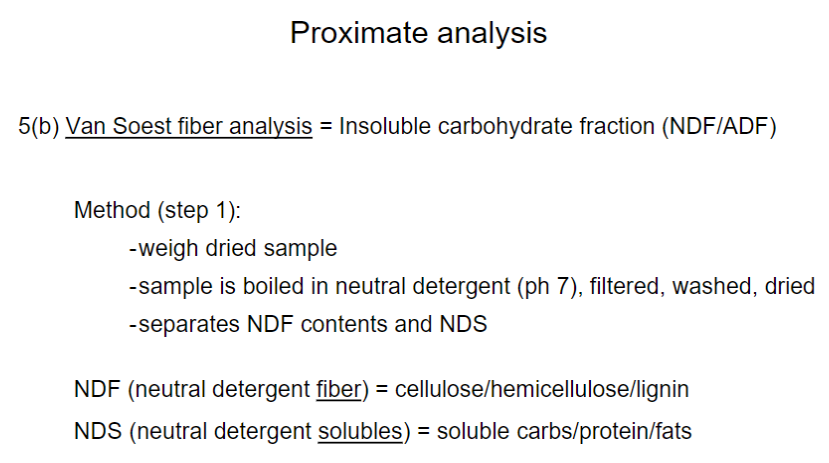
Step 1: Neutral Detergent Digestion

  1. Weigh the dried sample

  2. Boil in neutral detergent (pH 7)

  3. Filter, wash, and dry the sample

  4. Separates the sample into NDF and NDS

Fractions

  • NDF (Neutral Detergent Fiber) โ†’ cellulose, hemicellulose, and lignin

  • NDS (Neutral Detergent Solubles) โ†’ soluble carbohydrates, protein, and fats

<p>Definition</p><p>- Measures the insoluble carbohydrate fraction using Neutral Detergent Fiber (NDF) and Acid Detergent Fiber (ADF)</p><p>Step 1: Neutral Detergent Digestion</p><ol><li><p>Weigh the dried sample</p></li><li><p>Boil in neutral detergent (pH 7)</p></li><li><p>Filter, wash, and dry the sample</p></li><li><p>Separates the sample into NDF and NDS</p></li></ol><p>Fractions</p><ul><li><p>NDF (Neutral Detergent Fiber) โ†’ cellulose, hemicellulose, and lignin</p></li><li><p>NDS (Neutral Detergent Solubles) โ†’ soluble carbohydrates, protein, and fats</p></li></ul><p></p>
20
New cards

Van Soest Fiber Analysis: Separating Fiber Fractions

Step 1: Neutral Detergent Digestion

- Separates forage into:

  • NDS (Neutral Detergent Solubles) โ†’ protein, starch, sugars, organic acids, pectins

  • NDF (Neutral Detergent Fiber) โ†’ hemicellulose, cellulose, lignin

Step 2: Acid Detergent Digestion

- Separates NDF into:

  • Hemicellulose โ†’ removed into solution

  • ADF (Acid Detergent Fiber) โ†’ cellulose and lignin

Step 3: 72% Sulfuric Acid Digestion

- Separates ADF into:

  • Cellulose โ†’ removed into solution

  • Lignin โ†’ remains as residue

Memory Cue

  • NDF = Hemicellulose + Cellulose + Lignin

  • ADF = Cellulose + Lignin


<p>Step 1: Neutral Detergent Digestion</p><p>- Separates forage into:</p><ul><li><p>NDS (Neutral Detergent Solubles) โ†’ protein, starch, sugars, organic acids, pectins</p></li><li><p>NDF (Neutral Detergent Fiber) โ†’ hemicellulose, cellulose, lignin</p></li></ul><p>Step 2: Acid Detergent Digestion</p><p>- Separates NDF into:</p><ul><li><p>Hemicellulose โ†’ removed into solution</p></li><li><p>ADF (Acid Detergent Fiber) โ†’ cellulose and lignin</p></li></ul><p>Step 3: 72% Sulfuric Acid Digestion</p><p>- Separates ADF into:</p><ul><li><p>Cellulose โ†’ removed into solution</p></li><li><p>Lignin โ†’ remains as residue</p></li></ul><p>Memory Cue</p><ul><li><p>NDF = Hemicellulose + Cellulose + Lignin</p></li><li><p>ADF = Cellulose + Lignin</p></li></ul><p></p>
21
New cards

Van Soest Fiber Analysis: Acid Detergent Step

Step 2: Acid Detergent Digestion

  1. Weigh the dried NDF sample

  2. Boil in acid detergent (pH below 7)

  3. Filter, wash, and dry the sample

  4. Separates hemicellulose from the remaining ADF

Fiber Fractions

  • NDF โ†’ cellulose, hemicellulose, and lignin

  • ADF โ†’ cellulose and lignin

Key Relationship

- NDF โˆ’ ADF = Hemicellulose

<p>Step 2: Acid Detergent Digestion</p><ol><li><p>Weigh the dried NDF sample</p></li><li><p>Boil in acid detergent (pH below 7)</p></li><li><p>Filter, wash, and dry the sample</p></li><li><p>Separates hemicellulose from the remaining ADF</p></li></ol><p>Fiber Fractions</p><ul><li><p>NDF โ†’ cellulose, hemicellulose, and lignin</p></li><li><p>ADF โ†’ cellulose and lignin</p></li></ul><p>Key Relationship</p><p>- NDF โˆ’ ADF = Hemicellulose</p>
22
New cards

Van Soest Fiber Analysis: Lignin Separation

Step 3: Concentrated Sulfuric Acid Digestion

  1. Weigh the dried ADF sample

  2. Boil in concentrated sulfuric acid (72%)

  3. Filter, wash, and dry the sample

  4. Separates cellulose from acid detergent lignin

Fiber Fractions

  • ADF (Acid Detergent Fiber) โ†’ cellulose and lignin

  • ADL (Acid Detergent Lignin) โ†’ lignin

Key Relationships

  • ADF โˆ’ ADL = Cellulose

  • ADL = Lignin


<p>Step 3: Concentrated Sulfuric Acid Digestion</p><ol><li><p>Weigh the dried ADF sample</p></li><li><p>Boil in concentrated sulfuric acid (72%)</p></li><li><p>Filter, wash, and dry the sample</p></li><li><p>Separates cellulose from acid detergent lignin</p></li></ol><p>Fiber Fractions</p><ul><li><p>ADF (Acid Detergent Fiber) โ†’ cellulose and lignin</p></li><li><p>ADL (Acid Detergent Lignin) โ†’ lignin</p></li></ul><p>Key Relationships</p><ul><li><p>ADF โˆ’ ADL = Cellulose</p></li><li><p>ADL = Lignin</p></li></ul><p></p>
23
New cards
knowt flashcard image
24
New cards

Calculating Nitrogen-Free Extract (NFE)

Given Values

  • Moisture = 5%

  • Crude Protein (CP) = 8%

  • Ether Extract (EE) = 12%

  • Ash = 4%

  • Crude Fiber (CF) = 5%

NFE = 100 - (% moisture + % CP + % EE + % ash + % CF)

CF = NDF

Remember: Use crude fiber (CF) in the NFE formula, not NDF or ADF.

<p>Given Values</p><ul><li><p>Moisture = 5%</p></li><li><p>Crude Protein (CP) = 8%</p></li><li><p>Ether Extract (EE) = 12%</p></li><li><p>Ash = 4%</p></li><li><p>Crude Fiber (CF) = 5%</p></li></ul><p>NFE = 100 - (% moisture + % CP + % EE + % ash + % CF)</p><p>CF = NDF</p><p>Remember: Use crude fiber (CF) in the NFE formula, not NDF or ADF.</p>
25
New cards

As-Fed Basis vs. Dry Matter Basis

As-Fed Basis (AFB)

- Nutrient content of food including moisture

Dry Matter Basis (DMB)

  • Nutrient content of food excluding moisture

  • Represents nutrients in the dry portion only


<p>As-Fed Basis (AFB)</p><p>- Nutrient content of food including moisture</p><p>Dry Matter Basis (DMB)</p><ul><li><p>Nutrient content of food excluding moisture</p></li><li><p>Represents nutrients in the dry portion only</p></li></ul><p></p>
26
New cards

Moisture Content in Feed

Definition

- Moisture โ†’ amount of water contained in an ingredient or feed

Ways to Express Moisture

  • Wet weight โ†’ amount of water by weight (kg)

  • Moisture percent โ†’ percentage of the feed's total weight that is water (%)


<p>Definition</p><p>- Moisture โ†’ amount of water contained in an ingredient or feed</p><p>Ways to Express Moisture</p><ul><li><p>Wet weight โ†’ amount of water by weight (kg)</p></li><li><p>Moisture percent โ†’ percentage of the feed's total weight that is water (%)</p></li></ul><p></p>
27
New cards

As-Fed (As-Is) Feed Composition

Total Feed Weight

  • Includes both Dry Matter (DM) and moisture

  • As-fed/as-is = total feed weight = 100%

Key Relationship

- DM (%) + Moisture (%) = 100%

<p>Total Feed Weight</p><ul><li><p>Includes both Dry Matter (DM) and moisture</p></li><li><p>As-fed/as-is = total feed weight = 100%</p></li></ul><p>Key Relationship</p><p>- DM (%) + Moisture (%) = 100%</p>
28
New cards

Dry Matter (DM): Definition and Measurement

Definition

  • Dry Matter (DM) โ†’ dry portion of an ingredient or feed after removing its moisture

  • Contains the nutrients in the feed, including carbohydrates, proteins, minerals, and fats

Ways to Express Dry Matter

  • Dry weight โ†’ weight of the feed remaining after water removal (kg)

  • DM (%) โ†’ percentage of the feed's total as-fed weight that is dry matter

  • DM (%) + Moisture (%) = 100%


<p>Definition</p><ul><li><p>Dry Matter (DM) โ†’ dry portion of an ingredient or feed after removing its moisture</p></li><li><p>Contains the nutrients in the feed, including carbohydrates, proteins, minerals, and fats</p></li></ul><p>Ways to Express Dry Matter</p><ul><li><p>Dry weight โ†’ weight of the feed remaining after water removal (kg)</p></li><li><p>DM (%) โ†’ percentage of the feed's total as-fed weight that is dry matter</p></li><li><p>DM (%) + Moisture (%) = 100%</p></li></ul><p></p>
29
New cards

As-Fed Basis vs. Dry Matter Basis

Definitions

  • As-Fed Basis (AFB) โ†’ nutritional composition of food as it is fed, including moisture

  • Dry Matter Basis (DMB) โ†’ nutrient composition of the food after moisture is removed

Reporting Nutrient Values

  • Nutrient profiles (e.g., proximate analysis) and metabolizable energy (ME) can be expressed on either an AFB or DMB

  • Always check which basis is used when comparing values

Why Use AFB for This Course and Project?

  • Represents the food in the form the animal actually consumes, including its natural moisture

  • Allows nutrient content and energy to be calculated based on the total amount of feed offered or eaten


<p>Definitions</p><ul><li><p>As-Fed Basis (AFB) โ†’ nutritional composition of food as it is fed, including moisture</p></li><li><p>Dry Matter Basis (DMB) โ†’ nutrient composition of the food after moisture is removed</p></li></ul><p>Reporting Nutrient Values</p><ul><li><p>Nutrient profiles (e.g., proximate analysis) and metabolizable energy (ME) can be expressed on either an AFB or DMB</p></li><li><p>Always check which basis is used when comparing values</p></li></ul><p>Why Use AFB for This Course and Project?</p><ul><li><p>Represents the food in the form the animal actually consumes, including its natural moisture</p></li><li><p>Allows nutrient content and energy to be calculated based on the total amount of feed offered or eaten</p></li></ul><p></p>
30
New cards

As-Fed Basis vs. Dry Matter Basis

Definitions

  • As-Fed Basis (AFB) โ†’ nutritional composition of food as it is fed, including moisture

  • Dry Matter Basis (DMB) โ†’ nutrient composition of the food after moisture is removed

Reporting Nutrient Values

  • Nutrient profiles (e.g., proximate analysis) and metabolizable energy (ME) can be expressed on either an AFB or DMB

  • Always check which basis is used when comparing values

Why Use AFB for This Course and Project?

  • Represents the food in the form the animal actually consumes, including its natural moisture

  • Allows nutrient content and energy to be calculated based on the total amount of feed offered or eaten


<p>Definitions</p><ul><li><p>As-Fed Basis (AFB) โ†’ nutritional composition of food as it is fed, including moisture</p></li><li><p>Dry Matter Basis (DMB) โ†’ nutrient composition of the food after moisture is removed</p></li></ul><p>Reporting Nutrient Values</p><ul><li><p>Nutrient profiles (e.g., proximate analysis) and metabolizable energy (ME) can be expressed on either an AFB or DMB</p></li><li><p>Always check which basis is used when comparing values</p></li></ul><p>Why Use AFB for This Course and Project?</p><ul><li><p>Represents the food in the form the animal actually consumes, including its natural moisture</p></li><li><p>Allows nutrient content and energy to be calculated based on the total amount of feed offered or eaten</p></li></ul><p></p>
31
New cards

Converting Dry Matter Basis (DMB) to As-Fed Basis (AFB)

Conversion Formula

  • % Nutrient (AFB) = % Nutrient (DMB) ร— (% DM รท 100)

  • % DM = 100 โˆ’ % moisture

Example: Crude Protein (CP)

  • CP (DMB) = 7%; moisture = 22%

  • DM = 100 โˆ’ 22 = 78%

  • CP (AFB) = 7 ร— (78 รท 100) = 5.46%

Key Point

- Converting DMB to AFB accounts for moisture, so the nutrient percentage decreases.

<p>Conversion Formula</p><ul><li><p>% Nutrient (AFB) = % Nutrient (DMB) ร— (% DM รท 100)</p></li><li><p>% DM = 100 โˆ’ % moisture</p></li></ul><p>Example: Crude Protein (CP)</p><ul><li><p>CP (DMB) = 7%; moisture = 22%</p></li><li><p>DM = 100 โˆ’ 22 = 78%</p></li><li><p>CP (AFB) = 7 ร— (78 รท 100) = 5.46%</p></li></ul><p>Key Point</p><p>- Converting DMB to AFB accounts for moisture, so the nutrient percentage decreases.</p>
32
New cards

Converting Dry Matter Basis (DMB) to As-Fed Basis (AFB)

Conversion Formula

- % Nutrient (AFB) = % DM of food ร— (% Nutrient (DMB) รท 100)

Example: Crude Protein (CP)

  • CP (DMB) = 7%; moisture = 22%

  • Step 1: Determine DM = 100 โˆ’ 22 = 78%

  • Step 2: Calculate CP on an AFB

    • % CP (AFB) = 78 ร— (7 รท 100)

    • % CP (AFB) = 5.46%


<p>Conversion Formula</p><p>- % Nutrient (AFB) = % DM of food ร— (% Nutrient (DMB) รท 100)</p><p>Example: Crude Protein (CP)</p><ul><li><p>CP (DMB) = 7%; moisture = 22%</p></li><li><p>Step 1: Determine DM = 100 โˆ’ 22 = 78%</p></li><li><p>Step 2: Calculate CP on an AFB</p><ul><li><p>% CP (AFB) = 78 ร— (7 รท 100)</p></li><li><p>% CP (AFB) = 5.46%</p></li></ul></li></ul><p></p>
33
New cards

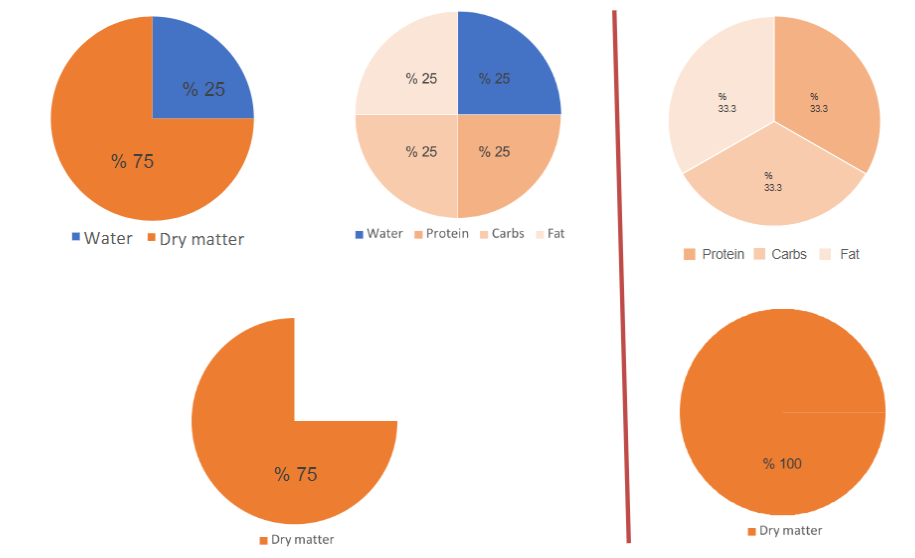
Nutrient Composition: Water and Dry Matter

On an AFB

  • Dry matter = 75%

  • Moisture = 25%

  • Protein = 25%

  • Carbohydrates = 25%

  • Fat = 25%

On a DMB

  • Dry matter = 100%

  • Protein = 33.3%

  • Carbohydrates = 33.3%

  • Fat = 33.3%

  • Protein + carbohydrates + fat = 100% of DM

<p>On an AFB</p><ul><li><p>Dry matter = 75%</p></li><li><p>Moisture = 25%</p></li><li><p>Protein = 25%</p></li><li><p>Carbohydrates = 25%</p></li><li><p>Fat = 25%</p></li></ul><p>On a DMB</p><ul><li><p>Dry matter = 100%</p></li><li><p>Protein = 33.3%</p></li><li><p>Carbohydrates = 33.3%</p></li><li><p>Fat = 33.3%</p></li><li><p>Protein + carbohydrates + fat = 100% of DM</p></li></ul><p></p>