Capacitance
 Call Kai
 Learn
 Practice Test
 Spaced Repetition
 Match
 Flashcards
 Knowt Play
1/19

There's no tags or description
Looks like no tags are added yet.
20 Terms
Capacitor
device that stores charge
two parallel plates separated by a short distance
electrons flow from negative terminal of battery and distribute evenly over metal plate connected to that terminal
electrons on this now negatively charged plate exert repulsive electrostatic force on electrons of opposite plate
causing an equal number of electrons to flow away from the plate towards the positive terminal such that the plate gains an equal magnitude positive charge
charge stored in capacitor, Q refers to magnitude of charge stored on each plate
electric field forms between parallel plates and there is a pd
Capacitance
the charge stored per unit potential difference of a capacitor
Q = CV
Energy stored in a capacitor
the area under a Q against V graph
stored energy is electrical potential energy, and the capacitor will discharge very quickly if connected to an electrical device it can transfer its stored energy to
W=21QV=21CV2=21CQ2
only half of the energy supplied by the battery is transferred to capacitor - the rest wasted due to resistance in the circuit and lost to the surroundings as charge flows through the circuit
capacitors in series
CT1=C11+C21+⋯
capacitors in parallel
CT=C1+C2+⋯
Charging a capacitor through a fixed resistor
when a pd is applied across a capacitor, the capacitor becomes charged
the capacitor is charged and will retain this charge even when the energy source is disconnected
charge stored on the capacitor, starts at zero and increases exponentially as charge from the battery is transferred to the capacitor
high rate initially as difference between the potential difference of the battery, (which is fixed) and the potential difference across the capacitor, which is initially zero, is at its largest
potential difference across it increases, proportional to the charge
difference in potential between the source and the capacitor decreases until when equal - no charge flows - 0 current
current decreases exponentially, flattening off 0
graphs for charging capacitor

time constant for charging capacitor
time taken for capacitor to charge to 67%
discharging a capacitor through a fixed resistor
When the switch is closed, the capacitor will discharge as charge flows towards the resistor, and the energy stored will transfer to the surroundings, as thermal energy
it loses charge at exponential rate
pd across capacitor decreases at an exponential due to this
V = IR where V is capacitor pd and R is resistor resistance so the current decreases exponentially
time constant for discharging capacitor
time taken for quantity that decreases exponentially to fall to 37% of initial value
discharge curves

dielectric
insulating material that that increases the capacitance of a parallel plate capacitor to store charge when placed between the plates of a capacitor
in electric field, every molecule becomes polarised - electrons move slightly towards positive plate
induces electric field of its own, opposing electric field due to charged plates - resultant electric field strength decreases
V = Ed so at same separation, smaller field means smaller pd across plates
C = Q/V so for same charge, greater capacitance
stored energy decreases as the capacitor attracts dielectric which requires work done on dielectric
relative permittivity / dielectric constant of a material
ratio of charge stored by a parallel plate capacitor with dielectric filling space between plates, compared to charge stored without the dielectric for the same potential
polar molecules
electrostatic forces of electrons have caused them to distribute themselves unevenly across the molecule, leading to a charge across the molecule
dipole
consists of two equal and opposite point charges
orientation polarisation
in substances which contain molecules where covalent bonds are formed between atoms of different elements.
the electrons in each covalent bond shared unequally between the two atoms joined by the bond - form a permanent electric dipole in which one atom is positively charged and the other is negatively charged.
electric field is applied - the two atoms in each bond are displaced in opposite directions so the dipole tends to align with the field by turning slightly.
field is absent - the dipoles lie in random directions.
ionic polarisation
in substances where ions are held together by ionic bonds
the oppositely charged ions of each ionic bond are displaced in opposite directions when an electric field is applied.
the ions in each bond form a dipole that tends to align with the field
electronic polarisation
electrons of each atom are displaced relative to the nucleus of the atom when an electric field is applied.
centre of the electron distribution no longer coincides with the nucleus
the electron distribution and the nucleus form a dipole that tends to align with the field
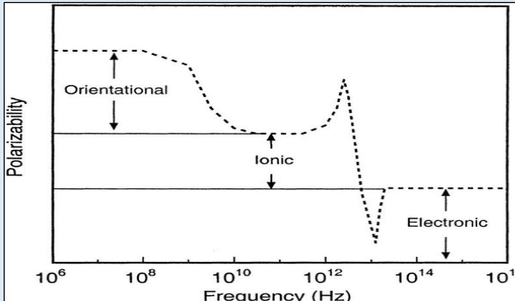
polarisation and frequency
alternating electric field - the polar dipoles rotate and the non-polar dipoles oscillate as the field strength increases and decreases
low frequencies, all three polarisation mechanisms alternate in phase, but as the frequency increases each mechanism ceases to work
due to inertia, with the mass of the particles playing a key role.
each time the field changes direction the particles also have to change direction, larger particles need a larger force to change their direction of motion.
orientation decreases first, followed by ionic and then electronic
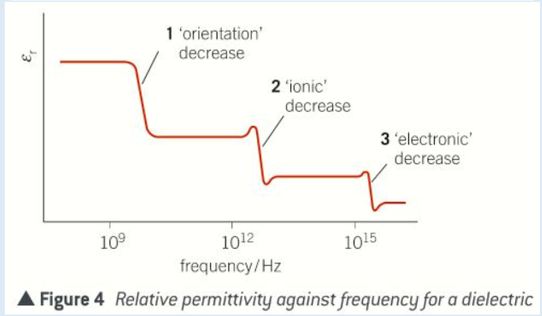
why energy stored in capacitor increases when dielectric is removed
work done against electrostatic force to remove dielectric
increasing energy stored in capacitor
capacitor isolated so charge on the plates constant
capacitance increases
so voltage increases