L11 - Chromosomal Mutations
 Call Kai
 Learn
 Practice Test
 Spaced Repetition
 Match
 Flashcards
 Knowt Play
1/25

Earn XP
Description and Tags
causes/consequences, evolutionary opportunities
26 Terms
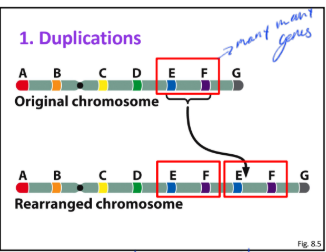
Chromosomal Rearrangement: Duplications
Mutation in which part of the chromosome has been doubled
Chromosomal Rearrangement: Deletions
Loss of a chromosome segment

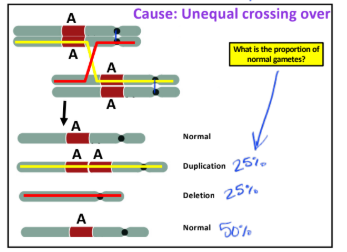
Chromosomal rearrangements are caused by ______.
Unequal crossing over
Chromosomal rearrangements are detected by _________.
Loops in prophase
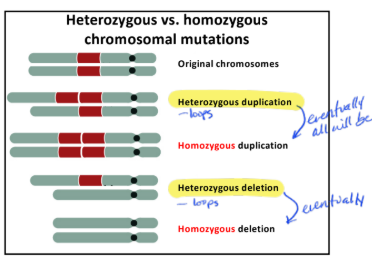
Only present in individuals who are heterozygous for rearrangements

Heterozygous vs. Homozygous chromosomal mutations
Heterozygous duplication or deletion results in loops in prophase I
Consequences of Chromosomal Rearrangements:
Duplications
Unbalanced gene dosage
Deletions
Unbalanced gene dosage
Pseudodominance
Haploinsufficiency
Loss of function due to complete deletions
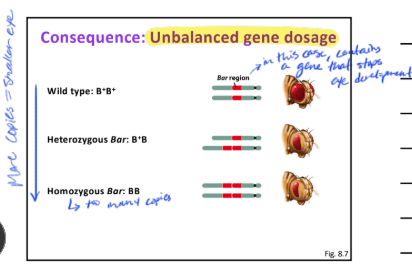
Consequence: Unbalanced gene dosage (Duplication)
Region of fly chromosome that controls eye development duplicated
Heterozygous Bar results in underdeveloped eyes
Homozygous Bar results in extremely underdeveloped eyes due to the presence of too many copies of the gene
Consequence: Pseudodominance
Expression of recessive alleles when paired with deletions
Consequence: Haploinsufficiency
Cri-du-chat syndrome:
Deletion on chromosome 5
Affected individuals are heterozygous (hemizygous at the gene level)
One copy of the gene is not sufficient for normal development
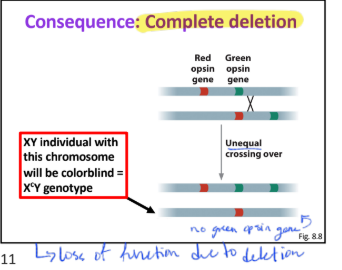
Consequence: Complete deletion
Complete loss of function due to deletion
Ex: Colorblind individuals
Evolutionary novelty of chromosomal rearrangement
Duplicated genes are an important source of evolutionary novelty

Chromosomal Rearrangement: Inversions
A chromosome segment is inverted 180 degrees (chromosome breaks in 2 places)
No lost/gained genetic material, only DNA sequence has been altered
Results in pronounced phenotypic affects
*Loops occur in heterozygous inversion individuals

Inversions are caused by _____________.
Radiation, major breaks (causes chromosome to reattach incorrectly, altering DNA sequence)

Two Types of Inversions:
Paracentric: does not include centromere
Pericentric: includes centromere

Consequences of Inversions:
Mild effects in original heterozygote
All genes are present
Some effect of gene positioning (regulatory)
Major effects during crossing over in Prophase I
Formation of nonviable gametes (50%)
Overall effect of repressing recombination at break points of inversion
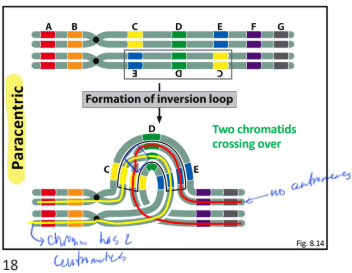
Inversions: Paracentric
One chromosome forms without centromeres and one with 2 centromeres
Crossing over within loop creates ½ nonviable gametes
Dicentric = broken (nonviable due to absence of many genes)
1 lost chromosome due to no centromeres
Inversions: Pericentric info
Includes centromere
Inversions are very common
Crossing over within loop creates ½ nonviable gametes

Inversions are important in ____________.
Speciation (groups of same species slowly segregate due to genetic differences)
Inversions were important to distinguish chimpanzees from humans at the genetic level
Recombination is suppressed around inversions
Chromosomal Rearrangement: Translocations
The movement of genetic material between nonhomologous chromosomes or within the same chromosome (not the same as crossing over)
Types:
Nonreciprocal: material moves from one chromosome to another without reciprocal exchange
Reciprocal: Two-way exchange of segments between the chromosomes
Detection at Prophase 1: cross formation (KINDA SIMILAR TO WHY LOOPS FORM)
Causes of translocations include ______________.
Radiation, transposons, and unknown
Translocation consequences:
Mild effects in the original heterozygote
All genes are present
Loss of function if genes are interrupted
Some effect of gene positioning (regulatory)
Major effects during crossing over in Prophase I
Formation of nonviable gametes
Translocation Types: Alternate Segregation
Anaphase II: 2 translocated move to one end while 2 normal move to the other end of cell
4 viable gametes
Full gene complement

Translocation Types: Adjacent-1 Segregation
Anaphase II: 1 normal + 1 translocated move to each end of the cell
4 nonviable gametes
Duplicated and deleted genes

Translocation Types: Adjacent-2 Segregation (rare)
Anaphase II: 1 normal and 1 translocated to each end of cell
4 nonviable gametes
Duplicated and deleted genes

Robertsonian Translocation
Fuse 2 chromosomes together
Can cause Down’s syndrome
Results in the formation of one big chromosome and a small fragment (lost over evolutionary time)
***Chromosome number is reduced
Robertsonian Translocation is important in ______________.
Evolution
