geometry formulaes
 Call Kai
 Learn
 Practice Test
 Spaced Repetition
 Match
 Flashcards
 Knowt Play
 Podcast
1/42

There's no tags or description
Looks like no tags are added yet.
43 Terms
Sum of Interior Angles of a Triangle
The sum of all three interior angles in any planar triangle is always 180∘. Hinglish recall: Teeno interior angles ko jodo, yog hamesha 180∘ aayega.

Basic Area Formula for Any Triangle
Area=21×base×height, where height represents the perpendicular altitude dropped onto the chosen base. Hinglish mnemonic: Base aur perpendicular height ke gunaa ka aadha (samosa ka aadha).
Perimeter and Semi-Perimeter of a Triangle
Perimeter is the total boundary distance: P=a+b+c. Semi-perimeter (s) is exactly half of the total boundary: s=2a+b+c. Hinglish: Puri boundary ka aadha.
Heron's Formula for Triangle Area
Area=s(s−a)(s−b)(s−c), used whenever the lengths of all three sides are known directly. For example, a triangle with sides 13, 14, and 15 yields s=21 and an area of 84.
Area of an Equilateral Triangle
Area=43a2, where a represents the side length. Hinglish mnemonic: 'Root-3 by 4, a-square'.
Height (Altitude) of an Equilateral Triangle
h=23a. Note the denominator distinction: height uses 2, whereas area uses 4 (area requires a larger denominator). Hinglish: Height me 2, Area me 4.
Equilateral Triangle — Perimeter and Interior Angles
Perimeter equals 3a because all three sides are equal. Each individual interior angle measures 3180∘=60∘. Hinglish: Teen judwa bhai, sab barabar.
Pythagoras Theorem for Right Triangles
P2+B2=H2, where P is the perpendicular height, B is the base, and H is the hypotenuse located directly opposite the 90∘ angle.

Area of a Right-Angled Triangle
Area=21×B×P, calculated by multiplying the two mutually perpendicular legs and halving the product. Hinglish: Dono perpendicular sides ka gunaa, phir aadha.
Fundamental Pythagorean Triplets (Top 6)
The six most common integer sets satisfying a2+b2=c2: (3,4,5), (5,12,13), (8,15,17), (7,24,25), (20,21,29), and (9,40,41). Any scalar multiple also forms a valid triplet, such as (6,8,10), (14,48,50), and (12,16,20).
Classification of Triangles by Angles
Acute: all three interior angles are <90∘. Right: exactly one angle measures 90∘. Obtuse: exactly one angle measures >90∘.
Classification of Triangles by Sides
Scalene: all three sides have different lengths. Isosceles: exactly two sides are equal in length. Equilateral: all three sides are equal. Hinglish memory trick: S-I-E = 'Sab alag, Ik jodi same, Ek jaise teeno'.
Square — Area, Perimeter, and Diagonal
For side length a: Area=a2=2d2; Perimeter=4a; Diagonal d=a2. Shortcut: If diagonal contains 2, removing it instantly reveals the side length a.

Rectangle — Area, Perimeter, and Diagonal
For length l and breadth b: Area=l×b; Perimeter=2(l+b) (semi-perimeter is l+b); Diagonal d=l2+b2. Tip: Use triplets for diagonals (e.g., sides 12 and 5 give diagonal 13).

Rhombus — Area, Side Length, and Perimeter
For diagonals d1 and d2: Area=21×d1×d2; Side a=21d12+d22; Perimeter=4a. Diagonals bisect each other perpendicularly at 90∘. Hinglish: Tedha square jisme chaaron sides barabar hoti hain.

Parallelogram — Area, Perimeter, and Diagonal Theorem
Area=base×perpendicular height (Trap: Never use l×b because the slant side is not perpendicular height); Perimeter=2(a+b); Diagonal relation: d12+d22=2(a2+b2) ('Do ka double' rule).

Trapezium — Area Formula
Area=21×(a+b)×h, where a and b are the parallel sides and h is the perpendicular distance between them. Hinglish intuition: Parallel sides ka average multiplied by height.

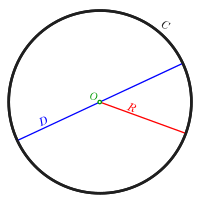
Circle — Diameter, Circumference, Area, and Ratio
Diameter D=2R; Circumference C=2πR=πD; Area=πR2. Ratio of circumference to area: AreaC=πR22πR=R2.
Semicircle — Area and Boundary Perimeter
Area=2πR2; Perimeter=πR+2R=736R when using π=722. Common trap: Never forget to add the flat straight diameter edge 2R. Hinglish: Chintu ki aadhi roti ka kinara.

Circular Ring (Annulus) or Path — Area
Area=π(R2−r2)=π(R+r)(R−r), where R is the outer radius and r is the inner radius. Hinglish: Difference of squares (a2−b2) ka algebraic jaadu. 
Circle Benchmark Values for Standard Radii
When π=722: For R=3.5: C=22, Area=38.5. For R=7: C=44, Area=154. For R=14: C=88, Area=616. For R=21: C=132, Area=1386. For R=28: C=176, Area=2464.
Optimal 2D Shape for Maximum Area at Fixed Perimeter
The circle. Given a fixed perimeter or length of wire, a circle encloses a strictly greater area than any polygon.
Cube — Volume, Surface Areas, Diagonal, and Ratios
For side length a: Volume=a3; Lateral surface area (4 walls) =4a2; Total surface area (6 faces) =6a2; Space diagonal =a3; Total length of 12 edges =12a; Ratio of Volume:TSA=a:6. 
Cuboid — Volume, Surface Areas, and Diagonal
For dimensions l, b, and h: Volume=l×b×h; Lateral surface area (4 walls) =2(l+b)h (perimeter of the floor × height); Total surface area =2(lb+bh+hl); Internal space diagonal =l2+b2+h2. Triplets: (3,4,12)→13, (12,16,21)→29. 
Hollow Box of Thickness t — Internal Dimensions
Closed box: inner dimensions are (l−2t), (b−2t), and (h−2t). Open box (open top): subtract 2t from length and breadth, but subtract only t from height: (h−t).
Three Cubes Recast into One — Side Length Identity
33+43+53=27+64+125=216=63. Melting three metallic cubes of edges 3, 4, and 5 produces a single large cube of edge length 6.
Right Circular Cylinder — Volume, CSA, TSA, and Ratios
For radius R and height H: Volume=πR2H; Curved surface area (can label) =2πRH; Total surface area =2πR(H+R). Ratio of CSA:TSA=H:(H+R); Ratio of CSAVolume=2R.

Hollow Cylindrical Pipe — Volume of Material
Volume=π(R12−R22)h, where R1 is the external radius, R2 is the internal radius, and h is the cylinder height. Hinglish: Bada cylinder volume minus khaali inner core.
Right Circular Cone — Slant Height, Volume, CSA, and TSA
Slant height L=H2+R2; Volume=31πR2H (one-third of an equivalent cylinder); Curved surface area (tent canvas) =πRL; Total surface area =πR(L+R); Ratio of CSA:TSA=L:(L+R).

Height Relationship for Cylinder Recast into a Cone of Equal Radius
Since volume is conserved and cylinder volume is 3 times cone volume for equal height, Cone Height=3×Cylinder Height. Conversely, melting a cone into a cylinder of identical radius yields Cylinder Height=3Cone Height.
Frustum of a Right Circular Cone — Volume Formula
Volume=31πh(R2+Rr+r2), where h is the vertical height, R is the larger base radius, and r is the smaller top radius. Represents a cone with its top peak sliced off (bucket shape). 
Sphere — Volume and Surface Area
Volume=34πR3; Surface Area =4πR2. For a complete sphere, Curved Surface Area equals Total Surface Area (CSA=TSA=4πR2) because it has no flat base boundaries. 
Hemisphere — Volume, CSA, TSA, and Height
For radius R: Volume=32πR3; Curved surface area =2πR2; Solid total surface area =3πR2 (curved bowl 2πR2 plus flat circular base πR2). The vertical height of any hemisphere is exactly equal to its radius: h=R. 
Number of Small Spheres Formed by Melting a Large Sphere
n=(rR)3, where R is the radius of the original large sphere and r is the radius of each new small sphere. Example: If R=6 and r=1, n=63=216 balls.
Composite Solid: Cylinder Surmounted by a Hemisphere — Volume
Total Volume=πR2(h+32R), where h is the height of the cylindrical section alone and R is the common radius. If total height is Htotal, then h=Htotal−R.
Cost Estimation: Boundary Fencing vs Surface Finishing
Linear boundary work (fencing, wiring, border edging) =Perimeter×Rate per unit length. Surface work (painting, flooring, turfing, gardening) =Area×Rate per unit area.
Conservation Invariance: Melting vs Wire Reshaping
Melting and recasting: Volume remains constant and invariant, while total surface area changes. Reshaping a continuous wire into a new closed geometry: Perimeter remains constant and invariant, while enclosed surface area changes.
Uniform Pathway Around a Rectangle — Area Formulas
Pathway of width w outside a rectangle of length l and breadth b: Area=2w(l+b+2w). Pathway inside the rectangle: Area=2w(l+b−2w). For a pathway inside a square of side a: Area=4w(a−w). Hinglish: Bahar ke path me plus 2w, andar ke path me minus 2w.
Net Percentage Change in Area Formulas
When both radius or side change by +x%: Net Area Change=(2x+100x2)%. For example, +50% gives 2(50)+1002500=125%, while +100% gives 300%. For two independent dimensions changing by x% and y%: Net Area Change=(x+y+100xy)%.
Scaling Laws for Geometrically Similar 3D Solids
If every linear dimension (length, radius, height) is multiplied by a scaling factor k: all surface areas multiply by k2, and the volume multiplies by k3.
Painted Cube Cut into n3 Smaller Unit Cubes
Exactly 3 painted faces (located at corners): always 8. Exactly 2 painted faces (along the edges): 12(n−2). Exactly 1 painted face (center of each face): 6(n−2)2. Zero painted faces (internal core): (n−2)3. Total surface area of all small cubes combined increases by a factor of n.
Transverse Cuts on a Cylinder and Tank Filling Time
Making n parallel cuts transverse to the circular base divides the cylinder into pieces and introduces 2(n−1) new circular faces. Time needed to fill a tank is given by Time=Volumetric Flow RateTank Volume. Hinglish: Har cut se do nayi circular satah judti hain.
Algebraic Shortcut: Finding Two Numbers from Their Sum and Difference
Given sum S and difference D: Larger Number=2S+D, and Smaller Number=2S−D. Hinglish: Bada nikalne ke liye jod kar aadha, chhota nikalne ke liye ghata kar aadha.