FART 1
 Call Kai
 Learn
Learn Practice Test
 Spaced Repetition
 Match
Match Flashcards
 Knowt Play
1/13

There's no tags or description
Looks like no tags are added yet.
Name | Mastery | Learn | Test | Matching | Spaced | Call with Kai | Chat |
|---|
No analytics yet
Send a link to your students to track their progress
14 Terms
Nanna Ziggurat at Ur & Stepped Pyramid of Djoser, Sumerian + Saqqhra, Egypt, Ur c. 2100 BCE + 2600 BCE
Djoser’s Stepped Pyramid (designed by Imhotep) was created by stacking progressively smaller mastabas on top of one another. Both the Ziggurat at Ur and Djoser's pyramid use steep, bent-axis or axial approaches to create a feeling of divine monumentality.

Great Pyramids at Giza, Egyptian. c. 2500 BCE
Built as massive tombs for the Pharaohs, heavy limestone blocks were transported across the desert on wooden sledges wet down with water, and stonework was fitted together using precise joinery techniques like mortise and tenon construction.

Inner Coffin and Mask of Tutankhamen, Egyptian. Thebes, Egypt, c. 1323 BCE
Discovered intact in 1922 by archaeologist Howard Carter, the gold mask and inner coffin served as the ritual burial housing for the Pharaoh, covered in protective hieroglyphics.

Votive Statuettes from Tell Asmar, Sumerian. c. 2900 BCE.
These figures use stylized abstraction (huge cylindrical eyes, geometric beard patterns) and strict frontality to maintain perpetual staring gaze/prayer toward the deity; many carry inscribed cuneiform prayers.

Funerary Krater from Dipylon Cemetery in Athens, c. 750 BCE
A large grave-marking vessel (krater) from the Geometric Period featuring highly abstracted, triangular human figures in mourning bands.

New York Kouros, Greek, Attica, c. 600 BCE (Archaic Period)
A rigid, male youth statue (kouros) typical of the Archaic Period. It displays strong Egyptian influence with its wide-eyed frontality, left foot forward, and idealized anthropomorphic rendering of the youth.

The Kritios Boy, The Charioteer of Delphi, & Zeus of Artemision, Acropolis at Athens. c. 470 BCE (early classical period)
The Kritios Boy marks the start of the Classical Period as the earliest known statue to display contrapposto (a natural shift in weight to one leg). Zeus of Artemision and The Charioteer embody Classical calm and composure, avoiding hubris (arrogant pride).

Discobolus (Myron) & The Spear Bearer (Polykleitos)
Greece, c. 450 BCE (Myron), 440 BCE (Polykleitos). High classical period.
Sculpted for athletic settings like the gymnasium or to honor victories at Olympia, these figures celebrate humanism. Polykleitos' Spear Bearer establishes the mathematical classicizing canon of proportions combined with dynamic contrapposto.


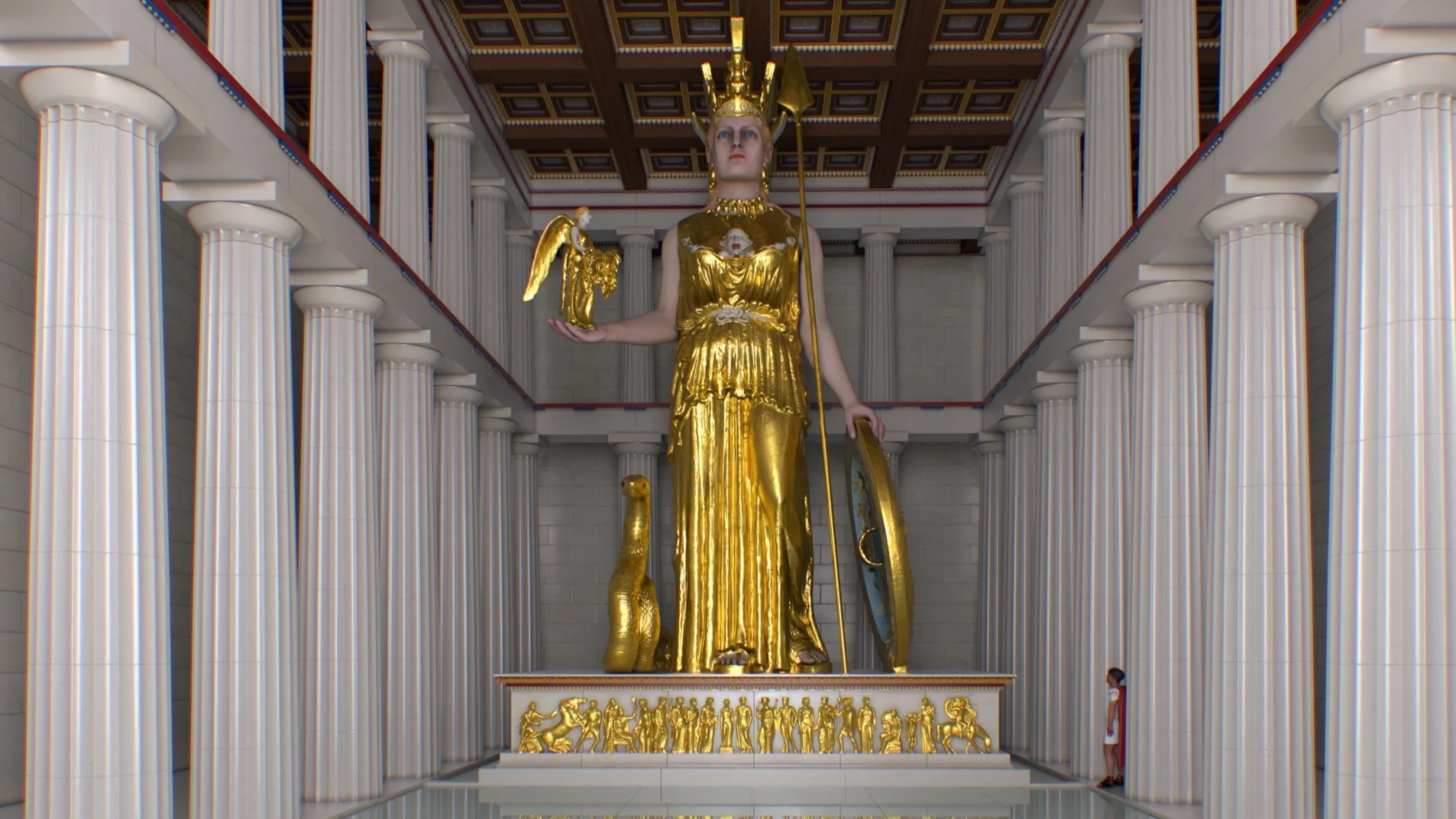
The Parthenon (Iktinos and Kallikrates) & Athena Parthenos (Reconstruction after Pheidias). Athens, Greece. 447 - 432 BCE (Parthenon), 438 BCE (Athena Parthenos) High Classical Period
Spearheaded by Pericles on the Athenian Acropolis, architects Iktinos and Kallikrates combined the Doric and Ionic Orders. They incorporated subtle optical curvature (bowing the platform and leaning columns inward so it looks straight to the human eye). Sculptor Pheidias supervised the narrative sculpture on the pediments and interior continuous frieze, as well as the gold/ivory statue of Athena Parthenos.
Temple of Portunus, Roman—Rome, Late 2nd century BCE (Republican Rome)
Blends Greek classicizing elements (Ionic columns) with Etruscan design through a single, direct staircase and porch that enforces strict axiality and frontality.

Pont du Gard (Nîmes, France). Late 1st century BCE (Imperial Rome)
A massive stone aqueduct built with true arches made of wedge-shaped stones (voussoirs) locked together at the top center by a keystone.

Sanctuary of Fortuna (Palestrina). ca. 100 BCE (Republican Rome)
Roman builders used molded concrete to build massive terraced platforms supported by long, tunnel-like barrel vaults.

The Colosseum, 80 CE (Flavian/Imperial Rome)
Built under the Flavian Emperors (Vespasian and Titus), this double-theater (amphitheater) used a complex skeleton of concrete arches, barrel vaults, and intersecting groin vaults to support seating around the central sand floor (arena).

The Pantheon, 125 CE (Imperial Rome)
Features a colossal dome made of lightened concrete with a 30-foot circular opening (oculus) at the top as its primary light source.
