Molecular Biology Exam 2
 Call Kai
 Learn
Learn Practice Test
 Spaced Repetition
 Match
Match Flashcards
 Knowt Play
1/79

There's no tags or description
Looks like no tags are added yet.
Name | Mastery | Learn | Test | Matching | Spaced | Call with Kai | Chat |
|---|
No analytics yet
Send a link to your students to track their progress
80 Terms
What are the steps of DNA cloning?
Isolation of gene of interest:
Preparation of a cloning vector
Joining DNA (ligation)
Introduction into a host (transformation)
Selection and screening
Multiplication and Harvesting
What are different classes of Restriction Enzymes?
Type 1: randomly cleaves DNA around 1000bp away from restriction site
Type 2: cleave within or a short specific difference from restriction site (important for DNA cloning)
Type 3: cleave 24 to 26 bp away from restriction site
Type 4: recognize and cleave modified DNA
How do Plasmids work?
small, circular pieces of double stranded DNA that contain a origin of replication creating unique restriction enzyme sites allow scientists to selectively grow the cells within the plasmid and cut it allowing foreign DNA to be inserted
Where will a restriction enzyme be cut?
at the naturally occurring restriction sites
Be able to draw a plasmid
Origin of Replication: allows the plasmid to be replicated in bacteria so it can be propagated
Antibiotic Resistance Gene: allows for selection of bacteria with the plasmid
Selectable Marker: to select for plasmids in non-bacteria cells
Promoter: allows cells to express the cloned DNA as mRNA. Giving a region for RNA Polymerase binding and mRNA synthesis to start
Inserted Gene/Restriction Sites: down stream of promoter so it can be expressed in cells of interest

What’s the difference between negative and positive inducible promoters?
Positive Inducible: gene of interest is switched on under specific conditions
Negative Inducible: gene of interest is switched off under specific conditions
What are the different methods of DNA cloning?
Use natural occurring restriction sites: cutting chromosomal DNA at the naturally occurring restriction sites to clone a specific region of DNA
PCR: add restriction enzyme sites and amplify a piece of DNA
Western Blots
uses antibodies directed against your protein of interest to detect the presence of protein in cells/tissues

Yeast-2-hybrid Screens
used to determine protein-protein interactions via gene expression
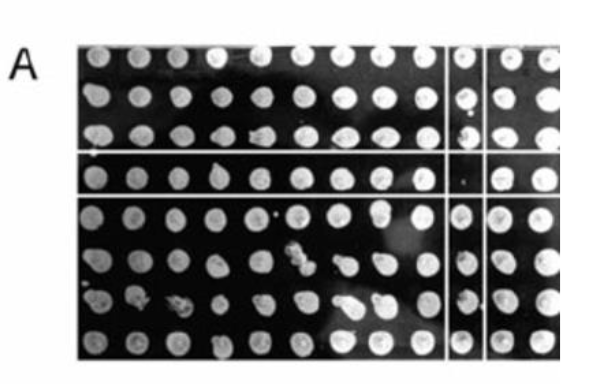
Sanger Sequencing Data
determines nucleotide order of a target DNA region with up to 99.9% accuracy

Sanger Sequencing vs Nanopore Sequencing
Sanger uses chain-terminating ddNTP’s and capillary electrophoresis to measure fluorescently labeled fragments that is generated on a computer after the band migrate past the detector and Nanopore uses single stranded DNA translocated through a motor protein causing current variation that is measured in real time giving a DNA sequence
Immunofluorescences vs Western Blotting
Immunofluorescences is using antibodies against a protein of interest to visualize localization of your protein in cell but it cannot investigate protein abundance. Western blotting can do the same thing except the protein abundance can be quantified but the localization of protein within a cell is lost.
Immunoprecipitation vs. Yest-2-Hybird
Immunoprecipitation uses antibodies and beads that bind to antibodies that purify your protein of interest from a cell lysate and proteins that are bound to the protein of interest are pull down as well and can provide investigation of direct and indirect interactions. Yeast-2-Hybrid is used to determine protein-protein interactions via gene expression; one protein of interest is 50% attached to your genes promotor while the other is attached to the 50% and if they interact you get gene expression.
What was learned from the Human Genome Project ?
Only 30% of human genome is genes including exons and introns
1.5% of human genome codes protein
Non-coding DNA has important roles including gene regulation, DNA structure, DNA replication and division and non-coding RNA
What is Genomics?
the sequencing of SNV’s (single nucleotide variants) and SNP’s (single nucleotide polymorphisms) from a panel, exome or whole of a genome
What is Transcriptomics?
genes being expressed in cells under a given set of conditions
Single cell transcriptomics: many cell types can be identified based on gene expression
Central nerve system transcriptomics: show differential gene expression with age in the same cells
What is Proteomics?
proteins expressed in cells under a given set of conditions and is used to investigate when and where proteins are expressed and interactions with one another (no PCR equivalent for proteins)
Single cell proteomics: define the cellular population in a tumor
The different types of Genomics?
Targeted Sequencing: only specific DNA regions are sequenced based on clinical observations using PCR to amplify regions of interest with the PCR product sequenced
Whole Exome Sequencing: all exomes (gene-coding regions) are sequenced but can cause missing SNP’s in non-coding regions because the PCR only amplifies exons and large amounts of data need to be analyzed
Whole Genome Sequencing: whole genome sequenced with the DNA broken up into fragments
The different types of Transcriptomics?
RNA-seq: uses reverse transcription to make cDNA that can be sequenced using DNA sequencing methods removing the rRNA and mRNA is reverse transcribed into cDNA that is fragmented and adapter sequences are added to provide prime binding sites for sequencing
Ribo-seq: isolates mRNA that is in the ribosome which is actively being translated and represents the proteins in the cell that is currently being made but mRNA does not always tell you the abundance of a protein
What is a chromosome?
compacted DNA that is packaged into cells
Difference between bacteria and eukaryotic chromosomes
Bacteria
chromosomes are circular
have an origin of replication
termination region
random coiling of DNA
Eukaryote
chromosomes are linear
have telomeres at the end of chromosomes
centromeres at the middle for attachment of the mitotic spindle
has controlled folding of DNA
What is a Centromere?
attachment point for the mitotic (meiotic) spindle for the equal and orderly division of chromosome sets to daughter cells during cell division
What is a Telomere?
repeat sequences at the end of chromosomes adding protection and stability and length decreases with age
What is supercoiling?
coiling of a coil; underwound DNA is negative right handed supercoils (caused by transcription) and overwound DNA is positive left handed supercoils (caused by DNA replication)
What is a linking number (Lk)?
the number of times a strand of DNA winds around the helical axis when the axis is constrained to lie in a plane
How can topology change electrophoretic movement of DNA?
catalyzes the underwinding and relaxing of DNA changing the link number and break DNA and religate it

How do topoisomerases I and II work?
breaks one of the two DNA strands, pass the unbroken strand through break, ligase the broken ends. Relaxes DNA one linking number (one twist)
break both DNA strands. Relaxes DNA two linking numbers (two twists)
What is a nucleosome?
DNA wrapped around histone octamer/first level of DNA packaging that leads to chromosome formation
What the different types of Histones?
H2A: regulate DNA accessibility, gene transcription, and DNA damage repair
H2B: helps package and organize eukaryotic DNA inside the cell nucleus
H3: regulating gene expression, DNA replication, DNA repair and chromosome stability
H4: helps package and organize eukaryotic DNA into nucleosomes
H1 (is not located in the histone octamer): ensures the DNA enters and exits the nucloesome at the same place and helps stabilize nucleosome and therefore repress transcription
What is the micrococcal nuclease restriction enzyme assay?
cleaves double stranded DNA but it can only cut the linker DNA (DNA between the nucleosomes) due to the proteins associated with DNA blocking micrococcal nuclease cutting and it tells us that histones are evenly spaced meaning the nucleosomes they contain have evenly distributed DNA
What are the six levels of DNA compaction?
DNA Double Helix
Nucleosome (6-fold DNA compaction)
30nm filament (40-fold DNA compaction)
Extended Chromosome Form (300nm)
Condensed Section of Chromosome (700nm)
Mitotic Chromosome (10,000-fold DNA compaction)
What the difference between remodeling and modification in nucleosome dynamics?
A chromatin remodeling complex can move chromosomes along DNA, remove nucleosomes from DNA, or change the type of histone in the histone octamer. All of this alters DNA activity.
Histone modifying enzymes modify the N-terminal tails of histones by post-transcriptional modifications
What’s the difference between cis and trans modifications for nucleosome dynamics?
Cis = histone modification directly affects chromatin structure
Trans = histone modification attracts proteins. the protein causes the chromatin to change
What are histone variants?
alter the histone octamers DNA binding affinity; differences in N-terminal tail alter suspectability for post-translational modifications and differences in C-terminal region alter which proteins H2A histones can recruit to the nucleosome
Different types of Histone variants
H3.3: replaces wild type at a sites of active gene expression
CENPA: replaces wild type at repeated DNA in centromeres. Connects to the kinetochore
H2AX: is associated with DNA repair and recombination
What is X-chromosome inactivation?
an X chromosome is permanently silenced in every cell by early blastocyst; in XX individuals only one X is inactivated and makes them a genetic mosaic due to X expressed genes
What are the different types of histone post-translation modifications?
Lysine (K): acetylation
Histone acetyltransferases (HATs): add acetyl groupsHistone deacetylases (HDACs): remove acetyl groups
Lysine acetylation: associated with enhanced DNA accessibility (and increased transcription)
Lysine methylation: H3 methylation stabilizes open chromatin
What is the function and purpose of epigenetics?
the study of the modifications to histones (and DNA); don’t change the underlying DNA but have significant impact on gene expression and it allows cells to maintain their specific identity after they divide
ex. a skin cell stays a skin cell because of the epigenetic code passed down from mother to daughter cell
What are the three models of DNA replication?
Conservative: two parental strands stay together and act as a template for new DNA
Semiconservative: parental DNA strands spread, and each strand becomes a template for new DNA
Dispersive: DNA duplex is synthesized in random patches
The experiment that helped prove the semiconservative model for DNA
E. coli are grown in a medium containing only heavy nitrogen. This heavy DNA e. Coli were grown in a medium containing only light nitrogen for exactly one or three cell divisions.
Newly synthesized DNA only contains N and is “lighter” than the original DNA. DNA is separated on a CsCl gradient separating of “heavy” and “light” DNA.

What is Origin of Replication?
specific DNA sequences where DNA replication starts
What is a Replication Fork?
site of new DNA synthesis, where parental DNA separates and daughter DNA starts
What are Okazaki Fragments?
fragments that are synthesized discontinuously (lagging strand)
What’s the difference between bacteria and eukaryotic origin of replication?
Bacteria and plasmids only have one while eukaryotes have multiple per chromosome
What are the steps of DNA replication?
Initiation: pre-replication complex binds to origin of replication and DNA helicase unwinds DNA creating replication fork and single stranded DNA binding proteins stabilize DNA and topoisomerase prevents overwinding of DNA
Elongation: RNA primase creates RNA primers on unwound DNA; DNA polymerase use the template to synthesize new DNA on the leading strand (continuous) to lagging strand (discontinous)
Termination: DNA polymerase leaves DNA
Steps for DNA polymerase inserting dNTP
binds to insertion site
3’ OH and a alpha phosphorous form a phosphodiester bond resulting in the nucleotide being added to the DNA strand
DNA polymerase translocates along the DNA strand. the attached nucleotide moves in the post-insertion site ready to have the next dNTP attached to its 3’ OH
(uses base pairing to determine right dNTP/uses exonucleases for errors)
What is Exonuclease and Endonuclease?
Endonuclease: cuts DNA at an internal position
Exonuclease: cuts DNA at its end
Origin of Replication (draw and label)

What is Pol III?
multi subunit protein that transcribes DNA to synthesize small non-coding RNA’s and also has a 3’ to 5’ exonuclease activity
What is a B clamp?
protein that increases processivity factors for DNA polymerase III during DNA replication
What is DNA helicase?
separates the parental DNA duplex to create single stranded DNA
What is topoisomerase?
enzyme that cuts one or both strands of overwound DNA to untwist before resealing the cut
What is primase?
RNA polymerase that creates the RNA primers needed for DNA polymerase to initiate DNA synthesis
What is Pol I?
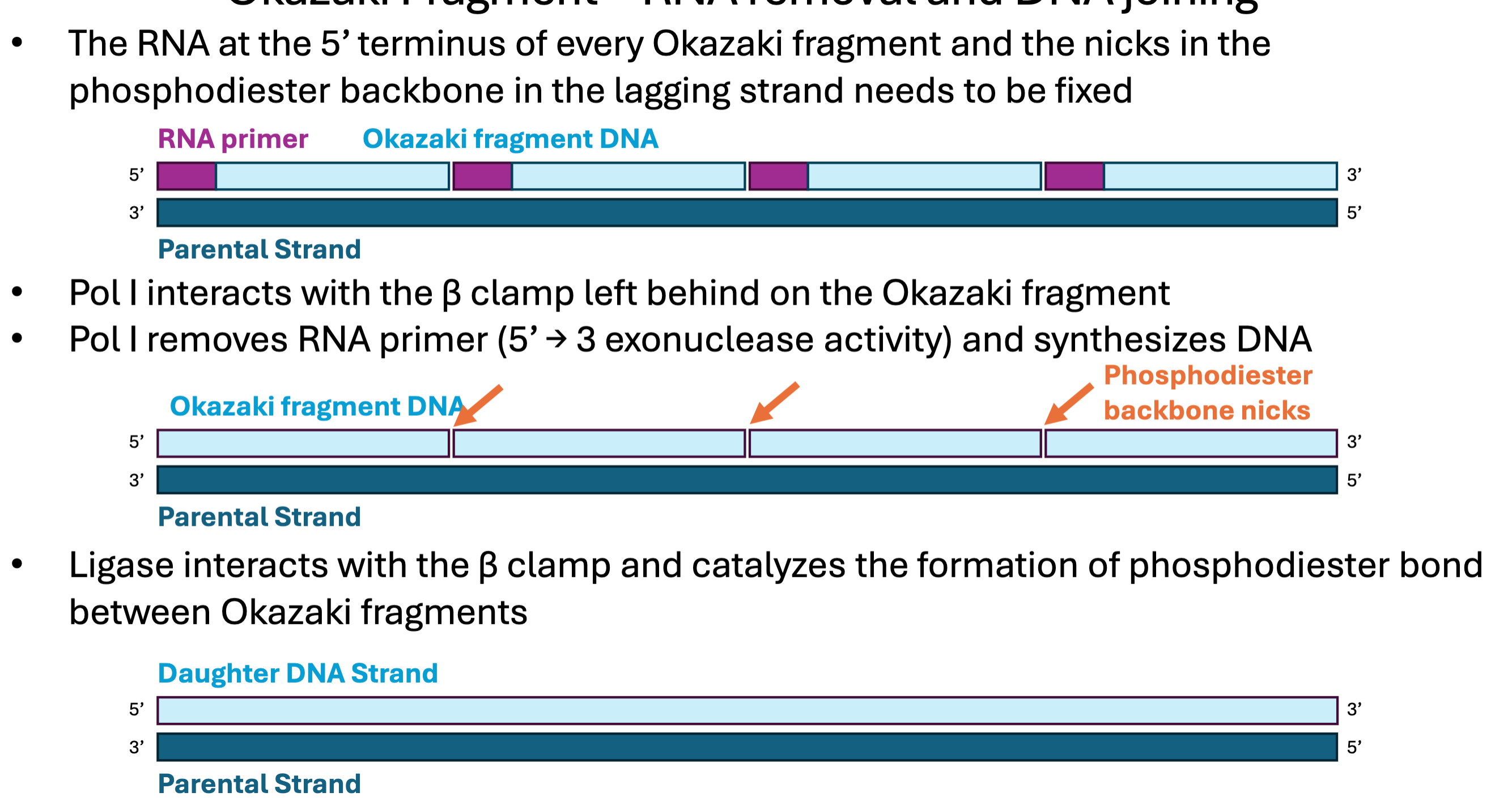
enzyme that removes the RNA primer and synthesizes DNA at the same time and has 5’ to 3’ exo nuclease activity
What is ligase?
seals nick in the phosphodiester bond left by Pol I and only works the 5’ end of the DNA ensuring that the RNA primers of Okazaki fragments are removed before nick is sealed
What is SSB protein?
binds to the unwound single-strand DNA to protect it from endonuclease activity and stimulate DNA polymerase by melting small hairpin structures
How does replisomes replicate the leading and lagging strands?
One of the Pol III - b clamp complexes with DnaB move continously along the leading strand while the other two Pol III - b clamp complexes repeatedly move on and off the lagging strand, extending the RNA primers place by primase.
Okazaki fragment processing
What’s the difference betweeen bacteria and eukaryotic replisomes?
they both duplicate genomic DNA but they feature distinct protein compositions, structural assemblies and mechanical polarities
What is the function of the Mcm2-7 complex?
forms a ring shaped hexamer like DnaB helicase and moves in 3’ to 5’ direction
What is the function of GINS and Cdc45?
serves as the core replicative DNA helicase in eukaryotes
What is the function of Pol a?
is the primase that initiates DNA replication; has no proofreading is prone to error
What is the function of Pol δ and Pol ε?
chromosomal replicases exonuclease proofreading activity; suggestions say pol delta replicates lagging strand and pol epsilon replicates leading strand
What is the function of PCNA?
the eukaryotic sliding clamp
What is the function of RPA?
binds to single stranded DNA and is the functional equivalent of E. coli SSB
What is eukaryotic Okazaki Fragment processing and how does it differ from bacteria?
cellular process that converts short, discontinuous RNA-DNA segments on the lagging strand into single, continuous DNA strand

What’s the difference between bacteria and eukaryotic initiation and termination?
for bacteria the RNA polymerase holoenzyme binds directly to specific DNA promoter sequences for initiation, for termination the RNA polymerase reaches the end of the gene and stops transcription via two distinct pathways
for eukaryotes the small ribosomal subunit binds to sequence on mRNA and positions the start codon into the ribosomal P site and initiator tRNA and large ribosomal unit then join, for termination the ribosome hits a stop codon in the A site and transferase cleaves the completed polypeptide chain from the final tRNA and dissociates
What’s the importance of telomeres and telomerase?
telomeres are sequences of DNA at chromosome ends that do not code genes and telomerase is an enzyme that is able to prime and synthesize DNA at these telomere ends that shortens over time as cells age leading to apoptosis; if telomerase is ever turned back on it can lead to cancer cells
What happens when a point mutation occurs in a specific cell?
Singe Cell Organism: DNA is mutated and if the cell survives it divides to create new cells; all of the progeny now have this mutation
Somatic Cells: only impacts part of the organism and the mutation is not passed to subsequent generations
Germ Cells: mutation impacts whole organism and subsequent have the mutation
What is a point mutation?
a change in a single base pair
ex. C becomes T or A becomes G
What is a indel mutation?
gain or loss of base pairs (changes reading frame)
What is structural variation?
large chromosomal rearrangements (can’t be repaired unlike other mutations); can involve one or multiple chromosomes
What is translocation?
occurs when a piece of chromosome breaks off and attaches to another chromosome
Different types of point mutations?
Transversions: substitution of a purine for a pyrimidine or vice versa; C becomes G or A
Transition: substitution of a purine for a purine or a pyrimidine for a pyrimidine; C becomes T or A becomes G
Silent: DNA sequence changes but amino acid does not
Missense: mutation causes a change in what amino acid is coded for
Nonsense: mutation changes sequence from amino acid codon to stop codon
What causes a frameshift (indel) mutation?
deletion of one or two base pairs; caused by aberrant recombination or template slippage during replication
What causes a triplet expansion?
indels that occur in multiple of three base pairs to preserve the reading frame; template slippage during replication is a common cause resulting in the same amino acid from regions of repeats in the nucleotides
What are triplet expansion diseases?
caused when the repeated amino acid sequences increase beyond a tolerated level for protein function

What are the different types of structural variation?
Single chromosome variations:
Deletion: causes loss of large section of chromosome and some genes are lost; one far apart now in close proximity
Duplication: amplification of a large section of chromosome and increased gene dosage (extra copy of genes in duplicated region)
Inversion: a large section of chromosome is inverted and can have varied impact on genes at the breakpoint at most
Multiple chromosome variations:
Insertion: DNA from one chromosome moves and is inserted into different chromosome and impacts can vary depending on where the insertion happens and if it disrupts genes or regulatory regions
Translocation: exchange of DNA between non-homologous chromosomes and impacts can very depending on where the translocation happens and if it disrupts genes or regulatory regions
What is the importance of structural variations relating to evolution and disease progression?
it can cause the rearrangement of DNA (chromosome fusions) and can drive evolution such as humans sharing similar DNA with chimpanzees
What is a fusion gene?
a hybrid of two different genes (cancers cells are relevant to this)
ex. translocational rearrangement of chromosome 9 with 22 leads to fusion of ABL gene on chromosome 9 with BCR gene on chromosome 22 creating BCR-ABL (breast cancer)