3.2.3 Group 7, the halogens
 Call Kai
 Learn
 Practice Test
 Spaced Repetition
 Match
 Flashcards
 Knowt Play
1/19

There's no tags or description
Looks like no tags are added yet.
20 Terms
Trend in oxidising ability
Halogens are oxidising agents that react by gaining an electron
Florine is the strongest oxidising agent as it accepts electrons more easily
Iodine is the weakest oxidising agent at it accepts electrons less easily
Oxidising ability decreases down the group:
Number of shells increase to sheilding increases
Atom becomes larger hence the outer shell is further away from the nucleus
Attraction of electrons to the nucleus is weaker
So atom is less likely to accept electrons
Relative reducing ability of halide ions
Reducing ability increases
Ionic radius increases down the group as more electron shells are added
The increasing radius leads to outer shells being further away from the nucleus
The outer electrons experience more shielding from the inner electrons
The electrostatic attraction between the outer electron and the nucleus gets weaker
Increase in ionic radius and shielding is greater than the increase in nuclear charge
Easier for larger halide ions to become oxidised and for an electron to leave

Trend in boiling points
Increases down the group
the molecule becomes larger in size and relative mass
Down the group the halogen molecules have larger electron clouds
This allows for stronger induced dipole dipole forces between molecules
These stronger intermolecular forces require increasing amounts of energy to overcome
Trend in electronegativity
Decreases down the group
Nuclear charge increases down the group as more protons are present
Atomic radius increases down the group, as more electron shells, greater shielding
Atomic radius and shielding effect is greater than the nuclear charge effect
So easier to remove an electron
Halogen halide displacement reaction
The more reactive halogen will displace the less reactive halogen from an aqueous halide solution
The displacing halogen is reduces and gains an electron to form a halide ion
The displaced halide gets oxidised and loses an electron to form a halogen
Outcomes of displacement reactions and observations

Sodium solid Halide ion reactions: why is it reacted with sulfuric acid
React with concentrated sulfuric acid because
It acts as an acid, forming hydrogen halides
Can act as an oxidising agent if the hydrogen halide formed is a strong reducing agent
Observations with solid sodium halide and sulfuric acid
In sodium chloride, chloride ions are not strong enough reducing agents to reduce sulfuric acid
Sodium bromide initially forms hydrogen bromide. Hydrogen bromide reduces sulfuric acid to sulfur dioxide and is oxidised to bromine
Sodium iodide forms hydrogen iodide, which is a stronger reducing agents, so reduces sulfuric acid further to different sulfur containing products


Test for halide ions
Reagents: silver nitrate and nitric acid
Nitric acid is added first to remove ions that interfere with the test such as carbonate and hydroxide ions
If the halide ion is in solids state, dissolve in water first
Hydrochloric acid is never used as it forms a white precipitate
Cannot test for fluoride ions because silver chloride is soluble and does not form a precipitate


Confirmation test for halide ion presence
Reagent: dilute and concentrated ammonia


Chlorine reactions:
Absence of sunlight- disproportionation reaction
with sunlight
With sodium chlorate
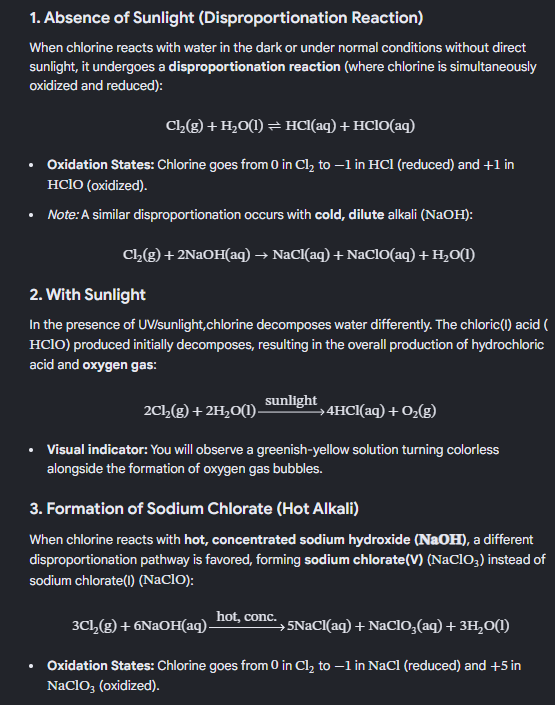

Chlorine reactions extra

Water chlorination
chlorine is added to water to kill harmful microorganisms reducing the chance that disease carrying organisms will be carried from a water supply to people
Chlorine is toxic, but the benefits outweigh the possible side effects
Controlled chlorination can greatly reduce public health risk

Adding sodium fluoride to water
May be added to water to increase the fluoride concentration
It reduces tooth decay
Potential harmful effects at different exposure levels
Excess fluoride exposure can cause dental fluorosis
Hazard controls when testing for presence of ions

Group two cation identification
Reagents:
Add sodium hydroxide to one beaker
Add sodium sulfate to the other beaker

Ammonium ion identification

Hydroxide ion identification

Sulfate ion identification

All anion and cation tests
