PNB exam 2
 Call Kai
 Learn
Learn Practice Test
 Spaced Repetition
 Match
Match Flashcards
 Knowt Play
1/66

There's no tags or description
Looks like no tags are added yet.
Name | Mastery | Learn | Test | Matching | Spaced | Call with Kai | Chat |
|---|
No analytics yet
Send a link to your students to track their progress
67 Terms
membranes are responsible for creating blank by regulating the blank between blank blank
compartmentalization, transport, two compartments
fluid mosaic model
made up of two things which are : fluid and mosaic
define fluid
define mosaic
give an example of a fluid mosaic model
fluid, and mosaic
fluid: things can move within the plasma membrane or through it
mosaic: plasma membrane=made up of many diff biomolecules
double membrane surrounding our cells
also membranes surrounding Indiv organelles
what is the primary structural component of the plasma membrane
they have a blank blank among them
most of the plasma membrane is composed of
fat/lipids
enormous diversity
phospholipids(purple here)
like bread of sandwich

what are the two regions of phospholipids
the longer region is made up of blank blank, long chains of blank, their charge can be described as, therefore the tail is
the other region is made up of, they’re blank like molecules that contain a lot of, blank blank blank, and v blank blank group
the blank of blank in the blank groups of the blank causes the….
which makes it
a head and a tail
tails=fatty acids, hydrocarbons , relatively even distribution, non polar
heads=glycerol, sugar, hydroxyl side chains, phosphate functional group
electronegativity of oxygen, phosphate groups, head= uneven distribution of charge there making it polar
what does amphilic mean
this allows the polar head groups to interact with(2 things)
this is important bc there’s what kind of enviro inside and outside the cell(interstitial fluid)
what does it mean for the non polar tails , what is the name for this
due to phospholipids having hydrophilic heads and hydrophobic tails if you place a phospholipid in an aqueous enviro, it will
molecule with polar and non polar porperties
other polar molecules+water
important bc there’s an aqueous enviro
they want to avoid interacting with water, causes them to have forced interactions with themselves and other lipids-hydrophobic effect
spontaneously assemble into smth that resembles a membrane
the plasma membrane contains more than just phospholipids
describe the two other molecules
peripheral proteins: present only on one side of the membrance(intracellular or extracellular side)
integral membrane proteins: pass through the membrane on both sides
ex: channel proteins and carrier proteins
extra: most of the proteins willl be integral membrane proteins
the membrane creates a…, allowing for
the membrane is blank blank, meaning that it
a physical and chemical barrier around the cell, compartmentalization
selectively permeable,controls which molecules are able to move into and out of the cell
proteins associated with the plasma membrane can create…., allowing them to
this also contributes to how protein components of the plasma membrane can facilitate… between..
interactions between cells that, attach to each other
facilitate communication, cells
note: (plasma membrane is important for attachment)
the plasma membrane does NOT determine
the plasma membrane is primarily
plasma membrane is important for …
the structure, shape, or morphology of the cell
a chemical barrier,
regulating transport between 2 compartments
extra; not like bacterial cell wall
what are the 4 functions of the plasma membrane
physical barrier
exchange
communication
attachment
PM-regualting transport between 2 compartments
molecules can move in two ways, describe them
in the first one there is no…
second one is more what than the first one
between cells(paracellular transport), no selectivity of plasma membrane here
through cells(transcellular transport)-requiring molecules to cross 2 membranes, more selective than paracellular transport
phosphate(head) has negative charge meaning that the head
pulls/ attracts charges up towards the head of the phospholipid
in the non polar tail there are what kind of tails, how many
two kinked tails
define hydrophilic and hydrophobic
hydrophilic-water loving
hydrophobic-water fearing
the polar heads orient themselves towards what molecules
the tail groups orient away from what? bc they’re..
fluid inside the cell/interstitial fluid is made up of what moelcule
therefore what moelcule interacts with interstitial fluid and why
this allows for what
water molecules
water, hydrophobic
water
the polar heads to interact with intracellular fluid to protect the tails
selective permeability-most things are not able to pass directly through plasma membrane, create compartmentalization-kept out or kept in due to this structure
what are exceptions that can pas through membrane easily
oxygen and carbon dioxide-gasses
v small non polar gasses
lipid loving
extra: covid virus is small and in lipid can easily pass through plasma membrane
cholesterol too -lipophilic and small
what do helper proteins do
anything we have protein that passes all the way through the plasma membrane it is what , also..
integral proteins protrude into blank and blank blank
cell to cell peripheral recognition only interact with the outside and participate in cell to cell peripheral recognition most of the time, they are what kind of proteins
allow molecules to pass all the way through the lipid bilayer
an integral protien/integral membrane protien=ion channels
cytosol, extracellular fluid
peripheral proteins
what type of transport is simple diffusion, osmosis, and facilitated diffusion
bulk flow is what kind of transport, what does it dpeent on
simple diffusion and osmosis(diffusion of water), and facilitated diffusion= passive transport
bulk flow =based on pressure gradient, moving things down bulk flow
what does passive transport require
the bigger the gradient the more..
molecules move through what kind of movement
requires concentration gradient (high to low)
diffusion
random movement
time goes up exponentially faster in distance
what do we want to be able to transport really rapidly (molecule wise)
circulatory system, digestive system, renal system all depend on
gasses-oxygen and co2-want to be able to transport really rapidly
really small lipid molecule moles
on selectivity
we want to be picky abt what can enter or leave
determine which mols from external get into body or are released
everything else that’s not permeable like ions like sodium, potassium, small mols like glucose, etc move with help of what protein?
water transport requires the help of what?
everything else that’s not permeable like ions like sodium, potassium, small mols like glucose, etc move with help of integral membrane proteins
integral membrane proteins
classify transport across membrane in two ways
what does passive transport not require, what does it require
what does active transport require, is it independent or dependent on solute concentration?
passive transport-does not require energy/ATP
requires diff concentrations of molecules on both sides of the membrane
form high conc to low conc
active transport invest energy into transport, doesn’t need high vs low conc, can move mols independently of their concentration
simlple diffusion, osmosis, facilitated diffusion, and bulk filtration are alll what type of transport?
passive transport:
don’t require energy energy investment
diffusion is due to what? what is this known as
random walks-trajectory of molecule is…..
distance the molecule travels is not in equal proportion to
einstein figured out you can describe diffusion using what equation
the random movement of molecules-known as Brownian motion
non linear/moelcule doesn’t move in a straight line,
time it spends moving around
root mean squared equation: tells us that time and distance have a nonlinear relationship bc the distance a particle diffused increases as the square root of time
when our molecules move randomly, they move left, right-x plane and forwards backwards in y plane and up and down in z plane
in each of these dimensions, what happens to diffusion
is diffusion efficient or inefficient going a long distance
when our molecules move randomly, they move left, right-x plane and forwards backwards in y plane and up and down in z plane
it gets less and less efficient with respect to time
important: rly inefficient to move a long distance using diffusion
describe the rate of diffusion over a long distance and over a short distance
when temperature increases, what happens tothe rate of diffusion
diffusion happens where,
diffusion=passive
slow over a large distance but extremely fast in a short distance
diffusion rate increases
diffusion happens everywhere, in open system or inside cellular compartment, or across divider/partition like plasma membrane
when molecules are larger, what happens to the diffusion rate
what does diffusion require
what is a concentration gradient
decreases
requires a concentration gradient
concentration gradient=absolute difference in solute concentration between two places, calculable
suppose you have two compartments, the left side has 10 red solute molecules and the right has 0 red solute molecules, what is the concentration gradient/difference in concentration
suppose this time, the two compartments both have five molecules in each side, what is the concentration gradient
what is flux
concentration gradient/difference in concentration of ten
0 here bc equal Amt on each side
flux: describes the movement of a particle in a single direction
what is net flux
if you have the same number of molecules moving left and right, what is the net flux , what is the other word for this
the overall pattern of movement in the population(after adding up flux from every molecule moving at the exact same time) =net flux
=0 , also equilibrium
extra: flux=vector too
bc mols is moving randomly, there’s flux one very possible direction(left , right, up , down,e tc)
describes each step in Brownian motion,
teh rate of diffusive flux is equal to what
the primary determinant for us is usually …
that molecules diffusion coefficient times it’s concentration gradient
concentration gradient
extra: diffusion coefficients=always constants and unique for every molecule
to find the difference in concentration gradient from one side vs the other, how do you do that?
subtract the side with least solute from the one with more solute

membrane surface area, membrane thickness, and concentration gradient are related to what?
composition of lipid bilayer, lipid solubility, and molecule size are related to what
in order for a mol to move across membrane pasively, it has to first be blank then
pink=related to diffusion
blue boxes= terms related to permeability
permeable and then diffuse
EXTRA
structure function relationships
structures inside of body that need to maximize rte of transport using diffusion, they opitmize their parameters, ex lungs
structure function relationships
structures inside of body that need to maximize rte of transport using diffusion, they opitmize their parameters, ex lungs
highly vascular/lot of blood flow , having vascularity increase surface area
small intestine: has villas and valleys called vili, increases membrane surface area
define osmosis
mass displaces what
what do solutes do to the concentration of water
if there is a high concentration of solutes, there will be what concentration of water
osmosis: diffusion of water molecules
volume
solutes lower the concentration of water so a compartment with higher concentration of solutes has a lower concentration of water,
extra: don’t find pure water anywhere in the body, always has solutes dissolved within it
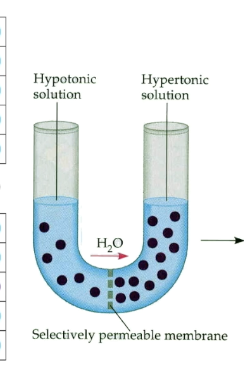
what will the result be (note the barrier is semi permeable to water)
what will happen to the volume of water on each side and why
in tube:
water moves from left side of tube to right side of tube
causes left side to decrease in volume and right side to increase in volume(direct relationship)

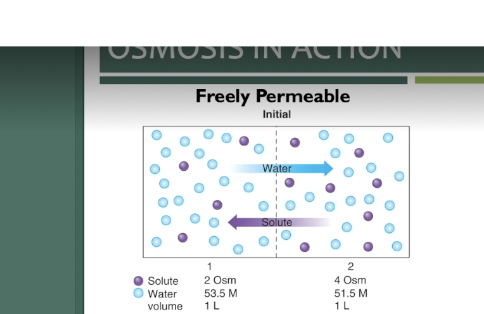
(separated by a membrane freely permeable to water and solutes)
what will happen here
what will be the result solute and water here
what is the net flux
bc membrane is freely permeable to both, both can move down their conc gradient until conc gradient no longer exists
result: equal concentrations of solute and water on both side, net flux is 0 here, containers have equal solute

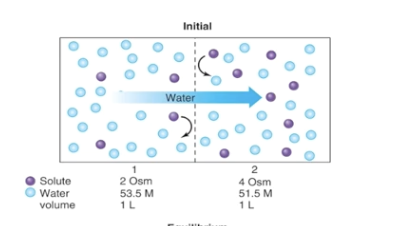
selectievely permeable membrane, only permeable to water
what will happen here
what will happen to the volume on both sides
what is movement of water linked to , it happens when
solute concentration in right side is higher 4 vs 2
bc there’s a conc gradient for water it moves from high conc to lower conc. move from left to right
left chamber loose volume, right side gains volume all from water.
changes in cell volume
solutes are unevenly distributed between two compartments

extra: we don’t typically want cells to change volumes so we have to regulate solute concentrations v carefully to limit what type of transport
osmosis that occurs

what is tonicity , what does it describe
what is a hypertonic solution
the relationship between volume and solute concentration
describing the conc of outside enviro relative tot he inside enviro
more solute outside the cell than inside the cell(high solute and less water)
extra: relative term that always reuiqre comparison between wo compartments
what is the result of cells being in a hypertonic solution
causes water to move out of the cell into the extracellular fluid and loose volume
what is a hypotonic solution
what is the result of cells being in a hypotonic solution
the plasma membrane does not give
lower solute outside the solution(and more water) outside the cell than inside the cell.
water comes inside the cell, cell increases in volume and swells, looses structural integrity
give physical protection
solute concentrations must be blank for cells to stay the same size
what is isotonic
balanced
when the extracellular solute concentration=to intracellular solute concentration
if we’re experiencing osmotic forces-pressure created by the water, it’s balanced out by some counterbalancing force
what is the hydrostatic force
the counterbalancing force, force that’s created by a fluid kept under pressure
facilitated diffusion
it requires the help of what molecule
give an example
an integral membrane protein for a molecule to be soluble
ex glucose transporters(help to bring glucose into he cell following a meal
glucose is large can’t pass through the membrane, requires the help of a carrier protein
bulk flow is what type of transport
what does it not require
instead it depends on what
as this gradient moves. from high to low, what moves with it
passive transport process
NO concentration gradient-moves mols independently of their concentrations
a pressure gradient,
as pressure equalizes(moves form high pressure to low pressure) the solutes are carried along with it
facilitated transport also uses ion channels, which is an example of what
with integral membrane proteins, each piece of the protein comes together to form a…
-specific type of integral membrane protein(that’s channel mediated)
integral membrane protein:
pore(tunnel) through the plasma membrane
which aspects increase the rate of flux and are proportional, which decrease the rate of flux and are inversely proportional
membrane thickness, lipophilicity, temperature, molecule size, surface area, and concentration gradient
increases the rate of flux and are proportional: temperature, surface area(bigger door instead of smaller door for molecules to pass through) , lipophilicity, concentration gradient
decrease rate of flux and are inversely proportional: membrane thickness and molecule size
with ion channels, is the pore opened all the time , what odes each ion channel always have
what Is a gating mechanism
what are voltage gated Chanels
what are mechanically gated ion channels
regardless of how it’s opened or closed, when door is open, how many molecules come in per second
no, each ion channel has a gate or a door
diff ways that you can open the gate/door
when channels opened based onchanges in charge of enviro outside of plasma membrane
ion channels that open based on changes in the physical structure of the cell
a lot
ion channels are what kind of transport
gating mechanisms are blank specificity
ion channels usually contribute to what?
what’s channelopathy
=always passive
complex gating mechanisms-high specificity
diseases,
disease that are caused by mutations in genes that encode the ion Channels(happens often)
FUGU-poisonous fish
can die from eating the fish caused by tetrodotoxin
what is tetrodotoxin
-toxin that evolves v specifically to inhibit voltage gated sodium channels
extra: they took that knowledge of that drug to develop new pharmaceutical drugs and study voltage gated channels
different mechanisms can be blank
channels form a pore OR blank blank across membrane
interdependent
continuous path across membrane
not all integral proteins=channels, some can be carriers/ transporters
carriers operate by alternating access model-never a continuous path throughout plasma membrane
carrier undergoes a conformational change that opens up to one membrane face and allows the solutes that are in that compartment to bind to the carrier
then it closes so it’s not accessible to the inside or the outside, trapping the solute inside=Occulusion state
then opens it up the opposite side to allow the solute to unbind and get released into the opposite compartment
other difference between carriers and channels
solutes have to actually bind to transporters to occur
NO binding in ion channels
transporters have a limited number of binding sites, carriers only move 1-5 mols per cycle
channel moves tens of thousand molecules per second

having binding sites can limit the rate of transport
concentration of solute on x axis
as concentration of solute increases, rate of transport also increases
but eventually the rat elf transport plateaus
direct consequence of having a limited number of binding sites
DOESN”T HAPPEN WITH CHANNELS
carriers tend to be larger than ion channels0prob due to the conformational channels that they have to make that ion channels don’t (open or close)
carriers can be classified bassedupone th number of solutes that they transport and the direction that they transport them
a carrier that transports only a single solute=uniport
more than 1 solute and f both solutes are being transported in the same direction=symport carrier
if the solutes are traveling in opposite directions=anti port carrier
primary carriers: carriers that don’t use energy work via facilitated diffusion
carriers that do require erg for transport can be either primary or secondary active transporters
primary active transportes; contains an enzymatic domain that hydrolyzes and breaks down ATP , most here are either uniporters or anti porters
secondary active transporters: use energy stored in pre-existing electrochemical gradients, most are symporters
sodium potasium pumps
sodium=highly concentrated outside the cell
potassium is highly concentrated inside the cell
sodium potassium cells move 3 mols of sodium out and 2 mols of potassium into the cell
both mols are moving in diff directions= S potasium pump=antiporter
bc both mols=moving against concentration gradients requires ATP
sodium potassium pump contains an enzymatic domain that breaks down ATP giving it the energy needed to do this transport
primary active transporter
sodium potassium pump can be plugged into alternating access model (open, closed, open)
sodum gl
sodium glucose transporter transports sodium and glucose into the cell
bringing sodium into cell is moving down concentration gradient, allows transporter to use energetic favorability to use glucose into cell, even though its unfavorable
by the coupling of these two, you et sodium glucose transporter that works via secondary active transporter
uses ALTERNATING ACCESS MODEL (open, closes, opens to opposite side)
passive and active transport can work together
epithelial cell in your gut does glucose absorption
on basal lateral membrane=sodium potassium pump(pumps potassium ina nd sodium out)
keeps sodium conc inside the cell v low
apical /topmembrane: sodium glucose supporter there(uses conc gradient of sodium to transport glucose in too) , increase glucose inside the cell to be absorbed into
allows glucose to be absorbed into intestinal fluid through facilitated diffusion
active transport helps to set and maintain the conc gradient that the passive transporters require to work