📸✨✨✨DH103 Dental Radiology Midterm
 Call Kai
 Learn
 Practice Test
 Spaced Repetition
 Match
 Flashcards
 Knowt Play
1/90

There's no tags or description
Looks like no tags are added yet.
91 Terms

Identify the major technique error on your patient's bitewing.
Horizontal angulation
Through the use of dental images, the dental radiographer can detect ________ that cannot be detected clinically.1. diseases2. lesions3. conditions of teeth and bones
1, 2, 3
An oral examination limits the practitioner to knowledge of what is seen clinically. Dental images allow the practitioner to see many conditions that are not apparent clinically.
Both statements are true.
To avoid overlapped contacts on a periapical image,
direct the x-ray beam through the interproximal regions.
When the kilovoltage is increased
electrons move from the cathode to the anode with more speed.
(1) A primary advantage to digital imaging is the superior gray-scale resolution that results. (1) Digital imaging uses up to 32 shades of gray.
The first statement is true; the second statement is false.
A cone-cut occurs when
the PID was not properly aligned with the periapical receptor holder.
A sensor with a fiber optic cable linked to the computer is placed into the mouth of the patient and exposed to x-radiation. This is an example of
direct digital imaging.
The CMS is defined as a series of intraoral dental images that shows
all the dentulous or edentulous tooth-bearing areas of the upper and lower jaws.
Your patient has asked why you prefer digital imaging to film. Which of the following reasons would you tell her?
The image appears almost instantaneously for both of us to view.
The purpose of the anode is to
convert electrons into x-ray photons.
How many exposures of the posterior teeth will you need to take when using the paralleling technique?
Eight
Your patient has a palatal torus, where should you place the receptor?
Place the receptor on the far side of the torus.
Another term for infection control is __________, which means the absence of pathogens, or disease-causing microorganisms.
asepsis
Which of the following receptor holders include aiming rings that aid in the alignment of the position-indicating device (PID) with the receptor?
Rinn XCP instruments
According to the text, anterior periapicals are always positioned with the long portion of the receptor in a ____________ direction, and posterior periapicals the receptor is always positioned with the long portion of the receptor in a ______________ direction.
vertical; horizontal
The lead apron
is recommended for intraoral exposures.

Identify this image; it is mounted using the labial view.
Mandibular right molars
If the milliamperage is increased, the receptor density ________, and the image appears _________.
increases; darker
Parallel is defined as
moving or lying in the same plane, always separated by the same distance and not intersecting.
Your patient has a shallow palate; you should modify your technique when there is a lack of parallelism ________________.
less than 20 degrees
When are bite-wings and periapical images prescribed?
As needed, based on the patient's individual needs
Sensors that cannot be sterilized
require complete coverage with disposable plastic sleeves for each patient.
Digital imaging uses _________________ to produce an image.
an electronic sensor and computerized imaging system
Within the x-ray tube, electrons are generated by the
tungsten filament in the cathode.
(1) You can use dental images to help educate your patient on his dental caries and periodontal disease. (2) You can also use dental images to help your patient see a picture of common conditions that cannot be seen clinically. These include cysts, extra teeth, and retained roots.
Both statements are true.
According to the basic rules of paralleling, the central ray should be directed ______________ to the receptor and the long axis of the tooth.
perpendicular
When the distal surfaces of the canines are not visible on a premolar bite-wing image, the solution is to
position the anterior edge of the receptor at the midline of the mandibular canine.
The appearance of a patient's finger on the image is called a
phalangioma
Vertical bite-wings are often used for patients with
bone loss.
The binding energy or binding force of an electron is
determined by the distance between the orbiting electrons and the nucleus.
Which of the following statements is true of wavelength in reference to radiation?
X-rays with longer wavelength have less penetrating power.
A radiograph is defined as
a picture on film produced by the passage of x-rays through an object or bod
Infection control is critical in your dental operatory because pathogens can be transmitted easily through which of the following1. your patient to you.2. you to your patient.3. from one patient to another patient.
1, 2, 3
The collimator ____________
restricts the size and shape of the x-ray beam.
To achieve parallelism between the receptor and the tooth, the ____________ distance must be increased to keep the receptor parallel with the long axis of the tooth.
object-receptor
Radiolucent refers to that portion of a dental image that is
black.
You are showing your patient a bite-wing image. Your patient points to a portion of the tooth that is the most radiopaque and wants to know what it is. What portion of the tooth is your patient pointing to?
The enamel
Which of the following images is used to evaluate the crown, roots, and supporting bone of a tooth?
Periapical
Which of the following statements is true of the receptor holder?
It is required when using the intraoral paralleling technique.
Under which of the following conditions must you wear your mask and safety glasses?
Whenever spatter and aerosolized sprays of blood and saliva are likely
Milliamperage regulates the _________ of electrons produced at the cathode filament.
quantity
When determining vertical angulation, if the position-indicating device (PID) is positioned above the occlusal plane and the central ray is directed _______, the vertical angulation is termed _________.
downward; positive
Blurred images appear on the dental image when
there is patient movement.
Short teeth with blunted roots appear on the image when
the vertical angulation is excessive.
You have noticed that your mandibular incisors are foreshortened; how would you correct this problem?
Decrease vertical angulation.
An underexposed receptor results from
insufficient exposure time.
The bite-wing image is used in the
interproximal examination.
When overlapped contacts appear on a dental image, the cause is
incorrect horizontal angulation.
(1) Radiation is the emission and propagation of energy through space or a substance in the form of waves or particles. (2) Radioactivity can be defined as the process by which certain unstable atoms or elements undergo spontaneous disintegration, or decay, in an effort to attain a more balanced nuclear state.
Both statements are true.
The teeth on your patient's images appear very radiopaque and the periodontium and tissue appear very radiolucent. Your patient's dental image has
high contrast.
Your patient is concerned about the amount of x-ray exposure she has had because she had x-rays taken quite often at her previous dental office. You explain to her that the images are necessary and you will be taking digital images which require _________ exposure than the films she previously had taken. Exposure times are ________ than that required for conventional radiography.
50% to 90% less
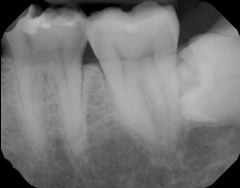
Identify the major placement error in this molar radiograph.
Too far distal
A beam alignment device can be used to help the dental radiographer position the PID in relation to the _____________ and the receptor.
tooth
The nucleus of an atom contains
protons and neutrons.
According to the basic principles of the paralleling technique, the receptor is placed in the mouth _________ to the long axis of the tooth being x-rayed, and the central ray of the x-ray beam is directed ____________ to the receptor and long axis of the tooth.
parallel; perpendicular
To minimize dimensional distortion, the object and receptor must be _____________ one another.
parallel to
Added filtration in the dental x-ray tubehead
results in a more penetrating useful beam.
Thermionic emission of electrons occurs at the
tungsten filament in the cathode.
To correct a dental image where apices do not appear,
the teeth being imaged must be firmly in contact with the bite-block.
You have noticed that your maxillary premolars are elongated, how would you correct this problem?
Increase vertical angulation.
Critical instruments are defined as instruments
that are used to penetrate soft tissue or bone.
The x-ray was discovered by
Wilhelm Roentgen
Who exposed the first dental radiograph in the United States using a live person?
Edmund Kells
Which of the following is an advantage of digital imaging?
Increased speed for viewing images
Which subatomic particle carries a negative electrical charge?
An electron
Which of the following statements is true of orbits or shells in the atom?
The orbiting shell closest to the nucleus has the highest energy level.
Which of the following statements is true of ionization?
An atom that gains an electron has a negative charge, and an atom that loses an electron has a positive charge.
An ion pair results when
an electron is removed from an atom.
Heat is a byproduct of x-ray production. Which component of the x-ray tubehead dissipates the heat created by the production of x-rays?
Insulating oil
Which of the following statements is true of characteristic radiation?
It only occurs at 70 kV and above.
Which is the most common possibility when an x-ray photon interacts with matter?
Compton scatter
Interaction with the x-ray photon as a result of the photoelectric effect is harmful to the patient because ionization occurs.
The statement is true.
The "Guidelines for Prescribing Dental Radiographs" state that
dentulous adult recall patients who are not at increased risk for caries should have posterior bite-wing examinations at 24- to 36-month intervals
State and federal laws require that dental x-ray machines operating above 70 kVp have a minimum total (inherent plus added filtration) of ____ mm of aluminum filtration.
2.5
In order to avoid the primary beam while taking dental images, you should stand at a ____-degree to ____-degree angle to the beam.
90; 135
Both statements are true.
(1) Radiation legislation varies greatly from state to state. (2) For example, in some states a dental radiographer must successfully complete a radiation safety examination before he or she may expose dental x-rays.
The ALARA concept states that all radiation must be kept
as low as reasonably achievable.
Your next patient is a 35-year-old man who you have been seeing for the past 10 years. The only treatment he has needed since coming to the dental practice has been his 6-month "prophys." He has no periodontal issues and is on a 6-month recall cycle. You last took four bite-wing images 1 year ago. Which of the following should you do?
Take the images in 1 to 2 years.
When contrasted with the use of 70 kV for dental x-rays, the use of 60 kV produces
less penetrating dental x-rays with longer wavelength.
(1) Density is the overall darkness or blackness of a dental image. (2) When the kilovoltage is increased while other exposure factors remain constant, the resultant image exhibits a decreased density and appears lighter
The first statement is true; the second statement is false.
According to the inverse square law, the intensity of radiation is __________ proportional to the ______________ from the source of radiation.
inversely; square of the distance
Dental images are a(n) _______________ comprehensive patient care.
necessary component of
When dental images are properly prescribed, exposed, and processed, the benefit of disease detection ____________ the risk of small doses of x-radiation.
far outweighs
(1) It is your responsibility to maintain competence in taking dental images; taking continuing education courses is one example. (2) You should always do your best to properly position and expose receptors in a manner that is accurate, time efficient, and comfortable for your patient.
Both statements are true.
Pathogens are
microorganisms capable of causing disease.
Which of the following viruses may be present in oral secretions?1. Cytomegalovirus2. Hepatitis B virus3. Herpes simplex virus4. Human immunodeficiency virus
1, 2, 3, 4
(1) Highly resistant bacterial and mycotic (fungal) spores are not killed during disinfection procedures; (2) however, highly resistant bacterial and mycotic spores are killed during sterilization
Both statements are true.
You have been using a dental x-ray machine that has a 4-inch PID. Your new machine has an 8-inch PID. Given that all exposure factors remain the same, according to the inverse square law, the resultant beam would be ___________ as intense.
one quarter
You have to take retake a dental image on your patient because the image is too light and is undiagnostic. Which of the following could you change to produce an image with increased density?
Increasing the exposure time

Identify the parts of the X-ray tube.
A. Filament and electron cloud
B. Focal spot on Tungsten target
C. Electronic focusing cup
D. Cathode