Microbiology Media Quiz 2

0.0(0)
Studied by 0 people
call kaiCall Kai
learnLearn
examPractice Test
spaced repetitionSpaced Repetition
heart puzzleMatch
flashcardsFlashcards
GameKnowt Play
Card Sorting

1/4

encourage image

There's no tags or description

Looks like no tags are added yet.

5 Terms

1
New cards

Sulfur Indole Motility (SIM) (what are the following tests used to determine, how do they work, differential or selective or both, what does a positive or negative test look like)

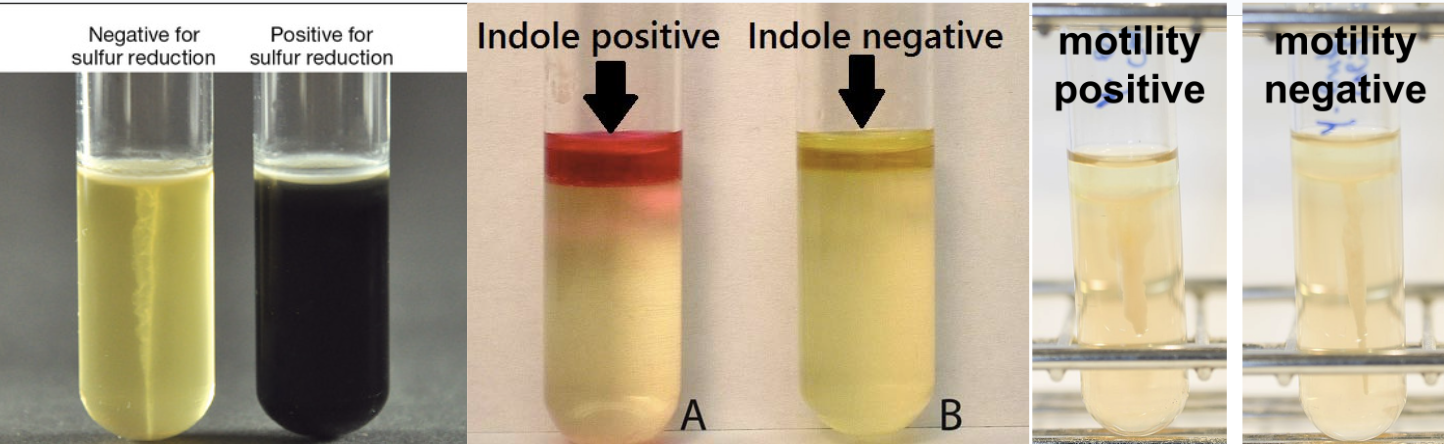
  • a semisolid, differential medium that differentiates different members of Enterobacteriaceae using 3 distinct biochemical characteristics

    • sulfur reduction test - ferrous ammonium sulfate (a metallic indicator) reacts with H2S to form a black precipitate (FeS or ferrous sulfide)

      • positive result = blackened medium (ex: P vulgaris, M morganii)

      • negative result = normal color (ex: E. coli, B subtilis, S marcescens, P aeruginosa, E faecalis)

    • indole production test - if the bacteria contains tryptophanase, it breaks down tryptophan into indole, pyruvic acid, and ammonia. after incubation, Kovac’s reagent is added to react with the indole

      • positive result = pink/red ring at the top (ex: E. coli, P vulgaris, M morganii)

      • negative result = normal color (ex: B subtilis, S marcescens, P aeruginosa, E faecalis)

    • motility test - low agar concentration allows flagellated bacteria to swim away from the stab line

      • positive result = cloudy growth that spreads outward from the stab line (ex: E. coli, P vulgaris, S marcescens, P aeruginosa, M morganii)

      • negative result = growth only stays near the stab line (ex: B subtilis, E faecalis)

<ul><li><p>a semisolid, differential medium that differentiates different members of Enterobacteriaceae using 3 distinct biochemical characteristics</p><ul><li><p><u>sulfur reduction test</u> - ferrous ammonium sulfate (a metallic indicator) reacts with H2S to form a black precipitate (FeS or ferrous sulfide)</p><ul><li><p><strong>positive result</strong> = blackened medium (ex: P vulgaris, M morganii)</p></li><li><p><strong>negative result</strong> = normal color (ex: E. coli, B subtilis, S marcescens, P aeruginosa, E faecalis)</p></li></ul></li><li><p><u>indole production test</u> - if the bacteria contains tryptophanase, it breaks down tryptophan into <em>indole, pyruvic acid, and ammonia</em>. after incubation, Kovac’s reagent is added to react with the indole</p><ul><li><p><strong>positive result</strong> = pink/red ring at the top (ex: E. coli, P vulgaris, M morganii)</p></li><li><p><strong>negative result</strong> = normal color (ex: B subtilis, S marcescens, P aeruginosa, E<strong> </strong>faecalis)</p></li></ul></li><li><p><u>motility test</u> - low agar concentration allows flagellated bacteria to swim away from the stab line</p><ul><li><p><strong>positive result</strong> = cloudy growth that spreads outward from the stab line (ex: E. coli, P vulgaris, S marcescens<strong>, </strong>P aeruginosa, M morganii)</p></li><li><p><strong>negative result</strong> = growth only stays near the stab line (ex: B subtilis, E faecalis)</p></li></ul></li></ul></li></ul><p></p>
2
New cards

Starch Agar (what are the following tests used to determine, how do they work, differential or selective or both, what does a positive or negative test look like)

  • differential medium that distinguishes bacteria that can and cannot hydrolyze starch

    • can hydrolyze starch if the enzyme amylase is present

  • the bacteria is streaked, incubated, and flooded with purple/black iodine (iodine stains starch, but not glucose)

    • positive result = clear halo forms around the bacterial growth (ex: B subtilis)

    • negative result = no halo present (ex: S marcescens, P aeruginosa, P vulgaris, E coli, E faecalis, M morganii)


<ul><li><p>differential medium that distinguishes bacteria that can and cannot hydrolyze starch</p><ul><li><p>can hydrolyze starch if the enzyme <em>amylase </em>is present</p></li></ul></li><li><p>the bacteria is streaked, incubated, and flooded with purple/black iodine (iodine stains starch, but not glucose)</p><ul><li><p><strong>positive result</strong> = clear halo forms around the bacterial growth (ex: B subtilis)</p></li><li><p><strong>negative result</strong> = no halo present (ex: S marcescens, P aeruginosa, P vulgaris, E coli, E faecalis, M morganii)</p></li></ul></li></ul><p></p>
3
New cards

MacConkey Agar (what are the following tests used to determine, how do they work, differential or selective or both, what does a positive or negative test look like)

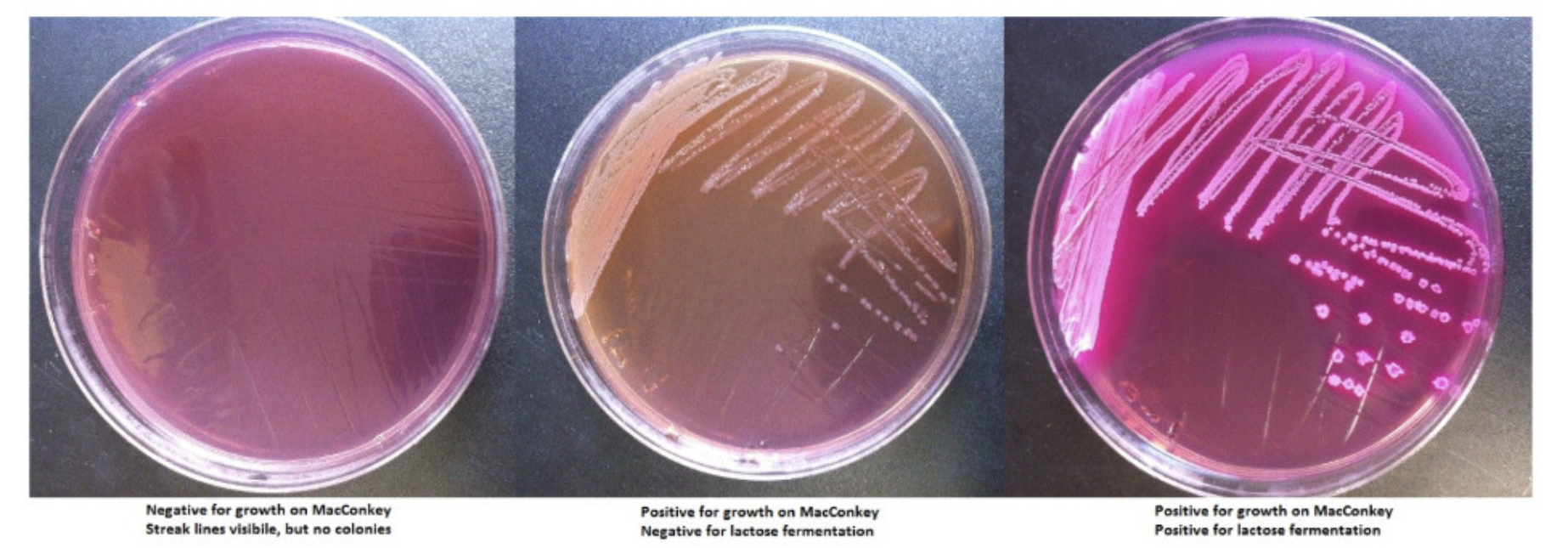
  • selective AND differential medium that contains bile salts, crystal violet dye, lactose, and a pH indicator

    • selects FOR Gram-negative bacteria b/c the bile salts + crystal violet dye inhibit the growth of Gram-positive bacteria

    • distinguishes between lactose-fermenting and non-lactose fermenting bacteria b/c the medium contains a pH indicator and lactose that can break down and release acid

  • No growth = no colonies (ex: B subtilis, E faecalis)

  • Non-lactose fermenter = colorless colonies (ex: S marcescens, P aeruginosa, P vulgaris, M morganii)

  • Lactose fermenter = pink/red colonies (ex: E coli)

<ul><li><p>selective AND differential medium that contains bile salts, crystal violet dye, lactose, and a pH indicator</p><ul><li><p>selects FOR Gram-negative bacteria b/c the bile salts + crystal violet dye inhibit the growth of Gram-positive bacteria</p></li><li><p>distinguishes between lactose-fermenting and non-lactose fermenting bacteria b/c the medium contains a pH indicator and lactose that can break down and release acid</p></li></ul></li><li><p><strong>No growth </strong>= no colonies (ex: B subtilis, E faecalis)</p></li><li><p><strong>Non-lactose fermenter</strong> = colorless colonies (ex: S marcescens, P aeruginosa, P vulgaris, M morganii)</p></li><li><p><strong>Lactose fermenter</strong> = pink/red colonies (ex: E coli)</p></li></ul><p></p>
4
New cards

Eosin Methylene Blue (EMB) Agar (what are the following tests used to determine, how do they work, differential or selective or both, what does a positive or negative test look like)

  • slightly selective AND differential medium that contains eosin (dye), methylene blue (dye), and lactose

    • selects FOR Gram-negative enteric bacteria b/c eosin and methylene blue inhibit the growth of Gram-positive bacteria

    • distinguishes between lactose-fermenting and non-lactose fermenting bacteria b/c the medium contains lactose that can break down and release acid, which absorbs the dyes to form colonies

  • No growth = no colonies (ex: B subtilis, E faecalis)

  • Non-lactose fermenter = colorless to amber colonies (ex: S marcescens, P aeruginosa, P vulgaris, M morganii)

  • Lactose fermenter = blue/black colonies (gram negative)

    • strong lactose fermenters (like E. coli) form metallic green colonies


<ul><li><p>slightly selective AND differential medium that contains eosin (dye), methylene blue (dye), and lactose</p><ul><li><p>selects FOR Gram-negative <em>enteric </em>bacteria b/c eosin and methylene blue inhibit the growth of Gram-positive bacteria</p></li><li><p>distinguishes between lactose-fermenting and non-lactose fermenting bacteria b/c the medium contains lactose that can break down and release acid, which absorbs the dyes to form colonies</p></li></ul></li></ul><ul><li><p><strong>No growth </strong>= no colonies (ex: B subtilis, E faecalis)</p></li><li><p><strong>Non-lactose fermenter</strong> = colorless to amber colonies (ex: S marcescens, P aeruginosa, P vulgaris, M morganii)</p></li><li><p><strong>Lactose fermenter = </strong>blue/black colonies (gram negative)</p><ul><li><p>strong lactose fermenters (like E. coli) form metallic green colonies</p></li></ul></li></ul><p></p>
5
New cards

Nutrient Agar (what are the following tests used to determine, how do they work, differential or selective or both, what does a positive or negative test look like)

  • generally used to grow and observe bacteria (doesn’t specifically test for anything)

  • contains basic nutrients like peptone (amino acids + nitrogen), beef/yeast extract (vitamins + minerals), agar (allows for bacterial growth)

    • positive result = visible colonies

    • negative result = no visible colonies


<ul><li><p>generally used to grow and observe bacteria (doesn’t specifically test for anything)</p></li><li><p>contains basic nutrients like peptone (amino acids + nitrogen), beef/yeast extract (vitamins + minerals), agar (allows for bacterial growth)</p><ul><li><p><strong>positive result</strong> = visible colonies</p></li><li><p><strong>negative result</strong> = no visible colonies</p></li></ul></li></ul><p></p>



