SECTION 2: AUTONOMIC NERVOUS SYSTEM
 Call Kai
 Learn
 Practice Test
 Spaced Repetition
 Match
 Flashcards
 Knowt Play
1/5

There's no tags or description
Looks like no tags are added yet.
6 Terms
Describe the AUTONOMIC NERVOUS SYSTEM (A N S)
The autonomic nervous system (ANS) (visceral motor system), and is responsible for transmitting involuntary signals from the CNS to smooth muscle, cardiac muscle, and glands.
• Controls smooth muscle, cardiac muscle, and glands.
• Regulates heart rate, digestion, body temperature, and blood flow.
• Automatically adjusts body functions based on different situations.
What is the ORGANIZATION OF THE ANS
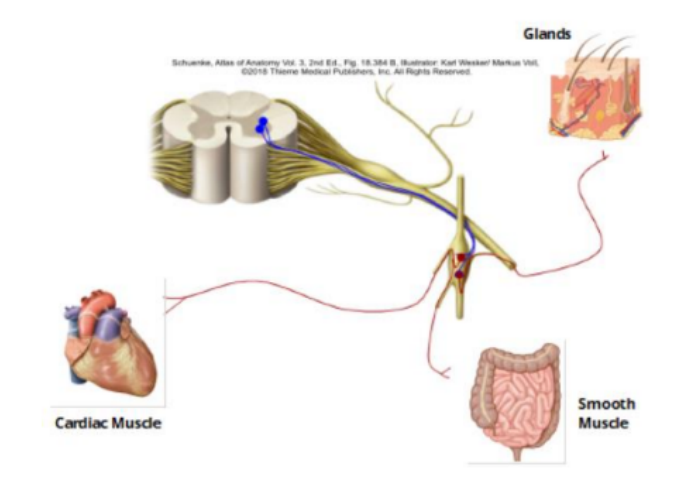
The ANS is a two neuron pathway, simply meaning that between the C NS and any target organ, there are two neurons.
1. The preganglionic neuron has its cell body within the CNS. The axon enters into the PNS and travels to the autonomic ganglion.
2. The autonomic ganglion is where the preganglionic and postganglionic neurons meet and communicate. It is located in the PNS.
3. The postganglionic neuron is entirely in the PNS. Its cell body is in the autonomic ganglion, while its axon travels to the target organ.

what is the Sympathetic Nervous System?
Functions + steps of how it works
Sympathetic Nervous System – Fight or Flight
• Prepares the body for stress and activity.
• Increases body activity to respond to threats, to multiple organs
The nerves of the sympathetic nervous system exit from the spinal cord to supply innervation to the body.
Exit spinal cord: Preganglionic axons leave the lateral horn with somatic motor axons through the anterior root.
Enter sympathetic trunk: Preganglionic axons travel through the spinal nerve to the sympathetic trunk, where they can move up or down the body.
Synapse: Preganglionic neurons synapse with postganglionic neurons in the ganglia.
Reach target: Postganglionic axons leave the sympathetic trunk, re-enter the spinal nerve, and travel to the target organ/tissue at approximately the same vertebral level.

What is the Parasympathetic Nervous System?
Functions + steps of how it works
Parasympathetic Nervous System – Rest and Digest
• Promotes relaxation and conserves energy.
• Supports digestion, waste elimination, and recovery.
• Produces more specific responses in individual organs.
As parasympathetic neurons originate from the brainstem or the sacrum, you can follow the pathway starting at either origin.
Exit brain or spinal cord: Preganglionic neurons leave the brainstem or sacral spinal cord.
Synapse: Preganglionic neurons travel to ganglia near or within the target organ, where they synapse with postganglionic neurons.
Reach target: Short postganglionic axons travel to the target organ/tissue.
CN III, VII, IX: Supply the head.
CN X (vagus nerve): Supplies the thorax and descending colon (except its distal portion).
S2–S4: Supply pelvic organs (bladder and reproductive organs).

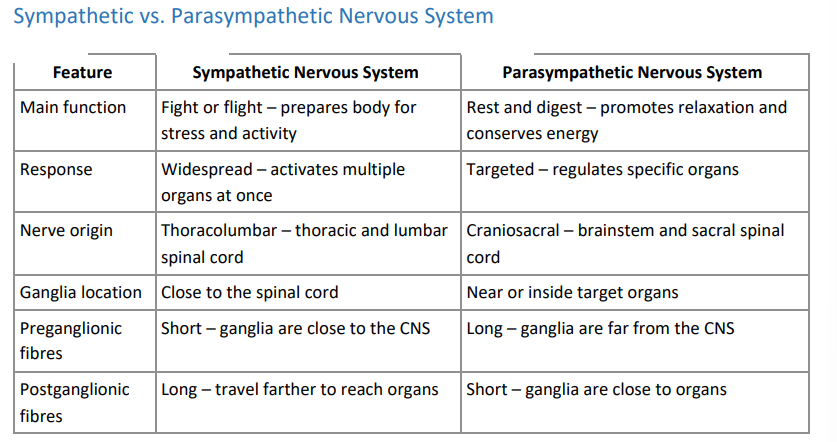
What are the three main anatomical differences between Sympathetic and Parasympathetic Nervous System
A. Origin of Nerve Fibres
Sympathetic – Thoracolumbar: Originates from the thoracic and lumbar spinal cord.
Parasympathetic – Craniosacral: Originates from the brainstem and sacral spinal cord.
B. Location of Ganglia
Ganglia: Clusters of neuron cell bodies where autonomic neurons communicate.
Sympathetic: Ganglia are close to the spinal cord, allowing signals to reach many organs.
Parasympathetic: Ganglia are near or inside target organs, allowing specific responses.
C. Length of Nerve Fibres
Preganglionic fibre: Travels from the CNS to the ganglion.
• Ganglia are located close to the spinal cord.
• Therefore, the preganglionic fibre is short because it doesn't have far to travel.
Postganglionic fibre: Travels from the ganglion to the target organ.
• Ganglia are located near or inside the target organ.
• Therefore, the preganglionic fibre is long because it must travel farther to reach the ganglion.

Sympathetic and Parasympathetic Nervous System Comparison