Basic Audiology
 Call Kai
 Learn
Learn Practice Test
 Spaced Repetition
 Match
Match Flashcards
 Knowt Play
1/118

Earn XP
Description and Tags
exam 1
Name | Mastery | Learn | Test | Matching | Spaced | Call with Kai | Chat |
|---|
No analytics yet
Send a link to your students to track their progress
119 Terms
110-120 db
What is the loudest sound that we can tolerate?
20 hz up to 20,000 Hz
What is the range of hearing for a human?
125 Hz to 8,000 Hz
what is the range tested in an audiogram
140 dB
what is the threshold of pain/damaging to the ear
110 dB
what is the highest threshold we test to in an audiogram?
The softest sound a young, normal hearing listener can hear at each frequency level
threshold of audibility contour
octaves
successful doubling of frequencies
inter-octave frequencies
frequencies in between octaves
intuitive threshold
the softest level that a given listener can hear a sound
operational threshold
the level of a sound that can be heard by an individual 50 % of the time
clinical threshold
the lowest level at which three responses are first obtained
familiarization phase
descending phase
threshold-search phase
modified hughson-westlake technique
familiarization phase
familiarize patient with stimulus they are listening for
descending phase
once you familiarize then you drop the level by 10 dB
threshold-search phase
once you reach where the patient cant hear the sound anymore start increasing by 5 dB, once they hear the sound drop 10 dB, repeat always increasing by 5 and dropping by 10 until you get three responses at the same location
air conduction
tones are transmitted through the air from a transducer, normally headphones, into the ear canal
bone conduction
tones are transmitted through the bones of the skull to the cochlea. A small bone oscillator is placed on the skull behind the pinna
red
what color are the symbols in the right ear
blue
what color are the symbols in the left ear

right AC (unmasked)

left AC (unmasked)
right AC (masked)

left AC (masked)

right BC (unmasked)

left BC (unmasked)

right BC (masked)

Left BC (masked)

right no response

left no response
slightly to the side of the line
where is bone conduction recorded?
on the left side of the line
where is the right ear recorded?
on the right side of the line
where is the left ear recorded?
solid lines
what are air conduction symbols connected with
dotted lines
what are bone conduction symbols connected with
timing of your response must be consistent to the timing of the stimulus
response must be latency consistent
should not be able to anticipate when you are going to present the stimuli
avoid pattern of presentation
can you get different results based on the headphones you use and the position of the headphones/oscillator
yes
listening checks daily
when should you be putting the headphones on yourself and checking the intensity and sound of the headphones?
no
can bone condition threshold be worse than air condition threshold?
PTA
pure tone average is the threshold average at 500, 1000, and 2000 Hz
no
do you test BC at 8,000 Hz
middle ear infection
otitis media
point of the cone of the ear drum
umbo
reflection of the otoscope
cone of light
always facing towards the front of the head
manubrium of malleus
tympanic membrane
ear drum; pearly grey semi-transparent
serous
none infected fluid
suppurative
infectious fluid
tympanosclerosis
scaring of the eardrum
conducive auditory system
outer and middle ear
examples of conductive hearing loss
pina malformation, wax plug/obstruction, ear infections
sensorineural
includes cochlea, auditory nerve, ascending auditory pathway
sensorineural hearing loss
loss of hair cells in the cochlea, loud noises, and age
mixed hearing loss
conductive hearing loss and sensorineural at the same time e.x. some who has dead hair cells and an ear infection
retrocochlear
something beyond the 8th nerve
air-bone gap
difference between AC and BC \
total conductive hearing loss= air conduction- bone conduction
bilateral
both sides “bilateral hearing loss”
bilateral
in both ears “bilateral hearing test”
unilateral
one side
monaural
one ear
behavioral test e.x. a pure tone test
subjective
neurophysiologic
objective
conductive
AC outside of normal
BC within normal
Air-bone gap
sensorineural
AC outside of normal
BC outside of normal
AC=BC
mixed
AC outside of normal
BC outside of normal
Air-bone gap
degree
normal, mild, moderate…
type
conductive, sensorineural, mixed…
configuration
flat, sloping, notched…
normal
-10dB to 16dB
slight/minimal
16dB to 25dB
mild
26dB to 40dB
moderate
41dB to 55dB
moderately-severe
56dB-70dB
Severe
71dB-90dB
profound
91dB +

flat configuration

sloping configuration
-sensorineural hearing loss

rising configuration
-rising configuration is a conductive hearing loss

notched configuration
noise induced hearing loss; sensorineural

fragmentary (left corner) configuration
sensorineural
most members of the deaf community have an audiogram thats left corner
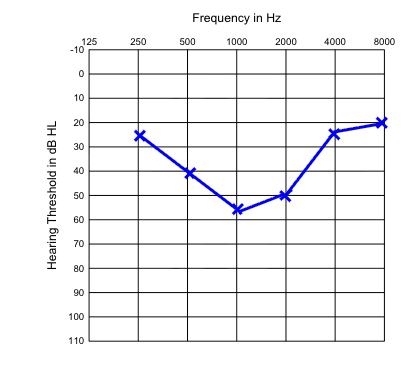
cookie-bite configuration
congenital hearing loss
nothing would happen after birth that would cause this
degree
determined by AC only
determined at each frequency
type
determined by both AC and BC
determined at regions of frequencies, meaning it varies by low-high frequencies
configuration
determined by AC only
determined across frequency
masking
to rule out participation by the non-test ear
crossover
when sound presented to the test ear arrives at the cochlea of the non-test ear
inter-aural attenuation
the drop in intensity of a sound as it crosses over to the non-test ear
40 dB
what is the inter-aural attenuation for air conduction testing
audiogram
a graph that shows the results of a hearing test by plotting the thresholds at different frequencies
40-60 dB
what is the average in dB for speech?
lower
the more hearing loss the ____ on the graph?
0 dBHL
what is the average hearing threshold?
frequency (Hz)
what is on the x-axis of the audiogram?
125-8000 Hz
what is the number range for the x-axis?
intensity (dB)
what is on the y-axis of the audiogram?
-10 to 110 dB
what is the number range for the y-axis?
start at 1000
then go up (2,000, 4,000, 8,000)
retest 1,000
then go down (500, 250)
what is the order you should test frequencies?
blue
what color corresponds to the left ear?
red
What color corresponds to the right ear?
annually
how often is an exhaustive calibration done?