Biology - Water
 Call Kai
 Learn
Learn Practice Test
 Spaced Repetition
 Match
Match Flashcards
 Knowt Play
1/40

There's no tags or description
Looks like no tags are added yet.
Name | Mastery | Learn | Test | Matching | Spaced | Call with Kai | Chat |
|---|
No analytics yet
Send a link to your students to track their progress
41 Terms
What are hydrogen bonds?
A hydrogen bond is a relatively weak electrostatic attraction between a partially positive hydrogen atom and a very electronegative atom such as oxygen
What type of bond does water have?
Covalent

What model of water is this and what’s missing?
Ball and Stick Model
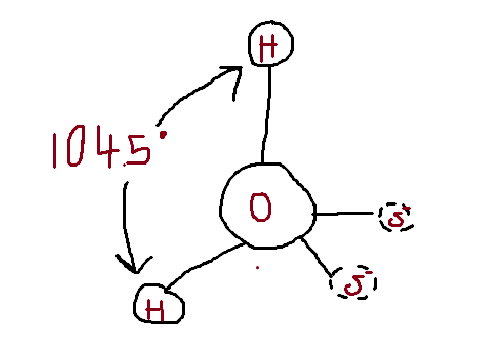

What model of water is this and what’s missing
Lewis Structure of Water


What would this look like with electronegativity
electropositive hydrogen, electronegative oxygen

What is the molecular formula for water?
H2O
In a water molecule, what bonds to what?
HYDROGEN bonds to the oxygen, hence it’s called a O-H bond
How is the shape of a water molecule described
bent or “V” shape due to its H-O-H bond
Why does water have a bent (V) shape?
due to its H-O-H the central oxygen atom has two unshared pairs of electron (lone pairs) that repel the two hydrogen atoms.
What does it mean for a molecule to be polar
Polar molecules are ones that have a partially positive charge on one end and a slight negative charge on the other end of the molecule
What is the electronegativity of oxygen
3.44
what’s the electronegativity of hydrogen
2.20
what does “δ” mean
delta, represents partial charge and means ‘not a full ionic charge’
What do most properties of water derive from?
it’s electrons being unevenly shared
what does ‘ H • • • O ‘ represent
hydrogen bonds found BETWEEN neighboring water molecules
Why is water a good solvent?
polar molecules (e.g. glucose) are charged and are attracted to the weak charges on water molecules
Why does water have a high specific heat capacity
4.2 J are needed to increase the temp of 1Kg of water by 1.C; this thermal energy is used to break hydrogen bonds between water molecules
why does water have a high latent heat of vaporization
a lot of thermal energy is needed for vaporization hence shallow aquatic habitats may thrive and loss of water for cooling is efficient
why does water have a high latent heat of fusion (turn inna ice)
water in cells stay liquid so cells arent damaged by ice crystal
why is water reactive?
water molecules are polar and can easily pull electrons away from unstable atoms or molecules. it also splits into H+ ions and hydroxyl ions OH-
why is ice less dense than water
water molecules form a rigid, open crystal structure when frozen, which keeps the molecules farther apart than they are in liquid form
insulation for aquatic animals by floating on the surface and forming a protective barrier that stops freezing air from turning the entire water body into solid ice
for what purpose can water not be compressed into a smaller volume
turgidity in plant cells, hydrostatic skeletal animals maintain their shape
why does water have high cohesion
hydrogen bonds holds water molecules together, supports columns of water in xylem, give
What percent of a cell’s mass is water
more than 70%
what’s a dipole
a separation of positive and negative electrical charges across a bond or a molecule
what is cohesion
Cohesion is the attraction between like molecules. In water, the positive hydrogen side of one molecule attracts the negative oxygen side of another, forming hydrogen bonds.
what is adhesion
Adhesion is the attraction between dissimilar molecules. It occurs when water is attracted to other charged or polar surfaces
water itself is electrically ________ or _______ however there are ______ that allow weak electrical attraction between water molecules which results in ________ and the ability to undergo ____ ____
balanced, neutral, dipoles, cohesion, mass flow
Define dipolar
This refers to a molecule having two distinct, opposite, electric poles
soluble
any substance that can dissolve in a liquid to form a solution is a soluble
insoluble
any substance that cannot be dissolved in a solvent is insoluble
explain why hydrogen bonds form between water molecules
due to uneven sharing of electrons, water is polar and gives the oxygen atoms a partially negative charge while the hydrogen atoms are partially positive. The partially positive hydrogen atoms of one water molecule is naturally attracted to the partially negative oxygen atom of a neighboring molecule, creating hydrogen bonds
what are some biological molecules that dissolve in water
Vitamin B2 (riboflavin) , Amino Acids, Vitamin B1 (thiamine), Nucleic acids, Simple sugars, ATP, Glycogen
what are some biological molecules that don’t dissolve in water
Fats, oils, waxes, steroids, phospholipids, carotenoids (light absorbing photosynthetic pigments), Vitamin A, Vitamin D, Vitamin K
explain water as a component of cells
most of the cells in the cytoplasm is water, providing liquid environment where organelles stay suspended. The water within cells also facilitates chemical reactions as well as actively participating in certain reactions such as hydrolysis (breaking down complex molecules)
explain water as a transport medium
water is an essential transport medium as it’s polar structure allows it to act as a universal solvent
explain water as a coolant
due to water’s high specific heat capacity it can absorb a large amount of thermal energy with only a small rise in temperature
What are the advantages of water as an environment for organisms
high specific heat capacity, offering aquatic organism a thermally stable habitat
Water is dense and provides physical buoyancy, organisms do not need heavy skeleton structures to support their weight.
water acts as a universal solvent, dissolving and carrying essential minerals and organic molecules for the organisms
What are the disadvantages of water as an environment for organisms
oxygen does not dissolve well in water, aquatic animals often have to work harder to extract enough oxygen e.x.: whales having to swim to the surface for air
sunlight is absorbed quickly by water, photosynthesis is restricted to surface layers and deep waters are pitch black and cold
due to density of water, moving quickly through it requires a streamlined body shape and expands a lot of energy
explain why the prescence of liquid water on earth is important to life as we know it on earth
liquid water acts as a universal solvent and a dynamic medium where vital biochemical reactions take place. Water’s molecular polarity allows it to break apart and dissolve many substances, cells rely on liquid water to facilitate the collision, mixing and metabolic reactions of molecules needed to sustain life.
find out what happened to water on venus
Venus lost its surface water due to a runaway greenhouse effect driven by intense solar heat, which evaporated its early oceans and allowed ultraviolet radiation to strip hydrogen into space