Clinical Psychology
 Call Kai
 Learn
 Practice Test
 Spaced Repetition
 Match
 Flashcards
 Knowt Play
1/99

There's no tags or description
Looks like no tags are added yet.
100 Terms
Early approaches to clinical work and training
Intuitive - basis of personal intuition and sources other than research
Pro: flexible - adapt to the client, good at interpersonal skills
Con: Restricted to what you know, bias, without research or knowledge there is potential to harm something (just hope and pray)
Scientist - 1940s in US trained to be clinician and researcher (separate things not integrated)
Pro: encourage empirical knowledge
Con: hard to put into practice
Applied-scientists approach
Clinical work as a scientific endeavour (integration of research into practice)
Look at what clients are doing
Evidence-based approach
Not entirely separate from previous, expanded on that
Most common. Best empirical evidence to select interventions and assessment methods that are best for their client. Client need taken into account
What is research?
A search or investigation directed to the discovery of some fact by careful consideration or study of a subject, in a critical or scientific way
Careful
Detached
No prescribed method
Discover vs confirmation
Facts and reality
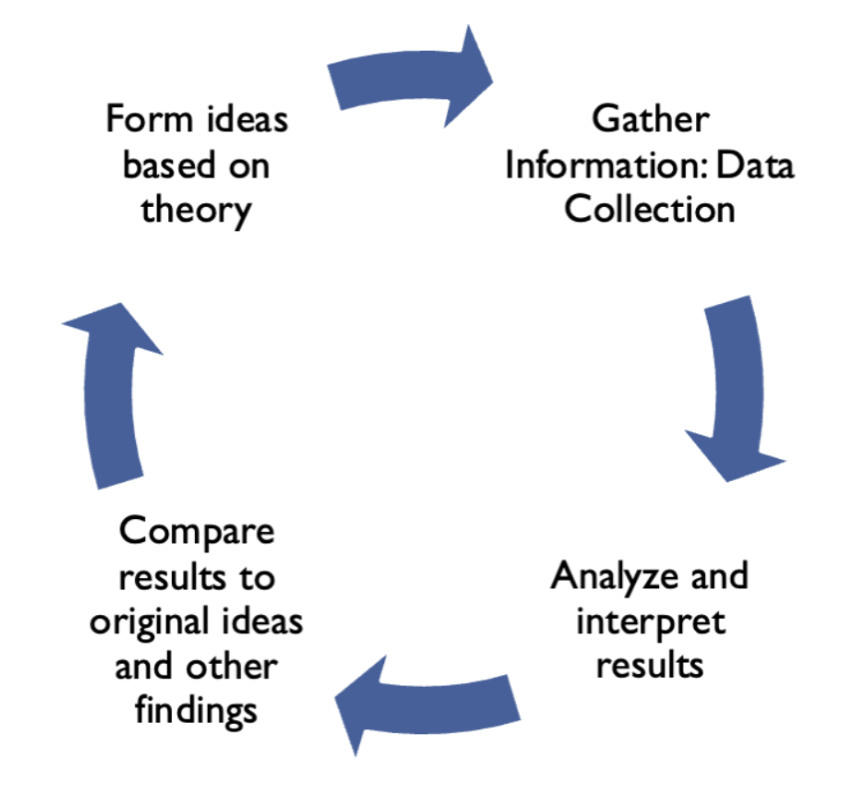
Research cycle
False assumptions
Ivory tower problem, not relevant outside of the academic space
Bias and error in analysis or when comparing to other things, taking it too far
Pure vs applied research
Basic (aka pure) addresses the generations and texting of theory ↔ Applied research - addresses practical questions: evaluation, audit, quality assurance, health services.
Clinical psychologist may do both types of research
What is a theory?
A set of statements that summarises and organises existing information about some phenomenon, provides an explanation for the phenomenon, and serves as a basis for making predictions to be tested empirically.
Are parsimonious
Good theories are falsifiable
Principle of parsimony
When there are competing interpretations about the simplest one that accounts for data. Occam’s razor - no need to add concepts that are not.
Explain why good theories are falsifiable
Any theory is the best “truth” available; a better explanation may exist… So science is all about trying to disprove things (it becomes a fact after failing to disprove them). Which means all theories must be falsifiable.
Epistemology
How we come to know something is real or true
Correspondence theory
It matches reality so its true (if rain drops from the sky, its raining)
Coherence theory
It’s logically consistent (if weather conditions necessary for rain are present, its raining)
Pragmatism
It’s true if its useful (if you go outside and when it's raining you’ll get wet, or making bread therefore yeast work dont know how but it works)
Consensus
Everyone agrees its true (everyone agrees that it’s raining)
Theories of knowledge
Realism
Critical-realism
Post-modernism and constructionism
Realism
Relies on correspondence theory of knowledge - to understand the real world as it exists as accurately as possible - quantitative relies heavily on this; hypothesis testing experiment
Critical-realism
Still relies on correspondence theory of knowledge, coherence and consensus - everything we know is through our own perception of it all filtered through us - having results or findings that can be replicated, use “triangulation” (combining multiple methods for the best approach)
Post-modernism & constructionism
Coherence and consensus: they don't believe there's an objective reality to test against. Only interested in the subjective.
Goal of research? To know and understand each story and interpretation - what methods are used? Qualitative; exploration and understanding, not falsification
How is scientific progress made? Induction
Particular to the general
Observation → pattern recognition → analyze → theory
No logical basis when used exclusively
Not truly ground up
How is scientific progress made? Deduction and falsification
Testing theories by narrowing in and answering specific questions
Theory → hypothesis → observation → conclusion
Progress is achieved through falsification of incorrect theories through this process, each time, the theory will be closer to the truth
Views science as a linear process, an accumulation of knowledge
Is psych “pre-paradaigmatic”?
Multiple paradigms are put forward by different school of writing all the time, often at the same time
Scientists may strongly disagree they propose and support their individual theories
They just kind of add stuff never totally get rid of theories
General type of research questions
Exploratory - inductive, focused on discovery. New realist, contradictory research to date, highly complex phenomenon.
Hypothesis-testing - hypothetico-deductive, confirmatory. Testing specific hypotheses based on a theory
Specific research questions: Description
Provide a full picture of the phenomenon
Specific research questions: Descriptive-comparison
Compare groups to look for differences in description of phenomenon
Specific research questions: Correlation
Investigating possible relationship between variables/phenomena
Specific research questions: Causality
Investigating the causes for a phenomenon of interest
Specific research questions: Measurement
Validate performance of measurement tools or ways of measuring a construct
Operational definition
A clear, specific, and measurable description of an abstract concept, variable, or behaviour so that it can be observed, quantified, and replicated by others.
Empirical hypotheses
Very specific hypotheses → what you expect to happen in your study related to your design variable, etc…. Usually these are the hypothesis that comes at the very end of the introduction section
Essential parts of a research manuscript
title
abstract
introduction
methods
results
discussion
Quantitative measures
All variables can be converted to numeric form and analyzed using stats
Validity

Construct validity
Refers to how well you translated or transformed a concept, idea, or behaviour – that is a construct – into a functioning and operating reality, the operationalization
Content validity
Refers to whether it covers all aspects of a construct (this is not stats, just expertise in theory, what you know about a measure)
Face validity
The measure looks right on the face of it, that is, that it self‐evidently measures what it claims to measure
Criterion validity
Refers to how well a measure correlates with established measures or indicators of the same construct.
Concurrent validity
“at the same time”. E.g., diagnostic interview and cutoff score (given in close proximity/time) does it line up with concurrent information.
Predictive validity
“predicting the future” e.g., IQ tests predict your performace in school
Convergent validity
Correlated with measures it should. E.g., BDI = PHQ-5 should have similar results. (not super different from concurrent)
Discriminant validity
Does not correlate with measures it is not supposed to. E.g, BDI ≠ GAD-7
Sensitivity vs Specificity Validity
Sensitivity: refers to how well a measure picks out people with the disorder (i.e., few false negatives)
Specificity: refer to how well a measure avoids diagnosing healthy people with a disorder (i.e., few false positives)
Ideally, a diagnostic measure should have a good balance of both
Sensitivity vs specificity refer to the ratios of probabilities in Signal Detection Theory (SDT)
Reliability
The degree of reproducibility of the measurement or its consistency. If you repeat the measurement in various ways do you get the same results each time?
Reliability: Equivalent-forms
Virtually never used at this point, although there are some expectations. The word reading efficiency/tower different words but the same test. For things with a practice effect but still testing the skills.
Reliability: Test-retest
Consistency of the measure over time. Longitudinal research. Construct needs to be theorized as stable rather than transient. Assessed with correlation coefficient.
Reliability: Internal consistency
Extent to which all items in a questionnaire more or less measure the same thing. All items are slightly different but should measure the same (intended) construct.
Reliability: Inter-rater
Extent to which outcome/results of measure are consistent across users. Used when scores are derived from a trained coder looking at raw data.
Nomial variables GAD, MDD, PTSD
Ordinal or interval variables
Basic types of hypotheses
Descriptive
Descriptive comparison (does group 1 differ from group 2)
Correlational (do X and Y convey)
Psychometric (is a measurement reliable and valid)
Three most common hypotheses in clinical psychology
Incremental validity
Mediation
Moderation
Incremental validity hypothesis
Enhancement motives will predict future binge drinking over and above past binge drinking (different visualization but same concept)
Mediation hypothesis
Start with basic prediction model: X predicts Y
A second theory based predictor is added: the mediator (Z)
X predict Z
Z predicts Y when controlling for X
Mediation occurs when the strength of the direct path (X-Y) is reduced or eliminated)
Moderation hypothesis
Start with basic prediction model X predicts Y
A second theory based predator is added the moderator (Z)
The relationship between x and y is changed when z is added
Changes in the size of effect
Changes in the direction of the effect
Used mostly for questions of when or who
What is qualitative research?
Linguistic data
Epistemological basis: rejected positivism
Personal meaning, personal interpretations; No Goal is description/undertiming of individual experience and reality; centers researcher bias, subjectivity
Focus on exploration, developing understanding.
Advantages of qualitative research
Complexity that cannot be expressed numerically
Expanded research question possibilities
Individuals can be studied in depth, detail
Raw data is more vivid and easily grasped/understood
Hypothesis generation and discovery-oriented research
More freedom to participant
“Gives voice” to participants
Finding things not originally expected
Define phenomenological
Understand people's thoughts, feelings, and perceptions. Systematic study of those things. Two key processes: Bracketing and describing.
Perception is primary
Understanding is the true goal of science
Every perspective is equally valid and interesting to the researcher
Perceptions are based on underlying presuppositions, which are also important to understand.
Describe Bracketing vs. Describing in phenomenology
Bracketing
Self-reflection
Stepping back
Describing
Only concrete, specific impression
Avoid evaluative terms, language
Avoid explanation, interpretation
Social constructionism
Focused on how language is used to order, manage the world. Not as much interesting in language as representing thoughts/feelings of individuals.
Rejects assumption of underlying, independent reality that can be known
Most psychological variables are not real “things” but rather social constructions
Should study language and how people construct arguments
Postmodernism
Hard to define → whole point is that there are no set definitions for anything. A lot in common with radical social constructionism
No such things as objectivity
No set meaning – all language is ambiguous
Focus of most research is deconstruction
Rejects correspondence theory of truth
Qualitative approaches to research
Narrative
Language based
Ethnographic
Narrative approach
Narrative analysis: Stories are raw data
Description of setting, main character, problem/situation
Series of actions, obstacles, conflicts, reactions, attempted solutions
Ending or resolution, statement of point and/or person’s current perspective
Life history research
Autobiographical or biographical story is the raw data
Goal: Understanding individual lives over time & often a specific issue or phenomenon within the context of their life history
Language-based approach: Discourse analysis
The language-based approach is used most in psychology. Rigorous examination of text
Goals
Analyze the discourse a speaker draws on + the subject positions that a speaker adopts & their place in social, historical context
Examine how language is used to perpetuate power differentials
Language-based approach: Conversion analysis
Study how what is said in conversation is perceived by listener via examining their responses
Goals
How things are accomplished via conversations
Common strategies used
Better understanding speech/interactions in particular settings (e.g., work, therapy)
Language-based approach: Deconstructionism
The major task of researchers as the “deconstruction” of the cultural, social, or epistemological assumptions of their work and that of others.
Goal
Deconstruct assumptions of their work to give space for multiple view/voices without the need to bring them together into one message
Ethnographic approach: General
Goal: understand social rules/norms that govern interaction in a particular culture
Method: Participant observation in the field → take extensive field notes → analyze field notes
Ethnographic approach: Focused/Applied
Goal: Answer a specific question about a situation, problem, etc.
Method: Interviews and observation with participants focused on the specific question → record responses & observations → analyze responses & observations
Common Qualitative Methods In Psychology
Qualitative observation
Researcher immersed in setting
Complete observer (more common) ↔ complete particiapant (rare)
Systematic, but unstructured
Detailed records (“field notes”)
Discovery oriented with clear focus
Overt vs covert
Covert = concealed observation
Overt = open observation
Text-based approaches
What makes this different from self-report? Approach as an example of communication not attempt to understand specific content of what someone is thinking, saying
How should we evaluate qualitative studies?
Explicitly owning one’s perspective
Situating the sample
Grounding in examples
Providing credibility checks
cohenrence
Accomplishes general vs. specific tasks
Resonates with reader
What does considering needs of participants means?
Potential needs and negative effects are different for everyone involved
Participants
Parents
Community
Science
Researcher
Job of researchers, and research review boards, is to balance needs and potential outcomes for everyone involved with focus on participants first
How does one ensuring ethical studies?
Independent review - provides an outside perspective
Tri-Council Policy statement
Two broad areas of ethics
Treatment of participants and confidentiality
Ethics: Treatment if participants
Informed consent
Voluntary participations
Freedom from harm
Informed consent
Ensure understanding
Competence, capacity (this is where differences for children come in, assent for children)
Considerations re: deception
Usually includes a signed form
Voluntary participation
Consider potential implicit coercion and captive populations (Forensics system, inpatient unit, cannot leave where they are. Ensure they still have a choice)
Cant use data for any other studies in the future because they did not consent to their data being shared for multiple studies. (Consent forms cover this now because of Open Science)
Freedom from harm: Non-RCT
Research should not harm participants
If harm is unavoidable… Harm should be minimised in all ways possible… and the potential gain to humanity must outweigh the harm done
Consider children, very vulnerable population
Watch for overtesting, could cause strain
Full consent is always necessary
You may need to stop your study you later realise harm exceeds potential gain
Freedom from harm: RCT
Control groups - are control group charmed by withholding treatment
Inflexible treatments - clinician cannot adapt using intuition or judgement
Randomization- lack of choice of treatments for clients
Narrow inclusion criteria - often excludes co-morbid patients
No access to help - good research would dictate that participants don't seek additional treatment
Confidentiality
All info should kep confidential. Do not share info about participants beyond approved team. Have systems in place to ensure confidentiality
Anonymity
Anonymity
Participants and data being kelp anonymous is ideal
True anonymity difficult in practice (the person testing them know, surveys, emails to sign up)
Privacy
Right to not provide info that may be too personal, intrusive. Only ask what you need to know
Classification of design
Non-experimental
Descriptive
Categorical
Inferring causation
Experimental
Quasi-experiments
Randomized
Randomized control trial (RCT)
Experimental design
Original "action of trying anything. Or putting it to proof; a test, trial”
What is essential to being experimental? Manipulation of natural course of events to specifically test hypotheses/theories
Notation: X = Intervention; O = Observation
Quasi-experiment
One-group, post-test design
X O
One group, pre-test/post-test design
O1 X O2
Randomized design
Two-group, post-test design
Most pure/basic research with experimental manipulation
High concern about carry-over effect re: tets/measures
Pre-test is not needed based on outcome variable
Pre-test could influence manipulation and/or treatment
When pre-test may not be possible or informative
Two-group, pre-test/post-test design
These designs would still be quasi-experimental if the groups are not randomized
Randomized control trial (RCT) design
Two-group , pre-test/post-test design with random assignment
This is the gold standard in clinical psychology
Example: Yoga and adolescents in hospital treatment
Waitlist control and treatment
Types of control groups
No-treatment
Wait-list
“Placebo”
Comparative treatment groups
Dismantling studies
Randomized control trial (RCT) design: Conceptual limitations
Ignores client choice
Researcher allegiance
Unethical randomization - Many things in clinical psychology research cannot be randomized (e.g., negative experiences, harmful behaviours)
RCT used when unnecessary
Generalizability
Therapist buy-in is also important, must believe in the treatment for it to work.
Randomized control trial (RCT) design: Practical limitations
Equivalence of groups - RCTs assume equivalence of groups but this is not assured at start or throughout study period
Attrition - Nature of RCTs (and clinical research/trials generally) can cause significant participant attrition
“Leakage” - Participants may have cross-over such that those in the control group learn through explicit sharing, modelling, etc.
Cooperation
Significant cost
External validity
Generalizability of the results. The extent to which the study results can be generalised to other samples with different characteristics than the study sample
Internal validity
The degree to which causality can be inferred from a study. The degree to which the intervention, manipulation, and/or experimental procedures, and not other factors, account for study results
Threats to internal validity
Spontaneous remission
Interfering events and secular drift
Maturation trends
Regression to the mean
Attrition
Diffusion, imitation of treatment
Special treatment, reaction of controls
Poor adherence to treatment protocol
Statistical conclusion validity
The extent to which the analysis performed enables one to draw correct (true) inferences about the phenomena of interest
Define self-report methods
Interviews
Questionnaire