environmental geochemistry exam #1
 Call Kai
 Learn
 Practice Test
 Spaced Repetition
 Match
 Flashcards
 Knowt Play
1/58

There's no tags or description
Looks like no tags are added yet.
59 Terms
what is the formula for Q?

what is Q equal to when the reaction is at equilibrium?
Q = K, where K is the equilibrium constant
what is the equation for Gibbs Free Energy?

what is the unit for G?
kJ/mol
What is the formula for 𝚫G if the reaction is happening at 25ºC?

How can you tell if a reaction is endothermic or exothermic?
If H is positive, the reaction is endothermic. If H is negative, the reaction is exothermic
What is the equation you can use to determine Keq from 𝚫G?

What does Henry’s Law say?
the solubility of a gas in a liquid is directly proportional to the partial pressure of the gas above the liquid
What is the equation for Henry’s law?
where C is the concentration of the gaseous species in solution
K is Henry’s Law constant in mol/L-bar
P is the partial pressure of the gaseous species

What is the zeroth law of thermodynamics?
If 2 bodies A and B are in thermodynamic equilibrium w/ 3rd body C, then body A and B are also in thermal equilibrium w/ each other
What is the 1st law of thermodynamics
the net change in energy of a system = heat added to the system - work done by the system
what is the 2nd law of thermodynamics
in all the spontaneous processes, the entropy of the universe increases
what is the 3rd law of thermodynamics?
the value of entropy of a completely crystalline substance is zero at absolute zero temperature
what is entropy?
randomness, disorder.
What is the order of entropy for the 3 phases of matter?
gas > liquid > solid
what is enthalpy?
The measure of total heat content of a thermodynamic system
What is Le Chatelier’s principle?
if a change is imposed on a system at equilibrium, the position if the equilibrium will shift in a direction that tends to reduce change
what affects What is Le Chatelier’s principle?
Temperature, concentration, and pressure
What is the difference between 𝚫Gº and 𝚫G?
𝚫Gº is the standard Gibbs free energy change of a reaction, it doesn’t tell us the direction of the reaction. 𝚫G is non-standard and does tell us the direction
what is Keq?
The equilibrium constant, when 𝚫G = 0
true or false: the equilibrium constant is temperature dependent
true
What is Ksp?
The equilibrium constant for ionic reactions when deal with activities
what is the formula for Ksp?
activity of the products over the activity of the reactants
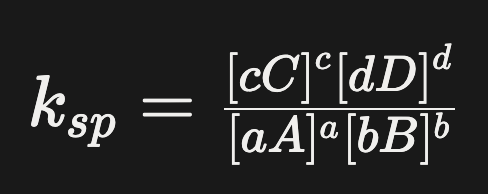
what is the activity of solids and water?
1
What is the formula for ionic strength?

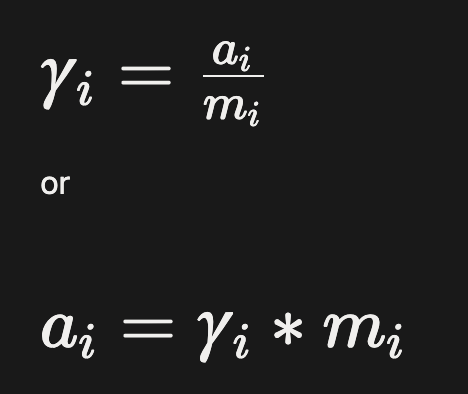
what is activity?
the effective concentration
What is another name for reaction quotient?
ion activity product (IAP)
What is the formula for IAP?

when does IAP = K
at equilibrium
what happens when Q/K is < 1
reaction shifts right, producing more products and using more reactants
what happens when Q/K is > 1?
reaction shifts left, turning products back into reactants
how is activity different from concentration?
activity is how much of the concentration actually reacts whereas concentration is how much total reactant or product is involved.
what is the ion activity coefficient equation
what is an aqueous complex
a dissolved species formed from 2 or more simpler species, each of which can exist in aqueous solution
what kinds of ions are aqueous complexes common with?
highly charged metal ions
What happens to the ions involved in aqueous complexes?
They’re removed from play, not available for reaction
What kind of bonding are aqueous complexes often involved in?
covalent
How is the order of a reaction determined?
it’s determined experimentally by plotting rate of change of reaction over time.
zeroth order
reaction rate is independent of the concentration of the reactant
1st order
reaction rate is directly proportional to the concentration of a reactant
2nd order
reaction is proportional to the square of the concentration of a reactant
what are factors influencing reaction rates?
homogeneous vs. heterogenous reactions, sub-steps and rare limiting processes, decrystallization (dissolution), diffusion, presence/absence of nucleation particles, inhibitors, capture of ions by complexes or chelates.
how can you assume rapid or slow equilibrium in natural systems?
through the comparison of half-lives of various reactions and residence times of water in different reservoirs
When do we need equilibrium models vs kinetic models?
an equilibrium model when you want to find the theoretical limits or final state of a system, and a kinetic model when you need to know how fast things happen or the path a system takes to get there
bronsted-lowry acid
proton donor
bronsted-lowry base
proton acceptor
what are the characteristics of strong acids?
they dissociate completely and have large Ka values
what is the pH range of natural waters
6 - 8.5
what is alkalinity?
the capacity of a water sample to accept protons and resist decreases in pH
what is acidity?
the capacity of a water sample to donate protons, neutralized OH-, and resist increases in pH
what is a buffer?
a solution with components that act to resist pH change when protons of hydroxyls are added
where is the highest buffering capacity?
when the pH and pKa are equal
what provides the bulk of the activity in most waters?
carbonate species
what happens when 𝚫G is negative
the reaction is spontaneous in the forward direction
what happens when 𝚫G is positive?
reaction proceeds toward reactants, reverse direction
what happens when 𝚫G is at 0?
indicates reaction is at equilibrium
unstable system
little or no disturbance is needed for the system to move toward lower energy conditions
metastable
locally stable, but given some activation energy, it will proceed to a lower energy state
stable
system is at lowest possible energy state (for the system)