Control of the heart rate.
 Call Kai
 Learn
 Practice Test
 Spaced Repetition
 Match
 Flashcards
 Knowt Play
1/13

Earn XP
Description and Tags
https://www.youtube.com/watch?v=uzUo3LwdCxY
14 Terms
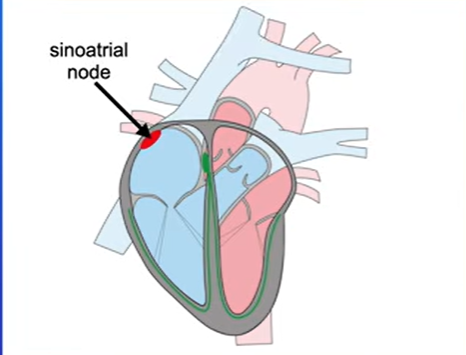
Why is the heart muscle myogenic
It triggers its own heart beat, initiated by the sinoatrial node in the right atrium (pacemaker)
Cells in sinoatrial node depolarise , triggering heart muscle to contract.
Avg heart rate is 70 bpm
What does sympathetic nervous system do in the autonomic nervous system
Triggers heart rate to increase
What does parasympathetic nervous system do in the autonomic nervous system
Triggers heart rate to decrease.
What does medulla oblongata do
Controls heart rate.
What is the accelerator nerve in the medulla oblongata
One centre in medulla oblongata increases heart rate via sympathetic nervous system]
This centre sends impulses to the sinoatrial node viathe accelerator nerve.
What is the vagus nerve in the medulla oblongata
The other centre in medulla oblongata decreases the heart rate via the parasympathetic nervous system.
This centre sends impulses via the vagus nerve, both the accelerator nerve and vagus nerve are motor neurones.
What does heart rate increasing / decreasing depend on
The blood pressure and the concentration of carbon dioxide in the blood
These two parameters are monitored by receptors which are found in blood vessels, and the receptors send info to medulla oblongata.
How is level of co2 in blood monitored
By chemoreceptors.
They are found in the aorta, and also in the carotid arteries which deliver blood to the brain.
They are also found in medulla oblongata.
Chemoreceptors monitor the pH of the blood rather than the actual concentration of co2
How is pH of blood decreased
Carbon dioxide dissolves in water in blood, which forms carbonic acid.
So if there is alot of carbon dioxide, more carbonic acid is formed which causes pH to decrease.
What happens during exercise
More co2 is produced in the blood, which decreases the pH of blood.
Chemoreceptors detect the decrease in blood pH, and increase frequency of impulses sent to SAN along accelerator nerve via sympathetic nervous system
The SAN then increases HR , and increases blood flow to remove CO2 faster,
CO2 levels return to normal.
What happens when blood pH is too high
Once high pH level is detected , an impulse is sent along sensory neurones to the centre to increase heart rate,
This impulse is sent along the sympathetic accelerator nerve, and causes acetyl chline to be release and bind to SAN.
The HR then increases and pH returns to normal.
What do baroreceptors do
If blood pressure changes, it is then detected by baroreceptors.
Baroreceptors are found in the walls of the aorta and the carotid arteries.
What happens when blood pressure is too high
High bp is detected, impulse is sent along sensory neurones to centre to decrease HR,
This impulse is sent along parasympathetic vagus nerves, and acetyl choline is released which binds to receptors on the SAN.
The HR then decreases and BP returns to normal
What happens when blood pressure is too low
Low BP detected, and an impulse is sent along sensory neurones to the centre to increase HR.
The impulse is then sent along the sympathetic accelerator nerve, and noradrenaline is released and binds to receptors on the SAN.
The HR then increases and BP is returned to normal