Herpetology Practical 2- Squamata
 Call Kai
 Learn
Learn Practice Test
 Spaced Repetition
 Match
Match Flashcards
 Knowt Play
1/72

Earn XP
Description and Tags
Name | Mastery | Learn | Test | Matching | Spaced | Call with Kai | Chat |
|---|
No analytics yet
Send a link to your students to track their progress
73 Terms
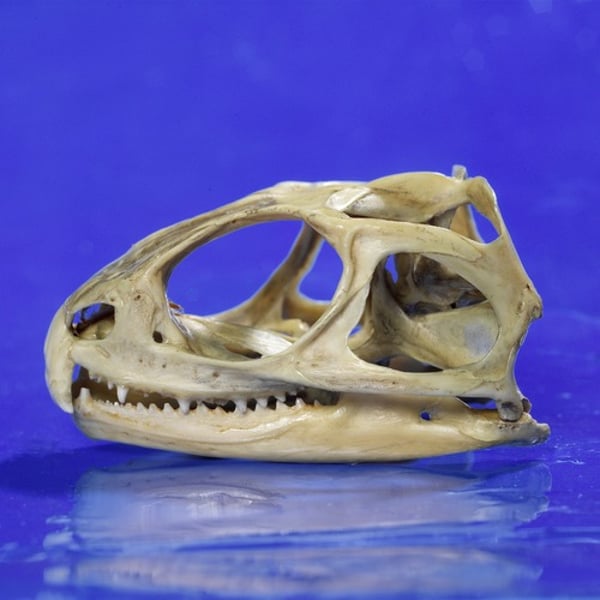
Sphenodon punctatus (Tuatara)
Lizard-like reptile that is sister to Squamata. Unique chisel-
shaped upper jaw overhanging the lower jaw. Erect spines down mid-dorsum and onto tail.
Rudimentary hemipenes, no tympanum. Historically native to New Zealand, now restricted to 30
islands off the coast of NZ and in the Cook Strait. Two species still recognized by some,
molecular evidence only supports recognition of S. punctatus. Skull replica.
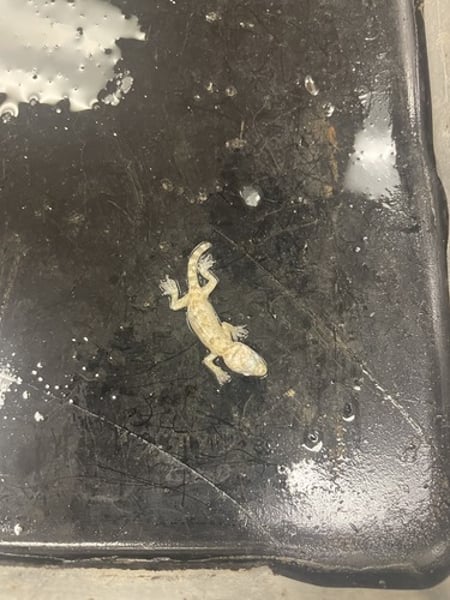
Hemidactylus turcicus (Mediterranean Gecko)
Gekkonidae
Native to the eastern Hemisphere, introduced
globally including most of GA. Identifying characteristics as per family and digits dilated
throughout length, with toe pad lamellae that form these dilations more or less divided into two rows, toes with distinct claws.
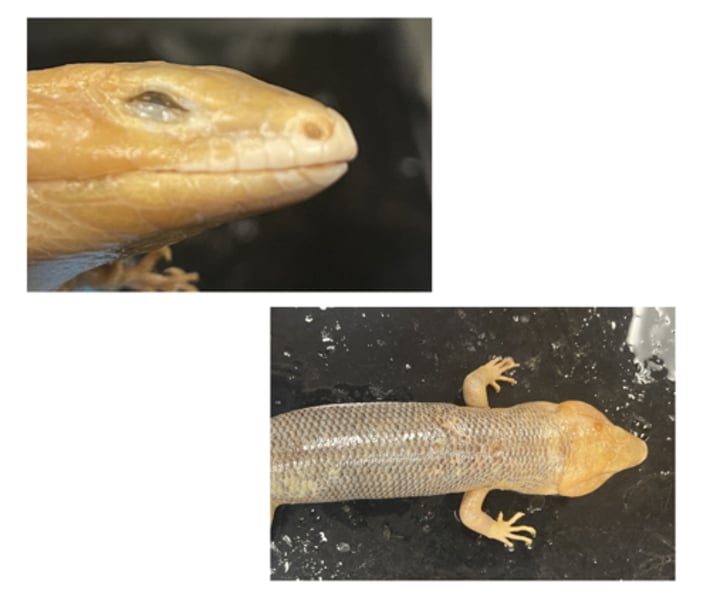
Plestiodon laticeps (Broadhead skink)
Scincidae
Acontiinae
Note that this genus was formerly included in the genus
Eumeces, which is now restricted to North Africa and western Asia. Distribution: Wide ranging
in south central and eastern North America, from E Texas to Florida, N to New Jersey. Sexually
dimporphic species with males being larger than females, and often with wider heads exhibiting
a red-orange color. Closely resembles other Plestiodon in GA (especially juveniles), including P.
fasciatus inexpectatus – P. laticeps possesses five labial scales, while fasciatus possesses four.
Inexpectatus has equally sized scale rows encircling the entire tail, while both laticeps and
fasciatus have a single wider row on the ventral portion of the tail
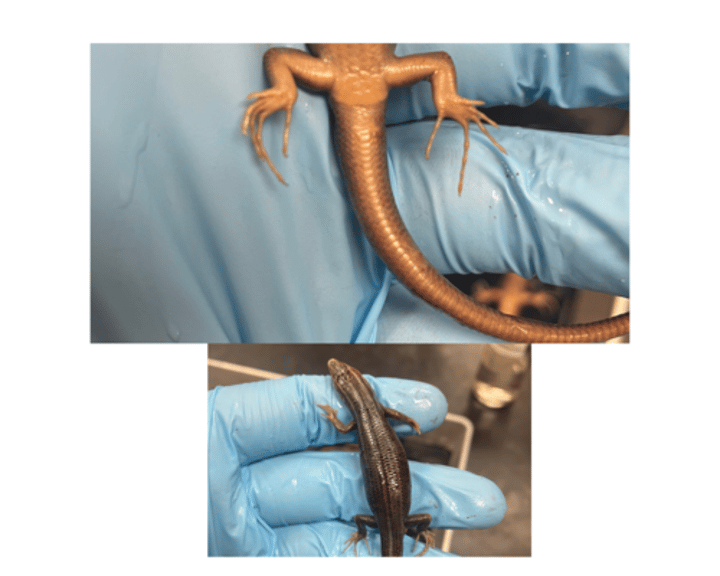
Plestiodon fasciatus (Five-lined skink)
Scincidae
Acontiinae
Distribution: Widespread from south central to southeastern North America, N to southern Ontario. Juveniles exhibit bright blue tail and prominent yellow or white parallel striping along dorsum. As with most Plestiodon, the tail color fades with age and the striping often becomes less prominent. Generally attain smaller adult body size that P. laticeps, confident ID still requires capture and careful inspection of labial scales and ventral scale rows on tail.
Plestiodon inexpectatus (Southeastern five-lined skink)
Scincidae
Acontiinae
Distribution: E Louisiana to Florida, N to Virginia. Morphologically similar to fasciatus as juveniles and adults, distinguished by presence of equally sized scale rows encircling the entire tail. In GA, they are often more closely associated with drier upland habitats than fasciatus, although it is not uncommon to find them cooccurring.
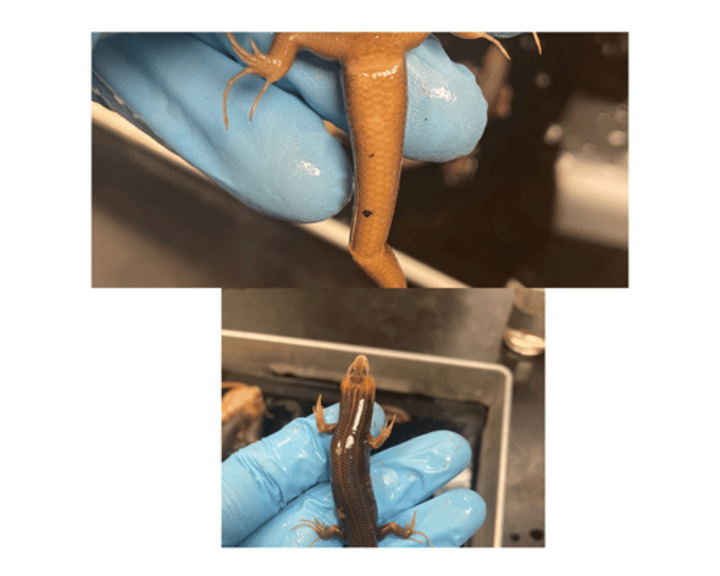
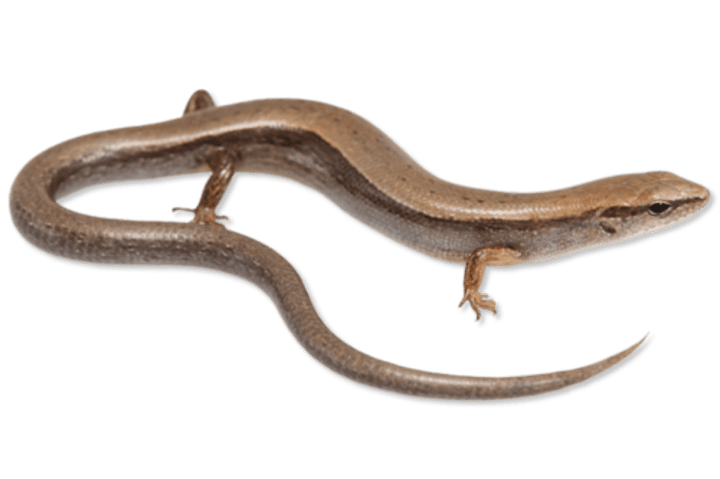
Scincella lateralis (Ground Skink/Little Brown Skink)
Scincidae
Acontiinae
Distribution: Central Texas to Florida, N to New Jersey, S to Durango and Coahuila MX. Elongated body with reduced limbs, relatively long tail. Uniformly brown or bronze dorsal coloration with dark shading or stripes on sides. Characterized and quickly distinguished from Plestiodon by much smaller adult body sizes (up to 15 cm, total length)
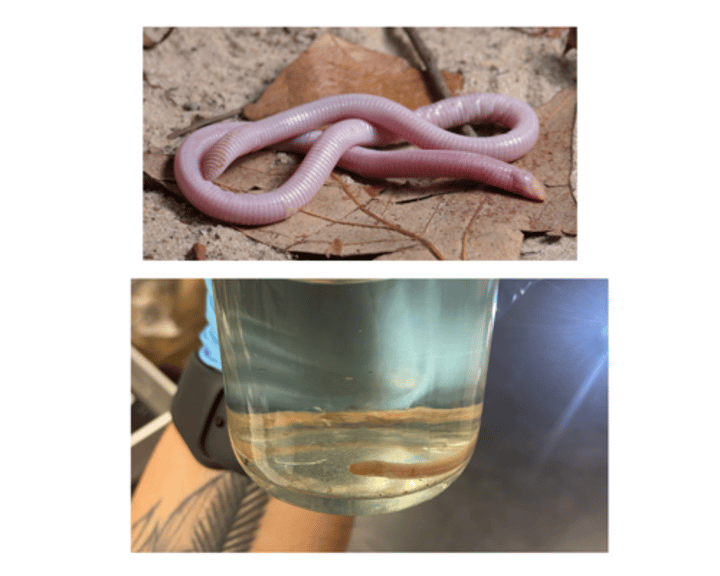
Rhineura floridana (Florida Worm Lizard)
Rhineuridae
Distribution: As for family. Identifying characteristics: as for family – juveniles lack the calloused upper surface of the tail that is exhibited by adults. Completely fossorial/subterranean; rarely encountered. Only two specimens confirmed from GA.
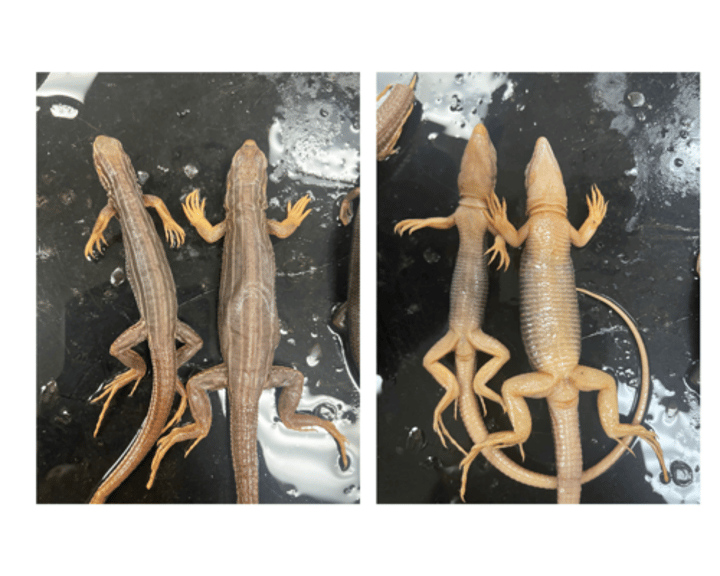
Aspidoscelis sexlineatus (Six-Lined Racerunner)
Teiidae
Distribution: Huge range including most of US E of New Mexico and South Dakota, excluding most of the NE. S to N MX. Formerly included in the genus Cnemidophorus, which is now restricted to a few South American
species. Identifying characteristics: as per family, plus gular scutes not
or scarcely enlarged compared to lateral gular scales, ventral scales
rectangular, in 8 longitudinal rows; dorsal body scales granular rather than smooth and shiny in Scincidae, preanal scales more than one, head scales not equal in size.
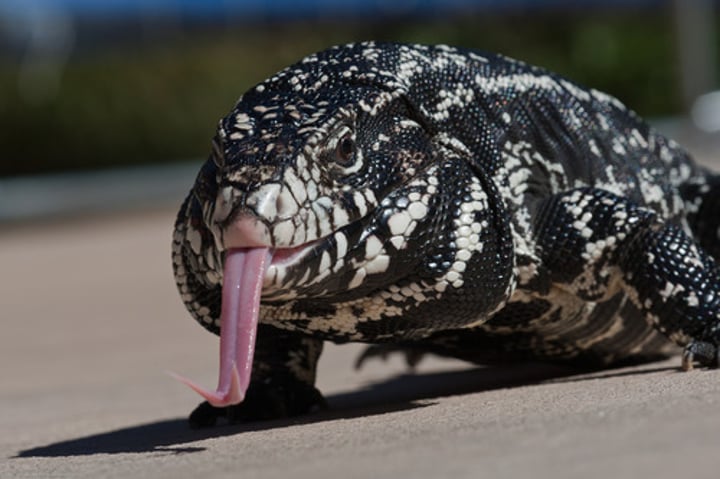
Salvator merianae (Black and White Tegu)
Teiidae
Distribution: Eastern South America from Northern Argentina through NE Brazil; mostly coastal but inland to Bolivia and central Argentina and Brazil. Generalist omnivore that is an established invasive throughout Florida and parts of coastal Georgia. Conservation priority in these invasive regions, in part by their propensity for nest predation on threatened native taxa like Crocodylus acutus and Gopherus polyphemus. NO SPECIMENS.
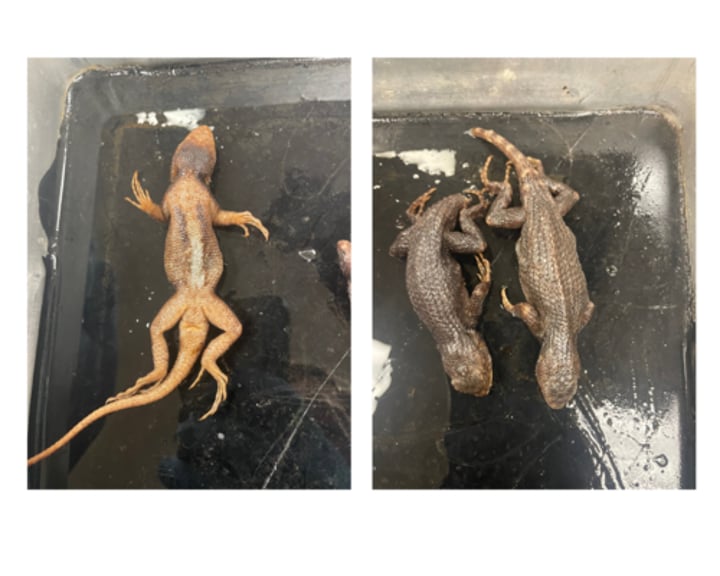
Sceloporus undulatus (Eastern fence lizard)
Phrynosomatidae
Distribution: Identifying characteristics: 4 - 7.25 in (10 - 18.5 cm). As a member of the spiny lizard family, the Fence lizard is the only lizard native to Georgia and South Carolina that has rough scales. Fence lizards are most commonly grayish in color, but may range from nearly black to brown. Females often have black horizontal patterning on their back, while during the breeding season, males have bright blue patches on their chin and underside.
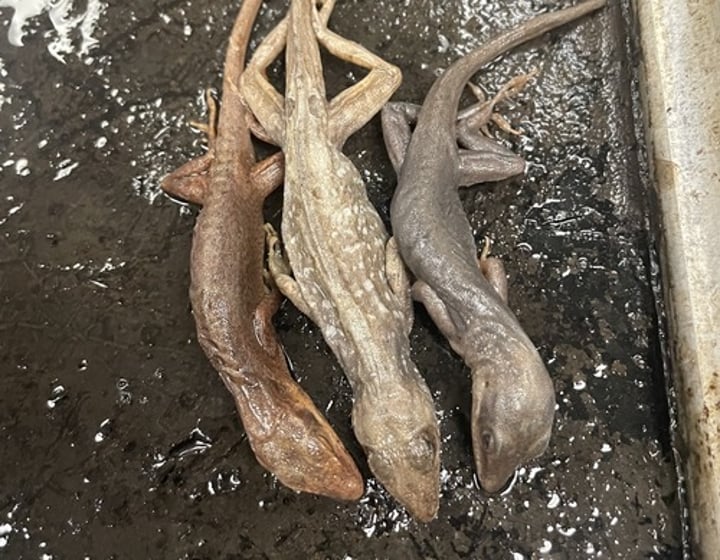
Anolis carolinensis (Green Anole)
Dactyloidae
Distribution: E Texas to Florida, N to Tennessee, S to Tamaulipas MX. Identifying characteristics: as per family plus subdigital lamellae expanded into
distinct toepads under penultimate (next to last) phalanges, similar to gecko toes; scales around body not of equal size; ventral scales not arranged in quadrangular rows; well‐developed throat fan (dewlap) present in males; head scales not of equal size; moveable eyelids present. Exhibits dramatic polychromatism, often rapidly shifting between green or brown dorsal coloration for crypsis, thermoregulation, and behavioral displays.
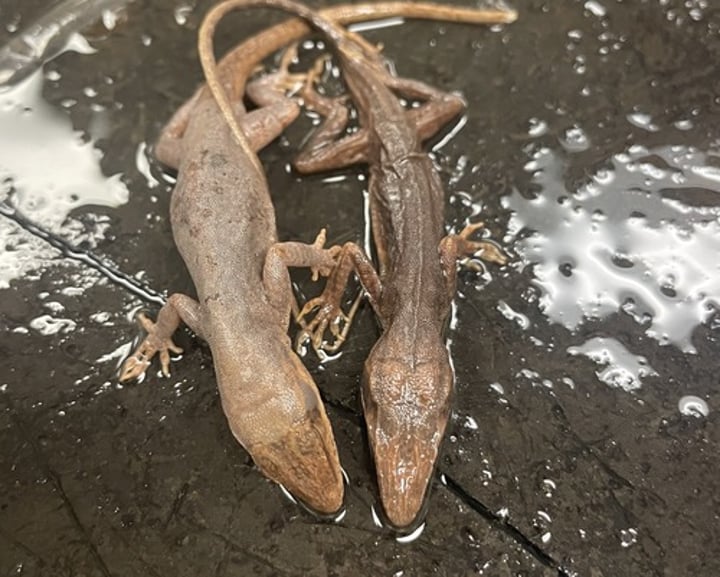
Anolis sagrei (Brown Anole)
Dactyloidae
Distribution: Native to the Caribbean, introduced throughout the southeast several decades ago – established through Florida and the extreme southern coastal regions of Georgia. Identifying characteristics: 12 - 21 cm in length. Brown to grayish in color, generally with whitish or yellowish patterning on the back. Males generally have an orange or red throat fan with a white edge. Although the brown anole has a shorter snout than the green anole (Anolis carolinensis), the two species are most easily distinguished by the Green Anole's green or lightly patterned brown coloration and by range.
Ophisaurus compressus (Island Glass Lizard)
Anguidae
Anguinae
Distribution: Coastal South Carolina and Georgia, throughout Florida. Identifying characteristics: 38 - 61 cm. Long, slender, legless lizards that superficially resemble snakes. They differ from snakes, though, in that they have moveable eyelids, external ear openings, inflexible jaws, and a prominent ventrolateral skin fold. Although generally smaller than the more common Eastern and Slender glass lizards, the Island Glass Lizard is also brown or yellowish in coloration. This species is best distinguished from other glass lizards by the presence of a single dark stripe down each side of the body, above the lateral groove, and, often, a dark dorsal stripe.
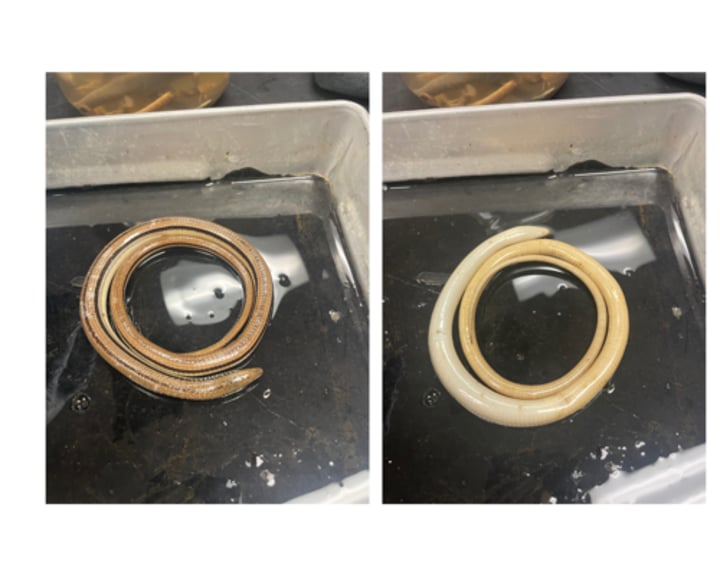
Ophisaurus ventralis (Eastern glass lizard)
Anguidae
Anguinae
Distribution: Widespread in the SE, but most common in coastal plains of Louisiana, Alabama, Georgia, and the Carolinas; throughout Florida. Identifying characteristics: 46 - 108 cm. The eastern glass lizard is the longest and heaviest glass lizard in the SE and is generally light brown or yellowish to greenish in coloration. This species is best distinguished from other glass lizards by the absence of a dark dorsal stripe in adults or dark markings below the ventrolateral fold and the presence of several vertical whitish bars just behind the head. Older individuals are less boldly patterned than younger individuals, often developing a greenish or speckled coloration.
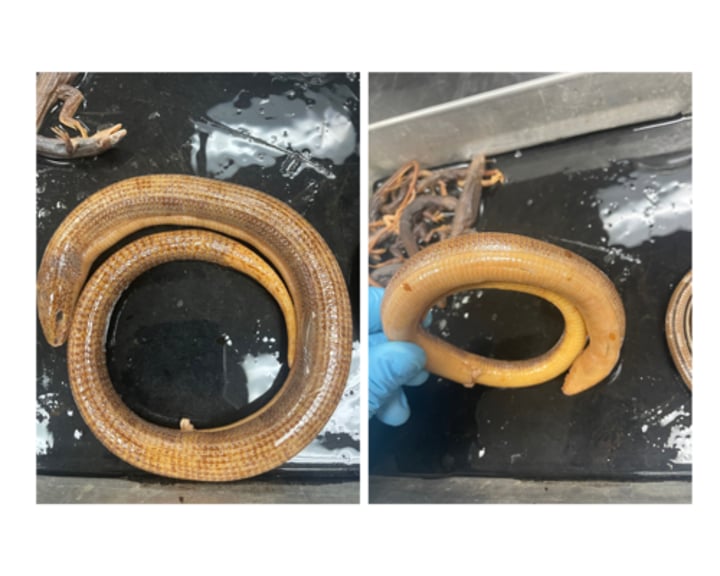
Gerrhonotus infernalis (Texas Alligator Lizard)
Anguidae
Gerrhonotinae
Distribution: Central and W Texas to N MX. Identifying characteristics: 61 to 64 cm. Possesses a flat, wedge-shaped head. Elongated body but with four well-developed limbs (as in all Gerrhonotinae reps). Its body is generally a yellow-brown color, often with darker brown and white checker patterning on its dorsal surfaces, and uniformly light-colored, white, or grey on its ventral surfaces. Its scales are very stiff and plate-like. Tail autotomy present, but often not as easily stimulated as in Anguinae representatives.
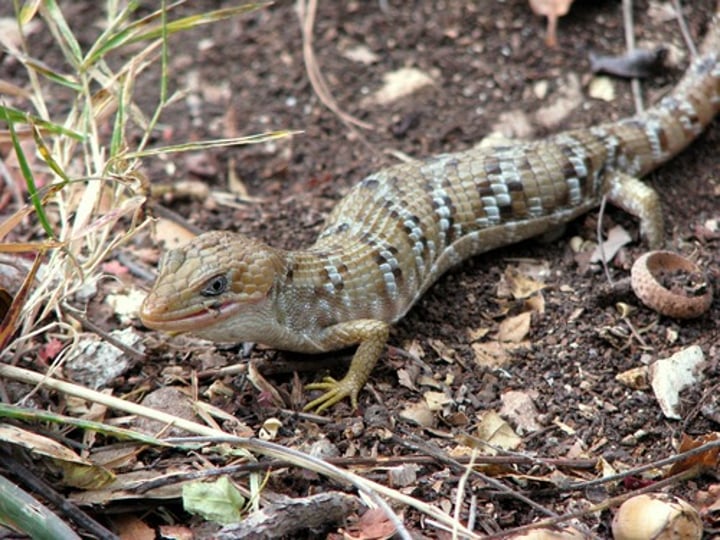
Indotyphlops braminus (Brahminy Blind Snake)
Typhlopidae
Native to SE Asia, parthenogenic species that has been introduced throughout tropical and subtropical regions of the world; occasional temperate records, established in Florida. Identifying characteristics: as for family; nasal shield completely divided; 20 scale rows throughout the body, rostral narrow, single postocular, poorly developed eye or eyespot, prominent cephalic glands forming lines beneath the head shields, and small size (to 20 cm).
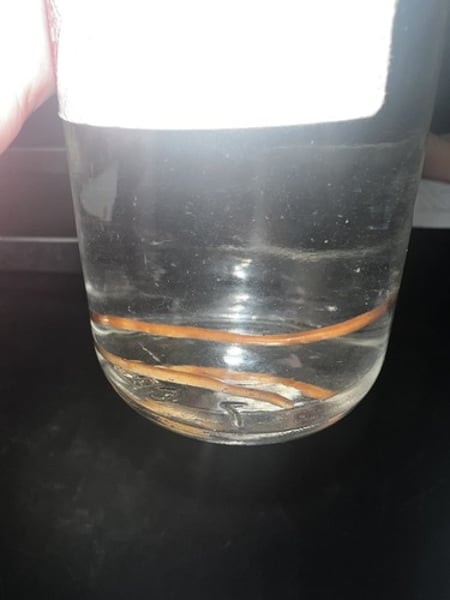
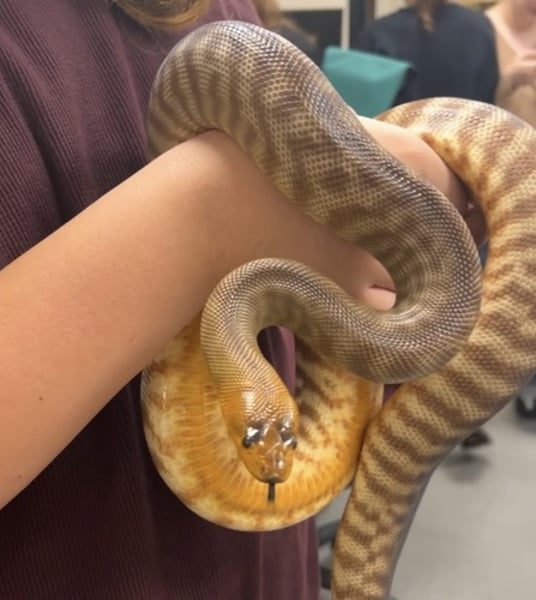
Aspidites ramsayi (Woma Python)
Pythonidae
Sub-Saharan Africa through SE Asia to Indonesia. Distribution: Endemic to Australia. Moderately sized (1.5 m SVL) as adults. The dorsal scales are small and unkeeled, with 50-65 rows at midbody. The ventral scales are 280-315 in number, with an undivided anal plate, and 40-45 mostly single (undivided) subcaudal scales. Some of the posterior subcaudals may be irregularly divided. Dorsal color is typically pale brown with prominent or faded banding that terminates before the ventral surface. The belly is cream or light yellow, occassionally with brown and pink blotches. The scales around the eyes are usually a darker color than the rest of the head, which can be olive, brown, or orange in color. Aspidites lack the heat sensing facial pits present in other Pythonidae representatives. Live Specimen.
Wilmaaaa MY BABY
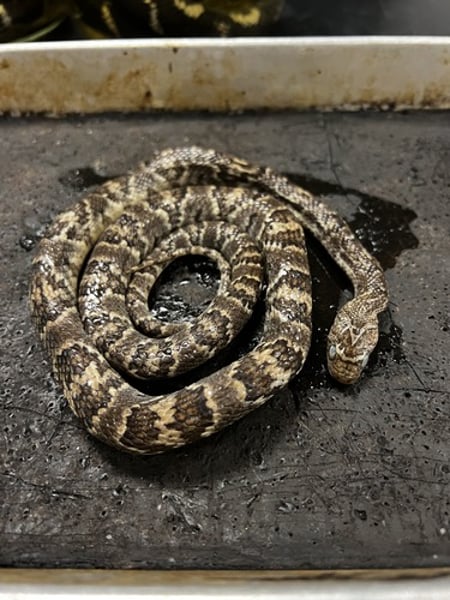
Trimorphodon lambda (Sonoran Lyre snake)
Colubridae
Sonoran Desert of New Mexico, Arizona, California, Nevada, and Utah. Identifying Characteristics: Mid-sized (61-91 cm) and slender snake with distinctly wide head. Mildly venomous species with some local swelling, blistering, and nausea reported from bites. Largely nocturnal inhabitants of rocky hillsides where they actively search crevices for sleeping lizard prey. Large eyes with vertical pupils when not dilated, anal plate is divided. Dorsal coloration varies from gray to light brown. Approximately 28 large dorsal blotches with light edges and a pale crossbar in the center, with smaller irregular blotches on the lower sides. A lyre-shaped (small U-shaped harp instrument) marking is present on top of the head. The underside is off-white or yellowish with dark spots.
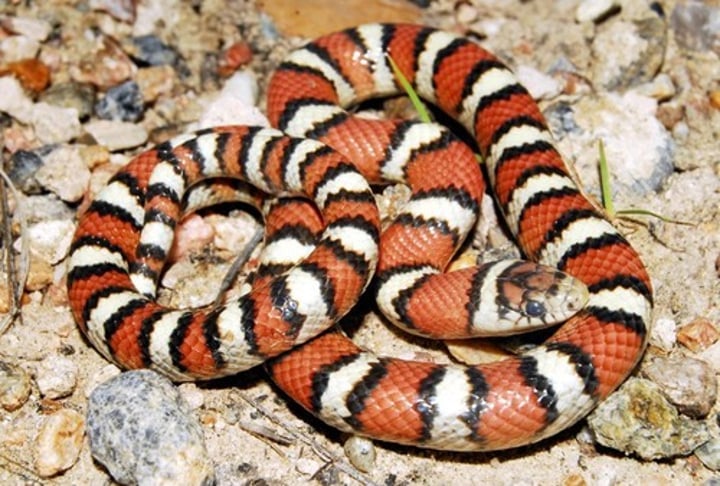
Lampropeltis gentilis (Western Milk Snake)
Colubridae
Western USA, north to Montana and south into northern Mexico. Identifying Characteristics: mid-sized snakes up to 100 cm with smooth scales, single anal plate, and alternating bands of red, black, and white or yellow. Banding extends onto ventral surface. Most strongly associated with grassland habitats, but scattered populations occur in desert montane situations and arid desert scrub. Live Specimen.
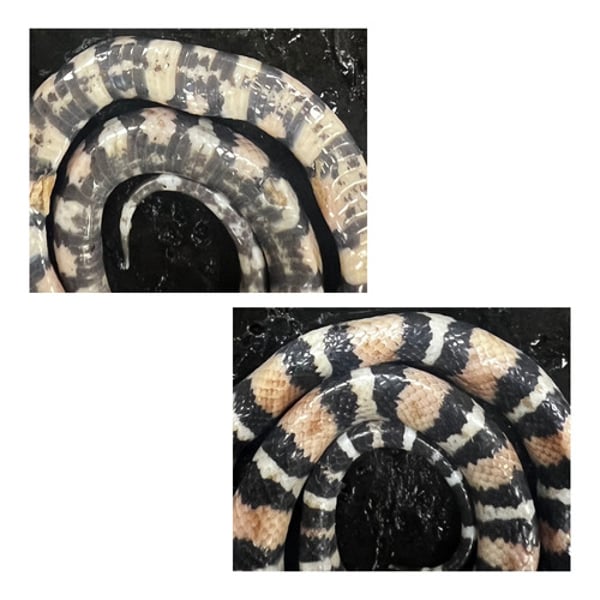
Lampropeltis elapsoides (Scarlet Kingsnake)
Colubridae
Largely restricted to the coastal plain of the southeast, with some piedmont populations. Identifying Characteristics: Small (31-54 cm) snakes with smooth scales, single anal plate, alternating bands of red, black, and white/yellow in which red is adjacent to the black bands. In Cemophora coccinea, the bands/saddles across the back do not extend across the belly, and the rostrum is typically more pointed than in L. elapsoides. Rarely encountered on the surface – can be found under tree bark, rocks, and rotting logs.
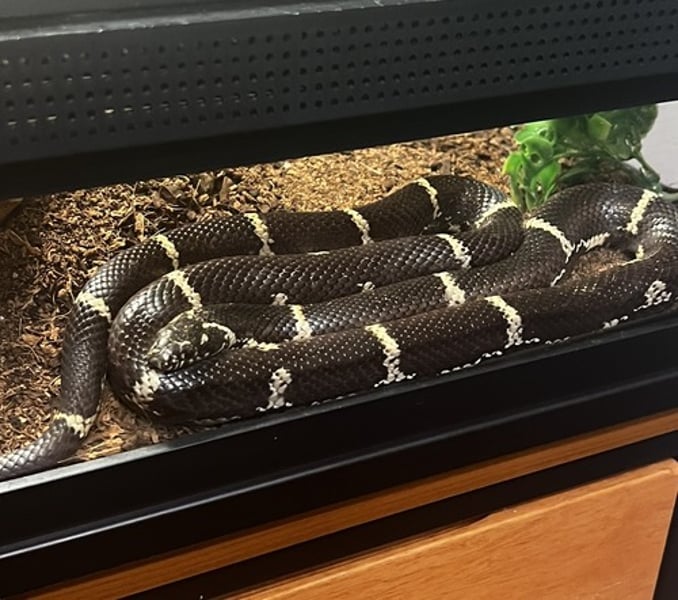
Lampropeltis getula (Eastern Kingsnake)
Colubridae
East coast including much of the coastal plain from Florida to New Jersey, extends into Piedmont and Appalachian foothills. Large (90-122 cm) snake with smooth scales, single anal plate, and shiny-black snakes with white or yellow “chain-link” bands that cross the dorsum and connect along the sides. Individuals from the Coastal Plain tend to have wide rings encircling the body while those from the mountains may have very thin bands or can be nearly completely black. Eastern kingsnakes have a short stout head and relatively small eyes for their body size. Powerful constrictors that are generalist in diet, but frequently consume other large snake species, including several native Crotalinae representatives. Preserved and Live Specimens.
Hehe, my baby chai
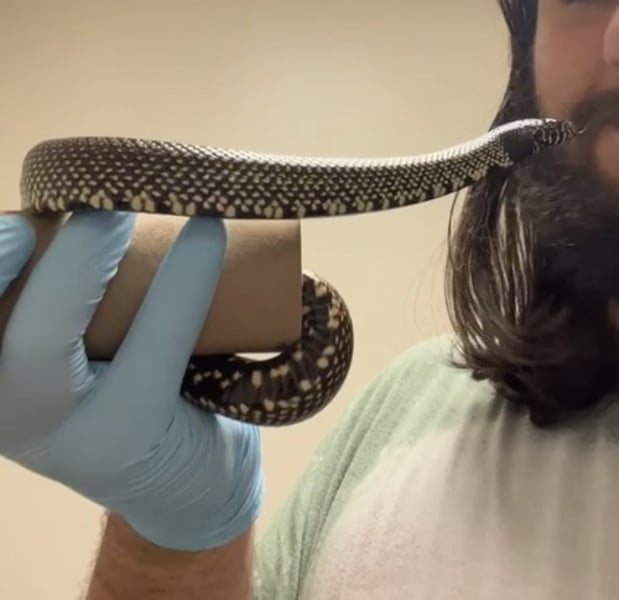
Lampropeltis splendida (Desert Kingsnake)
Colubridae
East coast including much of the coastal plain from Florida to New Jersey, extends into Piedmont and Appalachian foothills. Large (90-122 cm) snake with smooth scales, single anal plate, and shiny-black snakes with white or yellow “chain-link” bands that cross the dorsum and connect along the sides. Individuals from the Coastal Plain tend to have wide rings encircling the body while those from the mountains may have very thin bands or can be nearly completely black. Eastern kingsnakes have a short stout head and relatively small eyes for their body size. Powerful constrictors that are generalist in diet, but frequently consume other large snake species, including several native Crotalinae representatives. Preserved and Live Specimens.
Tavo :)
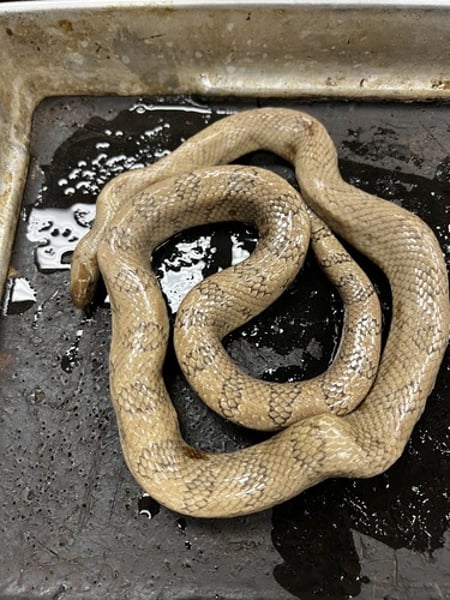
Lampropeltis rhombomaculata (Mole Kingsnake)
Colubridae
Throughout piedmont forests of the Mid-Atlantic States but are absent from mountainous regions of the Appalachians, most of Florida, and the Deep South. Identifying Characteristics: Mid-sized snakes (80-105 cm) that are rarely encountered on the surface. Smooth scales, single anal plate, and usually with light/dark brown to reddish dorsal color with a row of reddish-brown elliptical spots/blotches down the entire length of the dorsum. This pattern, though, often fades with age and older specimens can have no pattern at all. Their ventral surface is usually whitish or yellowish with red, gray, or brown mottling. Preserved and Live Specimens.
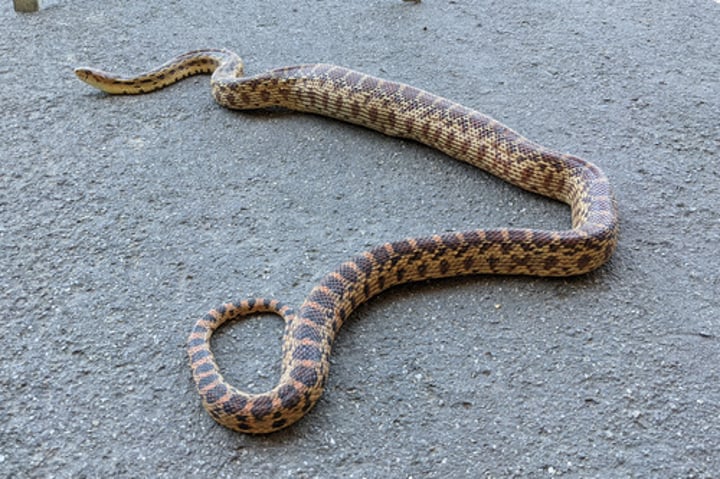
Pituophis catenifer (Gopher snake or Bull Snake)
Colubridae
Central and western North America, with some midwestern populations, extending south to northern and central Mexico, and North to southern Canada (records as far N as Calgary!). Large snakes with adult lengths frequently exceeding two meters (to 275 mm). Dorsum color and pattern is geographically variable and can be predominantly cream, yellow, tan, red, or brown with a series of dorsal and lateral blotches. These blotches transition into bands near the tail, and can range from 6-36 in number. Four prefrontal scales with an enlarged rostral scale on the tip of the nose. A dark bar typically extends downward from the eye to the supralabials, and a second dark bar from the eye laterally to the posterior corner of the mouth. Supralabials often possess dark barring, as well. Live Specimen.
Rose :) Not really her tho :(
Coluber constrictor (Racer)
Colubridae
Black Racers are found along the east coast from Maine to Florida (including all subspecies the distribution encompasses most of North America. Identifying Characteristics: Fairly large (up to 152 cm) and slender, solid black snakes. Smooth scales, large eyes, and white coloration under the chin. The ventral surface is generally uniformly dark gray or black. Adult racers can be mistaken for any of the other large black snakes present in the southeast, including Eastern Rat Snakes (wherein black phenotypes are generally restricted to the Piedmont and Mountains), black morphotype for the Eastern Hognose Snakes, Eastern K kingsnakes, or dark Coachwhips. However, black racers are generally more slender and uniformly black than those species. Additionally, racers lack the upturned nose of hognose snakes and keeled scales of hognose and rat snakes. Racers usually flee rapidly when encountered, unlike most other species that freeze and rely on crypsis. Young racers are generally tan or grayish with a series of brown or reddish blotches running down the center of the back. These blotches are more rounded (less square) than those of young rat snakes and water snakes. Additionally, young racers are more slender and have larger eyes than juveniles of most other colubrids in the southeast.
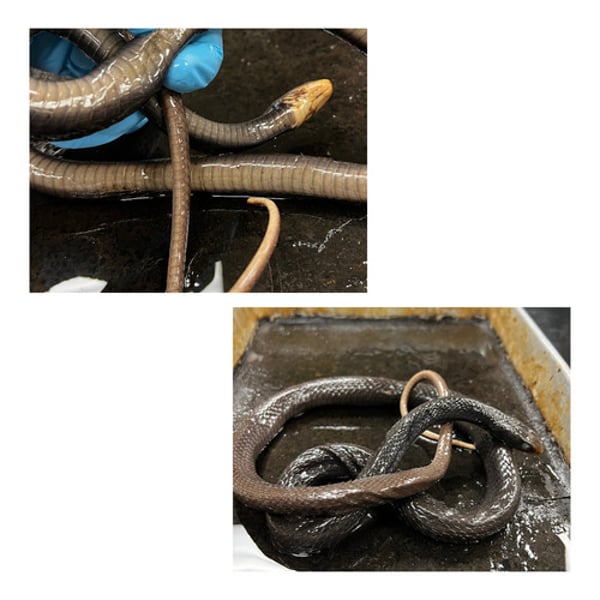
Carphophis amoenus (Worm Snake)
Colubridae
Eastern USA from New England to Goergia and west to the Mississippi River (replaced by C. vermis W of the Mississippi). Identifying Characteristics: very small (33.5 cm) uniformly brown or gray snakes with smooth shiny scales, tiny eyes, and a pointed tail tip. Ventral surface is pink to pale white below. The ventral coloration can often extend slightly onto the dorsal sides of the body. Fossorial species with subtle dorsoventral compression of head for burrowing lifestyle.
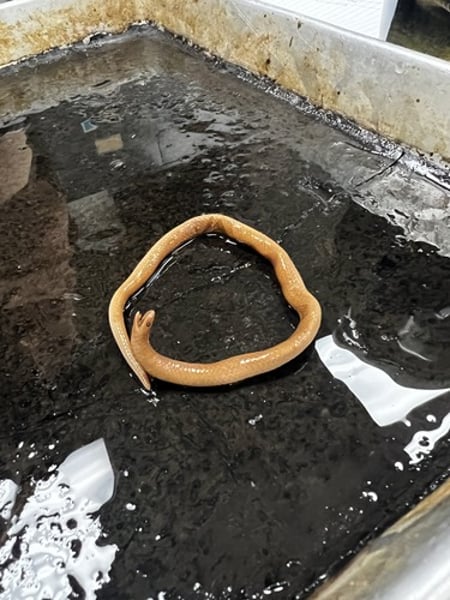
Cemophora coccinea (Scarlet Snake)
Colubridae
New Jersey south to Florida and west to Oklahoma. Identifying Characteristics: Fairly small (up to 51 cm) and relatively slender snakes that are patterned with alternating red, black, and white or yellow saddles (seemingly bands). Scarlet snakes are one of the three "tricolored" snakes in the southeast; like the scarlet kingsnake, red bands/saddles are not adjacent to the yellow bands/saddles. Distinguished from the scarlet kingsnake because the L. elapsoides has bands that completely or nearly encircle the body while the saddles of the scarlet snake do not extend onto the venter, leaving the underside solid white, pink, or grayish. The venomous eastern coral snake has a black snout and red bands that touch yellow ones. Scarlet snakes generally have a snout that is pointed and red and with red saddles that are much wider than those of other colors. Diet consists mostly of squamate eggs.
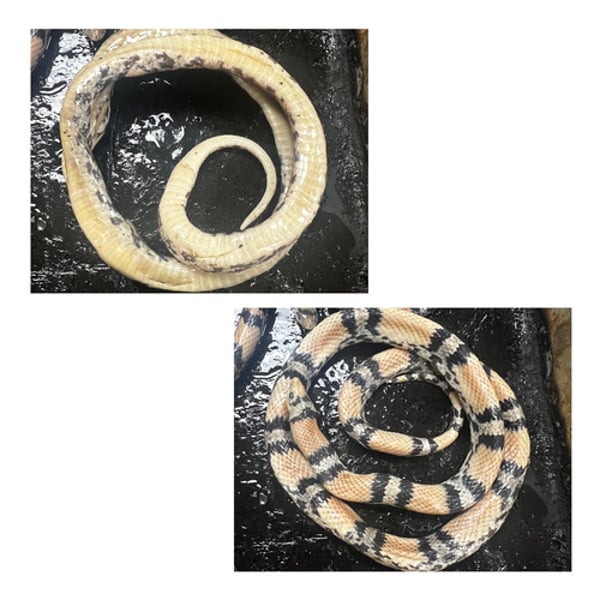
Senticolis triaspis (Green Rat Snake)
Colubridae
New Jersey south to Florida and west to Oklahoma. Identifying Characteristics: Fairly small (up to 51 cm) and relatively slender snakes that are patterned with alternating red, black, and white or yellow saddles (seemingly bands). Scarlet snakes are one of the three "tricolored" snakes in the southeast; like the scarlet kingsnake, red bands/saddles are not adjacent to the yellow bands/saddles. Distinguished from the scarlet kingsnake because the L. elapsoides has bands that completely or nearly encircle the body while the saddles of the scarlet snake do not extend onto the venter, leaving the underside solid white, pink, or grayish. The venomous eastern coral snake has a black snout and red bands that touch yellow ones. Scarlet snakes generally have a snout that is pointed and red and with red saddles that are much wider than those of other colors. Diet consists mostly of squamate eggs.
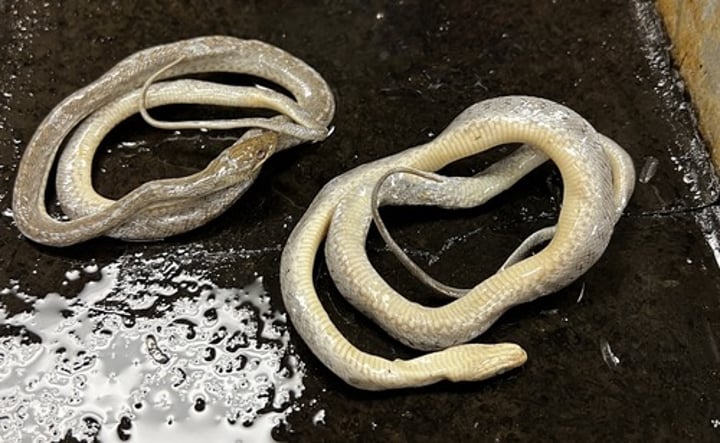
Pantherophis alleghaniensis (Eastern Rat Snake)
Colubridae
East of the Apalachicola River in Florida, east of the Chattohoochee River in Georgia, east of the Appalachian Mountains along east coast to northeast USA. Identifying Characteristics: Large (90-180) and slender snakes with partially arboreal habits. Highly variable across distribution – in Georgia, two prominent morphotypes exist (black and yellow). In Piedmont, most individuals are solid black in dorsal color, while those in the lower coastal plain are yellow with four dark longitudinal stripes. Ventral surface is white with frequent dark intrusions form dorsum. Juveniles are boldly patterned with dark blotches on light ground color – this tends to fade within a year or two. Prominent nest predators of eastern songbirds.
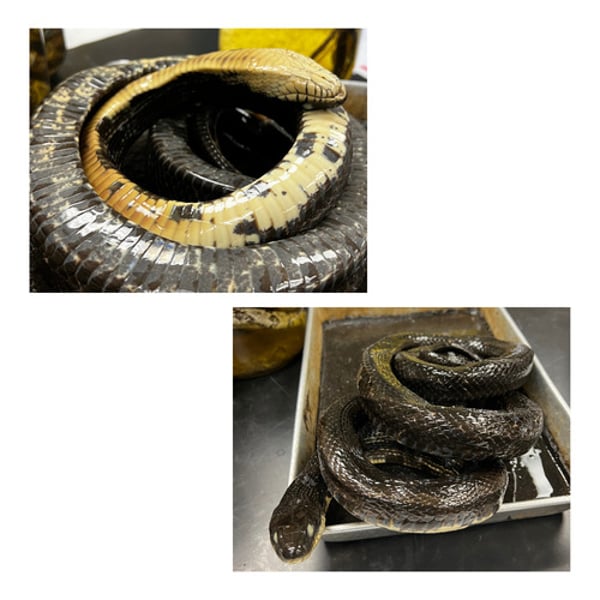
Pantherophis guttatus (Corn Snake)
Colubridae
Fairly large (76-122 cm) and relatively slender snakes that can be orange, reddish brown, brown, or gray with 27-40 squarish black-margined brown or reddish blotches. The belly is checkered with white and black markings, resembling a piano keyboard or “Indian corn”. Other distinguishing characteristics include a spear-shaped blotch on top of the head, pointing toward the nose, black stripes on either side of the bottom of the tail, smooth scales, and a stripe extending from the back of the eye past the corner of the jaw.
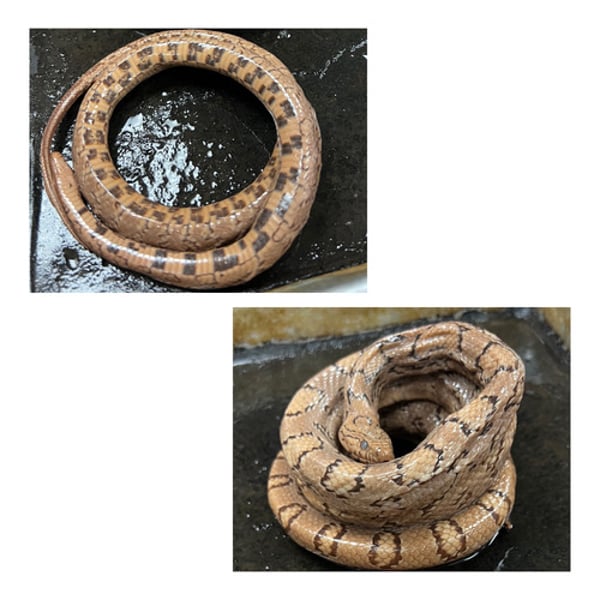
Masticophis flagellum (Coachwhip)
Colubridae
Widespread across southern USA. Identifying characteristics: Coachwhips are among the longest snakes in the SE, reaching over 244 cm. Their coloration is very distinctive, fading gradually from black on the head to tan or nearly white on the tail. The proportion of black to tan varies across our region and individuals in southern Georgia and Florida can be nearly completely tan. The pattern of scales on the tail resembles a braided whip, giving the snake its common name. Young coachwhips are very slender and completely tan with irregular darker bands and white markings on the head and neck. Coachwhips have large eyes and excellent vision.
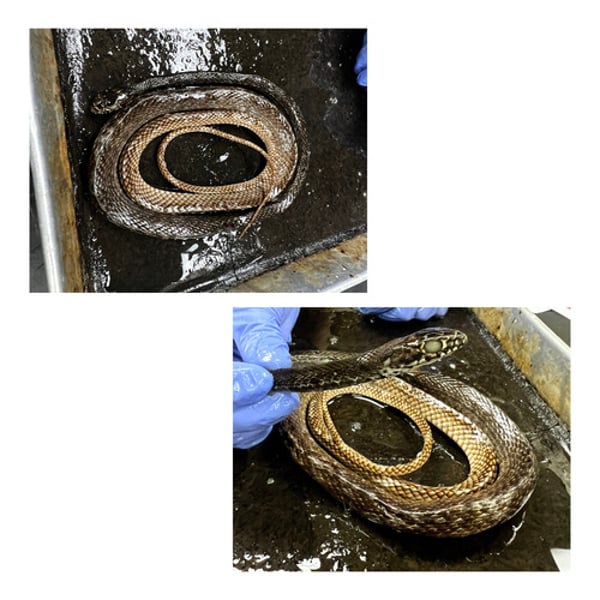
Opheodrys aestivus (Rough Green Snake)
Colubridae
Across southern USA. Identifying Characteristics: fairly long (81 cm), slender, bright green snakes with yellow or whitish bellies that spend much of their time climbing in vegetation. Their bright green color easily distinguishes them from all other snakes in the southeast but the similar Smooth Green Snake (O. vernalis) replaces this species in the Appalachian Mountains and the Northeast. Rough Green Snakes have keeled scales and large eyes. After death the color of green snakes fades to blue or black and dead individuals may resemble small black racers.
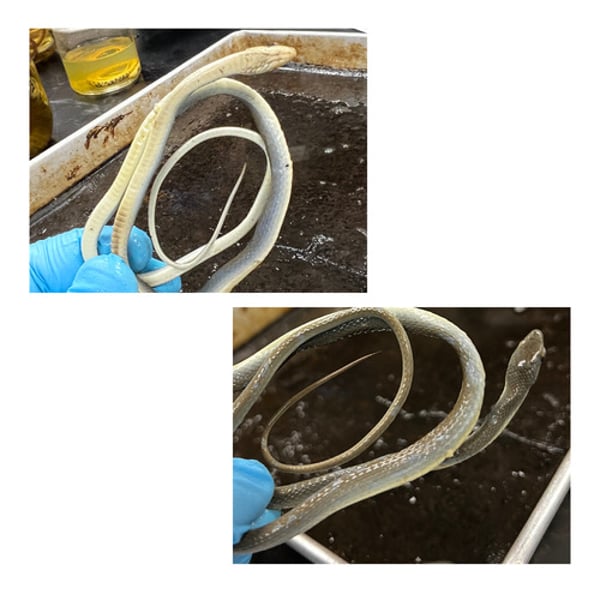
Storeria dekayi (Brown Snake)
Colubridae
Widespread through central and eastern US. Small (17-33 cm) snakes that are usually brown, but can be yellowish, reddish, or grayish-brown. Typically have two rows of dark spots, sometimes linked, along the back and a dark streak down the side of the head. The belly is light brown to white. A series of tiny black dots are often present along each side of the belly. The young have a yellowish collar going down the neck with a less evident dorsal pattern. This snake looks similar to earth snakes (Virginia sp.) but those species lack spots on the back and head. They can be distinguished from redbellied snakes (Storeria occipitomaculata) by their lack of red underside
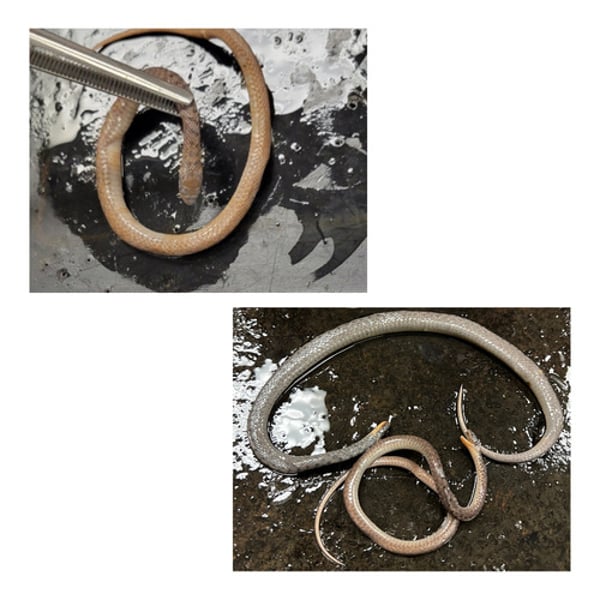
Storeria occipitomaculata (Red-bellied Snake)
Colubridae
Widespread through central and eastern US. Identifying Characteristics: Small (10 - 25 cm) woodland snake. Highly variable coloration, with some individuals ranging from bright orange to brown, gray, or nearly black. Occasionally individuals are found that are gray with a brown or orange stripe down the center of the back. Many individuals have a light brown ring behind the head. This species can easily be distinguished from all other small woodland snakes by their unmarked bright orange to red underside.
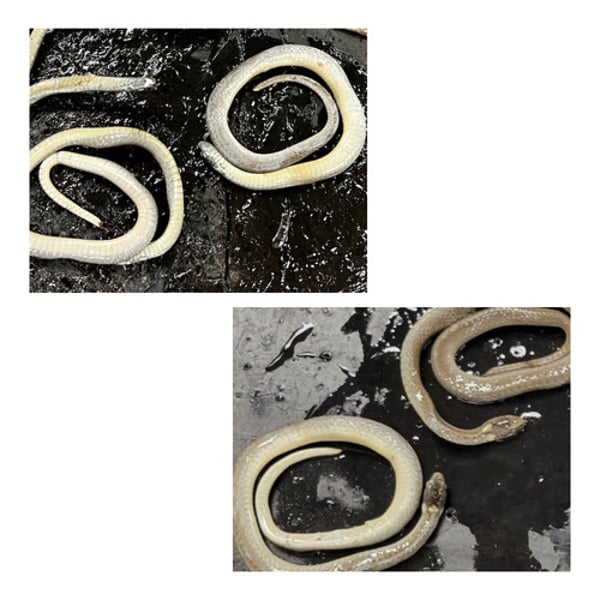
Virginia valeriae (Smooth Earth Snake)
Colubridae
Somewhat patchy distribution throughout central and eastern US. Identifying Characteristics: Smooth scales and a pointed snout. Most individuals have small black spots scattered on the back and sides. The belly is tan to whitish and is not sharply defined in color from the color of the sides (as in Carphophis amoenus and Storeria occipitomaculata). Smooth scales differentiate this species from the similar rough earth snake (Haldea striatula) and brown snakes (Storeria dekayi).
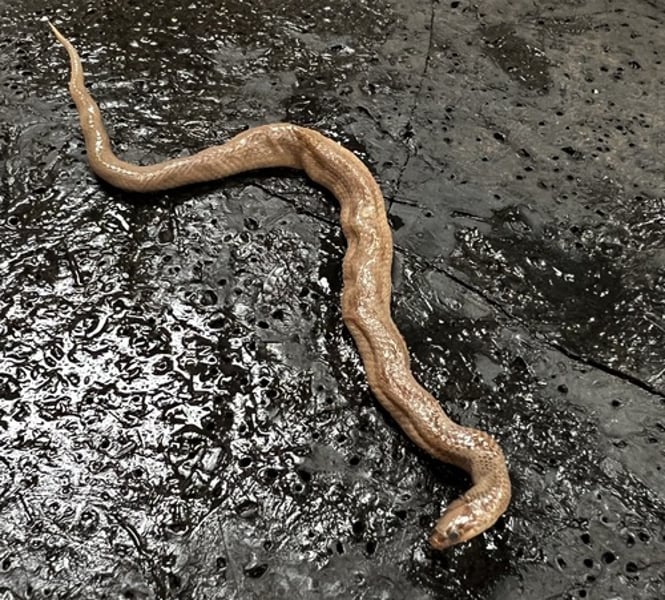
Haldea striatula (Rough Earth Snake)
Colubridae
small (18-25 cm) species with fairly slender brown to gray body with keeled scales and a pointed snout. The young are darker in coloration than the adults and may have a light band on the neck, which is sometimes lost as the species matures. The ventral surface is tan to whitish and is not sharply defined in color from the dorsum (as in Carphophis amoenus and Storeria occipitomaculata). Keeled scales differentiate this species from the similar smooth earth snake (Virginia valeriae) and worm snake. Brown Snakes (Storeria dekayi) possess dark spots and longitudinal stripes on the dorsum.
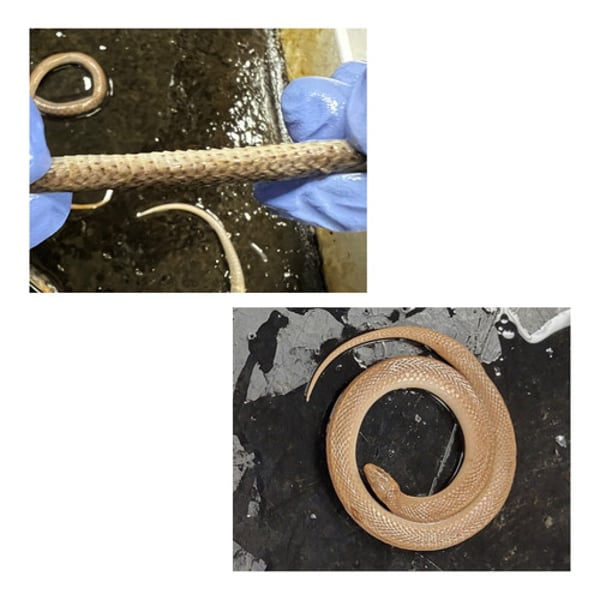
Tantilla coronata (Southeastern Crowned Snake)
Colubridae
Coastal Plain from the Florida panhandle north through Georgia (although absent from parts of southern Georgia) and into Kentucky and Virginia. Most common in coastal plain, but with patchy Piedmont populations. Identifying Characteristics: Small, slender snakes (13-24.5 cm). Adults are normally tan to brown with a black head and chin. A black band 3-5 scales wide can be seen on the neck. The belly is uniform white, yellow, or pinkish. The scales are smooth, and there are 15 dorsal scale rows at midbody. It has a round pupil and divided anal. Fossorial and most readily found under fallen tree bark, rotting logs, and rocks. Like most Tantilla, the diet of T. coronata includes an assortment of arthropods, with centipedes being a preferred prey item.
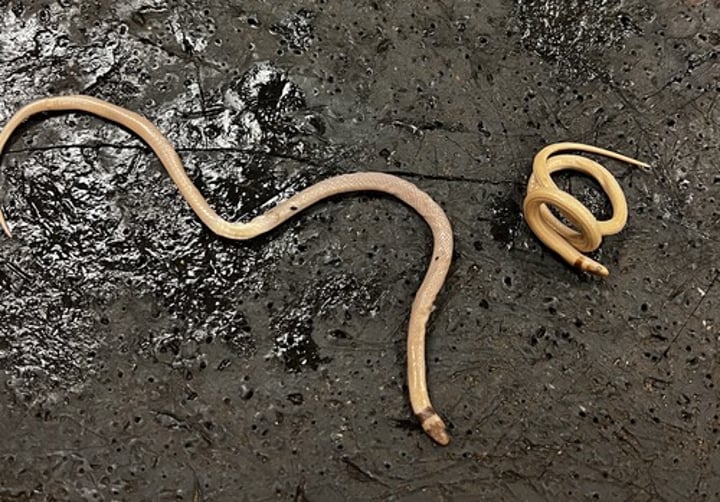
Nerodia erythrogaster (Plain Bellied Water Snake)
Natricidae
Coastal Plain from the Florida panhandle north through Georgia (although absent from parts of southern Georgia) and into Kentucky and Virginia. Most common in coastal plain, but with patchy Piedmont populations. Identifying Characteristics: Small, slender snakes (13-24.5 cm). Adults are normally tan to brown with a black head and chin. A black band 3-5 scales wide can be seen on the neck. The belly is uniform white, yellow, or pinkish. The scales are smooth, and there are 15 dorsal scale rows at midbody. It has a round pupil and divided anal. Fossorial and most readily found under fallen tree bark, rotting logs, and rocks. Like most Tantilla, the diet of T. coronata includes an assortment of arthropods, with centipedes being a preferred prey item.
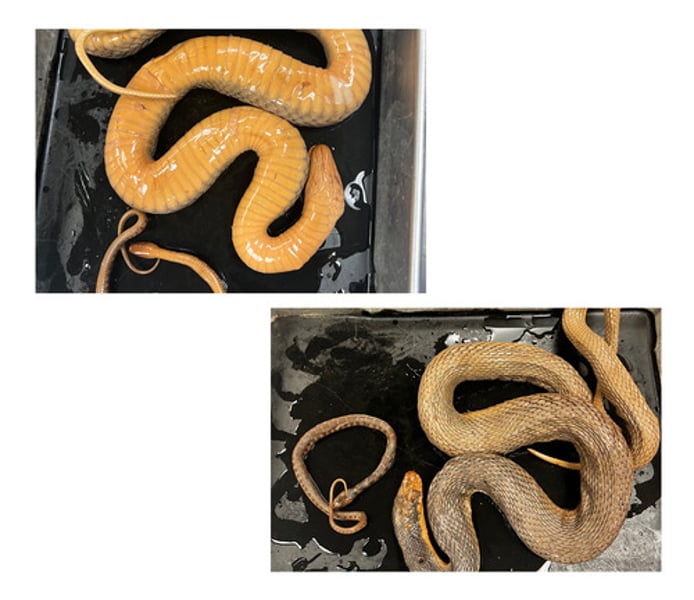
Nerodia sipedon (Northern Water Snake)
Natricidae
Wide distribution throughout east coast and Midwest – not present in coastal plain of southeast. Identifying Characteristics: Large (61-140 cm) semiaquatic snakes. All dorsal scales keeled; anal plate divided; loreal and preocular scales present; dorsal scale rows 21 or more rows; eyes and nostrils dorsally located, visible from above. Dorsal color varies from brown, to tan or grayish – some populations exhibit reddish coloration. Pattern and coloration are much more vivid in young and wet specimens. Their dorsum and sides have a series of square blotches that alternate and often merge to form bands. Ventral surface is heavily mottled with brown and sometimes reddish markings. Their scales are keeled and the anal plate is divided.
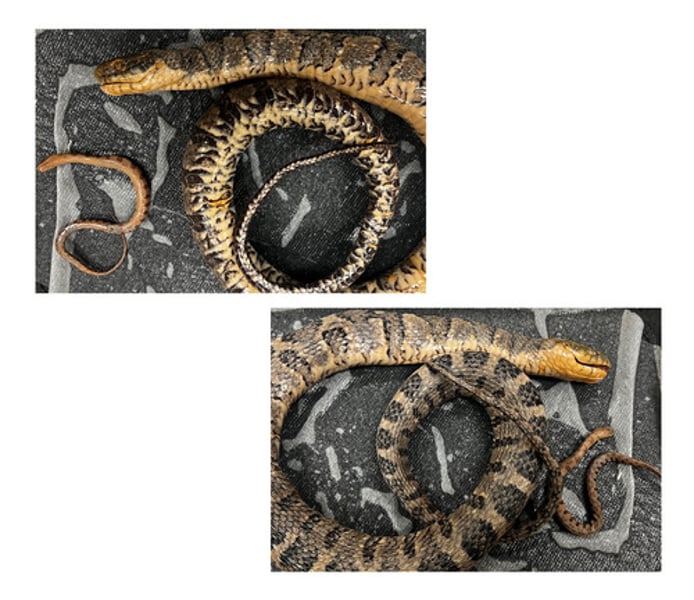
Nerodia taxispilota (Brown Water Snake)
Natricidae
Widely-distributed in the Coastal Plain and Piedmont regions of the Southeast from southern Virginia south through all of Florida. Identifying Characteristics: all dorsal scales keeled; anal plate divided; loreal and preocular scales present; dorsal scale rows 21 or more rows; eyes and nostrils dorsally located, visible from above. Large (76-152 cm) and fairly heavy-bodied semi-aquatic snakes. Coloration is generally light to dark brown with large dark brown square-shaped blotches. One line of square blotches runs down center of the dorsum and two other lines run in alternating rows along the sides of the body. The belly is usually light with brown splotches and black crescents. Like all natricid water snakes, N. taxispilota have strongly keeled scales; anal plate divided; head visibly wider than neck, giving it a slightly triangular appearance. Narrower heads than other Nerodia in GA. Additionally, the eyes are more dorsally positioned on the head and closer to the tip of the nose than in other Nerodia. Among the most riverine of the GA water snakes.
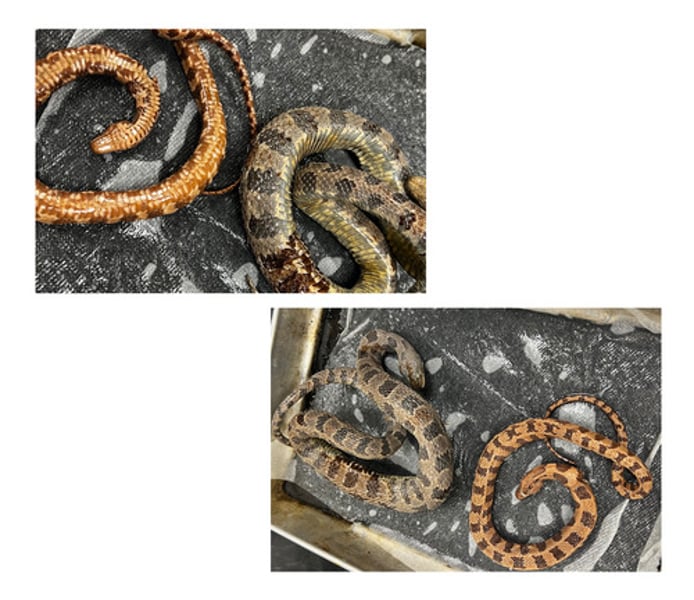
Nerodia fasciata (Banded Water Snake)
Natricidae
Coastal plain throughout the Southeast. Identifying Characteristics: Mid-sized (61-107 cm) water snakes. All dorsal scales keeled; anal plate divided; loreal and preocular scales present; dorsal scale rows 21 or more rows; eyes and nostrils dorsally located, visible from above. Coloration is variable, with snakes ranging from light brown or reddish to black in ground-color with darker crossbands. Crossbands are larger on the middle of the back and narrower on the sides (unlike the bands of copperheads, Agkistrodon contortrix, which are hourglass-shaped). Crossbands may be obscured as the snake darkens with age, and some individuals appear uniformly dark. In addition to crossbands, there are squarish spots at the sides of the belly and a dark stripe from the eye to the angle of the jaw.
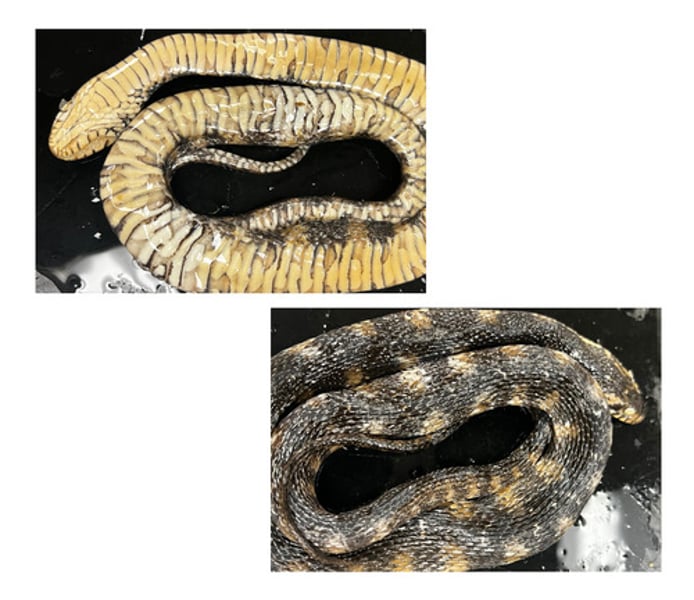
Regina septemvittata (Queen Snake)
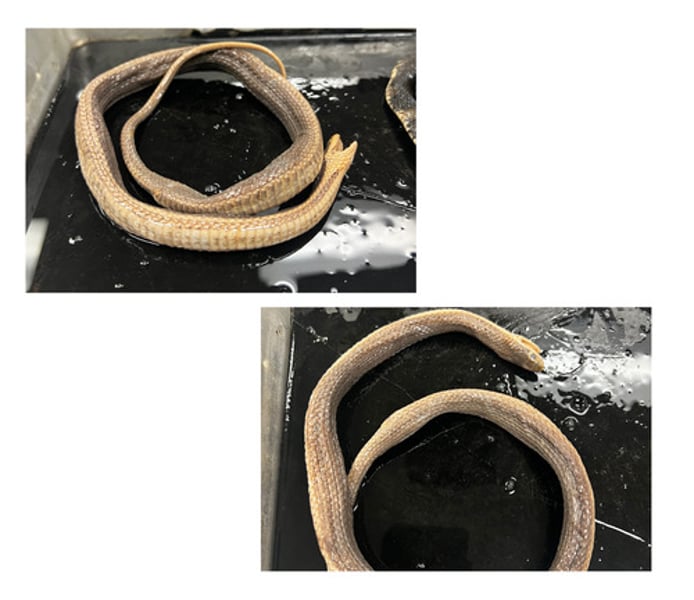
Natricidae
Southeastern Canada and Midwest ad eastern USA, south to NW Florida. Identifying characteristics: Small (to 61 cm) but stocky snakes with a head that is barely distinguished from the neck; keeled dorsal scales. Semiaquatic species often observed basking on branches of shrubs overhanging streams. Both adults and juveniles are generally grayish in coloration but may range from light brown to olive green. There may be three faint darker stripes running down the body. Two lighter (whitish or yellowish) stripes run down the sides. The belly is also yellowish with four brown stripes (two down the center, one along each side) and may have two faint lighter stripes running down the center of the back. Scales are keeled. Often co-occur with Nerodia sipedon in Georgia. Diet consists mostly of soft, freshly molted crayfish.
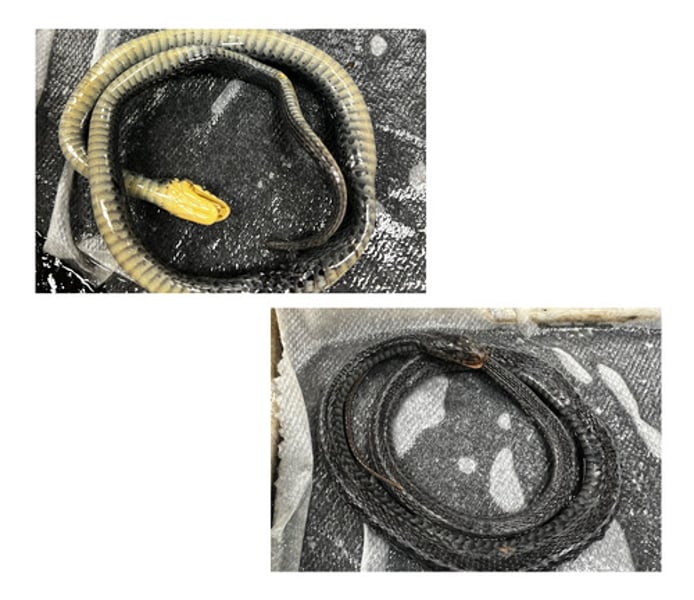
Thamnophis sirtalis (Garter Snake)
Natricidae
Massive distribution including nearly all of North America from southeastern Alaska to Costa Rica (dozens of subspecies). Identifying characteristics: small to moderate-sized (47-66 cm) snakes, seldom reaching more than 1 m; all dorsal scales keeled; anal plate entire, two prefrontal scales; pupil of eye large and round, subocular scales absent, rostral scale unmodified, light upper labial bars separated by thin black stripes on “upper lip.” Most individuals possess three yellow longitudinal stripes down the body. Some, however, exhibit a checkered body pattern with light stripes and a grayish or reddish body color. Specimens from southern Georgia and Florida are often bluish in background coloration. The ventral surface of garter snakes is white or light yellow. Similar in appearance to ribbon snakes (Thamnophis sauritus), but ribbon snakes are generally more slender and lack the vertical black lines on the upper labial scales. Note that Nerodia also possess vertical black lines on upper labials.
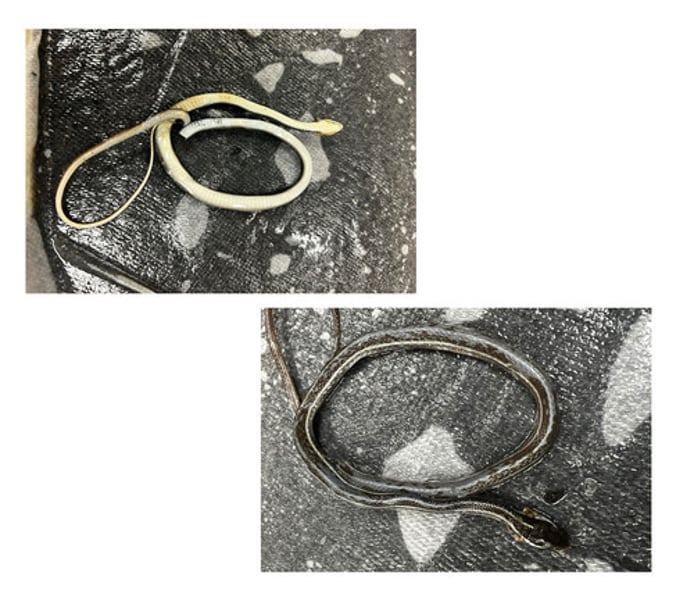
Thamnophis sauritus (Ribbon Snake)
Natricidae
Massive distribution including nearly all of North America from southeastern Alaska to Costa Rica (dozens of subspecies). Identifying characteristics: small to moderate-sized (47-66 cm) snakes, seldom reaching more than 1 m; all dorsal scales keeled; anal plate entire, two prefrontal scales; pupil of eye large and round, subocular scales absent, rostral scale unmodified, light upper labial bars separated by thin black stripes on “upper lip.” Most individuals possess three yellow longitudinal stripes down the body. Some, however, exhibit a checkered body pattern with light stripes and a grayish or reddish body color. Specimens from southern Georgia and Florida are often bluish in background coloration. The ventral surface of garter snakes is white or light yellow. Similar in appearance to ribbon snakes (Thamnophis sauritus), but ribbon snakes are generally more slender and lack the vertical black lines on the upper labial scales. Note that Nerodia also possess vertical black lines on upper labials.
Farancia abacura (Mud Snake)
Dipsadidae
Southeastern USA. Identifying characteristics: a large (up to 1.2 m) stout snake with glossy iridescent scales, a flat head that is not distinct from the neck, tiny eyes, and a sharp spine on the tip of the tail. Dorsal color varies from totally black to black with prominent red banding. Ventral color always with alternating red and black bands. Primarily aquatic and most often associated with swamps and other slow-moving bodies of water with an abundance of aquatic vegetation. Preserved specimen in collection is a juvenile.
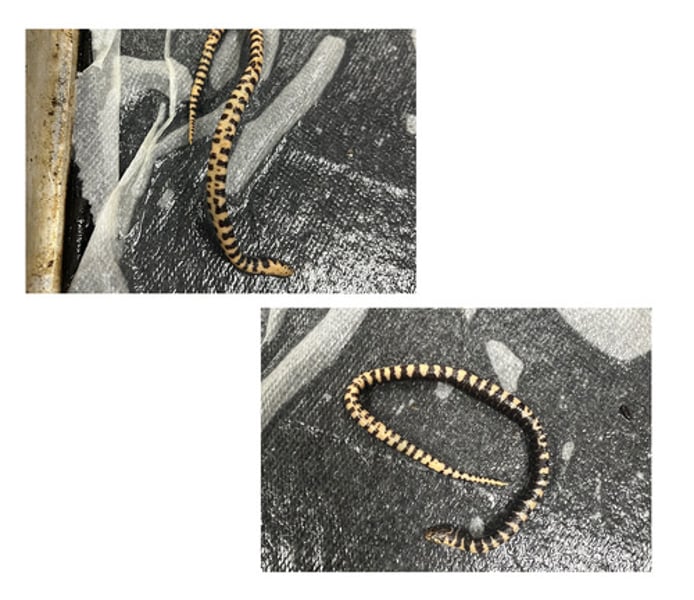
Heterodon nasicus (Plains/Western Hog-nosed Snake)
Dipsadidae
Southeastern USA. Identifying characteristics: a large (up to 1.2 m) stout snake with glossy iridescent scales, a flat head that is not distinct from the neck, tiny eyes, and a sharp spine on the tip of the tail. Dorsal color varies from totally black to black with prominent red banding. Ventral color always with alternating red and black bands. Primarily aquatic and most often associated with swamps and other slow-moving bodies of water with an abundance of aquatic vegetation. Preserved specimen in collection is a juvenile.
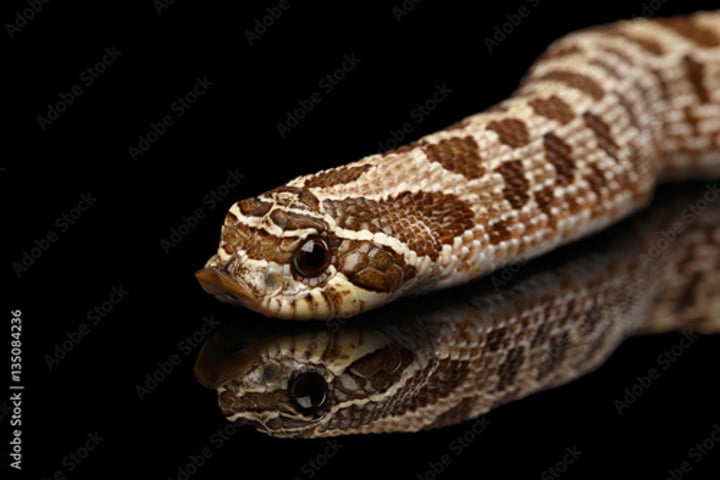
Heterodon kennerlyi (Mexican Hog-nosed Snake)
Dipsadidae
Southwestern United States and into central Mexico. Identifying characteristics: usually less than 80 cm in length, short-bodied, stocky snakes with blotched dorsal patterns; rostral scale keeled and turned upward; dorsal scales are keeled, anal plate divided. Elevated to specie status by Smith et al. (2003) based on two scale characteristics: H. kennerlyi with 2-11 azygous scales, and 0-6 loreal scales (H. nasicus possesses 8-27 azygous scales and 2-9 loreal scales). In addition to scale characters, H. kennerlyi and nasicus apparently have a very narrow zone of geographic overlap in extreme west Texas, with most of western and southern Texas, southern New Mexico, and southeastern Arizona representing kennerlyi range, whereas nasicus is a great plains specialist ranging from western and north Texas through the central US and as far north as Canada. Live Specimen.
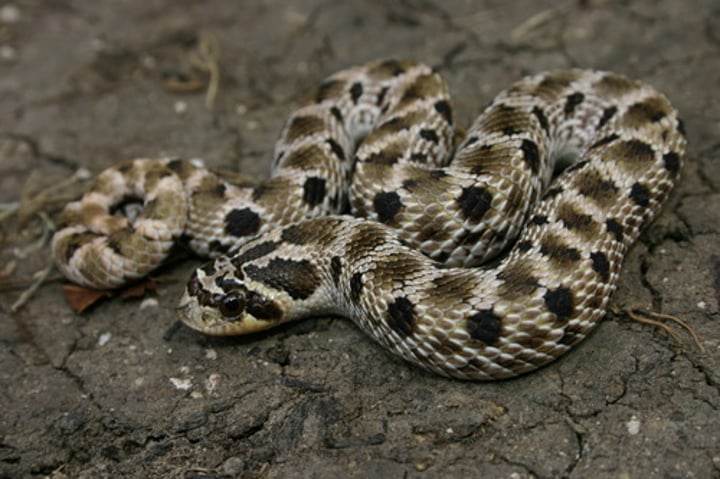
Heterodon simus (Southern Hog-nosed Snake)
Dipsadidae
Historically found in the Coastal Plain of the eastern United States from southern North Carolina to southern Mississippi and in most parts of Florida. Has declined in recent years and is now only found in scattered populations in South Carolina, North Carolina, Georgia, and Florida. Identifying Characteristics: Fairly small (61 cm), heavy-bodied snakes. Easily distinguished from other snakes in North America by their pointed, upturned snouts. Unlike eastern hognose snakes (Heterodon platirhinos), which are highlight variable in dorsal coloration and pattern, H. simus are always gray, tan, or reddish in color with a series of dark brown blotches down the center of the back and alternating smaller blotches along the sides. They are never solid black like H. platirhinos often is throughout the southeast. Further distinguished from H. platirhinos by the underside of the tail, which is the same color as the belly in H. simus (the underside of the tail is lighter than the belly in the H. platirhinos). Southern hognose snakes also have more sharply-upturned snouts than eastern hognose snakes. Like all Heterodon, H. simus often demonstrate dramatic threat displays when harassed, including neck spreading, hissing, and smearing themselves in cloacal secretions and feces before playing dead. Enlarged, fixed teeth and the rear of upper jaw that are grooved for venom delivery – also thought to be used for puncturing the abdomens of amphibians that inflate bodies when threatened. Venom is not medically significant for humans
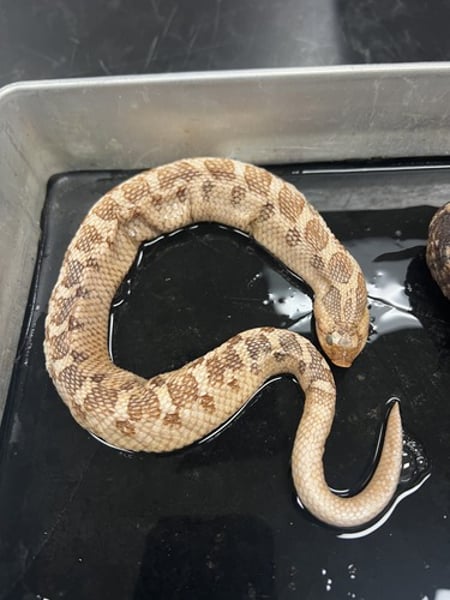
Heterodon platirhinos (Eastern Hog-nosed Snake)
Dipsadidae
Widely distributed across eastern and central North America into southern Canada. Identifying Characteristics: Heavy-bodied snakes are typically short and stout but can reach 115 cm in length. These snakes are easily distinguished by their upturned snouts, but they are highly variable in color. Dorsal background color can be yellow, gray, brown, green or black, often patterned with large, rectangular spots down the middle of the back. The scales of this snake are keeled and the underside of the tail is usually lighter than the rest of the venter. Like all Hetrodon, they often demonstrate dramatic threat displays when harassed, including neck spreading, hissing, and smearing themselves in cloacal secretions and feces before playing dead. Among the most specialized diets of North American snakes, thought to eat almost exclusively toads and frogs (although there are accounts of a more varied diet that can include reptile eggs, small mammals, and invertebrates). Enlarged, fixed teeth and the rear of upper jaw that are grooved for venom delivery – also thought to be used for puncturing the abdomens of amphibians that inflate bodies when threatened. Venom is not medically significant for humans.
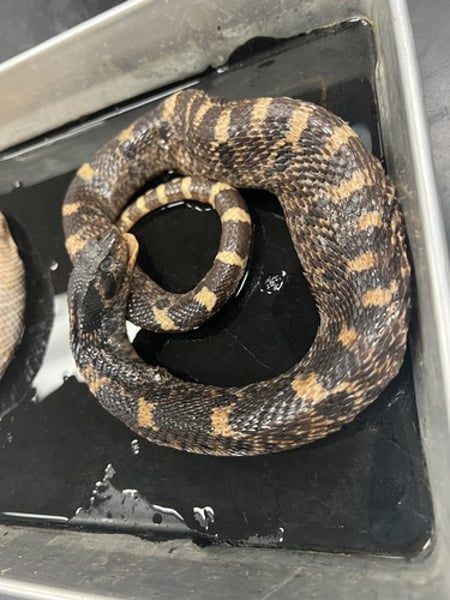
Hypsiglena jani (Chihuahuan Night Snake)
Dipsadidae
Southwestern USA into Northern Mexico. Identifying characteristics: usually less than 45 cm total length, light gray snakes with dark brown or gray dorsal blotches, smaller spots laterally, and an immaculate white/cream venter; scales smooth; anal plate divided; pupil of eye vertical when not dilated.
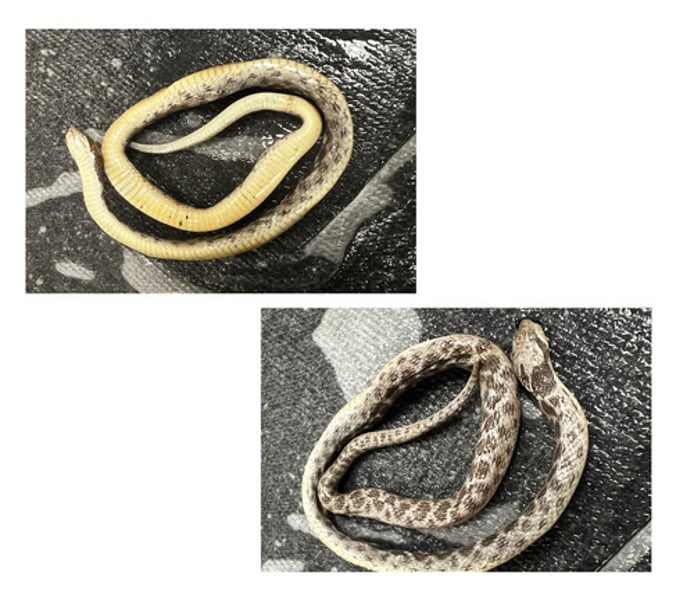
Diadophis punctatus (Ringneck Snake)
Dipsadidae
Massive distribution including SE Canada, nearly all of USA and into Central Mexico (10+ subspecies referenced on Reptile Database). Identifying Characteristics: Small (up to 40 cm, except southwestern populations that can exceed 65 cm), fossorial snakes with light or dark gray dorsal surface, prominent yellow-orange ring around dorsal surface of neck (absent in some southwestern populations), and a striking ventral surface with bright yellow, orange, and sometimes red coloration (various amounts of black spotting on ventral surface across distribution).
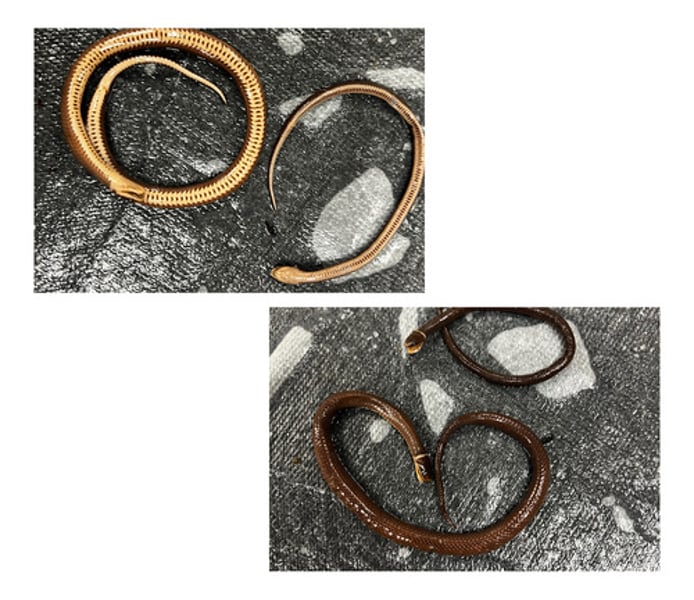
Rhadinaea flavilata (Pine Woods Snake)
Dipsadidae
Somewhat patchy distribution in coastal plain of southeast – a predominately neotroipical genus; R. flavilata is the only north American member of the Rhadinaea. Small, slender fossorial snakes (25 – 33 cm). Drosal oloration is generally brownish, ranging from golden brown to reddish brown with a darker head and lighter venter. There is a dark stripe passing through the eye and the upper lip scales are yellowish, leading to one of its common names, the yellow-lipped snake
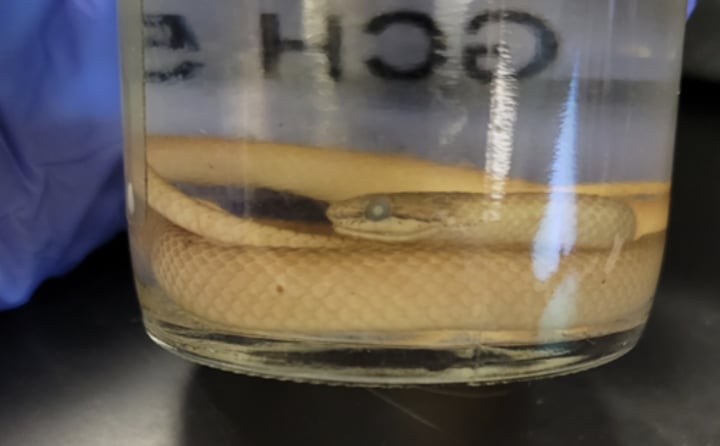
Micrurus fulvius (Eastern Coral Snake)
ELAPIDAE
Elapinae
Coastal plain in the southeast, some scattered piedmont populations in Georgia and Alabama. Slender, mid-sized (46-76 cm) snakes, exceptional specimens can reach almost 4 feet (122 cm) in length. They have smooth scales and the anal plate is usually divided. The most obvious feature of an eastern coral snake is the bright dorsal and ventral pattern of alternating red, yellow, and black rings in which the red and yellow rings are adjacent. The nose is black. Scarlet kingsnakes (Lampropeltis elapsoides) and scarlet snakes (Cemophora coccinea) are superficially similar but the red only touches the black rings. The coral snake is the only eastern species of snake with a pair of fixed fangs in the front of the mouth – specialized diet consisting of mostly other slender squamates (skinks and other snakes, predominately).
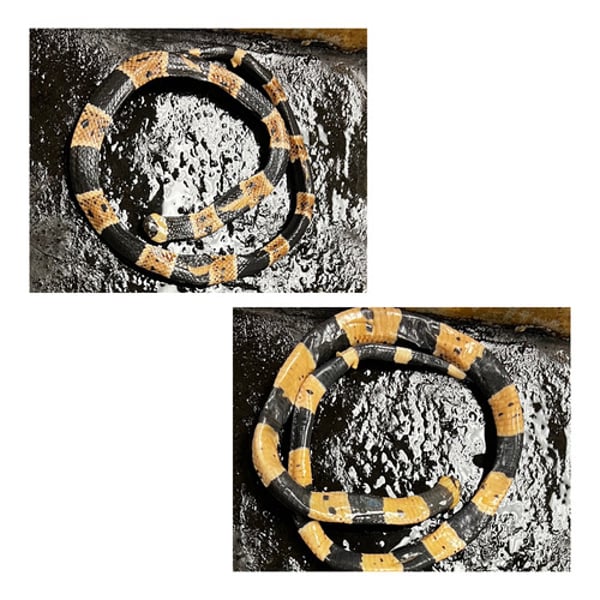
Crotalus adamanteus (Eastern Diamond-backed Rattlesnake)
VIPERIDAE
Crotalinae
Coastal plain in the southeast, some scattered piedmont populations in Georgia and Alabama. Slender, mid-sized (46-76 cm) snakes, exceptional specimens can reach almost 4 feet (122 cm) in length. They have smooth scales and the anal plate is usually divided. The most obvious feature of an eastern coral snake is the bright dorsal and ventral pattern of alternating red, yellow, and black rings in which the red and yellow rings are adjacent. The nose is black. Scarlet kingsnakes (Lampropeltis elapsoides) and scarlet snakes (Cemophora coccinea) are superficially similar but the red only touches the black rings. The coral snake is the only eastern species of snake with a pair of fixed fangs in the front of the mouth – specialized diet consisting of mostly other slender squamates (skinks and other snakes, predominately).
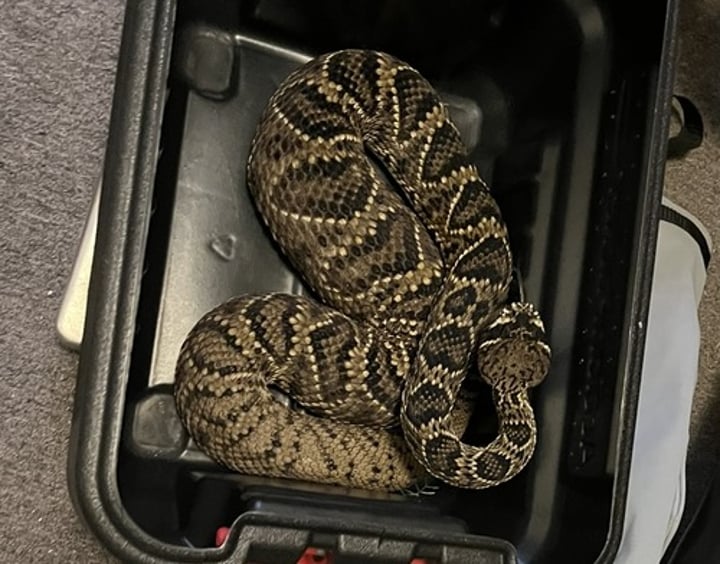
Crotalus horridus (Timber Rattlesnake)
VIPERIDAE
Crotalinae
Eastern USA, west into central Texas, absent from most of Florida. Sometimes referred to as Canebrake Rattlesnakes in southern portions of their distribution. Large, heavy bodied snakes with the characteristic rattles on the end of the tail. Adults range from 76-152 cm with the record being 183 cm. Scales heavily keeled. Usually gray and may even have a pink hue and a pinkish, yellow, orange, or brown stripe running the length of the back. Northern populations are typically more brown or yellowish and may even be completely black. Both forms have solid black tails that appear “velvety” and black chevrons on the dorsum and sides with the tip of the (V) pointing forward
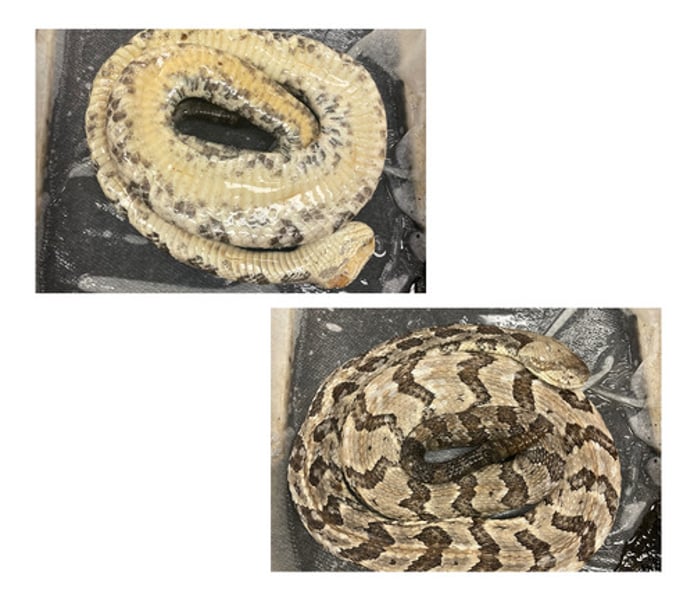
Crotalus lepidus (Rock Rattlesnake)
VIPERIDAE
Crotalinae
Chihuahuan and Sonoran Deserts of Texas, New Mexico, and Arizona; into north-central Mexico. Identifying Characteristics: Relatively small (40-84 cm) but heavy bodied rattlesnake. Scales heavily keeled. Incredibly variable across distribution, with representatives from the extreme eastern portions of the distribution (Stockton and Edwards Plateaus of Texas) displaying a nearly white dorsal color, while hose further west in Texas and into south-central New Mexico sporting various shades of tan, brown, red, pink, or orange. Those populations from the Franklin Mountains of El Paso, Texas and west into southern New Mexico and Arizona possess a gray dorsal color with green or pinkish hues of varying intensities. All individuals possess 13-21 dark crossbands along the entire length of the body, usually with 1-6 on the tail.
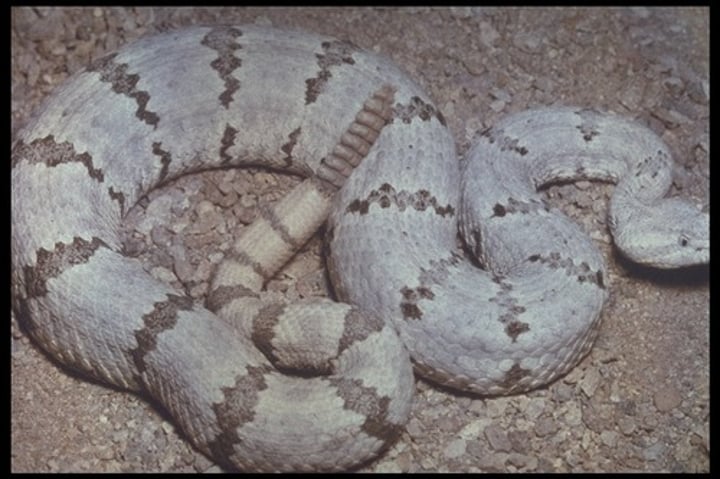
Sistrusus miliarius (Pigmy Rattlesnake)
VIPERIDAE
Crotalinae
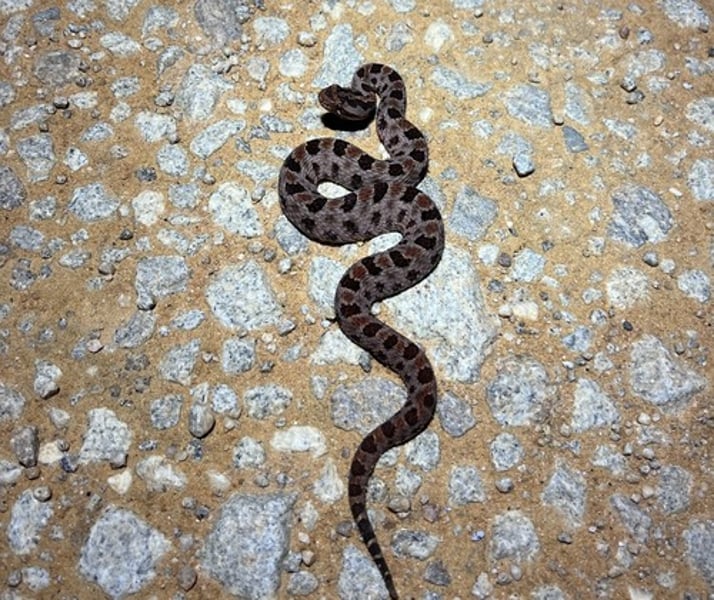
Throughout southeast to North Carolina, West to central Oklahoma and east Texas. Identifying Characteristics: A small (38-56 cm) rattlesnake, sometimes referred to as “ground rattler”. Scales heavily keeled. Unlike the larger rattlesnakes of the genus Crotalus, Sistrurus has nine large scales on top of the head and a much smaller rattle that is often inaudible. Over the broad geography distribution of the species, appearance can vary substantially, however, all possess a row of mid-dorsal spots and a bar than runs from the eye to the base of the mouth (color of this bar can vary from black to brownish red). An orange or reddish brown mid-dorsal stripe is also present. In young snakes, the tip of the tail is bright yellow and is used for caudal luring. The base dorsal color can be gray, tan, or lavender, with some specimens from northern Georgia and eastern North Carolina being orange or red. The GC Herpetology collection has live specimens from both the coastal plain and upper Piedmont of Georgia that illustrate this phenotypic variation. Live specimens.
Agkistrodon contortrix (Southern Copperhead)
VIPERIDAE
Crotalinae
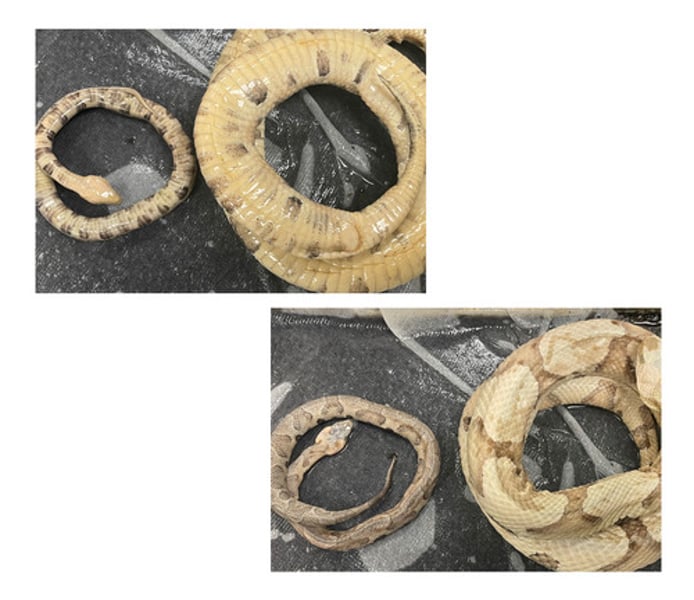
Eastern and Southern USA, absent from most of Florida and south-central Georgia. Identifying Characteristics: fairly large – 24 - 40 in (61 - 102 cm), heavy-bodied snakes with large, triangular heads and elliptical pupils (cat eyes). Scales heavily keeled. The body is tan to brown with darker hourglass-shaped crossbands down the length of the body (thinner on mid-dorsal line than on the sides of the body – this is not necessarily the case in the broad-banded copperhead, A. laticinctus, in central and west Texas). Individuals from the Coastal Plain of Georgia often have crossbands that are broken along the center of the back. The head is solid brown, and there are two tiny dots in the center of the top of the head. Juveniles resemble adults but have a bright yellow tail tip. As pit-vipers they have facial pits that sense thermal radiation.
Agkistrodon piscivorus (Cottonmouth/Water Moccasin)
VIPERIDAE
Crotalinae
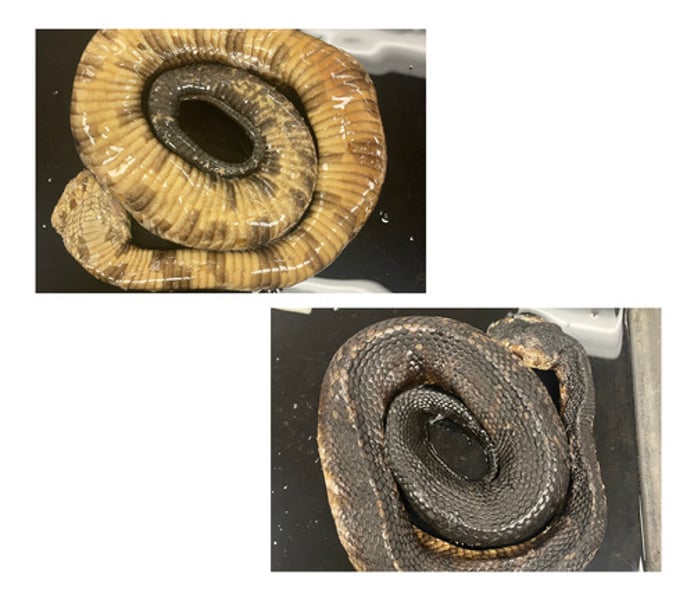
Heavy-bodied, semi-aquatic snakes with large, triangular heads with a dark line through the eye, elliptical pupils, and large jowls due to the venom glands. Scales heavily keeled. 3They are large – typically 61 - 122 cm, occasionally larger, keeled-scaled. Their coloration is highly variable: they can be beautifully marked with dark crossbands on a brown and yellow ground color or completely brown or black. Older adults are often dark and solid-colored whereas the juveniles are brightly patterned with a bright yellow tail tip that they wiggle to attract prey (caudal luring). The belly typically has dark and brownish-yellow blotches with the underside of the tail being black. As pit-vipers they have facial pits that sense thermal radiation.
Content: 7 genera (2 monotypic) with ca. 275 species.
Distribution: Tropics worldwide.
Identifying characteristics (external):
· Mostly small snakes (less than 40 cm in most species), wormlike (body same diameter throughout its length), burrowing snakes; largest species reaches ca. 90 cm.
· Brille absent (ocular scale), eye reduced to a small dark dot covered with a scale that does not conform to the eye shape
· Ventral scales not enlarged and differentiated from dorsal scales
· Ocular scale does not reach labial border on side of head
· Prefrontal and supranasal scales are fused; scales around midbody 18–44 rows.
Identifying characteristics (internal):
· Supratemporal (tabular) and postorbital bones absent
· Maxillary bone toothed and transversely aligned with skull axis, palatine and pterygoid bones toothless
· Dentary reduced, toothless, much shorter than cranium, the dentary bones cannot be moved forward independently
· Dorsal vertebrae lack neural spines and hyapophyses, pelvic vestiges present but not visible externally
· Only one type of visual cell present, the retina being composed only of single rods
· Liver with many small lobes; ileocolic cecum present
· Tracheal lung present, left lung vestigial or absent, left oviduct absent
· Diploid chromosome number 32 in two examined species
Typhlopidae
Content: 11 genera with 38 species. The genus Python is known from Miocene (23–5 mya) fossils.
Distribution: Sub-Saharan Africa, South and SE Asia to temperate Australia.
Identifying characteristics (external):
· Powerfully muscled constricting snakes; mostly medium to very large in size, with four species reaching a maximum total length in excess of 5.5 meters, and only a handful of species with maximum lengths under 50 cm; body form variable, ranging from elongate arboreal species with massive heads to short, stocky semi-fossorial species where the head is not distinct from the neck
· Dorsal scales usually small and smooth, but may be keeled in some genera
· Ventral scutes transversely enlarged to some extent
· Pelvic vestiges (“spurs”) always present in males, reduced or absent in females
Identifying characteristics (internal):
· Postfrontal (supraorbital) bone present; medial process of maxillary bone broad anteroposteriorly, palatine with foramen for maxillary nerve, palatine bone toothed; oviparous
· Postorbital bone present
· Supratemporal (tabular) bone elongated, extends beyond the paraoccipital process of the occipital—in conjunction with an elongated quadrate facilitates enlarged gape for swallowing large prey items
· Premaxillary teeth present, anterior mandibular and maxillary teeth larger than posterior teeth on these bones, coronoid bone usually present in mandible
· Levator angularis oris muscle absent
· Two functional lungs present, but left lung is much smaller than the right
· Hemipenis flounced and/or calycylate (small pockets or sunken interstices between the retiform [arranged like a net or reticulated] ridges), and bilobate (except in some Morelia); sulcus spermaticus bifurcated
Pythonidae
Content: About 100 genera with 844 species. At least seven extinct genera known from the Miocene (23–5.3 mya) of North America; several extant genera are known from North American fossils dating back to the Miocene.
Distribution: Mostly Holarctic, but representatives are found on every continent except Antarctica.
Identifying characteristics (external):
· Small to large snakes (up to 3 m maximum), usually semifossorial, terrestrial, semi-arboreal or arboreal
· Dorsal scales smooth or keeled, scale pits present or absent
Identifying characteristics (internal):
· Hyapophyses absent from vertebrae in most genera, confined to the anterior vertebrae in a few forms, and rarely with long-slender hyapophyses throughout
· Hemipenis asymmetrical, usually ornamented with calyces, papilla, or flounces; often bilobate with the single sulcus spermaticus on the outer side of the right lobe (= centrifugal)
· Maxillary teeth subequal, gradually increasing posteriorly, or with enlarged grooved or non-grooved teeth separated from the smaller anterior teeth by a gap (diastema)
Colubridae
Content: about 38 genera with 259 species. One extinct genus is known from the Miocene (23–5 mya) of North America, as well as two extant genera (Thamnophis and Nerodia). Other modern genera known from Pleistocene (2.6 mya to 12,000 years ago) deposits.
Distribution: North America to northern Central America, Africa, and Eurasia through East Indies.
Identifying characteristics (external):
· Small to moderate-sized snakes (to 200 cm), usually aquatic, semiaquatic or semifossorial in habits
· Dorsal scales usually keeled or weakly keeled
Identifying characteristics (internal):
· All body vertebrae with short, posteriorly curved hyapophyses
· Maxillary teeth increase in length posteriorly, with or without a gap (diastema) separating these from the two posteriormost teeth; the two posteriormost teeth are grooved in only a few natricine genera
· Hemipenis symmetrical, non-capitate, without an apical disk or calyces but with conspicuous spines
Natricidae
Content: About 90 genera with 817 species. Two modern and one extinct genus are known from the Pliocene (5.3–2.6 mya) of North America, and more recent fossils are attributable to extant genera.
Distribution: Throughout the Americas.
Identifying characteristics (external):
· Small to large snakes (some over 2 m), primarily terrestrial and semifossorial but with some aquatic and arboreal species
· Dorsal scales usually smooth, rarely keeled
Identifying characteristics (internal):
· Maxillary teeth increase in length posteriorly, often with a diastema (space) proceeding two enlarged terminal teeth with or without grooves for venom delivery
· Vertebral hyapophyses restricted to anterior vertebrae
· Hemipenis bilobed or simple, sulcus spermaticus single or forked
Dipsadidae
Content: Two subfamilies, Elapinae (ca. 300 species) and Hydrophiinae (8 genera, ca. 62 species). One extinct fossil genus from the Miocene (23–5 mya) and Pliocene (5–2.6 mya) of North America, and one extant genus (Naja) known from the Pliocene of Europe.
Distribution: Southern USA to southern South America, Africa, southern Asia to Australia, islands of Indian and Pacific Oceans
Identifying Characteristics (external):
· Moderately small to very large terrestrial, arboreal, fossorial or aquatic snakes, most species in the 50–150 cm range
· Loreal scale absent in terrestrial forms except as a scale anomaly; between the prefrontal and supralabials only a preocular scale separates the eyes and nostril; pupil of eye round or oval
· Eye well developed, covered by a brille, top of head with large, regular shields
· Dorsal scales smooth in all but one Australian genus; scale pits absent
Identifying Characteristics (internal):
· Venom-delivery fangs (grooved fang along anterior tooth face) located on a non-rotating maxillary bone with solid non-grooved teeth posterior to the fangs; no solid teeth occur on maxilla anterior to the fangs; premaxillary bones toothless and not in contact with maxilla
· Quadrate elongate and posteriorly directed, supratemporal bone elongate
· Dorsal vertebrae with compressed, posteriorly directed (recurved) hyapophyses
· Coronoid bones absent; septomaxillary bones contact front bones
· Harderian gland (gland in eye) confined to orbit
· Left lung absent; pelvic vestiges absent
· Geniohyoideus and sternohyoideus muscles absent; ceratomandibularis muscle present
· Hemipenis simple, deeply or shallowly forked; sulcus spermaticus forked and centripetal
· Diploid chromosome numbers: 26–40
ELAPIDAE
Content: three subamilies, Azemiopinae (2 species in one genus), Crotalinae (23 genera with 271 species), and Viperinae (12 genera with 101 species). Two recent genera (Agkistrodon and Crotalus) are known from the Pliocene (5–2.6 mya) of North America, one (Vipera) from the Pliocene of eastern Europe, and one (Bitis olduvaiensis) from the Pleistocene (2.6 my to 12,000 years ago) of Tanzania.
Distribution: Worldwide except south of Wallace’s line in Asia, and many islands, including Madagascar.
Identifying characteristics (external):
· Moderately small to large snakes (up to 3.6 m in Lachesis), most species less than 1 m in length
· Head large, somewhat flattened and usually very distinct from neck in most forms
· Loreal scale usually present, but may be absent in some genera
· Transversely enlarged ventral scutes always present
Identifying characteristics (internal):
· Maxillary bone short, rotating, with elongate fang for venom delivery; the fang and its replacement series are the only teeth present on the maxilla
· Premaxillary bones toothless; coronoid bones absent from lower jaw; septomaxillary bones contact frontal bones; prefrontal bones absent
· Quadrate elongate and posteriorly directed, supratemporal bones elongate
· Trunk vertebrae short and broad, all with hyapophyses
· Harderian gland extends past orbit into temporal fenestra
· Left lung absent or vestigial; pelvic vestiges absent
· Geniohyoideus, sternohyoideus, and ceratomandibularis muscles present; levator anguli oris muscle present in all but one primitive crotaline genus
· Hemipenis bilobed, with longitudinal folds and spiny throughout; frequently decorated with calyculae or flounces; sulcus spermaticus bifurcate
· Diploid chromosome number usually 36
VIPERIDAE
Content: 3 subfamilies (Anguinae, Gerrhonotinae, Anniellinae), 86 species.
Distribution: North America to Central America, and Eurasia.
Identifying Characteristics (external):
· Body elongate, limbs either relatively short, small, or completely absent; tail long and easily broken off (few adults have unbroken tails); eyes and eyelids present
· Scales usually rectangular and imbricate (overlapping edges); lateral fold containing granular scales (except in Anguis)
· Femoral and preanal pores absent
· Interparietal foramen small or absent
Identifying Characteristics (internal):
· Palpebral (eyelid tissue) ossifications present
· Premaxillary bones fused; palatal teeth present or absent; jaw teeth
· pleurodont, acrodont, tuberculate or loosely attached
· Supratemporal fossa open or roofed over, usually by the postfrontal
· bone
· Six cervical vertebrae and more than 26 presacral vertebrae present
· Anterior part of tongue forked (or at least strongly notched) at tip,
· more or less retractible into hind‐tongue
· Ventral body osteoderms present
· Caudal autotomy well developed and frequently employed
Anguidae
Content: 1 genus with 436 species
Distribution: Central and South America, Caribbean Islands, tropical Mexico and the southeastern U.S.
Identifying characteristics (external):
· Extensible throat fan present in males of many species; most genera are scansorial (adapted to climbing) with well‐developed arms and legs and an elongated snout
Identifying characteristics (internal):
· Dentary bone with posterior extension; angular bone reduced
Dactyloidae
Content: 9 genera with 165 species.
Distribution: North America from southern Canada south to Panama.
Identifying characteristics (external):
· Highly variable by genus, with the body form either being typical lizardlike with well‐developed limbs and a long tail or dorsoventrally flattened with short tails; the mid‐dorsal scale row is not differentiated from the adjoining dorsal scales; the interparietal is open and obvious
Identifying characteristics (internal):
· Presacral vertebrae reduced; flange on clavicle reduced; pterygoid teeth absent
· Group is morphologically diverse, only universal feature is from DNA
Phrynosomatidae
Content: 18 genera with 172 species. There are at least 8 fossil genera, seven
from the Cretaceous (145–65 mya) of North America and one from the
Miocene (23–5 mya) of South America. Modern genera are known as
early as the Oligocene (34–23 mya) from South America and the
Pliocene (5.3–2.6 mya) of North America.
Distribution: North and South America, including the Caribbean.
Identifying characteristics (external):
· Snout usually pointed, body typically elongated, limbs usually welldeveloped,
· tail long, dorsal scalation variable, but often granular,
· ventrals usually rectangular or hexagonal plates, body maximum to 100
· cm in largest genera, but usually much smaller
· Interparietal formaen absent in adults, eyelids present
· Femoral pores usually present
Identifying characteristics (internal):
· Tongue deeply forked anteriorly, vomeronasal system well developed
· Premaxillary bones fused, nasals usually paired, palatine divided
· Skull arches present
· Teeth usually restricted to jaws, but may be rarely preent/feebly
· expressed on the pterygoid, jaw teeth may be conical, bicuspid,
· tricuspid or molariform
· Clavicle simple or expanded, may be perforate, the interclavicles
· cruciform or rod‐shaped
· Osteoderms completely absent
· Coracoids and scapulae emarginated posteriorly
· Tail autotomy well developed
· Diploid chromosome numbers 34–56
Teiidae
Content: Monotypic (one genus and species)
Distribution: Restricted to upland xeric scrub in Florida, range extends briefly into coastal plain of Georgia W of Okefenokee basin.
Identifying Characteristics (external):
· Body worm‐like and of nearly equal diameter throughout; limbs absent externally; tail short, size 9–38 cm
· Eyes concealed under the skin; no external ear openings present
· Body and tail with encircling rings of flat scales
Identifying Characteristics (internal):
· Skull heavily ossified; frontal bones surround brain
· Palatine teeth absent; jaw teeth few, pleurodont or acrodont
Osteoderms present
Rhineuridae
Content: 2 subfamilies (Acontiinae, Scincinae), 1727 species. Two extinct fossil genera are known from the Late Cretaceous (145–65 mya) of Wyoming, and another from the Pleistocene (2.6 mya to 12,000 years ago) of the Mascarene Islands. The modern genus Eumeces is known from the North African Miocene (23–5.3 mya), and the extant genus Plestiodon from Oligocene (34–23 mya) to recent North American material.
Distribution: Worldwide except in highest latitudes and Antarctica.
Identifying characteristics (external):
· Body cylindrical, tail long to moderately long, body scales imbricate and usually cycloid, often with a shiny surface, legs and digits reduced in many genera, body form often elongate, many species have a transparent window in the lower eyelid
· Femoral pores absent, preanal pores absent
· Interparietal foramen often present, may be covered with bone in some forms
Identifying characteristics (internal):
· Postorbital bones reduced or absent
· Skull arches present or absent, supratemporal fossa often closed, post-temporal fenestra present or absent
· Pterygoid bone tooth or not, jaw teeth pleurodont, conical/bicuspid or spheroidal with compressed crowns
· Tongue with scale-like papillae, vomeronasal organ moderately well developed
· Osteoderms present dorsally and ventrally, including head region
· Caudal autotomy usually present
· Diploid chromosome numbers 26–32 in investigated species
Scincidae
Content: 64 genera with 1430 species. Three extinct genera known from the Eocene (56–34 mya) of Europe, and from the Pleistocene (2.6 mya to 12,000 years ago) of the Mascarene Islands near Madagascar
Distribution: Tropics worldwide and temperate Europe, introduced to many islands and temperate regions worldwide
Identifying characteristics (external):
· Typical gecko-like body with expanded toe tips
· Immovable eyelids with vertically elliptical pupil
· Males usually have preanal and femoral pores
Identifying characteristics (internal):
· Angular absent
· Supratemporals usually absent
· Jaw teeth pleurodont, usually small and pointed
· Caudal autotomy well developed
· Group is morphologically diverse, only universal feature is from DNA
Gekkonidae