Lec 6 - Action Potential conduction + synapse
 Call Kai
 Learn
 Practice Test
 Spaced Repetition
 Match
 Flashcards
 Knowt Play
1/39

There's no tags or description
Looks like no tags are added yet.
40 Terms
What do graded potentials and action potentials have in common?
Both are changes in membrane voltage.
Where do graded potentials occur?
In the dendrites and soma.
What type of channels produce action potentials?
Voltage-gated Na⁺ and K⁺ channels.
Do action potentials vary in size?
No. Action potentials are all-or-none and have the same amplitude once triggered.
they do not decay unlike graded potentials
they travel farther then graded potentials
How much must the membrane depolarize to go from −70 mV to −55 mV?
By 15 mV in the positive direction.
What type of protein is a voltage-gated Na⁺ channel?
A transmembrane ion channel that allows Na⁺ to cross the membrane when it opens.

How many gates does a voltage-gated Na⁺ channel have?
Two
Activation gate - top one
Inactivation gate - ball and chain on ICF side

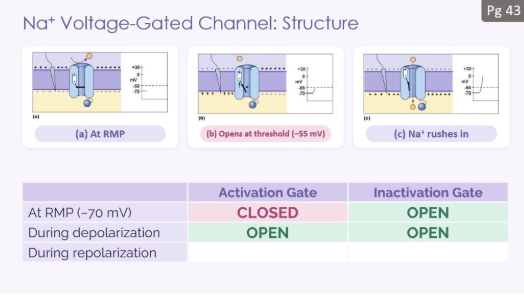
What is the state of the Na⁺ channel gates at resting membrane potential (~−70 mV)?
The activation gate is closed and the inactivation gate is open.
neurons cant enter at rest because the activation gate is closed at rest.
What happens to the voltage-gated Na⁺ channel when threshold is reached and the membrane starts depolarizing?
the activation gate opens, allowing sodium to enter the neuron. Both gates are open.
remember that at the peak sodium channel closes so which gate closes?
When Na+ channel closes at peak which gate closes?
Only one gate, the inactivation gate (ball and chain). it stays closed all the way until hyperpolarization.
During hyperpolarization of the action potential which gates are open
activation gate is closed and inactivation gate is open.
Easy way to remember the gates
Activation/Inactivation
Rest = C/O
Depolarization = O/O
Peak/Repolarization = O/C
Reset /Hyperpolarization= C/O
Absolute Refractory Period
A period when another action potential is impossible because voltage-gated Na⁺ channels are inactivated.
as long as the inactivation gate is closed that area of the axon can NEVER have another action potential

inactivation gate is only closed during repolarization
How many gates does a voltage-gated K⁺ channel have?
One gate: an activation gate.

A change in membrane voltage triggers it to open
When do voltage-gated K⁺ channels actually open?
Around the peak of the action potential - btu they are slow to open so the repolarization only happens after the peak.
Action potential Propagation / Conduction
The process by which an action potential travels down the axon.
Where does action potential propagation begin?
At the axon hillock, once threshold is reached. At this point voltage gated sodium ion channels open causing depolarization. The rest of the axon is still at rest.

How does depolarization in one section of the axon affect the next section?
Positive charge spreads into the neighboring resting section of membrane and makes it more positive. Positive charge starts to accumulate Na+ is attracted to the next region which is -70mV and because oppsoites atracts the Na+ spreads to it.
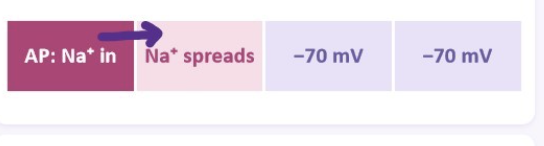
What happens when the next section of membrane reaches threshold?
Its voltage-gated Na⁺ channels open and a new action potential begins there.
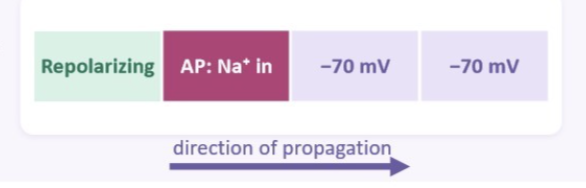
Action potential are unidirectional they never go backwards. The original first area of the axon repolairzes while the next section depolarises. Every section has to have to have an action potential.
Depolarize one section → Na⁺ spreads forward → next section hits threshold → next AP starts → previous section repolarizes.
Unmyelinated axon: Each successive section generates an action potential.
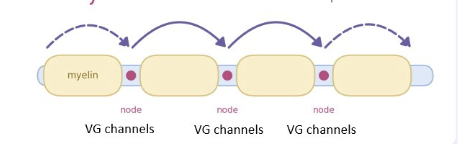
Myelinated axon: Action potentials are regenerated mainly at the nodes of Ranvier, where the membrane reaches threshold. The electrical signal spreads passively beneath the myelin between nodes.
Why does the action potential move forward instead of backward?
The section behind it is in the refractory period, with Na⁺ channels inactivated, so it cannot immediately fire again
Does the action potential get weaker as it travels down the axon?
No. It is regenerated at each section, so its amplitude stays the same. does NOT decay
myelinated neuron
A neuron whose axon is covered by a myelin sheath.
What is the main function of myelin?
It acts as insulation around the axon and reduces ion leakage across the membrane. Electrical current can travel farther between exposed regions.

What are nodes of Ranvier?
Gaps between sections of myelin along the axon where voltage gated sodium and potassium ion channels are found. Where action potentials are regenerated.
two main factors affect the speed of action potential propagation
myelination
axon diameter
How does myelin increase conduction speed?
Myelin insulates the axon, reduces ion leakage, and allows current to spread farther down the axon. It increases membrane resistance, making it harder fir ions to leak.
How does axon diameter affect conduction speed?
A larger axon diameter produces faster conduction it creates less membrane e resistance.. the bigger the axon the faster things flow.
saltatory conduction
Rapid conduction in myelinated axons where action potentials are regenerated at successive nodes of Ranvier. The action potential moves inside the axon doesn’t actually jump
multiple sclerosis (MS)
disease in which myelin sheath in the central nervous system is damaged, disrupting normal nerve signal conduction. Caused by the immune system attacks myelin in the brain and spinal cord.
commands from the brain may not be able to desired place so you may lose function of muscle.
What happens when myelin is lost?
More positive charge leaks out of the axon, so less current reaches the next node of Ranvier. The current reaching the next node may be too weak to bring the membrane to threshold. Which means that the potenial could be slower or completely fail.
chemical synapse
The junction where one neuron communicates with another neuron using chemical messengers.
presynaptic neuron
The neuron before the synapse that sends the signal.
postsynaptic neuron
The neuron after the synapse that receives the signal.
What is the synaptic gap/cleft.
The small space between the presynaptic and postsynaptic neurons.

What happens when an action potential reaches the axon terminal?
It triggers the presynaptic neuron to release neurotransmitter into the synaptic gap in bulk. Then they bidn to the receptors on th epost synaptic neuron.

How are neurotransmitter released by presynaptic neuron?
neurotransmitters are packaged into vesciles and then the
bulk transport - exocytosis is used
The chemical synapse step by step

so if there is no calcium - there is no neurotransmitter release.
Why must neurotransmitter eventually be removed from the synaptic cleft after bindign to the receptors on post synaptic neuron?
we would have an action potential forever, so we need to get rid of neuotransmitters int he cleft - there are three ways to do it.
What are the three main ways neurotransmitter can be removed?
Recycling/reuptake into the axon terminal,
enzymatic breakdown in the synaptic cleft
diffusion away from the cleft.
postsynaptic potential
A graded potential that occurs in the postsynaptic neuron after neurotransmitter binds to receptors.
EPSP: excitatory postsynaptic potential - likely to lead to action potential (Na+ depolarizes)
IPSP/ inhibitory postsynaptic potential - does not lead ot action potential (K+ out or Cl- in leads to hyperpolarization).
search before midterm
read page 53/54 in notebook