KSU Econ 1000 Final
 Call Kai
 Learn
 Practice Test
 Spaced Repetition
 Match
 Flashcards
 Knowt Play
1/100

There's no tags or description
Looks like no tags are added yet.
101 Terms
Opportunity Cost
value of the next valuable cost. Every choice has a cost.
Sunk Cost
A cost that has already been incurred and thus cannot be recovered (sleeping in and skipping a class... win lose).
incentives
a thing that motivates or encourages one to do something.
economic system
system of production, resource allocation, exchange, and distribution of goods and services in a society or a given geographic area.
Command
group making decisions; bureaucratic; group of bureaucrats making decisions; economic system in which the means of production are publicly owned and economic activity is controlled by a central authority that assigns quantitative production goals and allots raw materials to productive enterprises. (North Korea)
laissez-faire
an economic system in which transactions between private parties are free from government interference such as regulations, privileges, tariffs, and subsidies
market
economy in which decisions regarding investment, production, and distribution are based on market determined supply and demand, and prices of goods and services are determined in a free price system; prices and trade control allocation. (Singapore)
mixed
An economy that combines elements of capitalism and socialism, mixing some individual ownership and regulation. (USA)
economic freedom of the world index
an annual compilation of data representing factors which make a country economically free; compendium of 42 government policies affecting economic freedom based on objective data or independent surveys.
economic freedom
individuals have economic freedom when property they acquire without the use of force, fraud, or theft is protected from physical invasions by others and they are free to use, exchange, or give their property as long as their actions do not violate the identical rights of others. An index of economic freedom should measure the extent to which rightly acquired property is protected and individuals are engaged in voluntary transactions.
black market
non-legal market
inferior good
type of good whose demand declines when income rises. In other words, demand of inferior goods is inversely related to the income of the consumer. Description: For example, there are two commodities in the economy -- wheat flour and jowar flour -- and consumers are consuming both.
normal good
good for which an increase in income causes an increase in demand, or a rightward shift in the demand curve. If demand increases as income increases, it is a normal good or a good with a positive income elasticity of demand.
input
resources or factors of production used in the production of a firm's output
wealth increases and demand decreases - demand curve to the left (shift in demand) change in quantity supply
specialization of labor
think assembly line
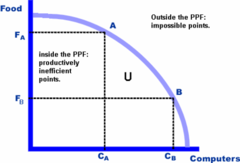
production possibilities frontier
total amount of output of a society
Money is efficiency enhancing tool that helps us engage in exchange.
law of demand
negative correlation; all else being equal, as the price of a product increases (↑), quantity demanded falls (↓) ; likewise, as the price of a product decreases (↓), quantity demanded increases (↑).
law of supply
fundamental principle of economic theory which states that, all else equal, an increase in price results in an increase in quantity supplied. In other words, there is a direct relationship between price and quantity: quantities respond in the same direction as price changes.
equilibrium
quantity demanded equals the quantity supplied
comparative advantage
maximize output; the work gains from trade for individuals, firms, or nations that arise from differences in their factor endowments or technological progress. (cheaper for one country to produce oranges and the other country to produce apples)
price ceiling
cannot exceed certain amount; a government-imposed price control or limit on how high a price is charged for a product
elasticity
the measurement of how responsive an economic variable is to a change in another
- the more substitutes the more elasticity for a price
- luxury/necessity
- the more time the more elasticity
total revenue =
price x quantity
marginal revenue
additional revenue you get from selling an additional unit (can be negative)
total cost =
cost of unit x quantity
marginal cost
Cost of each additional unit, change of cost over change in quantity (additional unit could cost more or less); change in the total cost that arises when the quantity produced is incremented by one unit. That is, it is the cost of producing one more unit of a good. In general terms, marginal cost at each level of production includes any additional costs required to produce the next unit.
profit max rule
produce a quantity where marginal revenue = marginal cost
invisible hand
a metaphor used by Adam Smith to describe unintended social benefits resulting from individual actions
entrepreneurs
individual who seeks arbitrage opportunities
perfect competition
1. many buyers
2. homogeneous product (a lot of substitutions)
3. free entry/exit from market
monopoly
opposite of perfect competition; failure; MARKET POWER; restricts quantity and raises price; dead weight loss is the downfall; restrict quantity relative to perfect competition; unsustainable on their own
1. Single seller/firm
2. No close substitutes
3. No free entry/exit from market
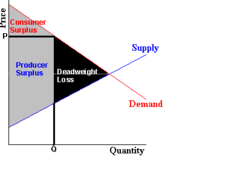
dead weight loss
uncaptured gains from a trade - value production more than cost of production; (also known as excess burden or allocative inefficiency) is a loss of economic efficiency that can occur when equilibrium for a good or service is not achieved or is not achievable; distorts peoples' behavior; government failure > taxes ... DWL
cartel
several firms agree to cut output and charge higher price; OPEC
Sherman antitrust act
passed by Congress in 1890, that prohibits monopolies or unreasonable combinations of companies to restrict or in any way control interstate commerce. Specifically outlawed is two or more persons engaging in monopolistic practices, such as price fixing, although it does not outlaw price-fixing per se... Price fixing is illegal
innovation
lower cost, new marginal cost; firms can earn profits by innovating
Joseph Schumpeter
creative destruction- old ideas are replaced with new.. endless cycle
natural monopoly
a monopoly in an industry in which high infrastructural costs and other barriers to entry relative to the size of the market give the largest supplier in an industry, often the first supplier in a market, an overwhelming advantage over potential competitors.
marginal benefits
incremental increase in the benefit to a consumer caused by the consumption of one additional unit of a good or service.
externality
the cost or benefit that affects a party who did not choose to incur that cost or benefit. (putting on deodorant);market failure; be positive (under produced) and negative (over produced)
• Optimal solution: pogouvian tax
• Ronald coase: coase theorem
• Public good: non-rival: anyones consumption doesn't diminish anyone elses consumption, marginal cost is 0 and charging a price would be inefficient; non-excludable:
Piguo
Invents Pigouvian Subsidy Tax; estimates what marginal external cost is and tries to tax the firm what the cost is
Coase Theorem
as long as transaction cost are low and property rights are well defined the market can allocate resources
rational ignorance
it makes sense not to be interested; refraining from acquiring knowledge when the cost of educating oneself on an issue exceeds the potential benefit that the knowledge would provide.; Voting is a non-marginal: vote only matters if it effects the final outcome; expressing of preferences
rational irrationality
widespread existence of irrational behavior (particularly in the realms of religion and politics) with the assumption of rationality made by mainstream economics and game theory.
concentrated benefits
benefits one specific group/part of population (braves stadium benefits the braves the most)
dispersed costs
costs are spread widely among a population (braves stadium cost is spread among the cobb county population
bureaucrat
looking out for own self-interests; an official in a government department, in particular one perceived as being concerned with procedural correctness at the expense of people's needs
regulatory capture
Bureaucrats tend to get captured by the industries that they regulate; form of political corruption that occurs when a regulatory agency, created to act in the public interest, instead advances the commercial or political concerns of special interest groups that dominate the industry or sector it is charged with regulating.
rent seeking
happens from lobbying to form an artificial monopoly; the use of the resources of a company, an organization or an individual to obtain economic gain from others without reciprocating any benefits to society through wealth creation. (uber v. taxis) using resources to lobby for restrictions to increase profits to create an artificial monopoly/power.
profit seeking
dead weight loss of taxation (Peguvian tax); DWL from taxation
price floor
minimum wage is a...
asymmetric information
study of decisions in transactions where one party has more or better information than the other
moral hazard
(first class asymmetrical) tendency of moral habits to act in undesirable manor; prohibits agents from acting properly; insurance and deductibles keeps everyone on track
adverse selection
agents selectively engage in trade to take advantage of private information
market failure
a situation in which the allocation of goods and services is not efficient. That is, there exists another conceivable outcome where an individual may be made better-off without making someone else worse-off.
changes in demand
- increase in wealth
- change in price of another good
- change in buyer preferences
gross domestic product
only captures legal transactions; doesn't measure leisure transactions; GDP = C + I + G + NX
Business cycle
the downward and upward movement of gross domestic product (GDP) around its long-term growth trend. These fluctuations typically involve shifts over time between periods of relatively rapid economic growth (expansions or booms), and periods of relative stagnation or decline (contractions or recessions).
boom
a period of rapid economic expansion resulting in higher GDP, lower unemployment and rising asset prices.
bust
a period of time during which economic growth decreases rapidly. In the stock market, busts are usually associated with bear markets. During busts, inflation decreases, and in extreme cases, can cause deflation. In addition, unemployment rises, income falls and demand decreases.
recession
a business cycle contraction which results in a general slowdown in economic activity. Macroeconomic indicators such as GDP (gross domestic product), investment spending, capacity utilization, household income, business profits, and inflation fall, while bankruptcies and the unemployment
Say's Law economics
or the law of markets, found in classical economics, states that aggregate production necessarily creates an equal quantity of aggregate demand.
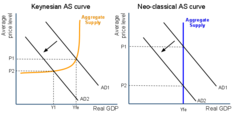
J.M. Keynes Theory
An economic theory of total spending in the economy and its effects on output and inflation.
Fiscal Policy
changes in how we spend money (increase G and decrease taxes)
monetary policy
adjustment of the money supply (increase MS = inflation); federal reserve bank
inflation
continuous devaluation of money
compounding
the process where the value of an investment increases because the earnings on an investment, both capital gains and interest, earn interest as time passes. This exponential growth occurs because the total growth of an investment along with its principal earn money in the next period. This differs from linear growth, where only the principal earns interest each period.
rule of 72
how long it takes for an economy to double (72/r)
real GDP
dollar values are different in different time periods
Robin Hood Theory
income is redistributed so that economic inequality is reduced. The effect is named after Robin Hood, said to have stolen from the rich to give to the poor.
income distribution
how a nation's total GDP is distributed amongst its population. Income and its distribution have always been a central concern of economic theory and economic policy
income inequality
The unequal distribution of household or individual income across the various participants in an economy. Income inequality is often presented as the percentage of income to a percentage of population. For example, a statistic may indicate that 70% of a country's income is controlled by 20% of that country's residents.
Gini Coefficient
measure of statistical dispersion intended to represent the income distribution of a nation's residents, and is the most commonly used measure of inequality.
Lorenz Curve
shows how much distribution is skewed. a graphical representation of the distribution of income or of wealth. It was developed by Max O. Lorenz in 1905 for representing inequality of the wealth distribution.

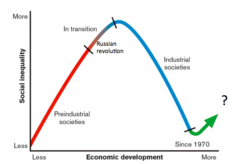
Simon Kuznet's Curve
society's start with equal incomes, as we become more industrialized incomes become less equal, but afterwards it becomes unequal again. Graphs the hypothesis that as an economy develops, market forces first increase and then decrease economic inequality.
optimal income distribution
the study of designing and implementing a tax that reduces inefficiency and distortion in the market under given economic constraints. Generally, this criterion consists of individuals' utility and the optimization problem involves minimizing the distortions caused by taxation.
utilitarian
Jeremy Bentham, John Stuart Mill, a theory in normative ethics holding that the best moral action is the one that maximizes utility. Utility is defined in various ways, but is usually related to the well-being of sentient entities. Classically, Jeremy Bentham defined utility as the aggregate pleasure after deducting suffering of all involved in any action.
maximin criterion
John Rowls, In decision theory, the pessimistic (conservative) decision making rule under conditions of uncertainty. It states that the decision maker should select the course of action whose worst (maximum) loss is better than the least (minimum) loss of all other courses of action possible in given circumstances. Also, called maximin regret or minimax criterion.
entitlement theory of justice
Robert Nozick, theory of distributive justice and private property created by Robert Nozick in his book Anarchy, State, and Utopia. The theory is Nozick's attempt to describe "justice in holdings" (Nozick 1974:150) - or what can be said about and done with the property people own when viewed from a principle of justice.
negative income tax
a progressive income tax system where people earning below a certain amount receive supplemental pay from the government instead of paying taxes to the government. Such a system has been discussed by economists but never fully implemented.
long run growth
A period of time in which all factors of production and costs are variable. In the long run, firms are able to adjust all costs, whereas in the short run firms are only able to influence prices through adjustments made to production levels.
short run growth
expresses the concept that an economy behaves differently depending on the length of time it has to react to certain stimuli. The short run does not refer to a specific duration of time but rather is unique to the firm, industry or economic variable being studied. A key principle guiding the concept of short run and long run is that in the short run, firms face both variable and fixed costs, which means that output, wages and prices do not have full freedom to reach a new equilibrium.
stagflation
high unemployment, high inflation
policy ineffective proposition
M (money supply) V (velocity: assume constant) = P (price level) Q (quantity) ... MV = PQ
Long Run Phillips Curve
tells us that there is no single unemployment number that one can single out as the full employment rate. Instead, there is a trade-off between unemployment and inflation.

rational expectations
An economic idea that the people in the economy make choices based on their rational outlook, available information and past experiences. The theory suggests that the current expectations in the economy are equivalent to what the future state of the economy will be.
inflation
increase in money supply; quantity supply of money
levels of unemployment
people who want to work and whether they are looking for work or not; U4; looking for job within 2 weeks, 1 year, 2 years; THE OPTIMAL RATE OF UNEMPLOYMENT IS NOT 0
frictional unemployment
is good. A type of unemployment explained by people being temporarily between jobs, searching for new ones. A labor market is regarded as being in the state of full employment if no frictional unemployment is present.
structural unemployment
A type of unemployment explained by a mismatch between the requirements of the employers and the properties (such as skills, age, gender, or location) of the unemployed.
cyclical unemployment
not good. A type of unemployment explained by the demand for labor going up and down with the business cycle.
Pigouvian Solution
don't know who values what, voluntary solution; cobb Braves stadium
Pigouvian Tax
pollution from cars into stream that kills fish, fishers complain external cost = tax damage to fisheries .. less damage
Rowls Theory
the theory of justice
Coasean Solution
fisherman complaining about pollution.. tax; car company says they'll pay fisherman to pollute stream
Non-Excludable Good
once a good has been created, it is impossible to prevent other people from gaining access to it (or more realistically, is extremely costly to do so).
Non-Liable
not liable
Non-Rival Good
a good that an be used by more than one individual at once
intermediate good
a good or service that is used in the eventual production of a final good, or finished product. These goods are sold by industries to one another for the purpose of resale or producing other goods.
final good
A good or service that is consumed by the end user and does not require any further processing. See also intermediate good.
circular flow
households and firms
