Vet Med Term - Ch 16
 Call Kai
 Learn
 Practice Test
 Spaced Repetition
 Match
 Flashcards
 Knowt Play
1/205

There's no tags or description
Looks like no tags are added yet.
206 Terms
Physical exams are performed to
Assess a patient’s condition
Assessment
Used to describe the evaluation of a condition
Signalment
A description of the animal with info about the animal including species, breed, age, and sexual status
Vital signs
Taken from animal to assess its health
Temperature
Pulse (pulse rate)
Respiration (respiration rate) (RR)
Blood pressure (BP)
Temperature
Vital sign that provides an indication of animal’s core body temp
Fever
Elevated body temp
Febrile
Med term for fever
Afebrile
Without a fever
Pyrexia
Med term for fever
Pyr/o
Fire
Hypothermia
Decrease in body temp
Pulse (pulse rate)
Vital sign that tells the number of time the heart beats/min
Heart rate (HR)
Number of times heart contracts and relaxes/min
Respiration (respiration rate) (RR)
Number of respirations/min
one total inhale and one total exhale
Blood pressure (BP)
Vital sign that may be taken on vet patients
Sphygomomanometer
Instrument used to measure blood pressure
Doppler
Instrument used to listen to blood sounds during the movement of blood pressure in animals
Normal dog vital signs
Heart rate (beats/min) → 70-160
Respiratory rate (breaths/min) → 8-20
Rectal temp (C) → 38-39
Rectal temp (F) → 100.5-102.5
Normal cat vital signs
Heart rate (beats/min) → 150-210
Respiratory rate (breaths/min) → 8-30
Rectal temp (C) → 38-39
Rectal temp (F) → 100.5-102.5
Normal hamsters vital signs
Heart rate (beats/min) → 250-500
Respiratory rate (breaths/min) → 35-135
Rectal temp (C) → 37-38
Rectal temp (F) → 99-100.5
Normal guinea pigs vital signs
Heart rate (beats/min) → 230-280
Respiratory rate (breaths/min) → 42-104
Rectal temp (C) → 37-39.5
Rectal temp (F) → 99-103
Normal rabbits vital signs
Heart rate (beats/min) → 130-325
Respiratory rate (breaths/min) → 300-60
Rectal temp (C) → 38.5-40
Rectal temp (F) → 101.5-104
Normal horses vital signs
Heart rate (beats/min) → 28-50
Respiratory rate (breaths/min) → 8-16
Rectal temp (C) → 37.5-38.5
Rectal temp (F) → 99.5-101.5
Normal cattle vital signs
Heart rate (beats/min) → 40-80
Respiratory rate (breaths/min) → 12-36
Rectal temp (C) → 38-39
Rectal temp (F) → 100.5-102.5
Normal sheep vital signs
Heart rate (beats/min) → 60-120
Respiratory rate (breaths/min) → 12-50
Rectal temp (C) → 39-40
Rectal temp (F) → 102.5-104
Normal goat vital signs
Heart rate (beats/min) →70-135
Respiratory rate (breaths/min) → 12-50
Rectal temp (C) → 38.5-40.5
Rectal temp (F) → 101.5-105
Normal pig vital signs
Heart rate (beats/min) → 58-100
Respiratory rate (breaths/min) → 8-18
Rectal temp (C) → 39-40
Rectal temp (F) → 102.5-104
Normal llama vital signs
Heart rate (beats/min) → 60-90
Respiratory rate (breaths/min) → 10-30
Rectal temp (C) → 37-39
Rectal temp (F) → 99-102.5
Normal ferret vital signs
Heart rate (beats/min) → 230-250
Respiratory rate (breaths/min) → 33-36
Rectal temp (C) → 38-40
Rectal temp (F) → 100.5-104
Auscultation
Act of listening
used to assess condition of heart, lungs, pleura, and abdomen
Palpation
Examination by feeling
can feel texture, size, consistency, and location of body parts or masses
Percussion
Examination by tapping the surface to determine density of a body area
sound may be produced and varies depending on amount of fluid, solid, or air present in area
Some instruments used for looking
Ophthalmoscope
Otoscope
Speculum
Speculum
Instrument used to enlarge the opening of a canal or cavity
is attached to an otoscope (or another scope) to provide a better view of canal or cavity
Venipuncture
Withdrawing blood from a vein (usually with a needle and syringe)
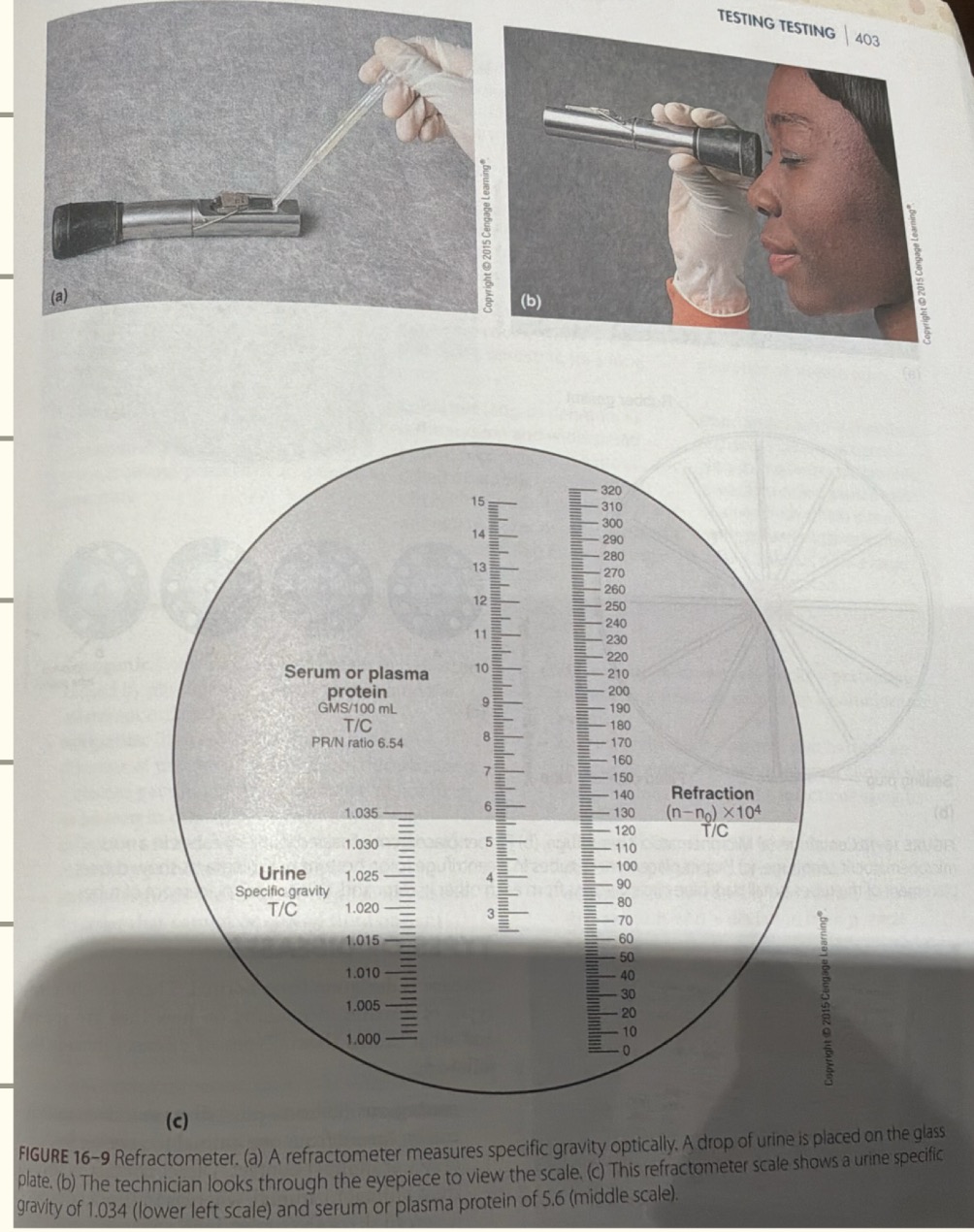
Refractometer
Instrument used to determine the deviation of light through objects
used to measure:
Solute (particle) concentration of serum
Urine
Other body fluids

Centrifuge
Machine that spins samples very rapidly to separate elements based on density
used to separate:
The formed elements of blood from liquid portion of blood
The liquid portion of urine from the heavier solids
Acid
The property of low pH, or high number of hydrogen ions
Alkaline (basic)
The property of high pH, or low number of hydrogen ions
Urine pH is affected by diet
Herbivores → more alkaline (higher pH) than carnivores
yellow-orange → acid urine
Green-blue → alkaline urine
Diagnosis
The determination of the cause of disease; to “know completely”
Diagnoses
Plural form of diagnosis
To diagnose
Is to determine the cause of disease
Differential diagnosis
The determination of possible causes of diseases; a list of possible causes of disease
Prognosis
The prediction of the outcome of disease; to “know before”
Sign
A characteristic of disease that can be observed by others
Symptom
A characteristic of disease that can be sensed only by the patient; incorrect term in vet med
Syndrome
A set of signs that occur together
Acute
Having a short course with a sudden onset; implies severe
Peracute
Having an excessively acute onset
Chronic
Having a long course with a progressive onset; persisting for a long time
Remission
Partial or complete disappearance of disease signs
Endemic
The ongoing presence of a disease in a group
also called enzootic if the disease is always present in an animal community
Epidemic
The sudden and widespread outbreak of disease in a group
also called epizootic if the outbreak attacks many animals in a group
Called episodic if the outbreak occurs sporadically
Pandemic
Disease outbreak occurring over a large geographic area
also called panzootic if the widespread outbreak affects many animals over a large geographic area
Pathogen
A microorganism that produces disease
Microorganism
A living organism of microscopic dimensions
not all microorganism are pathogens
Some microorganisms are normal flora
Normal flora
Live in animal’s body without causing disease
Bacterium
A microscopic, prokaryotic unicellular organism
examples:
Staphylococci
Streptococci
Bacilli
Spirochete
Endospore
Rickettsia
Bacteria
Plural form of bacterium
Prokaryote
An organism without a membrane-bound nucleus
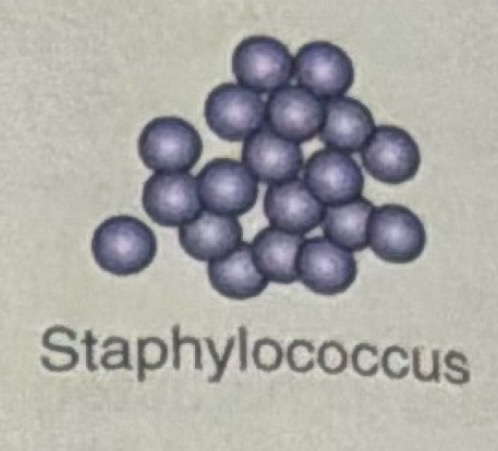
Staphylococci
Grapelike clusters of spherical bacteria
when “s” is lower case, used to describe morphology
When “S” is upper case, used as a genus name
Coccus
Sphere
Cocci
Plural form of coccus
Staphylococcus
Single form of staphylococci
Staphyl/o
Grapelike clusters

Streptococci
Spherical bacteria that form chains
when “s” is lower case, used to describe morphology
When “S” is upper case, used as a genus name
Streptococcus
Singular form of streptococci
Strept/o
Chain

Bacilli
Rod-shaped bacteria
when “b” is lower case, used to describe morphology
When “B” is upper case, used as a genus name
Bacillus
Singular form of bacilli

Spirochete
Spiral-shaped bacterium that are tightly coiled
Spirochetes
Plural form of spirochete

Endospore
A resistant, oval body formed in some bacteria

Rickettsia
A small rod-shaped bacterium transmitted by lice, fleas, ticks, or mice
Rickettsiae
Plural form of rickettsia
Fungus
A eukaryotic organism without chlorophyll
examples:
Yeast
Mold
Fungi
Plural form of fungus
Eukaryote
organism with a membrane-bound nucleus

Yeast
A budding form of fungus

Mold
Filamentous form of fungi

Parasite
An organism that lives on or in another living organism

Virus
A small organism that is not visualized via light microscopy; live only by invading cells
Virulence
Used to describe the degree to which an organism causes disease
Disease
Deviation from normal
Contagious disease (communicable)
Disease that can be spread from one animal to another by direct or indirect contact
Iatrogenic disease
Disorder caused by physicians or vets (and the treatment ordered)
Idiopathic disease
Disorder of unknown cause
peculiar to an individual and not likely to be seen in others
Infectious disease
Disorder caused by pathogenic organisms
Noncontagious disease
Disorder that cannot be spread from one another to another animal or by contact with a contaminated object
Noninfectious disease
Disorder not caused by organisms (e.g. genetic, traumatic, and iatrogenic)
Nosocomial infection
Disorder caused by pathogenic organisms contracted in a facility or clinic
Asymptomatic
Without signs of disease
Atraumatic
Pertaining to, resulting from, or caused by a non injurious route
Carrier
Animal that harbors an infectious agent without displaying clinical signs and who may transmit the infectious agent to others
Clinical
Visible, readily observed, pertaining to treatment
Contract
To catch a disease
Epidemiology
Study of relationships determining frequency and distribution of disease
Etiology
Study of disease causes
Excessive
More than normal