Structural Etiologies
 Call Kai
 Learn
 Practice Test
 Spaced Repetition
 Match
 Flashcards
 Knowt Play
1/25

There's no tags or description
Looks like no tags are added yet.
26 Terms
Acute vs Progressive
Acute structural changes:
Trauma
medical/surgical trauma
ETT
Tracheostomy
Cervical spine surgery
Carotid/Thyroid surgery
infection
chemical agents/toxins
Progressive Transformations:
osteophytes
diverticula
esophageal abnormalities
esophageal strictures/webs
neoplasms/cancer
Framework
What changed structurally
What did that structure normally do?
What swallowing physiology is disrupted?
What would I expect to observe?
What does that matter clinically?
Acute: Trauma
Accidental Trauma:
GSW
MVC
Falls
Penetrating trauma (knife wound)
Structural changes may coexist w/ changes in innervation
Trauma
If the same trauma occurs at 3 different levels (oral, pharyngeal, esophageal), what would you expect to look different clinically?)
Oral injury? Reduced bolus prep, poor bolus containment, AP transit
Pharyngeal injury? Altered airway protection, pharyngeal pressure generation, bolus clearance issues (residue)
Esophageal injury? pain, altered motility, retrograde flow
ETT: Endotracheal Intubation
ETT passes through the mouth (usually) into trachea for ventilation
Longer intubation associated w/ higher reports of dysphagia rate
Intubation can alter laryngeal sensation → silent aspiration may occur s/p extubation
Possible structural effects: Arytnoid injury, VF immobility; laryngeal edma, irritation, over time subglottic stenosis (narrowing of trachea)

PED (Post Extubation Dysphagia)
What are we looking for?
Airway protection: Voice changes, coupe with PO, secretion management, respiratory changes
Structural/Sensory clues: Edema, irritation, granulation tissue (laryngeal granulomas), suspected VF immobility
PED Often resolves w/in 48 hours → But not always
Tracheotomy/Tracheostomy
tracheotomy: creates an opening into the trachea
tracheostomy: the temporary or permanent opening with a tube (the actual tube)
trache bypasses the upper airway and changes the normal aerodigestive configuration
indications for needing a trach: upper-airway obstruction, respiratory failure (usually prolonged intubation w/ multiple failed extubations, secretion management needs, and many more (i.e. can’t be discharged while intubated)
Swallowing impacts are not explained by tube alone; consider mechanical and neurophysiological changes
Can cause decreased laryngeal elevation, decreased subglottal pressure** (this decreased pressure leads to us: not having adequate VF closure, which increases risk of aspiration); can’t voice/talk
Having a trach significantly increases risk of aspiration (that, is from just having trach alone, when also considering how they may be immunocompromised, respiratory status poor, sitting in hospital, not moving, etc., so already high risk for Aspiration PNA); also can cause reduced laryngeal sensation which can increase risk of SILENT ASPIRATION.
Basic Components of a Tracheostomy Tube
outer cannula: the outside wall of the trach tube providing basic stucture
Inner cannula: the tube that fits inside outer cannula; can be disposable or non-disposable (changed or cleaned each day)
flange: the “neck plate” that secures trach tube in place arounf pt’s neck; extends laterally and has slit on each side to allow for fastening of a trach collar around pts neck
Cuff: internal balloon designed to keep air from escaping around the tube from the lower to the upper airway; used to ibtain a closed circuit for ventilation; can be filled with air, water, or foam
Inflation tube/line: pathway for air to inflate and deflate cuff
Pilot balloon: small plastic balloon at end of inflation line allowing inflation/deflation of cuff
trach tie: attached to neck plate, keeps tube in place

Material and size of trach tubes
review

Types of Trach Tubes
Fenestrated vs Non-Fenestrated:
Fenestrated: Has one/two fenestras or “holes” in the outer cannula
WHY:
Openings facilitate airflow beneath the upper and lower airways
Function: aid in the decannulation process to facilitate communication
Cuff/Cuffless:
Air
water
foam
Cuffless (if there is no balloon, it is cuffless)
XL Distal
XL Proximal
which ones depends on anatomy/specific pt.
Speaking Valve
Air is able to enter through the speaking valve and travel to the lungs
Speaking valve closes after peek inspiration is reached causing this to be a closed system
still breathing through trach, but , When the pt exhales, the air does not go out of valve; instead, goes through least resistant pathway through the VF’s and out the Oral and/or nasal cavity (redirects airway to mouth and nose to allow us to speak)
will also usually have trach collar providing them humidified oxygen;
Benefits of Speaking Valve
Improves voice/speech***
reduces anxiety
increases socialization
increased appetite
improves swallow (because restores pressure/back to a closed system which is essential for following)
improves sensation and reduces risk of aspiration
improves secretion management
increases cough strength (bc now we have closed system)
restores Positive End Expiratory Pressure (PEEP) (don’t need to know that)
Improves Overall QOL (quality of life)
Accelerates weaning and decannulation (weaning pt off of trach)
How a Speaking Valve Improves Swallow
Increases Oropharyngeal Sensation
Aids in producing effective Cough
restores Subglottic pressure (i.e. the pressure of air below the glottis when it is closed)
PEEP is restored
Gas exchange is improved
O2 levels improve
reduces risk of Atelectasis (lung collapse)
Improves secretion management
Note: if there is a puff of air that means there is some type of occlusion that is blocking upper airway**** (e.g., maybe too much secretions, etc)
note: if pt has something occluding/blocking upper airway (e.g., tumor), not appropriate for a speaking valve!!! b/c air has no where to go; any type of anatomical structure blocking upper airway does not need speaking valve because air has no where to go out
Medical-Surgical Trauma: Why location matters
Head/neck, C Spine, vascular, thyroid, and airway sx’s can alter both structure and innervation*
Post-operative Edema; note: swelling usually goes down after surgery
Resections changes the available tissue for pressure generation, population, or airway protection
Nerve injury can add neuro component

ACDF: Anterior Cervical Disc Fusion
ACDF or any anterior approach to C Spine can produce dysphagia through post-edema (swelling), altered posterior pharyngeal contour - (reduced pharyngeal constriction from altered contour/pharyngeal edema, epiglottis may not be able to invert as well); new hardware (new hardware on its own can make it harder to swallow), possible nerve injury
What might we see?
Reduced hyolaryngeal elevation, reduced epiglottic inversion, reduced pharyngeal contraction, reduced UES opening, silent aspiration, or even absent pharyngeal swallow
Symptoms vary with surgical level
should not reccomend exercise fresh post sx

Carotid Endarterectomy and Thyroidectomy
is just removal of plaque from carotid artery;
Dysphagia can result when the RLN is injured and VF becomes paralyzed (VF allows us to generate pressure in addition to needed to be closed off for airway protection); results in unilateral VF paralysis
An incompletely closed glottis reduces the VF's role as the last line of defense against aspiration
Medical options: Injections, reinnervations
Structural Changes from Infections, chemicals, and toxins
Infections: fungal, bacterial, viral, or related chemical agents (think people who work in factories breathing stuff in all the time)
Inflammation, swelling, ulceration tissue injury, and airway compromise can rapidly change the swallow;
some conditions are primarily structural; others combine structural changes with neurologic ones
Severity can range from painful swallowing to life-threatening airway compromise (depends on pt and what they are ingesting/breathing in; her story of a pt drinking certain chemical to commit suicide; example of this)
Ludwig’s Angina: Structural emergency
an acute bacterial cellulitis involving submandibular and sublingual spaces
can produce rapid tissue swelling and airway compromise
s/s: pain, swelling, choking sensation, fever, breathing difficulty, drooling, and dysphagia
Priority=medical stabilization and airway management**

Botulism
Infection/toxin→ can produce severe swallowing impairment
Botulism is associated w/ a symmetric, descending paralysis and CN involvement (blocks nerve cells leading to muscles, causes muscle weakness/paralysis; starts in head and face and moves downwards in a symmetrical pattern)
Possible signs: xerostomia, dysarthria, dysphagia, muscle weakness
not every dysphagia following an exposure is caused by a physical obstruction
google s/s: Double or blurry vision; Drooping eyelids (ptosis); Trouble speaking or slurred speech; Difficulty swallowing (dysphagia) or dry mouth; Facial weakness; Descending muscle weakness or paralysis in the arms, legs, and trunk; Breathing difficulties or respiratory failure (which can be fatal if the diaphragm is paralyzed)
Chemical Injury
Ingestion→ Orally or breathing in
Possible structural consequences: Pharyngeal stenosis (narrowing), epiglottic injury, incomplete laryngeal closure, esophageal stenosis (narrowing)
Acute tissue injury can evolve into scar and stenosis
(think same pt drinking bleach for suicide attempt)
Progressive Transformations
Some structural changes develop over months or years rather than after one clear event
common mechanisms include slow bone growth or degradation/change of muscular or mucosal tissue
symptoms may appear gradually, making the onset easy to overlook
Progressive dysphagia should prompt consideration of structural change when the pattern is inconsistent w/ a purely neurogenic explanation.
Cervical Osteophytes
Osteophytes are bony outgrowths that may arise from cervical vertebrae
most are asymptomatic; large osteophytes may narrow the pharyngeal space
Will see often, especially in older pts; usually does not cause aspiration


Zenker’s Diverticulum/Killian Jameison
the pouch can collect food and when larger, contribute to obstruction
possible symptoms: progressive dysphagia, regurgitation of undigested food; weight loss; aspiration, throat mucous sensation
Zenker’s: originate on posterior wall of the PES/UES
Killian Jameison: Anterior lateral wall of the cervical esophagus (difficult to see on MBSS?)
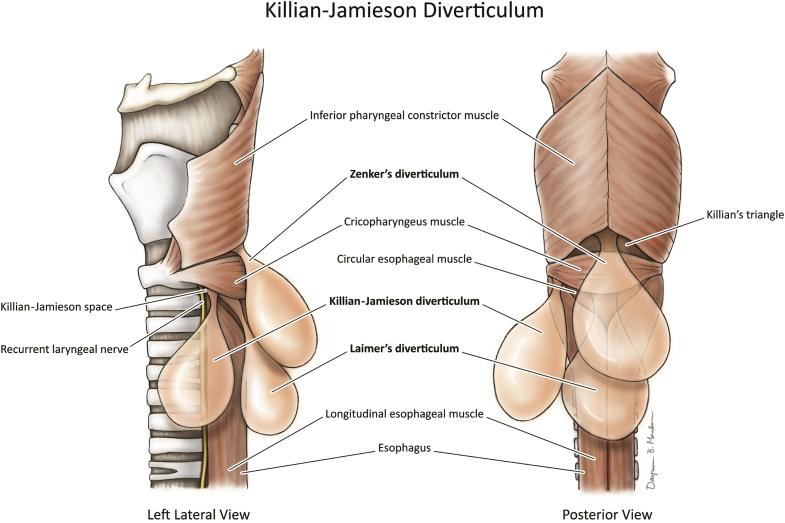

Strictures and Webs
Stricture: narrowing of a tube from inflammation, external compression, or scarring after mechanical/chemical trauma
Esophageal reflux can contribute to reflux strictures
Web: tissue band or ridge; it may be congenital or acquired
Dysphagia, when present, is often more prominent w/ solids
will often refer to GI for differential dx between what is a web and stricture; usually see in upper esophagus area

Esophagitis
What it is: google→ inflammation, irriation, or swelling of the mucosal lining of the esophagus (aka tissues that line the esophagus)
associated w/ candida, herpes, HIV, Cytomegalovirus
Lesion patterns vary by infection: inflammation and ulceration can make swallowing painful
Drug-induced esophagitis can occur when meds remain against the esophageal mucosa (esophageal wall) and cause ulceration (maybe recommend crushed or liquid meds in this case)
Management targets the underlying cause
i.e., reflux, infection, medication-related injury

Review
Acute Trauma: caustic ingestion (requires urgent medical attention; can also cause sensory changes and tissue loss), can cause scarring), prolonged intubation injury (can cause sensory changes, can cause scarring, can cause pain)
Acute inflammation/injury: Ludwig’s Angina (requires urgent medical attention, can cause pain, can cause edema/swelling)
Progressive transformation: cervical osteophytes (possible cause scarring if sx), Zenker’s diverticulum
idk what else required urgen medical attention could be more