Gastrointestinal Infections (GIIs) dr. bay
 Call Kai
 Learn
 Practice Test
 Spaced Repetition
 Match
 Flashcards
 Knowt Play
1/49

There's no tags or description
Looks like no tags are added yet.
50 Terms
what microbes are regularily Found in the Gi tract
• bacteria (majority)
• archaea
• fungi
• viruses
• protozoans (least?)
average adult GI tract surface is 400 m2
95% of bacteria is located in GI tract
Gastrointestinal infections (GII) and enterotoxigenic poisonings resul t in _____ of____
Inflammation of the Gi tract
what is responsible for most o fthe morbidity and
mortality of GIIs
Inflammation-
induced vomiting
and diarrhea are
responsible
what is diarrhea defined as
Diarrhea is defined as a decrease in consistency of bowel
movements (ie. unformed stool) and an increase in
frequency of stools to > 3 per day
acute vs persistent diarrhea
• Acute diarrhea: lasts 14 days or less
• Persistent diarrhea: lasts 14 days or longer
what GIIS caused by
GIIs are caused by a wide variety of viral, bacterial, fungal,
protozoan, and parasitic pathogens
• Common GIIs are viral and bacterial → our focus in class
what is Acute gastroenteritis and its main victims
inflammation of the GI tract
• 25% of all hospitalizations and 85% of all mortality associated with diarrhea involved the elderly (age > 60 yrs)
other groups at risk of Acute gastroenteritis
include children, travelers, campers,
patients in chronic care facilities, and immunocompromised
patients
Acute gastroenteritis and its resulting diarrhea are
caused by _______ resulting in _____
altered movement of ions and water in the
intestineresulting in increased colonic secretion
how does Gi tract normally behave
Normally, the GI tract absorbs a tremendous amount of fluids
and electrolytes → allowing only 100 to 200 mL of fluid to be
excreted in the stool daily
what is Acute infectious diarrhea:
Causes dehydration and is the second leading cause of
mortality in children younger than 5 years of age
Younger children (< 1 yr) have the highest risk of death from acute dehydrating diarrhea
for GIIs why are etiologic agents rarely identified
due to the infrequent
collection of stool samples, or inability of most laboratories
to detect the full range of pathogenic organism
what are the 2 main diarrheal forms
Watery diarrhea
Dysenteric (bloody) diarrhea
features of watery diarrhea
• is the most common; 90-95% of all GII patients
• results in severe dehydration, acidosis, shock, and electrolyte
imbalance
• Virulence factors include toxins that reduce host water adsorption
features of Dysenteric (bloody) diarrhea
• Less common; 5-10% of all GII patients
• results in mild dehydration, tenesmus (continual bowel
evacuation), rectal prolapse (organ misalignment), seizures
• If untreated may result in bacteremia or sepsis
• Virulence factors that promote mucosal and epithelial invasion
symptoms of diarrheal forms
Both diarrheal forms have symptoms of: vomiting, abdominal pain,
cramping, feve
water vs dysenteric compare stool characteristics, transmission and etiologic agents

what is the leading cause of infectious diarrhea
Viruses
what is norovirus
(NoV; aka Norwalk-like
viruses) account for < 90% of viral
gastroenteritis among all age groups
and 50% of outbreaks worldwide
what is Rotavirus
is the most common
cause of infectious diarrhea globally;
primarily affects children < 5 yrs
what are other viral GIIS
Other viral GIIs causing diarrhea
include: astrovirus, enteric
adenovirus, pestivirus, coronavirus,
and enterovirus
Viral gastroenteritis treatments
Antivirals\
Vaccines
features of antivirals
• no single antiviral is completely successful in treating/ curing
enteric viral infections → many in development
• the infection resolves within 3-7 days with adequate
supportive care (ie. ORST)
is their a vaccine for norovirus
No vaccines exist to treat norovirus
is their vaccine for rota virus
Rotavirus vaccine: RotaTeq• Infants (2-6 months):
• Does not protect against other viral gastroenteritis causes
what is the recommended treatment for for mild to moderate GIIs
Oral rehydration solution therapy (ORST)
Bacterial Gastroenteritis Infections
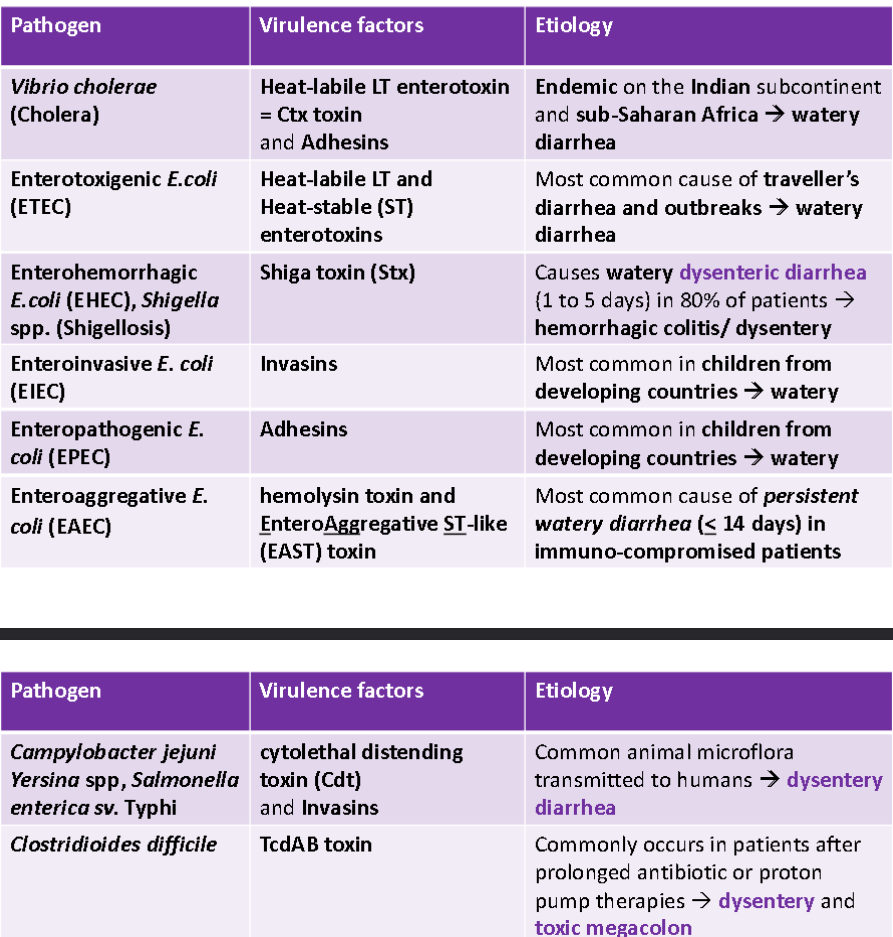
what are Virulence factors altering intestinal function:
adhesins
invasins
toxins (sub group enterotoxins)
what are adhesins
allow bacteria to adhere to host cells (e.g. pili,
lipopolysaccharides)
whata re Invasins
bacterial proteins that damage host cell
membranes to allow bacterial cell entry and invasive spread
what are Toxins
substances that kill host cells by disrupting their
normal function (e.g. Cdt, TcdAB, Hemolysin)
• Enterotoxins → toxins that alter the normal ion flux (Cl-, Na+, K+) and
lining function of host intestinal cells (e.g. LT/ Ctx, Stx, ST/ EAST)
why is stool cultures not recommended for watery diarrhea
Due to the low yield, stool cultures are not
recommended in most mild to moderate watery diarrhea
Stool cultures are only recommended for:?
• dysenteric diarrhea
• persistent diarrhea in immunocompromised patients:
• Patients < 65 years + comorbidity,
• Neutropenia: abnormally low number of WBC neutrophils
• HIV infection
• diarrhea where an outbreak is suggested
A general complication that often occurs long after GIIs,
especially with dysentery and toxin-mediated dysentery,
is _____?
post-infectious irritable bowel syndrome (IBS)
Laboratory tests for GIIs?

What is C. difficile infection (CDI)?
Clostridioides difficile (C. diff) is a bacterium that can cause infection and inflammation in the colon.
It commonly occurs after taking antibiotics that disrupt the normal gut microbiota.
This allows C. difficile to multiply and produce toxins.
These toxins damage the colon lining, causing inflammation and diarrhea.
what is Colonoscopy
raised white and yellowish plaques form
in the colon, and the surrounding mucosa may be
inflamed
what are symptoms of CDI?
ranges from mild diarrhea to life-threatening toxic
megacolon and pseudomembranous enterocolitis
what is treatments for CDI
Fecal transplants are becoming a popular treatment for
CDIs
• Healthy donor feces/ microbiota → oral, pill or suppository forms
what is the most important Diarrhea treatment
Fluid replacement is the cornerstone of therapy for
dehydration due to diarrhea regardless of etiology
• Weight loss monitoring: most reliable means of determining
the extent of water loss
what are other diarrhea treatments
anti-diarrheals
oral rehydration solution (ORS) therapy
what are anti-diarrheals and when are they used
diphenoxylate/atropine and loperamide
act by thickening stool
• Used for acute and chronic diarrhea → usage may mask signs
of more severe infection and increase toxin damage of GI tract
what are
oral rehydration solution (ORS) therapy
and when are they used
ORS includes
carbohydrates (typically glucose), sodium, potassium,
chloride, and water (ORS = <250 mOsmol/L)
• cholera infections: polymer-based ORS may be more
efficacious and contains rice, wheat, sorghum, or maize→ slower release of glucose
what is recommended for mild, self-limiting acute gastroenteritis
a diet of oral
fluids and easily digestible foods is recommended
• Dairy products and high fiber foods should be avoided
what is recommended for For severe dehydrating watery and dysenteric diarrhea
intravenous (IV) rehydration therapy,
antibiotics, and/or anti-diarrheal treatments are needed
• IV Lactated Ringer solution is preferred over saline → lactated
ringer assists in correcting metabolic acidosis
what food items should be avoided in the treatment of dehydration
Clear fluids, such as soft drinks, sweetened fruit drinks,
chicken broth, and sports drinks should be avoided in
the treatment of dehydration
• These hyperosmolar solutions may cause an osmotic
diarrhea
what does The indiscriminate use of antimicrobial therapy result in?
• Increases antimicrobial resistance & drug side effects
• Increases threat of superinfections due to loss of flora
Antibiotic therapy is recommended for?
• severe cases of diarrhea
• moderate-to-severe cases of traveler’s diarrhea
• most cases of febrile (feverish) dysenteric diarrhea
• culture-proven bacterial diarrhea
when is
Antimicrobial therapy not recommended?
Antimicrobial therapy is not recommended in EHEC
diarrhea as it may increase hemolytic uremia syndrome
(HUS) risk
Antimicrobial and Vaccine therapies
