2 Mesopotamia 2 Furious
 Call Kai
 Learn
 Practice Test
 Spaced Repetition
 Match
 Flashcards
 Knowt Play
1/50

There's no tags or description
Looks like no tags are added yet.
51 Terms
3 sources of authority in ED
Temple
Palace
City council (assembly in Stone)
Temple authority
Permanent installation at the heart of the city
Patron deity is a basic element of the city’s identity
Temple leadership may have been hereditary (Stone)
Palace authority- duties of kings
Temple maintenance
Military
Regulation of criminal, commercial, and family activities
Stabilize the economy (Stone)
Maintain peace (Stone)
Satisfy the gods (Stone)
Protect the weak (Stone)
Appoint governors (Stone)
Palaces (Stone)
e.g. Mari
Bathrooms with tubs
Elaborate kitchens
Audience halls - kings as arbiters of justice
ED Kings vibes
Representative of gods, but still human
“Chosen” by the gods
Accountable to gods
Multiple short dynasties (Stone)
City council authority
Little known about them
Cuneiform tablets were mostly from temples
Councils of elders, younger men (free part-time soldiers)
Kings consult on major decisions
I.e. when to go to war
May sometimes have chosen the king
Probably had other civic decision making functions, but we just don’t know
ED Mesopotamian society
Stratified by at least the Uruk period
Wealth and privilege disparities
Status marked by clothing and hairstyles
I.e. in cemetery at Ur
Builder kings
i.e. Gilgamesh of Uruk, King Gudea of Lagash
Metaphor of walls as creating a distinct city space
It’s the responsibility of kings to build temples, improve the city through building grand projects
Also: architects of society, build and maintain social and cosmological order as representatives of the gods (very Wheatley)
Later, kings, have names inscribed on bricks

Gilgamesh of Uruk
(ca. 2800-2500 BCE)
Dates unclear, because the Epic is thought to refer to an earlier time period
Believed to be a real king
Tale describes rise to power, fights with adversaries, gods, etc
Credited with building the first wall around Uruk
Defensive, but also symbolic establishing the city as a distinct social and political order

King Gudea of Lagash
Seated with text on skirts
Holding a model of a temple precinct
Akkadian/ Sargonic Dynasty
(2350-2154 BCE)
Unification of Sumerian and Akkadian city-states by Sargon the Great
The era’s first nation-state (McMahon)
Era of empire
Regional governors (McMahon)
Royal images in key locations (McMahon)
Akkadian language spreads
Official written language (McMahon)
By the later 3rd millennium BCE, the population is bilingual (McMahon)
Capital in Akkad/ Agade
Not yet found (possibly in modern-day Baghdad?)
Ruled for 5 generations
Rulers considered “Kings of the Four Quarters” (McMahon)
Trade and interactions amp up with the Persian Gulf
Bahrain, Oman, IVC
New systems of weights, measures, and legal oaths (McMahon)
Sargon the Great
Had humble beginnings, apparently
Son of a gardener and a priestess
Abandoned as a child
Became cup-bearer at the court of Kish (a position of trust)
Became a military leader, took over all of Southern Mesopotamia for 56 years
Myth persists long after the nation is gone (McMahon)
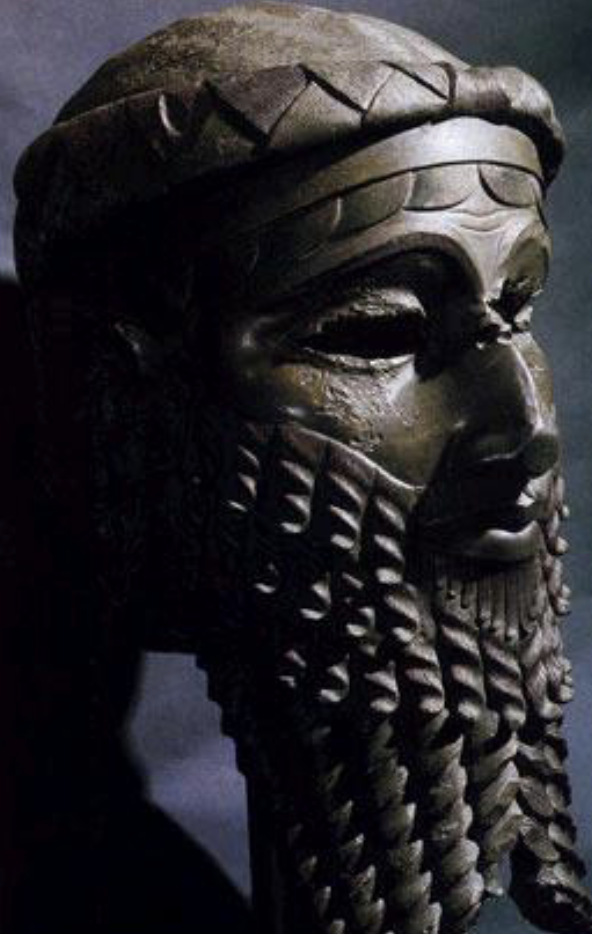
Enheduanna
Daughter of Sargon the Great
Priestess to Moon Goddess Nanna at Ur
The world’s first (known) great poet
Literary star
Example of the trend where women of high status often moved to other parts of the empire to consolidate power
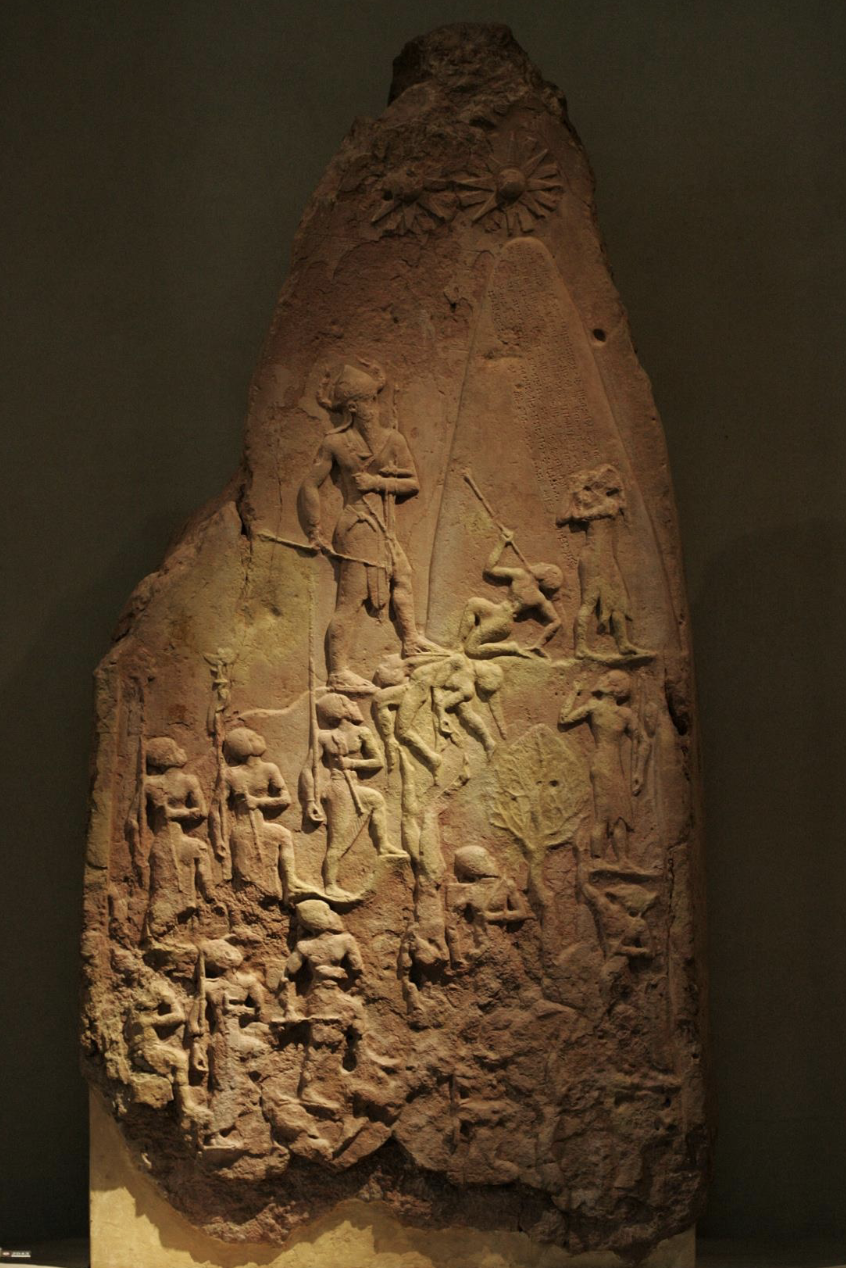
Naram-Sin
Most infamous of the Sargonic kings
Noted for expansion, ruled for 56 years
Known to be extremely confident, proud, and arrogant
Humility was socially expected of kings, therefore bad bad bad
“King of the Four Corners of the Universe”
Made himself a divine king, proclaimed himself a god equal to any gods in the pantheon
This succeeded, even if it was considered impious
Depicted with a horned helmet
Divine and militaristic symbolism
Denoted his status as a god-king (horns were previously only shown on deities)

Naram-Sin’s victory stele
Victory Stele over the Lullubi people in the Zagros mountains
Eastern frontier of the Akkadian empire
Shown larger than everyone else
Stark contrast with early depictions of kings
Akkadian era art (McMahon)
More movement
More detail
Maintains many ED/ Sumerian traditions
Military conquests are celebrated more than buildings
Akkadian seal style (McMahon)
Similar to Northern Mesopotamia
Often had elaborate animal conflict
Akkadian (McMahon)
The oldest known Semitic language
Sumerian (McMahon)
Ergative isolate
Collapse of the Sargonic dynasty
2154 BCE
Rapid collapse (McMahon)
Things began to fall apart after Naram-Sin
Short-lived dynasties are a repeating theme
UR III
2112-2004 BCE
Another attempt at empire after Sargon
There is not a lot of evidence for some time after the Akkadian empire collapses
Established by Ur-Nammu
Builder king
Covers all of Southern Mesopotamia
Political center at Ur
Sumerian as the main language
Return to many ED values
Emphasis on the religious side of kings
Big building boom in Ur
Ziggurats at their greatest height
Monumental art returns in ED forms (McMahon)
Defeated by the Elamite army
Some gaps in the archaeology because of excavation priorities (Pollock)
Or newer buildings destroyed older ones
UR III art (McMahon)
Ziggurats out of stepped platform temples
Icons representing both gods and the kings that built the temples
Art emphasizes the religious aspect of kingship
Baked clay figurines - usually naked and female
Ur III seals (McMahon)
Simplified from the Akkadian period
After Ur III
Era of political collapse after the king is captured by the Elamite army (Isin-Larsa) (McMahon)
Amorite kings filtered in and partially took over some city-states
Babylonians
Kasirtes
Assyrians
Persians (Cyrus the Great)
Isin- Larsa Period (McMahon)
2004-1763 BCE
Time of power struggle after the king of Ur was captured by the Elamite army
Leaders of Isin and Larsa were fighting for control
Hard to distinguish ceramically
Not a lot of monumental architecture
But urban domestic architecture at Ur is from this period
Courtyards surrounded by rooms, irregular architecture, winding streets
Old Babylonian Period (McMahon)
1763-1595 BCE
Babylon eventually won the power struggle
King Hammurabi
Mass-produced clay figures
Social classes in the Old Babylonian Period (McMahon)
Slave
Poor
Free
Female
3rd- early second-millennium BCE (McMahon)
Unclear era
Kingdom of Upper Mesopotamia/ Assyria (McMahon)
1813-1741 BCE
Mari: huge palace containing texts
Distinct ceramic culture
Eventually defeated by an Anatolian army
Also, an environmental disaster
After this, there is a “dark age” with very little record
Era of empires (McMahon)
Kassites
Mitanni
Assyrians
Elamites
Hittities
Lots of trade
City-states in Northwest Syria
Bronze Age Collapse (McMahon)
~1200 BCE - political collapse
Neo-Assyrian kings (McMahon)
Concept and image of kings were important
Palaces with miles of stone reliefs
Lots of art, seals became elaborate again
Defeated by Mede and Babylon
Neo-Babylonian period (McMahon)
The Ishtar gate was built
The Persian Empire (McMahon)
Started 539 BCE
Main source of Mesopotamia data
Excavation
Most important resource for archaeologists in Mesopotamia (McMahon)
Pottery
Mesopotamia excavation advantages
Rich architectural record
Many large sites
Some with very long occupation
Pretty good preservation
Apart from 20th century military damage
Preserved well because of desert conditions (Stone)
Mesopotamia excavation challenges
Massive tell sites
Very deep stratigraphy
Up to 50 m of continuous occupation
Alluvial accumulation, dune abrasion (in the south), wind and water erosion lead to the destruction of many sites (McMahon)
History of the field of archaeology
Takes off in West Asia, Egypt after Napoleon
By the mid-19th c., Europeans are fascinated with Mesopotamia
The Ottoman Empire begins to lose its hold, enabling research
Massive projects in West Asia
Sometimes for decades, even up to 100+ years
Funded by wealthy patrons in “The Golden Age of (Colonial) Archaeology”
Museum collection was the main motivation (McMahon)
The Louvre et al. refuse to recognize return claims of stolen things
Time of massive institutional looting
1920s (McMahon)
Shift to categorization and material culture sequencing
1960s onward (McMahon)
Wider questions of structure and progress drive research
Modern conflict
Over past 50 years, field research has declined
Many archaeologists now document damage and looting
Excavations at Tell Muquayyer
The City of Ur
Tells rises ~20 m in height above the desert plain
Ur
Sumerian city in southern Mesopotamia
By the Euphrates
At a strategic point controlling trade from the Persian Gulf
Materials from the Gulf itself, IVC
Known from biblical texts as the birthplace of Abraham
Early excavations at Ur - who?
John George Taylor
British Museum (check out my collab on next week’s video!)
Main urban occupation period of Ur
ED period, Akkadian era, Ur III
Ur city dimensions
~1200 m long, ~800 m wide
Ur city fun facts
2 ports
Walled city - 8 m tall walls
Both defensive and symbolic
Practice goes back to Uruk
Cities associated with temples of gods, so walls enclose and protect that sacred space, too
Probably connected to self-identification as urbanites
Ur population estimates
2600 BCE: 34,000
By 2000 BCE: 65,000
Leonard Woolley - background
Modest roots, had to get scholarships (rare at the time)
Studied theology at Oxford, became a freelance archaeologist
Trained by Flinders Petrie at Tell Amarna in Egypt
Petrie trained a lot of women and people from the Global South (more slayful than his name implies)
Never held an academic position
Spent a lot of time in Mesopotamia and Anatolia
Tell Achana in Turkey as a British spy (strong Laurie vibes ☹ )
Ur Excavation dates
1923-1934
Ended due to the Great Depression
Ur Excavation - Institutions
British Museum (everywhere? everywhere.)
University of Pennsylvania
Iraq National Museum
Guest stars at the Ur excavation
TE Lawrence
Max Mallowan
Gertrude Bell
Max Mallowan
Trainee at Ur
Went on to work at Nineveh
Agatha Christie’s husband