Structure and Bonding
 Call Kai
 Learn
 Practice Test
 Spaced Repetition
 Match
 Flashcards
 Knowt Play
1/19

There's no tags or description
Looks like no tags are added yet.
20 Terms
Describe the bonding in an ionic compound, e.g. sodium chloride
- giant ionic lattice
- electrostatic forces hold together oppositely charged ions
DO NOT mention intermolecular forces or molecules
Describe the bonding in graphite.
- giant covalent (2 marks)
- each C bonded to 3 others (1 mark)
- arranged in layers (1 mark)
- weak forces between layers (1 mark)
- delocalised electrons can move between layers (1 mark)
DO NOT mention intermolecular forces, ions, or molecules
Describe the bonding in diamond.
- giant covalent (2 marks)
- each carbon is bonded to 4 others (1 mark)
- held together by many strong covalent bonds (2 marks)
DO NOT mention intermolecular forces, ions, or molecules
Describe the bonding in a simple covalent molecule.
- covalent bonds between atoms
- weak intermolecular forces between molecules
Why does diamond have a high melting point?
- contain many strong covalent bonds (3 marks)
- that require a lot of energy to break (1 mark)
DO NOT mention intermolecular forces, ions, or molecules
Why does graphite have a high melting point?
- contain many strong covalent bonds (3 marks)
- that require a lot of energy to break (1 mark)
DO NOT mention intermolecular forces, ions, or molecules
why do simple molecular structure substances have a low melting and boiling point?
- held together by weak intermolecular forces (2 marks)
- doesn't take much energy to break them (1 mark)
Why do ionic compounds have a high melting point?
- strong electrostatic forces (2 marks)
- between oppositely charged ions (1 mark)
- require lots of energy to break (1 mark)
DO NOT mention intermolecular forces or molecules
diagram of graphite
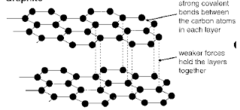
diagram of diamond

diagram of an ionic compound

why is graphite used as a lubricant?
- it is slippery (1 mark)
- because it is arranged in layers (1 mark)
- which can slide over each other (1 mark)
- because there are weak forces between the layers (1 mark)
why is diamond used for cutting (in drill bits)?
- many strong bonds (1 mark)
- mean it is very hard (1 mark)
Why do ionic compounds conduct electricity when molten or in solution?
- ions are able to move (1 mark)
- so can carry charge (1 mark)
Why does diamond not conduct electricity?
there are no electrons or ions free to move
Why do simple covalent compounds not conduct electricity?
there are no electrons or ions free to move (1 mark)
Why do ionic compounds not conduct electricity when solid?
ions can't move (1 mark)
Describe the bonding in fullerenes
A sphere of carbon atoms
each carbon is bonded to 3 others
delocalised electrons can move around the structure
Why are fullerenes used as lubricants?
They are slippery
As there are weak intermolecular forces between the molecules
so they can slide over each other
How does the boiling point of simple covalent compounds change as the SIZE or MASS of the molecule increases?
- bigger molecules have higher boiling points (1 mark)
- because they have stronger intermolecular forces (1 mark)
- which require more energy to break (1 mark)