Muscle systems
 Call Kai
 Learn
 Practice Test
 Spaced Repetition
 Match
 Flashcards
 Knowt Play
1/27

There's no tags or description
Looks like no tags are added yet.
28 Terms
What are the types of tissue and how do they cause movement?
cardiac: squeezes on internal material (blood) and propels it through the circulatory system
skeletal: contraction causes external movement
smooth: propels hollow organ material, such as food, in a certain direction
What do all the 3 types of muscle exhibit?
excitability, elasticity, extensibility, contractility and contractile proteins (mitochondria, nuclei, and plasma membrane)
What is excitability?
can change from relaxed to contracted based on electrical properties at their plasma membranes
What is elasticity?
can return to its original length after contraction
What is extensibility?
can stretch or extend
What is contractility?
allows muscle tissue to pull on its attachment points and shorten with force
how do the three tissues differ in organization?
skeletal: as long as the muscle organ they are arranged in; often referred to as muscle fibers
cardiac: each have one to two nuclei and are physically and electrically
connected to each other with gap junctions so that a charge that occurs in one
cell is spread to others
smooth: contractile proteins are not arranged like stripes, so it’s called “smooth”
Epimysium
sheath of dense, irregular connective tissue
separates muscle from other tissues and organs in the area
allows for passage of blood vessels & nerves between fascicles
fibers of this are continuous with the fibers of the tendon

Fascia
additional layer of dense irregular connective tissue

Fascicle
bundles that muscle cells are organized into

perimysium
connective tissue wrapped around fascicle

endomysium
thin connective tissue layer of collagen fibers surrounding muscle cells

periosteum
membrane of blood vessels and nerves that wraps around most of your bones
tendons are continuous with the fibers of this, uniting muscle to bone for effective movements

How does bone movement work with tension?
the tension created by contraction of the muscle fibers is transferred though the epimysium to the tendon, and then to the periosteum to pull on the bone for movement of the skeleton
What is myogenesis?
Each cell had its own nucleus, upon fusion, you get a longer cell with multiple nuclei
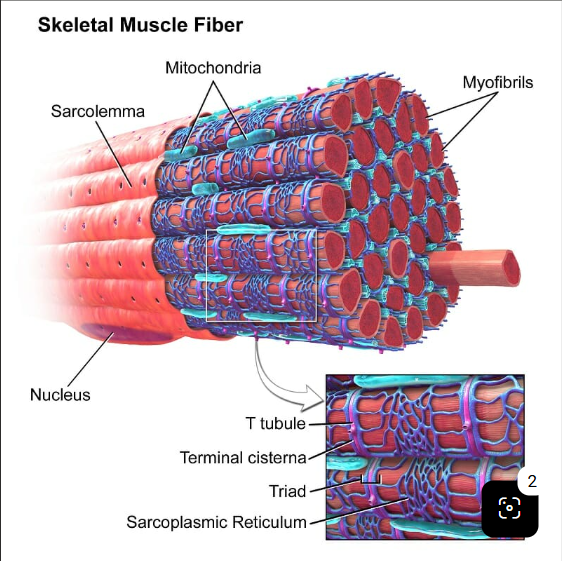
sarcolemma
plasma membrane
lipid bilayer
punctured with deep invaginations called t-tubules
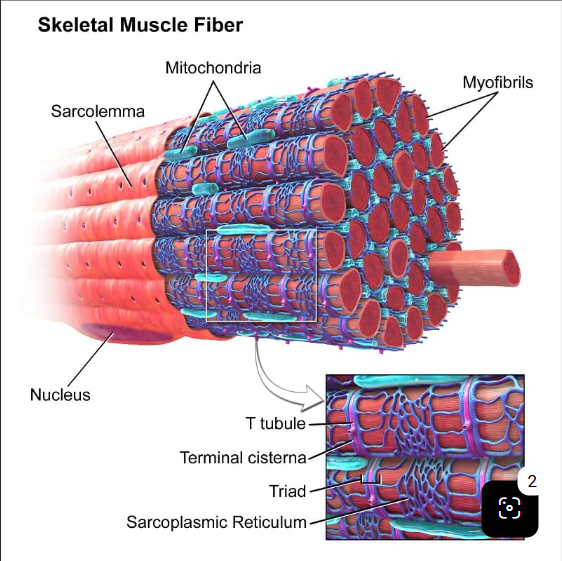
What are t-tubules?
the key to respond to electrical charges
sarcoplasm
cytoplasm
Sarcoplasmic reticulum
functions primarily in storage and release of Ca
calcium ions play a critical role in muscle cell contraction
myofibril
a long cylinder of contractile proteins that shorten during contraction
when myofibrils shorten, they tug on the epimysium at the ends of the muscle, which in turn pulls on the tendons and brings the bones closer together.
Sarcomere
the smallest unit in which contraction occurs; pulls its ends together during contraction
myosin
protein arranged as a thick filament
actin
protein arranged as a thin filament
describe the regions involved in contraction
A-band: entire length of single thick filament
H-zone: paler region within A-zone
M-line: horizontal line at the exact center of the sarcomere
Z-line: thin filament forms the borders that surrounds the thick filaments

what is neuromuscular junction (NMJ)
site of contact between neuron and skeletal muscle
what are Motor neurons
a specialized nerve cell in the central nervous system (CNS) that transmits signals to muscles and glands to control movement
what is a motor end plate
a specialized region of a muscle cell that is part of NMJ
what is membrane potential
The difference in electrical charge between sides
the resting membrane potential is the electrical voltage difference across a cell’s membrane when it is not sending signals
all excitable cells have a significant membrane potential
inside of these membranes is around −60 to −90 mV, difference is due to the Na/K