Biology: Functional Groups and Carbohydrates (Also Water) Quiz Prep
 Call Kai
 Learn
Learn Practice Test
 Spaced Repetition
 Match
Match Flashcards
 Knowt Play
1/41

There's no tags or description
Looks like no tags are added yet.
Name | Mastery | Learn | Test | Matching | Spaced | Call with Kai | Chat |
|---|
No analytics yet
Send a link to your students to track their progress
42 Terms
What are Functional Groups?
Functional Groups are an atom or group of atoms that display consistent properties and reactivity regardless of the exact molecule they are found in.
Are most functional groups polar or ionic? And what do those terms mean?
Yes they are polar which means uneven charges with slightly negative areas and some are ionic meaning they have a full positive or negative charge
Why are functional groups strongly attracted to water and other polar or charged molecules?
Because they are usually polar or ionic and their uneven or full electrical charge allows them to attract water and other polar and charged molecules
How do functional groups affect the properties and behaviour of a larger molecule?
They can make a larger molecule more soluble in water and that allows it to interact and react more easily with other molecules
Why are functional groups called handles on a molecule
Because they provide places where a molecule can attract other substances and take part In chemical reactions
How can we compare ethane and ethonol to show that functional groups can change a molecules properties?
So ethane is a non-polar hydrocarbon with no functional group so it stays gas at room temp and does not dissolve in water, ethonol has a polar hydroxyl group which makes it a liquid at room temp and highly soluble in water.
What are Hydrocarbons?
Chains of carbons and hydrogens
What types of bond are: Alkanes, Alkenes and Alkynes
Alkanes - Single Bonds
Alkenes - Double Bonds
Alkynes - Triple Bonds
What does the Functional group Hydroxyl look like? What Major classes of molecules is it?
Hydroxyl is a single bond: (—OH), O—H
Major Class Of Molecules is: Alcohol

What does the Functional group Carbonyl look like? What Major classes of molecules is it?
Carbonyl is a double bond: (—C=O),
Major classe”s” of Molecules are:
Aldehydes, which are basically on the side of a molecule.
Ketones, which are in the middle of a molecule
Esten O—C=O
Amide N—C=O

What does the Functional Group Carboxyl look like? What Major Classes of Molecules is it?
Carboxyl is both a single and double-bond based on how it’s represented: (—COOH), (C=O, and —OH attached to the C)
Major Classes of Molecules: Organic Acids

What does the Functional Group Animo look like? What Major Classes of Molecules is it?
Amino is a single bond represented in 2 ways: (NH₂) or N—H and another —H connected to the N)
Major Classes of Molecules: Amino Acids

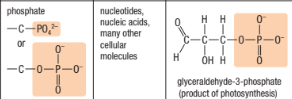
What does the Functional Group Phosphate look like? What Major Classes of Molecules is it?
Phosphate can be represented in 2 ways: (PO₄-2) or P and 3 single bonds of O and 1 double bonded O attached to the same P)
Major Classes of Molecules: Nucleic Acids or Nucleotides
What does the Functional Group Sulfhydryl look like? What Major Classes of Molecules is it?
Sulfhydryl is a single bond: (—SH)
Major Classes of Molecules: Many Cellular Molecules

What is carbon and why does I matter?
So carbon is the backbone of biological molecules and its useful in living things because C can form 4 covalent bonds
What type of structures can carbon create?
Straight Chains: Just a straight chain of carbon
Branched Chains: A main carbon chain with smaller chains coming off it
Rings: Carbon atoms connect in a closed loop

What is the term for the arrangement or chain of carbon atoms?
A carbon skeleton
What is a dehydration synthesis aka condensation reactions? example?
The components of a water molecule are removed to then build a large molecule from smaller subunits. EG: like when sugar molecules combine to form starch which is a large macromolecule.
What is a hydrolysis reaction? Example?
It adds components of a water molecule H+,OH- and then the water breaks down the bigger molecules
EG: Starch breaking down into sugar
Do enzymes catalyze or speed up both dehydration synthesis and hydrolysis reactions?
Yes
What are organic molecules?
They are compounds that contain carbon, hydrogen, and oxygen and they have Carbon-hydrogen bonds and can also contain N,P and sulphur (N,P chem)
What are macromolecules? (or biological molecules)
They consist of carbohydrates, Lipids, proteins, and nucleic acids and they are basically the building blocks of life
What are MONOMERS AND POLYMERS?
MONOMER: Single repeating units that are then joined together to form a POLYMER
So what are carbohydrates
They are essential for all life
plants use them for us through photosynthesis
we get energy from the breakdown of carbs
Its made up of C,H,O the ratio 1:2:1 (CH2O)n
What does the term saccharide and the suffix ose refer to
Sugars
What are monosaccharides
They are simple sugars and the general formula was same as the ratio (CH2O)n 1:2:1 and monosaccharides taste sweet
What are some types of monosaccharides?
Triose, pentose, and hexose (n=3,n=5,n=6)
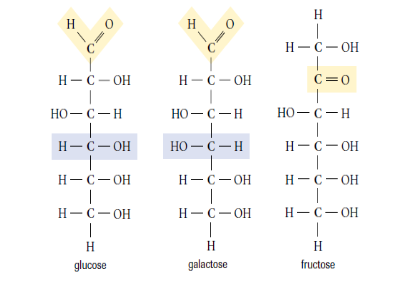
Aldose Vs Ketose? (Aldyhide vs Ketones oo?)
Aldose: Carbonyl Group C=O at the end of c
Ketones are middle of c

How would you write the chemical formula for these monosaccharides and what’s the term you can describe all 3 of them as?
Formula for all 3 of them is C6H12O6
The term is: isomers which basically means that they all have the same chemical formula but have different structure and those isomers have different physical and chemical properties
What does a alpha glucose look like vs beta glucose? how would you recognize it?
Alpha glucose would have the hydroxyl group (OH) under the plane vs beta glucose the hydroxyl group would be above the plane (Alpha OH below, Beta OH above)
What are Disaccharides?
Those are sugars containing two simple sugars (monosaccharides) that are attached by covalent bonds called glycosidic linkages and those bonds form by dehydration synthesis
What is maltose?
Maltose is a disaccaride made up of two glucose molecules joined together by a 1,4-glycosidic linkage

What is sucrose?
Most common sugar found in food and Glucose is bonded to fructose
Do Disaccharides dissolve in water?
Disaccharides generally do they are transportable but don’t get through cell membranes (so controllable).
Whats lactose?
its found in milk which is energy for infant mammals and GLUCOSE IS BONDED TO GALACTOSE and requires enzyme lactase to be digested
What is a polysaccharide?
its a long chain of monosaccharides, usually glucose and it may be branched and unbranched and its used for storage and structure
Plants can store extra glucose as starch but what is starch made of?
Its made up of two molecules
Amylose (20–30%) is a straight, unbranched chain of 1,4 bonds that twists into a tight spiral, making it slow to digest.
Amylopectin (70–80%) is a highly branched chain because it uses both 1,4 and 1,6 bonds, creating an open structure that is much faster and easier for your body to break down.
How is starch stored and are polysaccharides hydrophilic?
Starch is stored as granules in chloroplast
Yes they are hydrophilic but their size means they cant dissolve, (good for storage tho)
What is glycogen
How animals (vertebrates) store sugar in their liver and muscles and have many brahcnes so enzymes can easily convert them to glucose
Cellulose what is that? are cellulose molecules branched or coiled?
Made of chains of beta glucose and is the main component of plant cell walls
Neither which allows many hydrogen bonds to produce tight bundles called microfibrils
Chintin what is that form?
A hard exoskelton of insects and stuff and the cell wall of many fungi (other cool name for chintin is Polymer of N-acetylglucosamine)
Whats the process when carbohydrate bonds need to be broken called? And why do carbohydrate bonds need to be broken down?
So Carbohydrates need to be broken down in order to release a single glucose monosaccharide for cells to use in respiration and the glycosidic bond is then split through a process called hydrolysis that’s when water is added to the bond