14D sn1, sn2, e1, e2
 Call Kai
 Learn
 Practice Test
 Spaced Repetition
 Match
 Flashcards
 Knowt Play
1/57

There's no tags or description
Looks like no tags are added yet.
58 Terms
Nucleophile defintion
aspecies that can donate a electron pair to an electrophile to FORM a bond
-species that can donate an electorn pair/ forms a nond with a hydrogen is called a brostedbase
-usually a base or negatively charged
Electrophile defintion
species than can attack a electrion pair or accept a pair from a nuclepjole to form a new boind
posivitely charged or partial charge
-called acids when the speices accepting the electrron pair is a hydrgoen, called a bronsted acid
haloalkane properties
LG ability ranked?
defined by
size of the halogen substiuent
2. polarity of the carbon halogen bond
which affect the LG ability of the halogen→ defined by bond strength and the stability of molecule holding negative charge after depature
I>Br>Cl>F
Bond length order halogens
I>Br>Cl>F
Bond polarity order halogens
F>Cl>Br>I
Nucleophilic ability of departed LG of haloalkanes (good nucleophiles that are weak bases)
solvent: H20, R-OH (polar, protic)→ I>Br>Cl>F
solvent: polar aprotic → F>Cl>Br>I
what are solvents known to be protic and aprotic
protic; h2o and R-Oh
aprotic: DMSO, DMF, acetone
nucleophilic substiution (general reaction type (uni and bi))
regaent attacs the haloalkane sanad replaces the halide (the nucleophile fully replaces the halide)
type 1 reaction: negatively charged halogen nucleophile= gives rise to neutral profyct and LG
NU- + R-LG→ Nu-R + LG-
type 2 reaction: neutral halogen nucleophile=gives rise to positviely charged product + LG→ where the nucelophile carries the positive formal charge
Nu + R-LG→ (Nu-R)+ + LG-
unique reaction; the nucelophile is a halide, the reaction can go both ways, reversible reaction
rules for electron arrow pushing
the curved arrows never start at the electron deficient areas unless theres another arrow pointing to it→the arrows are unidirectional
when combining a anion with a cation, draw the curved arrow starting at an electiron pair on the anion and ending at the cation
the movement of the electron is determined by which speices ismore electronegative
simple electron pushing reaction types
rxn1: dissociation of a polar covalent bond into ions
rxn2: formation of a covalent bond from ions
rxn 3: combined rxn 1 and rxn 2; simulatimous making and breaking of two bonds→ substitution
rxn 4: reactions making or breaking double/triple bond (addition and elimination)
rxn 1: the more electropnegative species accepts the electron
rxn2: the lone pair moves toward the other atom, forming a new bodn
rxn3: substitution
rxn4: involves attacking the bond itself, arrow points from the bond (ususally the second arrow in order)
what is the mechanism at ewhich the lG leaves frpom a species /nucelophile or electrophile forms
disscoiation, electron pushing from the covalent bond that atatches the two atoms goes to the pre-nucleophile
-usually assisted by being in a polar solvent
nucleophilic addition
alcohol conversion
nucleophilic substitution
sn1, sn2
bimolecular nucleophilic substitution
Sn2
k=[reagent][nucleophile/base]
concerted reaction→ single step front and backside attack
-works best for weakly basic but good nucleophile (must be a good nucleophile to allow one step reaction) and primary akyls
thermodynamics of a sn2 reaction, activation energy diagram
caveat for sn2 reaction where the electorphile is a stereocenter
front and backside attacks create chiral molecules (if the ordering becomes different)
inversion of configuration for sn2
sn2 reactions are stereospecific, backside displacement creates the inversion of configuration (the wedges becomes dashes and the dashes becomes wedges)
retention of configuration reaction
-two sn2 reaction mechanisms
assuming order does not change, substitute 1st with intermdiate nucleophile, which switches the configuration due to backside attack and then substitute with another nucleophile for switching it back
what components does a substitution reaction depend on
-the reactivity of the nucleophile
pthe nature of the LG
-the strcuture of the alkyl portion
nucleophicity versus basicity
nucleophilicity describes how fast the bond forms (thermo, k)
basicity describes the stability of the product (Kb/Ka)
leaving group ability (when can you use pKa as a comparison to determine LG strength)
capacity to accomdate a negative charge
weak bases are good leaving groups (due to ability to accomodate a negative charge) → only use when comparing between closely related species (the lower the pka the better)
common leaving groups for sn2 reaction
halides
sulfur derivatives (ROSO3-)(RSO30)(sulfate ions)
sn2 arrow pushing

Nucleophilicity trends
charge, basicity, solvation, steric hinderance, polarizability
down the row versus across the row
-best nucelophiles are strongly basic and rreadily donate an electrion pair
charge-Of a pair of nucleophiles containing the same reactive atom, the species with a negative charge is the more powerful nucleophile.
basicity-The more basic species is the more reactive nucleophile. As a result, in the progression from the left to the right of the periodic table, nucleophilicity decreases.
solvation
protic→bad for small nuc
aprotic→ goof for small nuc and sn2 reaction
steric hinderance→Sterically bulky nucleophiles react more slowly.
polarizability→ larger and more polarizable, leads to faster nucelophiilic substitution
-down the row→ nuc ability inc
-across the row from right to left→ nuc ability inc
energy curve/act energy curve for protic solv→ what does this indicate about sn2 solvents
sn2 reactions occur best in polar a

protic solvents
effect of reagent on rate of nucleophilic attack/substitution reaction
-works best for unbrached primary alkyls
-the more groups on the electrophlic cabron, the harder for attack
-less effect of a group on the cabron to have a long chain than to be attched to bulky groups→ want it to be UNHINDERED
hinderance
What you’re checking | What makes it hindered? | Effect |
|---|---|---|
Carbon bearing the leaving group | Large groups around that carbon block the nucleophile’s approach | Makes SN2 harder |
Nucleophile/base’s reactive atom | Large groups close to the atom donating its lone pair | Makes attacking carbon harder; a bulky strong base often favors E2 |
what bonds define a protic solvent
n-h or o-h bonds
solvyolysis
went a solvent splits a bond, in most cases, the solvent is also the nucelophile
-works best for secondary and tertiary alkanes
Unstable Carbocation: The first and rate-determining step of an \(S_{N}1\) solvolysis reaction is the loss of the leaving group to form a carbocation. Primary carbocations are highly unstable due to a lack of alkyl groups to provide stabilizing inductive effects and hyperconjugation.
High Activation Energy: Because a primary carbocation is so high in energy, the activation energy required to form it is prohibitive under normal solvolysis conditions.
Preference for \(S_{N}2\): Instead of undergoing solvolysis (\(S_{N}1\)), primary haloalkanes prefer \(S_{N}2\) pathways when a strong nucleophile is present because their unhindered carbon center leaves them highly accessible to backside attack.
difference between the environment for a sn2 vs sn1 reaction from occuring
-when in a solvent + order carbon that is highger than primary, steric hinderance interrupts substitution reactions, the solvent undergoes a sn1 instead of sn2 reqtctionwitht he regaent
unimolecular substitution→sn1 reaction
reaction rate=k[reagent'/starting halide']
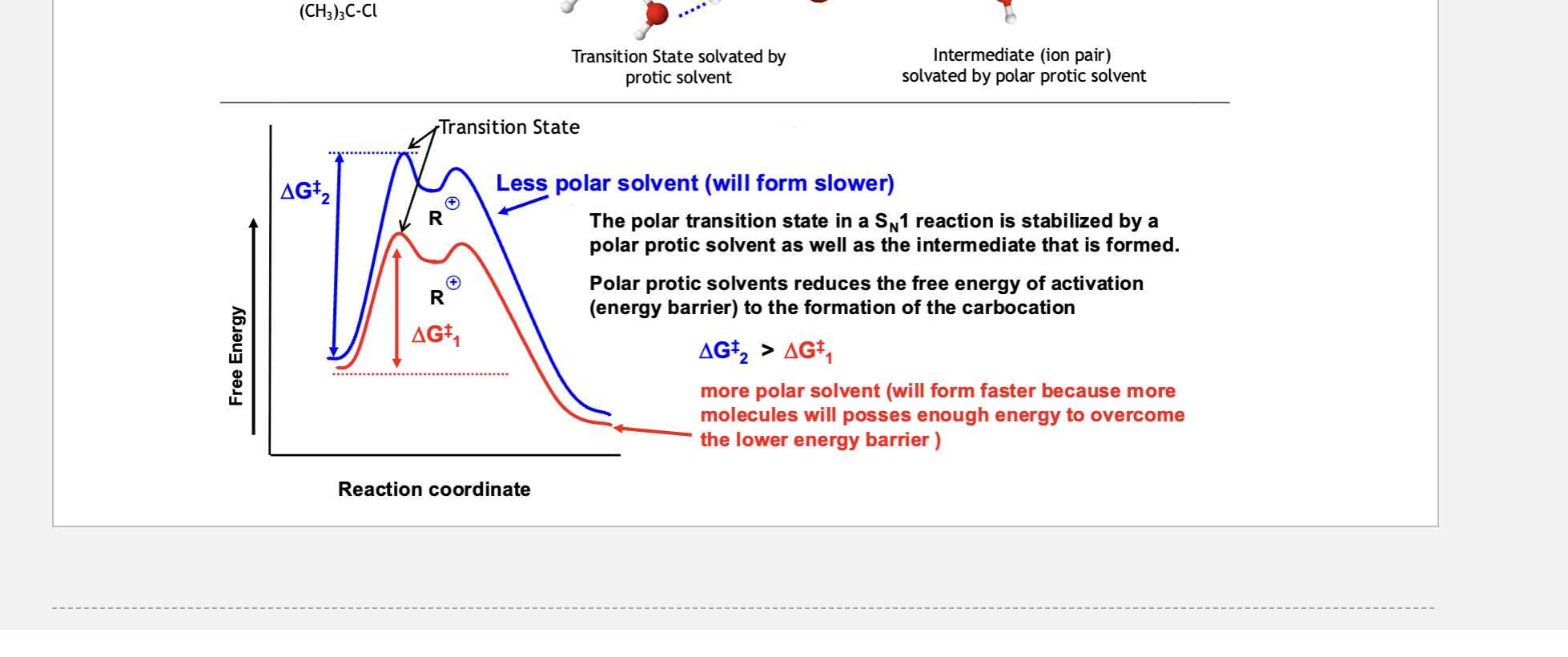
-the reaction speed is determined by rate determing step of how fast a carbocation forms
-mechanism consists of three steps with an intermediate→ carbocation
activation energy diagram for sn1, what peaks, what are diffferences ineach activaiton energy wall and what intermediate is found

steps of sn1 ( neutral nucelophile versus non neutral nucleophile)
holds the carbocation charge, needs pt to balance out the positive charge on the substituted group
neutral nucleophile→ 2 steps
charged/neg nucleophile→ 3 steps (include proton transfer)


unimolecular elimination reactions of haloalkanes
differences between uni and bi molecular reactions (sn1,sn2,e1,e2) and why
why would a reaction choose to do unimolecular over bimolecular?
can the leaving group depart without simultaneous double-bond formation(for e rxns) /no db just leaving group leaving (for sn rxns) leaving behind an excessively unstable carbon? If yes, E1 becomes possible; if no, the concerted pathway avoids that problem.
-unstable carbon=carbocation→ supported by more hindered alpa carbon
-unstbale carbon can allow reaction with weaker bases/nucleophiel
-discirminating factor→ LG leaves before sunstitution/elimination of beta hydrogem for unimol
SN1: help the C–leaving-group bond break to form ions → an ionizing, often polar protic solvent helps.
SN2: help the nucleophile attack as the leaving group departs → a polar aprotic solvent often helps.
zaitsev and hofmann summed up on the character of a base for E2 reaction where alkene has two options
Both options can achieve the needed alignment by rotating single bonds. Which product is favored depends on the reaction conditions: a small strong base usually favors the more substituted alkene, while a bulky base often favors the less substituted alkene.
Preference | Alkene favored | Common conditions |
|---|---|---|
Zaitsev | More substituted double bond: more carbon groups attached to the C=C carbons; this is what they usually want, bc its stable for the carbon double bond | E2 with a small base; usually E1 |
Hofmann | Less substituted double bond: fewer carbon groups attached to the C=C carbons | E2 with a bulky base |
what is the electorphlic site for all nucleophiles in ALL reactions up to epoxides
a partial positive carbon (which is made possinle to dipole)
polar solvents and sn1 reactions

hyperocnjugation and sn1 and e1 reactions; hydride shift and methyl shift
-more groups on the carbocation, the more stable this leads to hydride shifts and methyl shifts
hydride shift-, the carbocation charge directly shifts to a carbon next to it that has 2 methyl groups attached. the hydrogen that was on the tertiary carbon is donated to the original carbon
methyl shift- the carbocaion shiftf to a terminal cabron with 3 methyl groups attached. the methtl group that was on the temrinal carbon goes to the orginial carbon, the carbocation shiftfs the end; carbons that can do methyl shifts have 4 carbon groups attached (becase its at the end)
-rememmber the cabrocation that is destined to hold the charge is the one that was attached to the LG
E2 antiattack, antiperiplanar and trans diaxal
chain→ rotate the bond so that the beta hydrogen and lg lie in the same plane 180 degrees away
cycllic→ Find the carbons directly next to the carbon bearing the leaving group.
Check each neighboring carbon for a hydrogen.
If that carbon has a wedged CH₃, its H is dashed. If it has a dashed CH₃, its H is wedged.
Compare that H with the leaving group: opposite faces → a trans-diaxial arrangement is possible in the appropriate chair.
For example, with wedged Br:
Neighboring carbon | Its β-H | Can eliminate with Br? |
|---|---|---|
Wedged CH₃ and an H | Dashed H | Yes, in the chair where Br is axial |
Dashed CH₃ and an H | Wedged H | No, that H is on the same face as Br |
CH₂ | One up H and one down H | Yes, use the down H |
racemic and sn1 reactions
(only sn1 not e1)
-equal amount r and s
-dwap the wedge and dash ONLY at the reacting stereocenter
-squiggly line often represents racemic in one structure→ the added group could be either wedge or dash
what makes hoffman majority, what is hoffman
-the prefereance of less substituted group around the double bond of alkene
-e2 reactions prefer this when they react with a bulky base
-specifically only seen in e2 since e2 reactions happen with bulky bases and usually not e1
zaistev is made majority when and which reactions favor this, what situation does this prefer
-the prefereance of a more substituted alkene group
-this is prefered naturally by all e1 reactions and e2 reactions that has a small base
elimination (both reaction types) is regioselective and stereoselective,
stereoisiomers prefer trans position (less crowded)
elimination product depends of hoffman or zaistev
arrow pushing for e1 reaction , int?, nuc? elec?, how many steps
step1: LG leaves, creates carbocation→ no elec or nuc is needed for this step
intermediate; carbocation
step 2: deprotionation
nuc; often H₂O or an alcohol, but acting as a base by removing H⁺.
elec; the carbocation is electrophilic; in the elimination step, the β-H is the site the base attacks
-the carbocation pulls in the end, indriectly acting as a electrophile for the basic solvent nucleophile
Step | Arrow pushing | Intermediate / roles |
|---|---|---|
1. Leaving group leaves | Arrow from the C–LG bond to the leaving group. It takes both bonding electrons. | Forms a carbocation intermediate, which is electrophilic. No nucleophile is needed for this step. |
2. Double bond forms | Arrow from a base’s lone pair to a β-H; simultaneously, arrow from that C–H bond to the bond between the β-carbon and carbocation carbon. | The base accepts H⁺, and the C–H electrons form the π bond. |

arrow pushing for e2 reaction , int?, nuc? elec? , how many steps
no int, everything occurs in one step
nuc; strong base lone pair (often O)
elec: The β-H is the electrophilic site attacked by the base.

Arrow | Starts at → ends at | What happens |
|---|---|---|
1 | Base’s lone pair → β-H | Base removes the hydrogen. |
2 | C–H bond → bond between α- and β-carbons | Those electrons form the double bond. |
3 | C–leaving-group bond → leaving group | Leaving group takes the bonding electrons and leaves. |
remember, susbsitution and eleimination reactions are both possibilites
look at table for help
for unimolecular, the LG leaves first and then attack occurs for biomolecular, this occurs in one step→ thus for e1 a weak base is sufficient, need more a strong solvent to make the lg leave and create a carbocation while for the ew reaction, you need a strong base to react and attack the hydrogen
after forming the db, the groups of the beta carbon become..
planar
steps to assigning r and s R is what S is what
step 1; rank the groups based on atomic number
step1a; if there is a tie, then move outward until there is a aotm on the list that is larger atomicnum
step 1b;; treat multiple bonds as the same atoms in the list
step2; drawa line idneitfy if clockwise or counterclockwuse
-R is clockwise and S is counterclockwise
step3; look at the lowest ramked atom, if poitining toward, then reverse the original assignment, keep if away and if on the plane, substitute with a wedged or dashed atom, redraw the line and then re apply rule 2 and 3.
common hoffman bases, common zaitsev
Product usually favored | Bases to recognize | Reason |
|---|---|---|
Zaitsev: more substituted alkene | NaOMe, NaOEt, NaOH, KOH | Smaller bases can reach the β-H that produces the more substituted double bond. |
Hofmann: less substituted alkene | KOtBu/tBuOK, NaOtBu, LDA | Bulky bases preferentially remove the more accessible β-H, often on the less substituted β-carbon. |
I⁻, Br⁻, RS⁻ (such as MeS⁻), CN⁻, N₃⁻
Good nucleophile, weak base
HO⁻, MeO⁻, EtO⁻
Good nucleophile, strong base
tBuO⁻, LDA
Poor SN2 nucleophile, strong base
H₂O, MeOH, EtOH
Weak nucleophile, weak base
Water, methanol, ethanol
polar protic,
DMSO, DMF, acetone, acetonitrile
polar aprotic, Polar, without an O–H or N–H bond
Negative O →
Bulky negative O →
I⁻/Br⁻/RS⁻ →
Neutral water/alcohol →
Negative O → strong base.
Bulky negative O → E2.
I⁻/Br⁻/RS⁻ → good nucleophile, weak base.
Neutral water/alcohol → weak nucleophile, weak base., good solvent