ochem chapter one: structure determines properties
 Call Kai
 Learn
Learn Practice Test
 Spaced Repetition
 Match
Match Flashcards
 Knowt Play
1/17

There's no tags or description
Looks like no tags are added yet.
Name | Mastery | Learn | Test | Matching | Spaced | Call with Kai | Chat |
|---|
No analytics yet
Send a link to your students to track their progress
18 Terms
what do quantum numbers describe
how electrons move/ behave as waves
what is the principle quantum number and what is the relationship between its value, energy, and its distance from the nucleus
n= 1, 2, 3… (some integer)
the higher the value of n, the higher the energy and the further away from the nucleus the electron is
what is the Orbital Angular Momentum Quantum Number and what does it tell us
l= an integer (the value of n-1. that number is the maximum)
this tells us the shape of the electron wave/ orbital
ex: if n=2, ℓ= 2-1 → ℓ= 0, 1 (
Magnetic Quantum Number
ml = 0 ± 1, ± 2, … ± 𝓁
the number of values corresponds to the number of orientations in space for a given orbital
so if 𝓁= 0 (s orbital) then ml= 0 (ONE value for ml means ONE orientation in space)
if 𝓁= 0, AND ± 1
visualize 𝓁=1 m𝓁 =0, ±1
𝓁= 1 so it is a p-orbital
since m𝓁 has three values (0, -1, +1) then the orientations in space for the given orbital are 3
a p-orbital looks like a figure 8 (∞)
we can look at this on different planes (px, py, and pz)
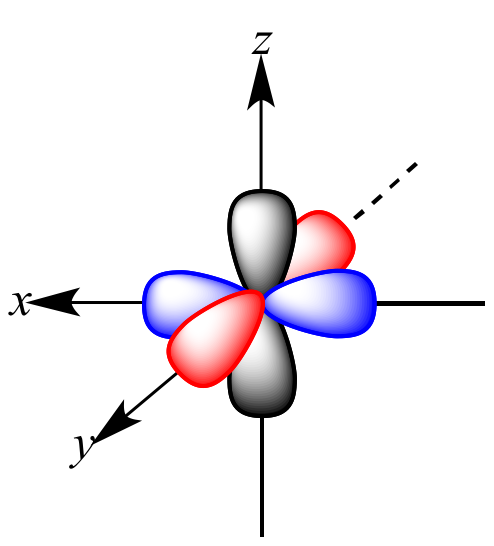
think of it as a standing wave between two fixed points
Magnetic Spin Quantum Number
ms = +1/2 (↑) or -1/2 (↓)
tells us the spin orientation for an electron
electron configuration
we can add elecrtons to orbitals to get the proper configuration for various elements
any orbital holds max 2 electrons __ __ __
Pauli Exclusion Principle
part of electron configuration
avoid having a situation where two electrons have the same set of quantum numbers (like two up spins or two down spins)
Hunds Rule
(electron configuration)
for degenerate orbitals, add electrons to empty orbitals first with parallel spins before we start pairing up
electronegativity
the ability of an element to pull electron density towards itself in a bond .
formal charge
method for counting electrons based on the idea that electrons in bonds are being equally shared
count the total number of lines and dots on an element and compare it to the number of valence electrons it started with.
if lines and dots are bigger than Ve-, then the element has a negative charge.
net charge
the sum of all formal charges
we want negative charges on electronegative elements
positive charges are best on less electronegative elements
Ka and acid strength
higher the value for Ka, the stronger the acid
an strong acid has a Ka larger than 1
pKa and acid strength
the lower the value of pKa, the stronger the acid
electronegativity and acid strength
the more electronegative the central atom is (that the H is bonded to), the stronger the acidity
can look at the second row of the periodic table
functional groups definition
an atom or group of atoms that determine how a molecule reacts and what its properties are. this is how we can classify organic molecules
R-group
any generic alkyl group