Fructose 2,6-bisphosphate
 Call Kai
 Learn
 Practice Test
 Spaced Repetition
 Match
 Flashcards
 Knowt Play
1/9

There's no tags or description
Looks like no tags are added yet.
10 Terms
Fructose 2,6-bisphosphate (Overview and Structure)
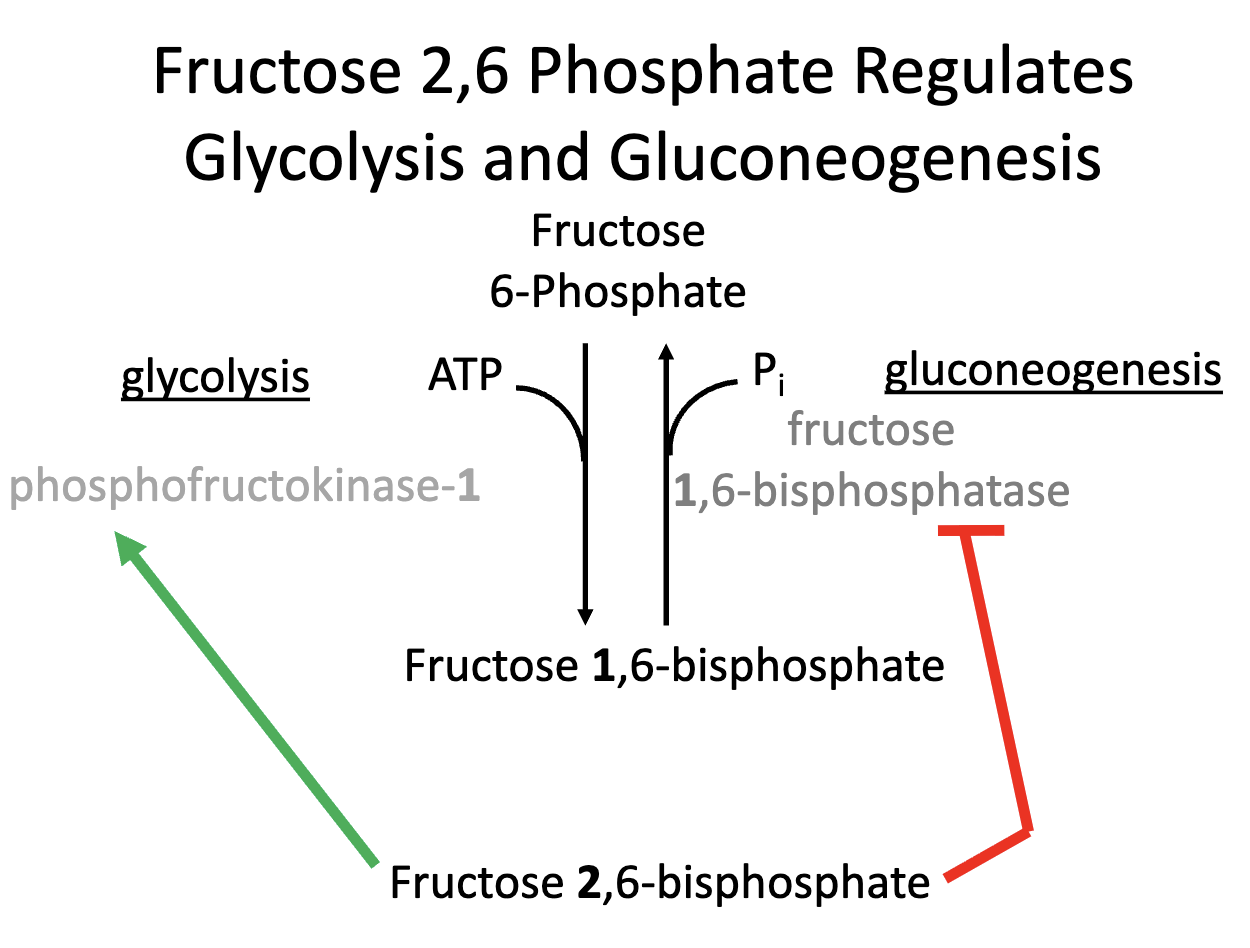
Fructose 1,6-bisphosphate is a ketose with 6 carbons that is phosphorylated on carbon 1 and carbon 6. Fructose 1,6-bisphosphate is an intermediate in glycolysis and gluconeogenesis. Fructose 1,6-bisphosphate is generated during glycolysis by the phosphorylation of fructose 6-phosphate on carbon 1. The reaction is catalyzed by kinase called phosphofructokinase-1 that catalyzes the transfer of a phosphate from ATP to carbon 1 of fructose 6-phosphate. During gluconeogenesis, the enzyme fructose 1,6-biphosphatase catalyzes the removal of a phosphate group from carbon 1 generating fructose 6 phosphate.
Fructose 2,6-biphosphate is identical to fructose 1,6-biphosphate except that it is phosphorylated on carbon 2 and carbon 6 instead of carbon 1 and carbon 6.
Fructose 1,6-bisphosphate is generated by the phosphorylation of fructose 6-phosphate on carbon 2. The reaction is catalyzed by a kinase called phosphofructokinase-2 that catalyzes the transfer of a phosphate from ATP to carbon to a fructose 6-phosphate. The enzyme fructose 2,6-bisphosphatase catalyzes the removal of a phosphate group from carbon 2 generating fructose 6-phosphate.
Fructose 2,6-biphosphate
what is the structure
how is it made
Fructose 2,6-biphosphate is identical to fructose 1,6-biphosphate except that it is phosphorylated on carbon 2 and carbon 6 instead of carbon 1 and carbon 6.
Fructose 2,6-bisphosphate is generated by the phosphorylation of fructose 6-phosphate on carbon 2.
The reaction is catalyzed by a kinase called phosphofructokinase-2 that catalyzes the transfer of a phosphate from ATP to carbon to a fructose 6-phosphate.
The enzyme fructose 2,6-bisphosphatase catalyzes the removal of a phosphate group from carbon 2 generating fructose 6-phosphate.
Reciprocal Regulation of Glycolysis and Gluconeogenesis
Fructose 2,6-bisphosphate is an activator of phosphofructosekinase-1, an enzyme that regulates glycolysis.
Fructose 2,6-bisphosphate is an inhibitor of fructose 1,6-biphosphatase, an enzyme that regulates gluconeogenesis.
Regulation of glycolysis and gluconeogenesis by fructose 2,6-bisphosphate is an example of reciprocal regulation preventing glycolysis and gluconeogenesis from occurring at the same time in the same cell.
Bifunctional Enzyme
method of control
Phosphofructokinase-2 and fructose 2,6-bisphosphatase enzymes (phosphorylate and unphosphorylate fructose 6-phosphate to make fructose 2,6-bisphosphate) are part of a single protein.
One end of the protein has the kinase activity shown here on the left and the other end of the protein shown here on the right has the phosphatase activity.
The activity of both enzymes is regulated by phosphorylation by protein kinase A
In the unphosphorylated state, phosphofructokinase-2 is active and fructose 2,6-bisphosphatase is inactive.
When the protein is phosphorylated by protein kinase A, phosphofructokinase-2 is inactive and fructose 2,6-bisphosphatase is active.
A phosphatase can remove the phosphate from the enzyme returning the molecule to the unphosphorylated state.

Summary of Fructose 2,6-bisphosphate
In summary, fructose 2,6-bisphosphate is a a ketose with 6 carbons that is phosphorylated on carbon 2 and carbon 6.
Fructose 2,6-bisphosphate is created from fructose 6-phosphate in a reaction catalyzed by phosphofructokinase-2.
Fructose 2,6-bisphosphate is converted to fructose 6-phosphate in a reaction catalyzed by fructose 2,6-bisphosphatase.
Fructose 2,6-bisphosphate reciprocally regulates glycolysis and gluconeogenesis because it activates phosphofructokinase-1 and inhibits fructose 1,6-bisphosphatase.
Phosphofructokinase-2 and fructose 2,6-bisphosphatase are present in one protein.
Phosphofructokinase-2 is active when the molecule is unphosphorylated, a fructose 2,6-bisphophatase is active when the molecule is phosphorylated by protein kinase A
Fructose 1,6-bisphosphate

Fructose 2,6-bisphosphate

Fructose 2,6 Phosphate Regulates
One protein has
both kinase and phosphatase activities
Regulation of enzyme activity by phosphorylation

Fructose 2,6-bisphosphate Summary
• Fructose 2,6-bisphosphate is a ketose with 6 carbons that is phosphorylated on carbon 2 and carbon 6
• Fructose 2,6-bisphosphate is created from fructose 6-phosphate in a reaction catalyzed by phosphofructokinase-2
• Fructose 2,6-bisphosphate is converted to fructose 6-phosphate in a reaction catalyzed by fructose 2,6-bisphosphatase
• Fructose 2,6-bisphosphate reciprocally regulates glycolysis and gluconeogenesis because it activates phosphofructokinase-1 and inhibits fructose 1,6-bisphosphatase
• Phosphofructokinase-2 and fructose 2,6-bisphosphatase are present in one protein
• Phosphofructokinase-2 is active when the molecule is unphosphorylated and fructose 2,6-bisphosphatase is active when the molecule is phosphorylated by protein kinase A