ADHD
 Call Kai
 Learn
Learn Practice Test
 Spaced Repetition
 Match
Match Flashcards
 Knowt Play
1/19

There's no tags or description
Looks like no tags are added yet.
Name | Mastery | Learn | Test | Matching | Spaced | Call with Kai | Chat |
|---|
No analytics yet
Send a link to your students to track their progress
20 Terms
General information
Stigma:
Related to overdiagnosis and potentially inappropriate treatment
Related to disability status (“invisible disability”
Who should be evaluated
In pediatrics (per AAP)
4-18 yrs
Symptoms: inattention, hyperactivity, and/or impulsivity
Interference with QOL: academic and/or behavioral problems
In adults: typically done by self referral due to interference with QOL
Diagnosis (DSM-V)


1st line stimulant
Lisdexamfetamine (Vyvanse): prodrug conjugated to an amino acid that requires cleavage during metabolism to the active dextroamphetamine
Typically first line, but not according to insurance …
Longer time to onset of effect (~2 hours)
Provides 10 to 12 hours of symptom control
Lower risk for abuse○ NICE guidelines recommend it as a preferred long-actingamphetamine formulation
Increased safety
Established efficacy
Atomoxetine (Strattera)
Time to effect: Lower onset to effect (2-4weeks), full benefit in 6-12 weeks
Place in therapy: monotherapy
Common ADRs:
BP/HR elevations, dry mouth, insomnia, nausea (can try divided doses), fatigue, sedation, and dizziness
In adults: urinary hesitation/retention, sexual adverse effects (decreased libido and ED)
Warning/precautions: Suicidal ideation in children and adolescents (boxed warning), hepatotoxicity, and psychiatric effects (aggression, psychosis, mania)
Discontinue immediately
Viloxazine (Qelbree)
MOA: SNRI, also increases 5-HT levels in prefrontal cortex
Place in therapy: monotherapy
Time to effect: improvement in symptoms within 1 week
Common ADRs: somnolence, decreased appetite, nausea/vomiting, insomnia, BP/HR elevations, and irritability
Warning/precautions: Suicidal thoughts and behaviors (boxed warning) and psychiatric effects (mania)
Drug Interactions: strong CYP1A2 inhibitor
A2-adrenergic agonist: guanfacine and clonidine
MOA: acts presynaptically to inhibit norepinephrine release and postsynaptically to increase blood flow in the prefrontal cortex
Enhances working memory and executive functioning
Place in therapy: monotherapy (nonstimulant option) or adjunct
Role as adjunct: to reduce disruptive behavior, control aggression, or improve sleep in youth
Common ADR (dose dependent): Sedation (subsides in 2-3 weeks), dizziness, hypotension, and constipation. May cause weight gain.
For dizziness: check BP and maintain hydration
Time to effect: 1-2 weeks
Warning/precautions:
Risk for severe ADRs: peripheral vasculopathies, rebound hypertension, rebound/behavioral dyscontrol, heart block, sudden death
Prescreen for cardiac abnormalities
Make sure to withdraw slowly to prevent rebound effects
Other: Guanfacine may be preferred due to
Longer half life
Greater α2a selectivity, so less sedation and dizziness
Bupropion
MOA: A weak DNRI (dopamine and norepinephrine reuptake inhibitor)
Place in therapy: Monotherapy
Helpful in concomitant depression or for patients experiencing ADRs with stimulants (less appetite suppression and weight loss)
Time to effect:1-2 weeks, full effects in 6 weeks or more
Common ADRs: nausea, rash, insomnia
Warning/precautions: Suicidal thoughts and behaviors(boxed warning). Avoid in history of eating disorder, seizure, or tics.
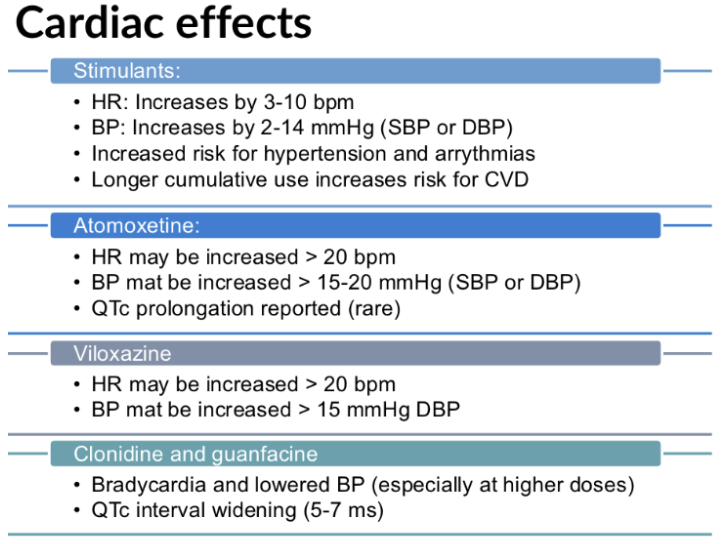
Cardiac Effects for All agents
Screen for
Exercise intolerance
History of syncope/fainting
Arrythmia
Structural heart defects
Congenital cardiac disease
Family history of arrhythmia, early sudden death (<40 years), premature cardiovascular disease or myocardial infarction
If risk factors are identified, get a baseline ECG and cardiology consult.
Monitor HR and BP prior to initiation, at dose increases, regularly throughout treatment
Alternative Therapies
impramine/desipramine (and other TCAs)
Modafinil
Nonpharmacologic Therapy

Nutritional and Dietary Interventions
Eating a balanced diet with lean protein, fiber, and complex carbs to minimise risk of nutritional deficiencies
Limiting sugar consumption in children
Avoiding food dyes:
Deficiencies in vitamin A, D, iron, magnesium, zinc, and copper may contribute to symptoms
Supplement vitamin D and iron in the presence of deficiencies
Other helpful supplements:
omega-3 fatty acids
Multivitamin
N-acetylcysteine (impulsivity and irritability only)
Other Interventions
Yoga
Meditation
Regular exercise
External trigeminal nerve stimulation (eTNS)
Future therapies: pro/prebiotics
Common ADRs and Treatment (Stimulants)
Reduced appetite, weight loss: Eat nutrient dense, high-calorie meals. Administer the medication at or after a meal. Consider appetite stimulant (cyproheptadine) at bedtime
Stomach ache: admin on full stomach; lower dose if possible
Insomnia: Give dose earlier in the day; lower or omit the last dose; switch to a shorter acting agent, consider a sedating medication at bedtime (guanfacine, clonidine, melatonin, or cyproheptadine)
Headache: divide dose, give with food, or give an analgesic (NSAID or APAP)
Dry mouth: Nonpharm/OTC recommendation.
Hypertension/tachycardia: lower dose or consider alternative therapy
Rebound symptoms: Use longer-acting (or higher dose of long-acting) stimulant. Add a short acting agent near the end of day/time of rebound. Consider nonstimulant therapy.
Irritability/jitteriness: Assess for comorbid condition (eg, bipolar disorder); reduce dosage; consider mood stabilizer or second-generation antipsychotic
Other mood lability:
During peak→ reduce dose or change to long acting formulation
During wearing off → add an additional dose or change to long acting formulation
Child’s growth (stimulants)
Dose dependent height deficits
Mainly in the first 2 years
1-1.4 cm/year
Weight deficits are more prominent
Mean of 3 kg (6.6 lbs) in first year
Mean of 1.2 kg (2.6 lbs) in second year
Less deficits with inconsistent use
Consider medication free weekends or summers
Less common/Rare ADRs (stimulants)

Stimulant Warnings
Warnings
Boxed warning: Abuse, dependence, misuse, addiction, and overdose
Psychosis, severe anxiety, or panic attacks
Often in patients with other underlying conditions (such as GAD or bipolar disorder)
Risk increased with cannabis/multi-substance use
Treat the underlying cause or condition FIRST
Mood disturbance (ie, irritability, lability, or depression) in pediatrics
Often in patients with underlying depression
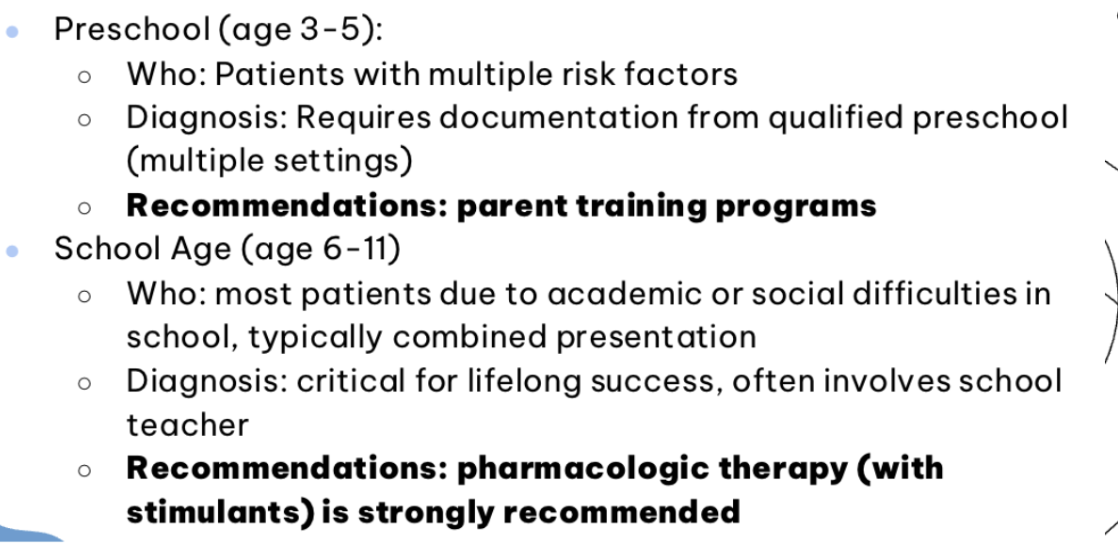
Pre-school aged patients are most susceptible to sadness, irritability, and mood lability with stimulant treatment
Focus on non-pharmacologic care in this population
Warning: Stimulant withdrawal
Risk with abrupt discontinuation or substantial dose reduction following prolonged use, particularly with high doses
Initial phase (crash)
Lasts 1-2 days
Symptoms: prolonged sleep, depressed mood, irritability, overeating, slight cravings
Dysphoria phase
Days to weeks
Symptoms: difficulty sleeping (insomnia) or excessive sleeping (hypersomnia), fatigue, unpleasant/vivid dreams, psychomotor agitation or retardation, cravings, lethargy, psychosis


Lines


LDX/DEX- Lisdexamfetamine/Dextroamphetamine
AMPH/MXA- Amphetamines/mixed amphetamines
MPH/DMPH- Methylphenidate/dexmethylphenidate
Methylphenidates vs. amphetamines
Amphetamines are typically more effective
Amphetamines cause more adverse effects in children compared tomethylphenidates○
Significant increased in systolic blood pressure and weight loss
Children need to start stimulants at very low doses due to low weight and high risk for ADRs
Amphetamines are not readily available at low doses
Conclusion: Methylphenidates are preferred 1st line in children and amphetamines are preferred 1st line in adults
Treatment summary

Monitoring and switching
Monitoring
Monthly visits until symptoms are stabilized
Maintenance: Every 3-6 months
Safety: HR/BP, height, weight, eating patterns, and sleeping patterns
Efficacy: Monitor for change in validated scale as well as assessment of:
Overall functioning (work/school and relationships)
Real-world collateral information (grades, report cards, work evaluation, attendance records)
Titration typically weekly (3-7 days)
Switching between meds
Stimulant to atomoxetine or viloxazine
Continue stimulant for the first few weeks to allow atomoxetine or viloxazine to reach full effect
Atomoxetine or viloxazine to a stimulant
Can stop atomoxetine or viloxazine abruptly
Alpha-2-adrenergic agonists can be used as adjuncts to stimulant medications (so cross over is ok!)
Personalized care and special pops
Personalized Pharmacotherapy
Metabolism differences: CYP2D6
Amphetamines, atomoxetine, and bupropion are eliminated by CYP2D6
Poor metabolizers increased (risk ofADRs)
Rapid metabolizers (reduced efficacy)
CYP2D6 inhibitors (bupropion, fluoxetine) increase concentrations
Males have higher bioavailability of methylphenidate than females
Special Populations
Pregnancy
Mild symptoms: Drug holiday for 1st trimester
Significant impairment: continuation of treatment after discussion of risks vs. benefits
Pediatrics
Neurologic, physiologic, and psychosocial changes throughout development.
Age-related pharmacodynamic and pharmacokinetic differences/changes
Patients with Comorbidities
Treat underlying conditions first
