I-O Psych, chap 4 and 5
 Call Kai
 Learn
 Practice Test
 Spaced Repetition
 Match
 Flashcards
 Knowt Play
1/57

Earn XP
Description and Tags
4. Measuring work performance and 5. Management of performance
58 Terms

Criteria
Outcome variables such as measures of employee knowledge, job performance, or attitudes. They are used to show the effectiveness of HR functions or procedures such as personnel selection (hiring) procedures or training systems.

Conceptual criterion
An abstract idea of the “essence” of a job. It cannot be measured directly.

Actual criterion
The performance measure or measures (e.g., performance ratings, sales figures) you will actually use to try to capture the conceptual criterion. All actual criteria have some degree of unreliability and measurement error.
Criterion problem
The difficulty of capturing the conceptual criterion with the actual criterion measures. This is because the job analysis does not completely define the conceptual criterion, plus the actual criterion measures are unreliable and contain some measurement error.
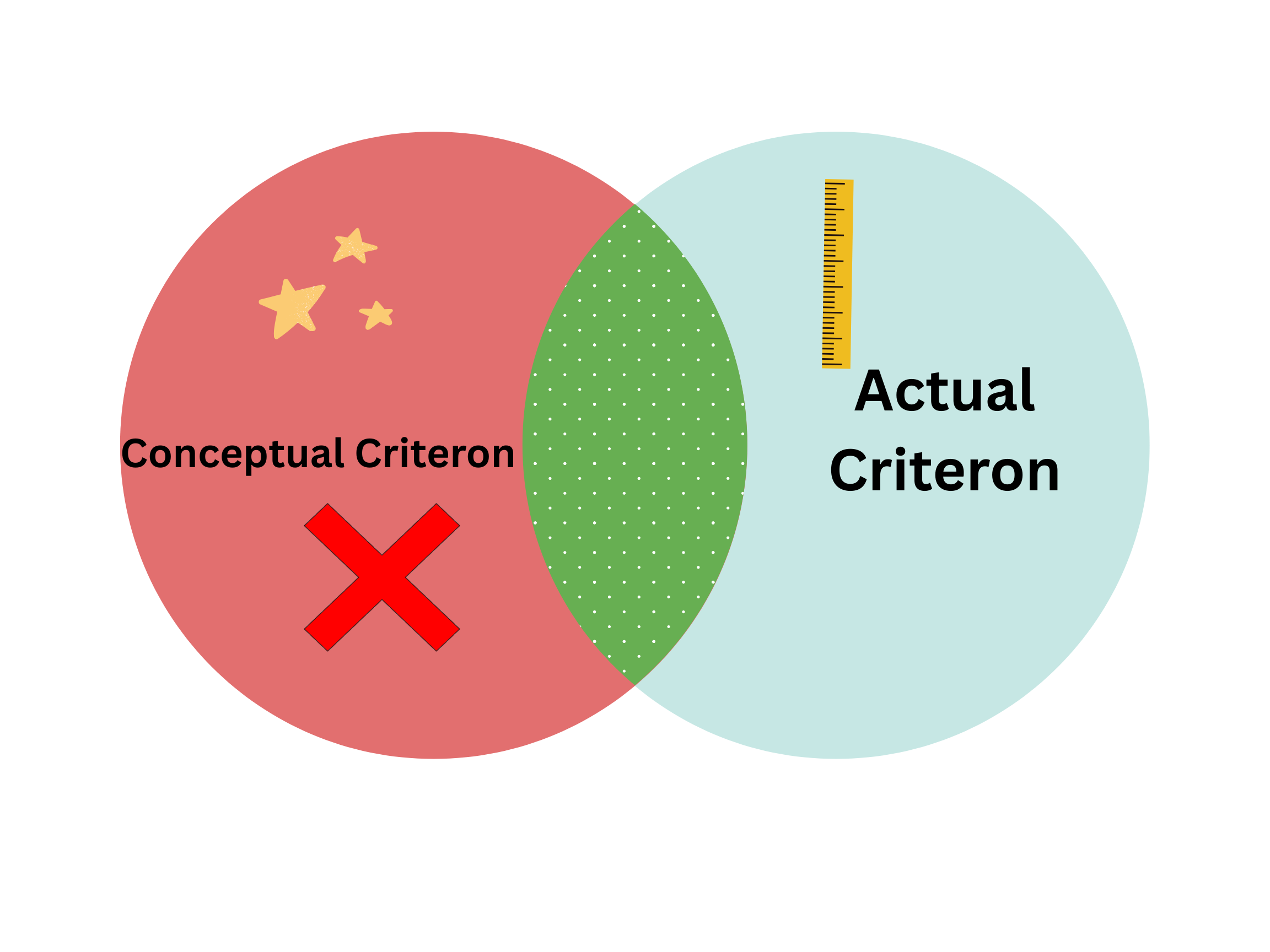
Criterion deficiency
The degree to which the actual criterion fails to overlap with the conceptual criterion.

Criterion contamination
When an actual criterion measure includes something that it should not (e.g., bias), leading to error.

Criterion relevance
The degree to which the actual criterion overlaps with the conceptual criterion.
Dynamic criteria
The concept that performance for an individual employee may change over time.
Typical performance
The job performance that an employee usually exhibits.
Maximum performance
The performance that an employee is capable of carrying out.

Composite criterion (or criterion composite)
A combination of multiple criteria, added or averaged together, used to show the “bottom-line” work performance. For example, one could see whether a training program helps an employee’s behavior overall.
Multiple criteria
Treating each criterion measure separately in an analysis. For example, one could see whether a training program helps customer service behavior, safety behavior, and other behaviors of employees.
Interactive
Using multiple versus composite criteria.
Task performance (or core task performance)
The core tasks that make up a particular job, typically shown in a job description.

Contextual performance
Behaviors that support the social environment in the workplace.

Organizational citizenship behaviors (OCBs)
Behaviors focused on helping individual coworkers and helping to support the organization.
Counterproductive work behavior (CWB)
Work behaviors such as theft, derailment of others, and abusive leadership.
Adaptive behavior
Includes factors such as adjusting to new social and tasks environments. It includes adapting to work stress, solving problems creatively, handling emergencies, and cultural and interpersonal adaptability.
Creative performance
Involves problem-finding, flexibility, originality, and evaluation of ideas.
Objective measures
Performance measures not based on the judgment of others, such as number of sales (for a sales job) or number of units produced (for jobs that can be quantified).
Subjective measures
Performance measures based on the judgment of another person such as supervisor performance ratings.
Presenteeism
A situation in which a worker comes to work sick, perhaps because they thought that the boss expected them to do so
Performance appraisal
Measurement of employee performance based on pre-established criteria, and communication of this information to the employee.

Developmental reasons
Appraisals conducted with the primary purpose of developing future performance.
Administrative reasons
Appraisals conducted to make decisions on past performance, such as pay or promotions.
Research purposes:
Appraisals conducted to validate a selection battery or validating and assessing the effectiveness of a training program.
Legal reasons
Conducting appraisals for the purpose of legal documentation.
Interactive
Common uses of performance appraisals.
Trait appraisals
Appraisals which focus on measuring employee characteristics such as reliability, honesty, punctuality, or friendliness.
Behavioral appraisals
Appraisals that measure the frequency with which specific observable work behaviors occur.
Outcome appraisals
Appraisals which focus on quantitative metrics such as sales figures, number of units produced, or number of mistakes.

Absolute appraisals
Appraisals that compare one’s performance to pre-established criteria.
Ex:
Graphic Rating Scale
Behaviorally anchored rating scale (BARS)
Behavioral Observation Scale
Essay Appraisal Form

Relative appraisals
Appraisals that compare one’s performance to other ratees’ performance
Ex:
Straight Ranking
Forced Distrubtion
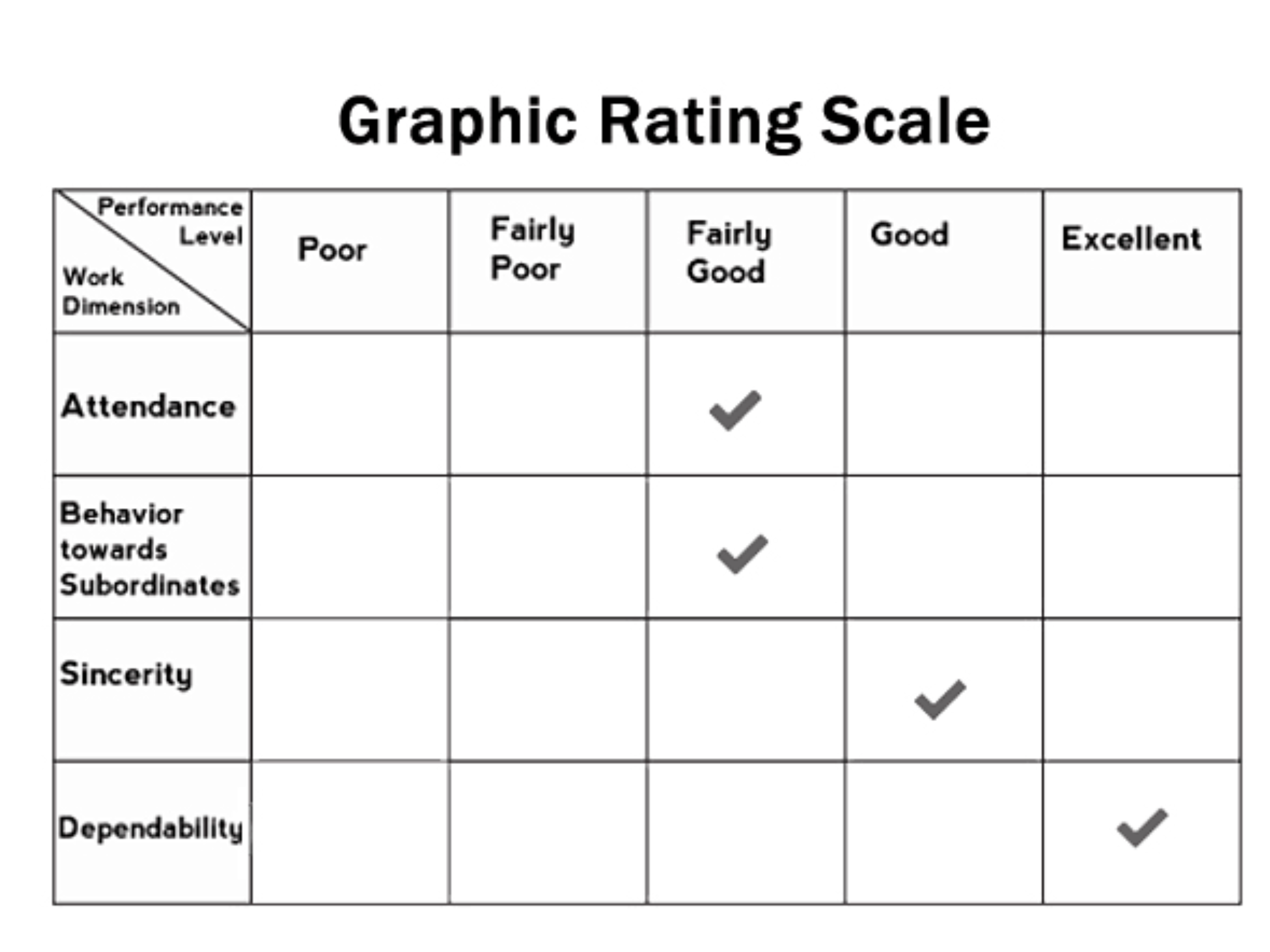
Graphic rating scale
(A type of Absolute Appraisal) A scale that lists traits and behaviors, where raters assess ratees on a scale consisting of a continuum.

Behaviorally anchored rating scale (BARS)
(A type of Absolute Appraisal) A performance appraisal format that identifies the most important aspects of a job and includes behavioral descriptions of high, average, and low levels of performance for each aspect.

Behavioral observation scale (BOS)
(A type of Absolute Appraisal) A hybrid of BARS and graphic rating scale, this appraisal format asks raters to describe the frequency with which each behavior takes place.
Essay appraisal form
(A type of Absolute Appraisal) An appraisal form whose primary purpose is to give feedback and is in the form of an essay.

Straight ranking
A type of relative appraisal where the rater ranks each employee from strongest to weakest in performance.

Forced distribution
A relative appraisal format where there are restrictions on what percentage of employees can be placed in the top, middle, and bottom categories.
360-degree appraisal
A performance appraisal system where data are collected from multiple raters at all levels, including managers, peers, subordinates, and customers.
Electronic performance monitoring
Systems that utilize technology such as video cameras, recording of employee–customer interactions, or recording keyboard strokes to observe, review, and act on employee performance in a continuous fashion.
Coaching
Training and development of a person to achieve professional goals.
One-on-one meeting
A short, regularly scheduled meeting between the manager and employee for coaching and regular connecting.
Leniency error
A type of distribution error in which the rater gives all ratees a very high rating without distinguishing among them.
Strictness
A type of distribution error in which the rater gives all ratees a low rating without distinguishing among them.
Central tendency error
A type of distribution error in which the rater gives all ratees a medium rating without distinguishing among them.
Contrast error
A rater error where a person is rated higher or lower than warranted because the person’s performance is higher or lower than their peers’.
Halo effect
A rating error where the ratee’s overall impression in the eyes of the rater drives the performance score, regardless of the questions being asked.

Similarity and liking
A rating error where the ratee is evaluated higher than warranted because the rater likes the ratee or because the rater feels that the ratee is similar to the rater.
Recency error
A rater error where events that occurred in the recent past have undue influence over the performance appraisal compared to events that occurred in the more distant past.
Rater error training
A type of training familiarizing raters with different types of rating errors in the hope that raters will avoid committing these errors.
Frame-of-reference training
A type of rater training teaching raters the meaning of each performance dimension and level, showing raters how to rate.

Performance appraisal system training
This training program educates raters about the features of the appraisal system, as well as teaches raters how to give feedback and communicate more effectively during the appraisal process.
Calibration meeting
A rater reliability session where raters come together to discuss the ratings that they gave to the employees they are rating, defending and justifying their particular ratings.
Diary keeping
A method where the rater keeps records of important performance incidents
Feedback context
The conditions under which feedback is delivered; includes factors such as the relationship quality between employees and managers, team cohesiveness, organizational culture.
Sandwich technique
A method of delivering feedback; starting with more positive pieces of feedback, followed by areas for improvement, ending the meeting on a positive note with an action plan.
Action plan
Setting goals for the near future regarding what the employee and the manager will do to improve the employee’s effectiveness.