Medical Microbiology exam #2
 Call Kai
 Learn
 Practice Test
 Spaced Repetition
 Match
 Flashcards
 Knowt Play
1/111

There's no tags or description
Looks like no tags are added yet.
112 Terms
what are prions?
Rouge protein that may cause genetic mutation or cause other normal proteins to misfold
How do viruses contribute to some cancers?
They can destroy the function of certain genes that control the growth of cell (destroy repressor)
ex: HPV
How can bacteriophage can be used for biological control?
used for Phage Therapy for bacterial infections and Prevent food Spoilage such on deli meat to prevent listeria
injection its DNA into bacterium and bursts cell
why is Bacteriophage used for biological control?
can’t infected human cells
can infected specified bacterium
disadvantage can ONLY kill only bacterium whereas antibiotic can multiple pathogens
What did Van Leewenhoek contribute to microbiology?
First observe living microorganisms
found animalcules in his mouth and sick people, and water
What did Homles contribute to microbiology?
Proposed the idea that doctors could be transmit disease on their hands
What did Semmelweis contribute to microbiology?
encouraged physicians to wash their hands before seeing and between patients as they would not when performing autopsies and delivering babies.
What did john Snow contribute to microbiology?
outbreak of Cholera it was suspected that it called from not having proper sewers so install a sewer system which help the smell which did help but not overall
- John made a spot map of cholera cases and discovered that cholera was transmitted in water but still didn’t know what about the water
What did Nightingale contribute to microbiology?
scrubbed the hosptial and washed the clothes and bandages of patients to improve sanitation
What did Lister contribute to microbiology?
used phenol (use as sterilization) during surgery resulting in fewer surgical deaths
What did Robert Koch contribute to microbiology?
proposed the germ theory disease (certain germs can cause diseases)
developed 4 postulates
developed techquies for pure cultures
What is spontaneous generation?
if condition are right than it can be life

What did Louis Pasteur contribute to microbiology?
disproved Spanatneous generation by:
His design allowed air inside the flasks to be exchanged with air from the outside, but prevented the introduction of any airborne microorganisms, which would get caught in the twists and bends of the flasks’ necks. If a life force besides the airborne microorganisms were responsible for microbial growth within the sterilized flasks, it would have access to the broth, whereas the microorganisms would not. He correctly predicted that sterilized broth in his swan-neck flasks would remain sterile as long as the swan necks remained intact.
developed a vaccine fro rabies

What did Hesses ontribute to microbiology?
Angelina proposed use Agar (comes from seaweed) to solidify his bacterial culture media
one of the techniques use to grow pure cutlures
What are the four Koch’s Postulates?
1. The microorganism is found in every
case of the disease
2. The microorganism can be isolated
in pure culture (i.e. no other
contaminating organisms)
3. The same disease is produced when
the pure culture is inoculated into a
healthy but susceptible host
4. The same microorganism can be
recovered from the new hos

Why is it not always possible to prove Koch’s postulates?
some disease only have human host, ethic barriers, and some diseases are asymptomatic
What is meant by bacterial Growth?
Multiplying or dividing of bacteria ( the increase bacteria numbers)

What happens during binary fission regarding bacteria?
happens often as e very 20 mins
quicker than human cell cycle (takes 24hrs)
doubling in every unit of time

What are the four stages of a bacteria growth curves?
Lag phase: ( Adaption to new environment making new enzymes
Log phase: bacteria growing dividing at a max rate ( best phase to function of bacteria)
Stationary phase: cell division = cell death due limited or oxygen or accumulation of toxic products/ acids ( quit increasing)
death/Decline: number of viable cells decrease ( cells undergo programmed cells death or genetically programmed to die release nutrients that can be used by other cells)
What are some conditions that can affect bacteria growth?
Oxygen
pH ( most bacteria grow at neutral pH)
temp
salt (most grow in non-salty environments)
What is a Halophile?
Bacteria can growth in extreme salty environments
What is a halotolerant?
Bacteria can tolerant growing in extreme salty environments
What is a psychrophile?
Bacteria can growth in extreme cold environments
What are psychrotolerant?
Bacteria can tolerant growing in extreme cold environments
What are mesophiles?
Bacteria can growth in neutral hot environments (human temp, and most bacteria that cause disease)
What are Thermophiles?
Bacteria can growth in extreme hot environments
What are Hyperthermophiles?
Bacteria can growth in extreme hot environments (hotter than Thermophiles)
What are obligate aerobes?
can ONLY grow with o2
What are obligate anaerobes?
can ONLY grow without o2
What are facultative anaerobes?
have the option to grow with or without o2 but prefer to grow with o2
what is a aerotolerant anaerobes?
can tolerant growing without or with o2 but doesnt have a preference of either
What is a biofilm?
a complex ecosystem containing a mix of bacterial types
What is the benefit of biofilm formation for microbes?
higher resistance to antibiotics
slow down of antibiotics or antiseptic the reaching to cells
good site for horizontal gene transfer
What types of infections where biofilms are involved?
periodontal disease
cystic fibrosis
infections medical devices in or on body
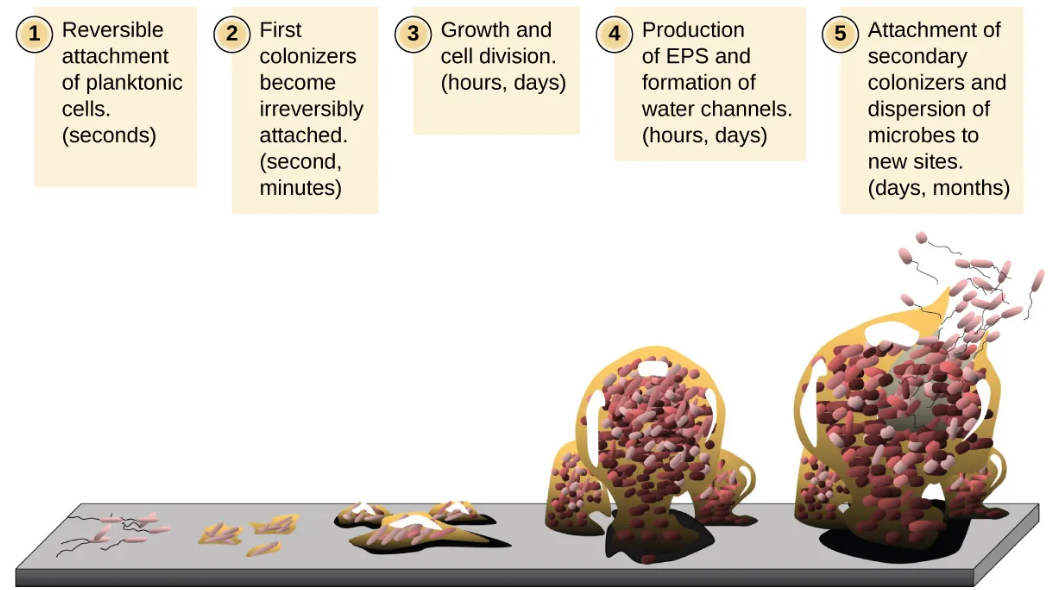
What are the steps of biofilm formation?
Attachement
Growth & friends
Quorum sensing (required #s of bacteria that all communicate to produce Ai’s. not enough bacteria Ai is low, alot of bacteria AI is high which triggers relesease of EPS) with Autoinducer
EPS ( makes biofilm): extracellar polymeric substance
biofilm community grows & thrives
What is central Dogma of biology?
DNA turns into RNA through transcription ( RNA polymerases reads DNA of make copy of RNA
Translation is when ribosomes read the RNA and builds protein
How is central Dogma biology applied to bacteria?
Since there is no nucleus transcription & translation are coupled and can occur at the same time allowing rapid growth
in eukaryotes RNA needs to processed and removed introns in order to create mRNA then go to the ribosomes while bacteria RNA doesn’t need to process they are read for translation

What are the difference between Bacteria genomes and eukaryotes genomes?
Bacteria are haploid ( one copy of each gene) whereas eukaryotes are diploid ( two copies)
if a gene mutation can affect haploid immediately (if beneficial one can rapid evolution of the bacterial population)
What is vertical gene transfer?
Genetic inform is passed from generation to the next ( parent to child)
What is Horizontal gene transfer?
Genetic inform is passed between members of the same generation (peer to peer)
Transformation
Transduction
Conjugation
How was Horizontal Gene transfer discovered?
After injection of the smooth ( w/ capsule) of streptococcus into mouse that are heat-treated dead cells, the injection of rough of streptococcus into mouse which dies it is discovered that the rough streptococcus now has a capsule.
What are the consequences of Horizontal gene transfer?
Enhances the rate at which bacteria can evolve
being resistant to an antibiotic confers a selective advantage
How often does Horizontal Gene transfer occur?
doesn’t happen frequently and extra genes can weight bacterium down)
What is transformation regarding HGT?
involves a bacterium taking up DNA fragments that another bacterium ( probably died) has left in the environment
occurs naturally in bacteria that cell need s to have those genes
receiving bacterium must have gene similar to the gene being taken up so it can be integrated and maintained
What is transduction regarding HGT?
involves bacteriophage
during assembling the virus can accidentally pick pieces of the bacterium’s DNA and transfer the new bacterial cell it is trying to infect
in step 5: brings host DNA to new bacterial cell. only if its integrated to chromosomes it will be maintained
Limit to this is attachment has to happen, and host cell must have specific receptors

What is Conjugation regarding HGT?
requires contact between donor and recipient bacteria
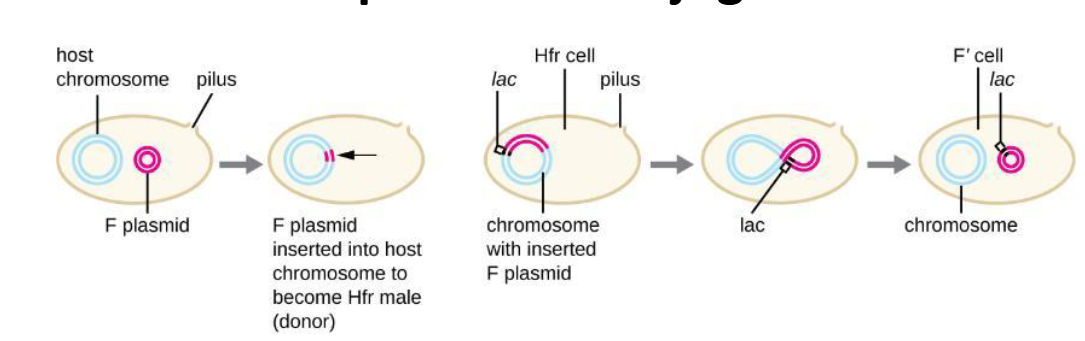
mediated by an f pili encoded on an f plasmid that can get transferred to the recipient cell
happens regularly

Why must fragments must be integrate into chromosome?
They must be integrate the chromosome because they wont be replicated and cell eat it thinking its junk
What is transfer in a F+ cell?
In F+ cell one strand of F plasmid DNA is transferred to the F+ recipient cell
What is transfer in a Hfr ( high frequency recombination) cell?
only if the f plasmid integrates into the host cell’s chromosome it becomes an Hfr cell
DNA from the donor cell chromosome can be transferred to the recipient cell
How do we prevent microbial growth in order to preserve or extend the shelf life of food?
drying
Salt/sugar (osmotic pressure)
pH
Heat to kill & then seal
Modified Atmospheric Packing (MASP): things package with inert gasses to inhibit microbial growth
What is disinfection?
Destruction of most microorganisms and viruses on nonliving tissue
ex: alcohol or soap on equipment or surfaces
What is pasteurization?
Use of heat to destroy pathogens and reduce the number of spoilage microorganisms in foods and beverages
Ex: milk and fruit juices
What is Sanitization?
removal of pathogens from objects to meet public health standards
ex: washing tableware in scalding water in restaurants
What is sterilization?
Destruction of all microorganisms and viruses in or on an object
ex: canned food
What is the range of susceptibility of bacteria, enveloped viruses, unenveloped viruses, endospores, and cysts? (most resistant to most susceptible)
Endospores, cysts, unenveloped viruses, bacteria, and enveloped viruses
How does Ultraviolet work as antimicrobial agent?
preventing replication and transcription & replication (denaturing DNA)
good for surfaces because it penetrates poorly
How does Ionizing work as antimicrobial agent?
formation of free radicals which damage nucleic acids and proteins
penetrates material well
increases shelf-life
makes food safer and reduces food-borne illness
How does temperature work as antimicrobial agent?
denaturing enzymes & proteins degrading nucleic acids and disrupting cell membranes
Why is moist heat better than dry heat?
better heat transfer
water avabile for hydrolysis
can kill bacteria spores due to heat and pressure
How does filtration work as antimicrobial agent?
stops bacteria & viruses going through if they are large enough
How does salt work as antimicrobial agent? ( ask kelly about)
creates salty environments where bacteria can grow
Why can cholera be filter through multiple layers of cloth?
Cholera have these copepods which are tiny crustaceans that cling to the bacteria. Through filtering they copepods get hung on cloth & reduces the risk of cholera
What are Phenolics do and example of them?
denature proteins and disrupt membranes
ex: antibacterial soap, disinfectant in Lysol
What do metals do an example of them?
binds to proteins and inhibit enzyme activity
ex: Sliver & copper
example uses: topical antiseptic, mouth wash, treatment of wounds and burns
What do Halogens do an example of them?
Oxidation and destabilization of cellular macromolecules
ex: iodine, chlorine
example uses: water disinfectant, prevention of dental caries
What do Alcohol do an example of them?
denature proteins and disrupt membranes
ex: ethanol
example uses: disinfectant or antiseptic
What do Surfactants do an example of them?
Lowers surface tension of water to help with washing away of microbes and disruption of cell membranes
ex: quaternary ammonium salts
example uses: soaps and detergent, disinfectant, antiseptic mouthwash
What do Bisbiguanides do an example of them?
disruption of cell membranes
ex: Chlorhexidine
example uses: oral rinse, hand scrub for medical personnel
What do Alkylating agents do an example of them?
inactivation of enzymes and nucleic acids
ex: formaldehyde
example uses: tissue specimen storage, embalming, sterilization of medical equipment
What do peroxygens agents do an example of them?
oxidation and destabilization of cellular macromolecules
ex: hydrogen peroxide & benzoyl peroxide
example uses: acne medication, toothpaste ingredient
How was antibiotics were found?
Paul Ehrlich coined the term chemotherapy (use chemical against disease)
synthetic chemicals that were more toxic to microorganisms than to humans
Who found penicillin?
Alexander Fleming in 1928
usesful but is limited to small quantites
discovered it worked through experiment on a police man: started to get better when using it but later died after they had ran out
Who found the first drug to treat tuberculosis?
selamn Waksman discovered that antibiotics made by the soil bacterium streptomyces ( used to for TB)
What does bactericidal mean?
bacteria are killed
What does bacteriostatic
growth of bacteria is inhibited
What does spectrum of activity refer to?
range of bacteria for which they are effective
Broad spectrum: Kills/inhibits growth of bacteria a wide range of bacteria
Narrow spectrum: Kills/inhibits growth of just a few types of bacteria
What is the pros & cons of Broad spectrum drugs?
pros: not sure what is ( might it without knowing what it is)
Cons: Kill healthy microbes ( might kill the ones we need)
What is the pros & cons of narrow spectrum drugs?
pros: Knowing or have time to find out (protects health microbes)
cons: if wrong or missed target patient be in a terrible prolong state
What does selective or differential toxicity mean?
very toxic for bacteria but minimally toxic for mammals
What does Therapeutic index mean?
refers to ratio of toxic dose/ Therapeutic does
High is good bc their is a big zone between safe & toxic
low must be careful to dose bc small zone between safe & toxic
What are some sources of antibiotics?
Natural: made from species of bacteria or fungi
semi-synthetic: modifications are made to naturally occurring compounds to enhance their activity
synthetic
How are antibiotics different between chemical antimicrobial agents in terms of safety and mechanism of action?
chemical antimicrobial agents can use on non living tissue while antibiotics can be use inside the body
What are the five mechanism of antibiotic kill/inhibit bacteria?
Inhibition of cell wall synthesis
Inhibition of protein synthesis
Disruption of cell membranes
inhibition of metabolic pathways
inhibitors of Nucleic Acid synthesis
Why do antibiotics use Inhibition of cell wall synthesis is effective against microorganisms?
inhibits the formation of NAM-NAM crosslinks ( inhibits the linking enzymes so NAM & NAG are just neighbors- tretapeptide side chains) the cell bursts from osmotic pressure bc wall isnt maintained
safe for human cells bc they dont have a cell wall
very therapetuic index bc no animal cell walls
ex: penicillin
How do beta-lactam antibiotics works?
There B-lactam ring interacts with enzymes from tetrapeptide side chains to stop wall
Why do antibiotics use Inhibition of protein synthesis is effective against microorganisms?
affect the translation through by targeting 70s ribosomes
not safe for pregnant women or young children due to effects on developing teeth
high therapeutic index bc eukaryotes have 80s ribosomes
ex: Doxycycline
Why do antibiotics use Disruption of cell membranes is effective against microorganisms?
targets different type of sterols of cell membranes ( animal= cholesterol, bacteria= something similar to cholesterol- ergosterol)
can have some toxicity to humans
ex: Polymixin
Why do antibiotics use inhibitors of Nucleic Acid synthesis is effective against microorganisms?
inhibits the enzymes for unwinding circular bacterial DNA to proceed to replication & transcription
less selectively toxic than other antibiotics than other antibiotics
ex: Metronidazole
What is the mechanism of amoxicillin & side effects?
inhibition of cell well synthesis
rash
What is the mechanism of doxycycline & side effects?
inhibit protein synthesis
darkened skin color
What is the mechanism of cephalexin & side effects?
inhibit cell wall synthesis
purple skin rash with peeling
What is the mechanism of ciprofloxacin & side effects?
inhibit nucleic acid synthesis
Tendon problems or nerve damage
What is the mechanism of clindamycin & side effects?
side effects: vaginal itching
inhibit of protein synthesis
What is the mechanism of metronidazole & side effects?
inhibit of nucleic acid synthesis
side effects: Nerve damage of limbs or optic nerve
What is the mechanism of azithromycin & side effects?
inhibit protein synthesis
side effects: yellowing of skin or eyes
What is the mechanism of Sulfamethoxazole and trimethoprim & side effects?
side effects: anorexia
inhibit metabolic pathway work
What is the mechanism of Augmentin (amoxicillin and clavulanate) & side effects?
inhibit cell wall synthesis
side effects: diaper rash or bloody diarrhea
What is the mechanism of levofloxacin & side effects?
Inhibit Nucleic acids synthesis
side effects: tendon rupture
Why do antibiotics use inhibitors of metabolic pathways is effective against microorganisms?
Bind critical enzymes act as Competitive inhibitors to shut down critical metabolic pathway
ex: Sulfanilamide resembles PABA so it prevents folic acid synthesis( made from bacteria in our body) which ultimately inhibits synthesis of nucleotides