Genetic and Genomic Relationships
 Call Kai
 Learn
 Practice Test
 Spaced Repetition
 Match
 Flashcards
 Knowt Play
1/27

There's no tags or description
Looks like no tags are added yet.
28 Terms
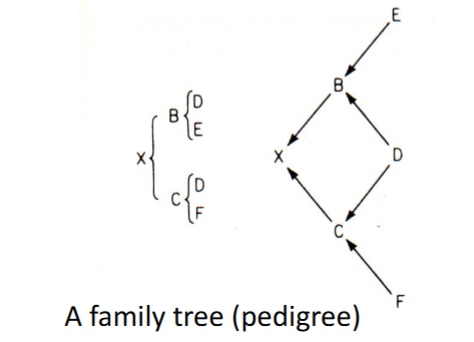
It is the proportion of alleles they share because of family membership or a common ancestor; more specifically, it reflects alleles identical by descent. Relatives resemble one another because they inherit DNA from common ancestors.

A pedigree is a recorded chart or table of an animal's ancestry, lineage, and descent
It provides the genetic and record information on the individual animal and its ancestors
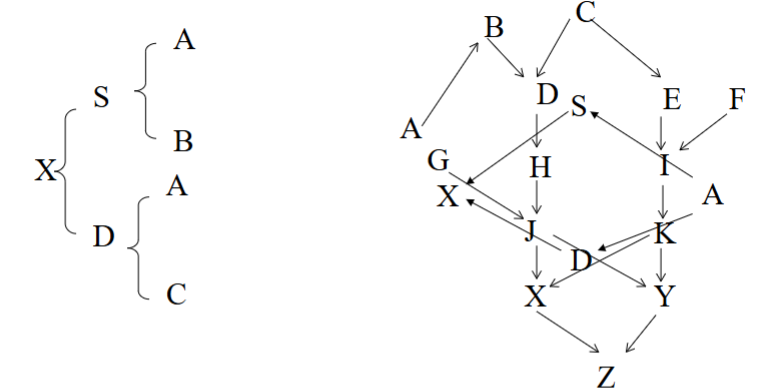
A common ancestor is an ancestor shared by two or more individuals, contributing to their allelic similarity
A common ancestor of both parents can also cause inbreeding in their offspring.
IBD means alleles are shared because they were directly inherited from a recent/common ancestor.
Example: full sibling shared the same allele from a grandparent
IBD is the basis of pedigree relationship and inbreeding coefficients.
IBS means alleles have the same state but may not have come from a common ancestor
Example: two unrelated people having the same allele due to evolutionary pressures
Similarity can occur coincidentally or through independent mutation.
They will help predict breeding values (EBVs) of selection candidates by utilizing performance of its relatives
Relationships allow performance information from relatives to improve the accuracy of estimated breeding values for young selection candidates
To help design mating systems
To avoid the effect of high level of inbreeding (AKA inbreeding depression)
To explore heterosis (AKA hybrid vigor) or non-additive effects due to combination of gene alleles and genes
To optimize genetic diversity in small populations
What is the inbreeding coefficient, Fx?
Fx is the probability that the two alleles at a locus in individual x are identical by descent
Equivalently, it is the expected proportion of loci that are IBD
OR, its the probability of the proportion of an individual’s loci containing alleles that are identical by descent
Ranges from 0 to 1
It measures the level of inbreeding in one individual.
What is Wright's coefficient of relationship, Rxy?
Rxy is the proportion of one individual's alleles that are identical by descent to alleles in a second individual
Measures pedigree relatedness between two individuals.
Ranges from 0 (completely unrelated) to 1 (identical twins)
Essentially the level of similarity in the genome between two individuals based on the common ancestor
The path method, the tabular method, and a genomic relationship matrix based on DNA markers. The tabular and genomic approaches are especially useful for larger datasets.
What are the rules to calculate numerator relationship in the Tabular Method?
The numerator relationship between individuals X and Y equals the average numerator relationship between X and the parents of Y (or Y and the parents of X
The numerator relationship between an individual and itself is 1 plus its inbreeding coefficient
An individual’s inbreeding coefficient equals half the numerator relationship between its parents
Wright’s coefficient of relationship between individual X and Y equals the numerator relationship between them divided by √1+Fx*√1+Fy
Define inbreeding coefficient and Wright’s coefficient of relationship between two individuals
The inbreeding coefficient of an individual is the value of the individual’s diagonal element and subtract 1. i.e. Fx=r xx -1
Wright’s coefficient of relationship between two individuals (for example X and D): is the appropriate off- diagonal element and divide by √1+Fx*√1+FD

Fx = 1.25 - 1 = 0.25, or 25%
Rationale: use Fx = rxx - 1.
This standardizes the numerator relationship for any inbreeding in the two individuals.

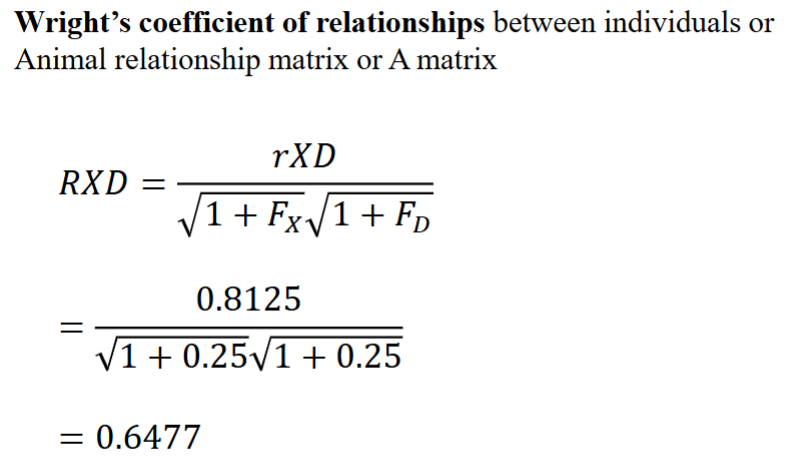
Calculation card: If rXD = 0.8125 and FX = FD = 0.25, what is RXD?
RXD = 0.8125 / √[(1.25)(1.25)] = 0.65, approximately 0.6477
Rationale: divide the numerator relationship by the inbreeding-adjusted denominator.
They are expected averages based on ancestry, not the exact DNA inherited by each animal. Mendelian sampling causes relatives to inherit different actual fractions.
It is the random segregation of parental alleles that makes actual DNA sharing differ among relatives. Full siblings do not necessarily share exactly 50% of their DNA.

A GRM is based on actual marker genotypes, while the A matrix is based on recorded pedigree. The GRM can capture realized Mendelian sampling.
Why is GRM often more accurate than Wright’s coefficient of relationships?
It captures the actual genotypes (Mendelian sampling), while Wright’s coefficients is a pedigree average
EBVoffspring = ½ EBVsire + 1/2EBVdam + Mendelian Sampling
The mendelian sampling = the chance factor in distributing half the genetic material from each parent to their offspring
GRM is based on the actual genotypes so it captures accurately the Mendelian Sampling
Thus, full siblings may actually share 45 or 55% of their DNA rather than the expected 50%.
Accounting for those small differences in the relationship matrix and tracing individual genes can greatly increase reliability of GBVs, especially if the number of genotyped individuals is large

They are coded as 0, 1, and 2 for the three genotype classes, such as AA, AB, and BB, after choosing an allele coding scheme. Numeric coding allows matrix calculations across many markers.
Z is the genotype matrix after genotypes are centered using allele frequencies. Centering adjusts genotype values relative to expected allele counts.
G = ZZ' divided by 2 times the sum across markers of pi(1 - pi)
This scales marker similarity by expected genetic variation from allele frequencies.
What does pi mean in the VanRaden GRM formula?
pi is the frequency of the chosen allele at marker i. Rationale: allele frequency determines the expected variance at that marker.
In the tabular method, why is a new individual's row calculated after its parents' rows?
Its relationships are calculated as averages of the relationships involving its parents. Parent information must already be present in the matrix.
What does a diagonal A-matrix value greater than 1 indicate?
It indicates inbreeding, and F equals the diagonal value minus 1. The diagonal contains 1 plus the individual's inbreeding coefficient.
If two animals have very similar SNP genotypes across many markers, what should their genomic relationship be?
Their genomic relationship should be relatively high. Greater marker similarity indicates greater realized genetic similarity.
The genomic relationship matrix detects it because it uses actual DNA-marker genotypes. Pedigree gives the expected average, whereas genomics captures realized Mendelian sampling.