Energy Transfers: Coupled reactions and Redox
 Call Kai
 Learn
 Practice Test
 Spaced Repetition
 Match
 Flashcards
 Knowt Play
1/39

There's no tags or description
Looks like no tags are added yet.
40 Terms
First Law of Thermodynamics
Energy cannot be created or destroyed, only change forms. One material gains energy --> another loses
Second Law of Thermodynamics
Every energy transfer causes some usable energy to be lost. Increases the entropy of the universe.
Living things increase their own complexity/decrease their randomness
Increase randomness of their surroundings/They expel wastes from breakdown of more complex molecules and expel thermal energy (heat)
How do chemical reactions in living things proceed?
Energy stored in the form of chemical energy in chemical bonds are released by breaking those bonds.
endothermic reaction
Energy is absorbed. Products have MORE potential energy than the reactants.
Exothermic Reaction
Energy is released. Products have LESS potential energy than reactants
Free Energy (G)
Energy that can do useful work - not lost during energy transfer
(T/F) All energy released in an exothermic reaction can do useful energy
FALSE
(T/F) Exothermic reactions require energy to proceed
TRUE - all chemical reactions require some energy INPUT to proceed
endergonic reaction
have a positive △G value
Products have more FREE ENERGY than reactants (absorbs)
endergonic reactions
Reaction DOESNT proceed spontaneously
endergonic reactions
exergonic reaction
have a negative △G value
Products have less FREE ENERGY than the reactants (release)
exergonic reactions
How do cells harness released energy from broken bonds + put it to work for a chemical reaction?
Coupled reactions
Energy coupling
To facilitate desired reaction in cell --> exothermic reaction is coupled with desired reaction to overcome activation energy barrier
ATP (energy currency of cell)
Nucleoside triphosphate - energy input for endergonic reactions
How does ATP power cellular reactions?
Releasing energy when one of its phosphates is cleaved
Why do living things use ATP for cellular processes (used directly by cells)?
Cells can readily regenerate ATP using free energy from exergonic reactions (readily reversible - can make more when used up)
Why dont cells use energy from hydrolysis of food molecules directly?
Amount of energy released from food is too fast/too much to be managed efficiently by cells in one step. ATP can be readily coupled and universally used. Predictable amount of energy stored in it
Phosphorylation
Transfer of inorganic phosphate to another molecule
How to make ATP?
Add Pi to ADP: ADP + Pi + energy --> ATP + H2O
Phosphorylation of ADP occurs by these two kinds of reactions:
- Substrate-level phosphorylation and 2. Oxidative phosphorylation/chemiosmosis
substrate-level phosphorylation
When ATP is synthesized in the cytosol/fluid of organelle it's S.L.P. Enzyme-mediated process where energy from high-energy substrate is used to transfer a phosphate group directly to ADP to form ATP.
oxidative phosphorylation/chemiosmotic phosphorylation
Process that forms ATP using energy transferred indirectly via series of REDOX reactions
Outline process of oxidative phosphorylation/chemiosmotic phosphorylation
Energy from redox reactions used to create an electrochemical gradient (source of potential energy) by pumping H+ ions into a specific compartment within organelle. ATP is produced as H+ ions move back by diffusion through ATP synthase. Potential energy is transferred + used to add Pi to ADP
Redox Reactions - Oxidation
LE(H atoms)O - release energy
Redox Reactions - Reduction
GE(hydrogen atoms)R - gain of energy.
(T/F) Oxidation and reduction occur together
TRUE - when a molecule is oxidized, another must be reduced
When carbon is bound to oxygen, electrons:
are shifted away from carbon + toward oxygen. Akin to losing electrons - oxidation
When carbon is bound to hydrogen, electrons:
are shared evenly with carbon, hence move toward carbon. Akin to gaining electrons - reduction
How do you extract energy from food like glucose?
Must go through a process of controlled oxidation. As food becomes oxidized --> releases energy that can be stored or used
Controlled oxidation vs Combustion
NAD+ (oxidized - low energy, dead battery) becomes reduced to NADH (charged battery)
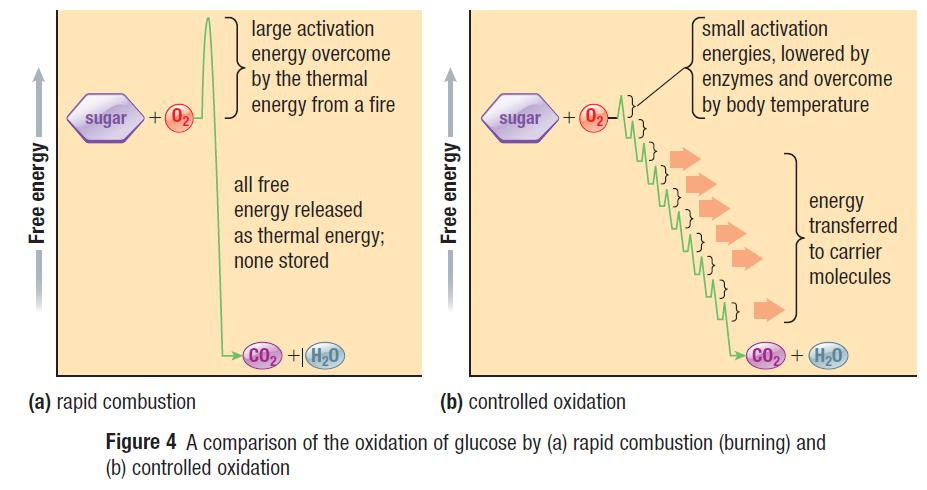
High energy electron carrier molecules
NADH and FADH2
CONTROLLED oxidation (aerobic cellular respiration) uses what?
High energy electron carrier molecules (NADH and FADH2)
NAD+
Functions in cellular respiration by carrying 2 electrons from one reaction site --> another
NADH
Can transfer 2 electrons (1 is a hydrogen atom) to another molecule
Equation for NAD+ and NADH
NAD+ + 2H --> NADH + H+
FAD
Reduced to FADH2. Then transfers 2 electrons to another molecule. Equation: FAD + 2H --> FADH2
How are electrons brought to the electron transport system in cellular respiration?
NADH and FADH2 bring electrons to the electron transport system in cellular respiration.