obu copeland art- EXAM 1
 Call Kai
 Learn
Learn Practice Test
 Spaced Repetition
 Match
Match Flashcards
 Knowt Play
1/101

There's no tags or description
Looks like no tags are added yet.
Name | Mastery | Learn | Test | Matching | Spaced | Call with Kai | Chat |
|---|
No analytics yet
Send a link to your students to track their progress
102 Terms
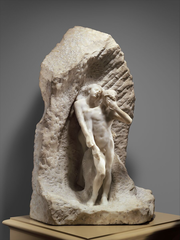
Auguste Rodin - Orpheus and Eurydice
Vincent Van Gogh - View of the Sea at Scheveningen

Gianlorenzo Bemini - David

Bridget Riley - Drift No. 2

René Magritte - The Treason of Images

Trevor Paglen - They Watch the Moon

China Tang Dynasty - Caravaneer on a Camel

Michelangelo - David

Rembrandt van Rijn - The Three Crosses

Tapirapé people - Cara Grande feather mask

palette
a range of colors or qualities
en plein air
painting outdoors
pointillism
A method for applying paint in small dabs of pure color, which create optical mixtures in the eye when seen from several feet away.
foreshortening
The use of perspective to represent in art the apparent visual contraction of an object that extends back in space at an angle to the perpendicular plane of sight.
representational art
art that recognizably represents or depicts a particular subject
realistic art
art that looks real
nonobjective art
art that has no recognizable subject matter
nonrepresentational art
art without reference to anything outside itself
abstract art
art that does not show a realistic subject, usually transforming the subject into lines, colors or shapes.
geometric shape
any shape enclosed by square or straight or perfectly circular lines
geometric form
three-dimensional form composed of regular planes and curves
organic shape
an irregular, non-geometric shape / freeform
organic form
3-d free flowing shapes found in nature
negative form
Has no physical existence- enclosed or defined by positive forms (a void).
chiaroscuro lighting
the composition of light and dark in an image or picture
- three crosses painting
tenebrism
dramatic use of intense darkness and light to heighten the impact of a painting
cross-hatching
the use of overlapping parallel lines to convey darkness or lightness
hatching
the use of NON-overlapping parallel lines to convey darkness or lightness
simultaneous contrast
when two different colors come into direct contact, the contrast intensifies the difference between them
arbitrary color
color chosen by an artist to express his emotions or feelings
.
.
local color/perceptual color
color as perceived by the eye
symbolic color
a color that has been assigned a particular meaning by the members of a culture
optical color mixing
placement of different colors in such a way that the human eye mixes them to form new colors
one-point linear perspective
one vanishing point
two-point linear perspective
two vanishing points
three-point perspective
three vanishing points
isometric perspective
linear perspective w/o a vanishing point; parallel lines in nature remain that way; flattening effect; interaction of 2D surface and spatial illusion
overlapping perspective
if objects overlap the object in front will appear closer
vertical placement
a method for suggesting the third dimension of depth in a two-dimensional work by placing an object above another in the composition
diminishing size
decreasing size of objects to imply increases distance. smaller objects appear farther away
atmospheric perspective
use of shades of color and clarity to create the illusion of depth. Closer objects have warmer tones and clear outlines, while objects set further away are cooler and become hazy
actual texture
how something actually feels
simulated/implied texture
the illusion of actual texture. The use of highlights and shadows will give the appearance of something feeling rough, smooth, wet, etc
radial balance
a composition in which all visual elements are balanced around and radiate from a central point
symmetrical balance
distribution achieved by arranging elements as horizontal or vertical mirrored images on both sides of an imaginary center line of a screen
asymmetrical balance
the type of balance when both sides of the central axis are not identical, yet appear to have the same visual weight
bilateral symmetry
a body plan in which a single imaginary line divides the body into left and right sides that are mirror images of each other
unity (art principle)
how all the details of an artwork come together to make a picture
scale
the size of one whole object in relation to a whole artwork
proportion
the relation based on size between parts or objects within a composition
emphasis (art principle)
the principle of creating a focal point to make a certain element stand out
focal point
the center of interest on a page or set of facing pages, created by using color, contrast and proportion
Hawaiian Feather Cloak & it's importance
provided physical protection, and were believed to provide spiritual protection for their wearers.
Triangles & hexagons are ______ shapes
polygons
what distinguishes a geometric shape from organic shapes?
ORGANIC: shapes, often curvilinear in appearance, that are similar to those found in nature, such as plants, animals, and rocks
GEOMETRIC: any shapes and based on math principles, such as a square, circle, and triangle
Michael Heizer, Double Negative, 1969-70
refers in part to both the natural and man-made negative space that constitutes the work

chiaroscuro
A chief tool employed by artists of the Renaissance and Baroque eras to show the effects of light
Artemisia Gentileschi, Judith and Maidservant with Head of Holofernes
Judith and Her Maidservant is one of four paintings by the Italian baroque artist Artemisia Gentileschi that depicts the biblical story of Judith and Holofernes
Georges Seurat's La Chahut (The Can-Can)
a very popular suggestive dance in which female dancers kicked their legs rhythmically to the beat of raucous music
Leonardo da Vinci's The Last Supper is based on what specific type of perspective?
one-point perspective
Gustave Caillebotte's Paris Street, Rainy Day is based on what specific type of perspective?
two-point perspective
In Harmony in Red (The Red Room), Henri Matisse deliberately intended to violate the laws of perspective. Why?
His interests were in things other than pure verisimilitude
What is the metaphorical significance of the feast-making spoon sculpture from the Ivory Coast?
It represents the power of the imagination to transform an everyday object into a symbolically charged container of social good
What is the significance of Japanese ukiyo-e printmaking in regards to how it influenced European art and design?
Degas, Van Gogh and Toulouse-Lautrec. During the 1860's Degas began collecting Japanese ukiyo-e prints, which gradually influenced his painting style. His figures are often placed asymmetrically and on a diagonal.
The Dead Christ, Andrea Mantegna - how does the artist adjust for distortion?
Mantegna has toyed with the rules of perspective making the head large, whereas if the rules of perspective had been adhered to then the head would be much smaller than the feet. There is an intense foreshortening of the body which makes it appear heavy and enlarged
Why is the stereoscope such an effective means of describing "real" space?
it mimics binocular vision
When and where was linear perspective first codified (studied, organized, and written down)?
during the renaissance in Italy
What qualities are shared by Utagawa Hiroshige's The Moon Pine on the Temple Grounds at Ueno, No. 89 from One Hundred Famous Views of Edo, and Henri Matisse's Harmony in Red (The Red Room)?
flattening of spatial death
What two kinds of perspective has J. M. W. Turner used in Rain, Steam, and Speed—The Great Western Railway?
atmospheric and one-point view
How does Katsushika Hokusai use scale to create drama in The Great Wave off Kanagawa?
used to demonstrate the power of nature
.
.
How does Chuck Close achieve in his paintings both an abstract and representational image?
use a grid system to break down photographs of himself and others and reproduce them in paint on a much-enlarged scale, a technique that combined both realistic presentation and abstract detail to create the portraits.
The author, Henry Sayer, describes Chuck Close's painting Stanley II as "layered" pointillism because...?
it is layered with thousands of little square paintings
How are time and motion treated similarly in Claude Monet's Water Lilies, Morning: Willows and Jackson Pollock's No. 32, 1950?
both compositions force the viewer's eye to keep moving.
How is movement achieved in Alexander Calder's Untitled (1976)?
through air movements
Why did Jackson Pollock place his canvas on the floor?
he wanted to be able to work from all sides of the painting & feel like he was in the painting
How does Auguste Rodin create tension between the two worlds in Orpheus and Eurydice?
by creating contrasting textures in the stone
What is frottage and what does it achieve as a visual effect?
a sheet of paper is placed over textured materials. then a pencil or crayon is rubbed across the paper to mimic a texture
What is impasto, what kind of texture is it?
impasto is a thick dough-like texture used in paintings, it's Italian
What is Op Art and which artist have we learned about as an example?
Op art: art style where line and color are manipulated so the eye percieves movement
artist examples: Victor Vasarely, Bridget Riley and Jesús Rafael Soto.
What is line as mark-making and whose artwork serves as an example?
line as mark making is drawing lines in patterns to create an image through shadows of density through lines
artist example: Jackson Pollock, Willem De Kooning, Franz Kline, Robert Motherwell and Franz Hoffman
Renoir's The Boating Party offers an example of
implied line
primary colors in additive system:
red, green, blue
secondary colors in the additive system:
cyan, magenta, yellow
primary colors in the subtractive system:
red, yellow, blue
secondary colors in the subtractive system:
orange, green, purple
Distinguish between linear perspective systems and other systems of perspective that do not use linear perspective
linear perspective: a type of perspective used by artists in which the relative size, shape, and position of objects are determined by drawn or imagined lines converging at a point on the horizon
1 point, 2 point, & 3 point....each has that many focal points
In Les Demoiselles d'Avignon, Pablo Picasso incorporates something like African sculpture, why?
it allows him to depart from exact representation of his subjects
The Treason of Images, by Rene Magritte, asks us to consider what?
that images and words refer to things that we see but are not the things themselves
AND
that we are often fooled by what we see, as with timber-l'loeil paintings
How did Michelangelo's David become political?
It was placed in Florence government square as a symbol of republics freedom from the Medici family
What about Vija Celmins' "To Fix the Image in Memory" is special?
The artwork casts 11 stones in bronze and painting them to resemble the original stones as closely as possible
What is meant by the term trompe-l'oeil?
fools the eye
What are the three essential components that define art?
Subject, soul, media
Who discovered that color is a direct function of light by passing sunlight through a prism and observing the bands of spectrum of colors?
Isaac Newton
The range of colors that an artist has preferred to use in a work is referred to as the ______.
palette
Which medium did artist Dan Flavin employ to transform a room?
Fluorescent lighting
How has the restoration of the Sistine Chapel changed our understanding of Michelangelo's palette?
The cleaning removed centuries of grime, dust, and candle smoke from the frescoes and revealed unexpectedly brilliant colours that partially contradict the celebrated sculptural qualities of Michelangelo's masterpiece.
List the elements of art:
shape, texture, color, form, value, space, line
(remember: Sally Tried Coloring For Value So Lightly)
List the principles of design:
unity, variety, emphasis, pattern, movement, rhythm, balance