Contract Law 1
 Call Kai
 Learn
 Practice Test
 Spaced Repetition
 Match
 Flashcards
 Knowt Play
1/44

There's no tags or description
Looks like no tags are added yet.
45 Terms
Subjective Theory of Contracts
No 2 persons could form a contract unless they truly intended to be bound by a single set of terms
A difference of genuine intent or interpretation, if proven, meant the parties formed no contract
There is no system based on this theory
Objective Theory of Contracts
A party’s intentions are not those she subjectively carries in her own mind but those that an OBJECTIVE reasonable person would, under all surrounding circumstances, attribute to her words
Meeting of the minds
when 2 people form an agreement, each is entitled to enjoy his reasonable expectations and beliefs, and in turn, must fulfil those of the other
Policy Consideration: sanctity of promises
keeping the value of promises
policy considerations: will theory
enabling the realization of human potential
policy considerations: free market
supporting free market and fostering efficiency
policy considerations: from status to contract
enabling social mobility and progress of people
policy considerations: non-classical theories
fairness, distributive justice, social values, human rights
Elements of a contract (RESTATEMENT §17)
mutual assent
consideration
is an invitation to make an offer an offer?
no, it is an invitation and create a possibility to make an offer in the future
offer
manifestation
of willingness to enter a bargain
so made as to justify another person in believing his assent is invited and will conclude it
The communication under the circumstances must cause a reasonable person in the offeree's position to think that if he does what the offeror is suggesting, they have a deal.
what is a manifestation?
an outward showing or communication via speech, writing, or behavior
a party’s manifest intention is the intention that, under all prevailing circumstances, a reasonable person would attribute to her on seeing what she does, hearing what she says, or reading what she writes
how do you know someone is willing to enter a bargain?
the communication must be as such that it would make a reasonable person in the offerees position understand that
the offeror wishes to make a bargain (arrangement calls on each party to do something for the other), and
what is expected that both will do
C/D Test

Commitment
the offeror has made up their mind
willing to do/sell something
a promise or guarantee
Detail
what is offered is clear enough and no further detail is needed
includes the price
Is an ad an offer
If there is commitment and specific details at a level that suggests that an offeree could conclude the deal by expressing consent without further negotiations, particularly if the ad is misleading, then an ad is an offer
policy considerations: too much dishonesty and disregard for the law in business practices; must hold people to their word and their duty to be honest and engage in fair dealings. Consumers are being misled and suffering from lack of fairness.
offers for rewards
Lost dog poster, $45 to the person who calls with info
Only one reward to give, only one person will get the reward.
Whoever does the act first accepts the offer
Only an offeree if you know about the offer (cannot know about it retroactively and demand reward)
acceptance generally
an offeror may impose on the offeree any requirements he chooses as to the mode of acceptance
mail asked for, only mailed is valid.
the offeror is the master of his offer
if the offeror imposes no requirements as to the mode or manner the offeree must accept, the offeree may accept in any way that is reasonable under the circumstances
always reasonable to accept in the same way the offeror made the offer
restatement 2 §69: silence as acceptance
an offerees silence can constitute acceptance when, given the circumstances, the offeror would naturally expect the offeree to come forth and speak up if she does not want to accept the offer
restatement §50(1)
acceptance of an offer is a manifestation of assent to the terms thereof made by the offeree in a manner invited or required by the offer
either in writing, verbally, or action that a reasonable person would believe to be acceptance
counteroffer
counteroffers act as rejections to original offers
with respect to any original offer, a counteroffer is an offer made by the ORIGINAL OFFEREE TO THE ORIGINAL OFFEROR , similar subject matter but different terms
a counteroffer is a rejection of the original offer UNLESS
he affirmatively manifests his wish to keep the offer under consideration, or
the original offeror manifests his intention not to treat is as a rejection
mere inquiry
a “mere inquiry” as to a change of terms, and such an inquiry is neither a counteroffer nor a rejection
mirror image rule
a meeting of the minds can only be created when there is a perfect match between the offer and the acceptance
what needs to match
terms: details of the offer (price, item, etc)
manner: how is it supposed to be accepted (text, call, signature)
time
if any of these are missing, the acceptance is missing and this is now a counteroffer
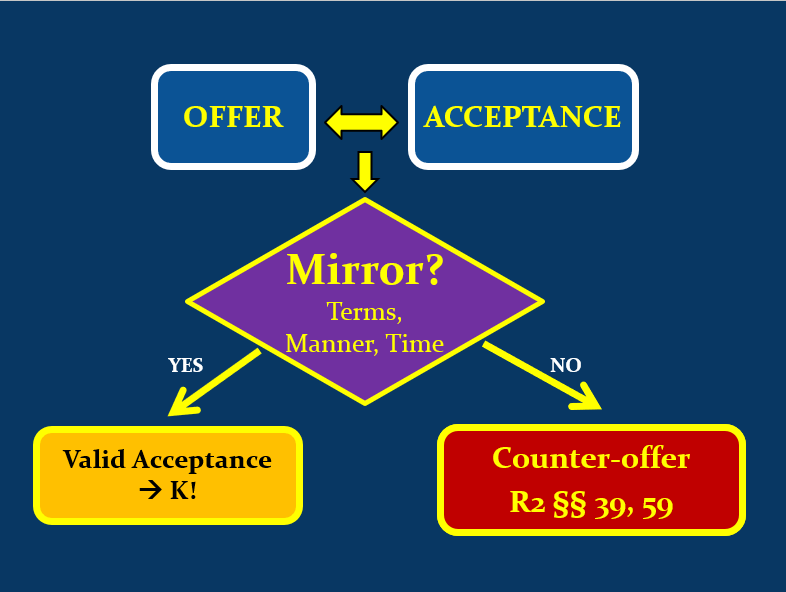
the power of acceptance and the power of revocation
the power of acceptance only exists in the offeree
an offeree is any person who, under the circumstances, reasonably beleives that the proposal is made to him and that his assent is invited
without an offer, there can be no acceptance
what terminates the power of acceptance
counteroffer/rejection in general
time for acceptance has expires- stated or reasonable
valid revocation of the offer by the offeror
death/incapacitation
what is needed for valid revocation
timing: must be revoked before its accepted. once accepted, it cannot be revoked
an offer is generally freely revocable at any time before it has been accepted
can do so even if he has promised he wont
communication: must communicate to the person that you want to revoke; cannot be internal
direct: told by the offeror they are no longer interested in selling (RESTATEMNET §42)
indirect: definite action counter to the offer; communicated from a reliable source (RESTATEMENT §43)
death does not revoke a contract; the estate must fulfil obligations
termination by offeree’s rejection
if the offeror makes an offer and hte offeree rejects the offer and then tries to accept after their initial rejection, the offer is dead, and the offeree has lost the power to accept
An offeree rejects an offer and thereby terminates it when she leads the offeror reasonably to believe that she has decided not to accept it
passage of time
an offer can die of old age
a sentence stating the offer is good for x days gives the offer an expiration
if no time is specified, the law limits its life to a reasonable time
the mailbox rule: RESTATEMENT §63
Unless an offer provides otherwise,
An acceptance made in a manner and by a medium invited by an offer is operative and completes the manifestation of mutual assent as soon as put out of the offeree’s possession, without regard to whether it ever reaches the offeror
Acceptance is effective on dispatch
Acceptance is effective when the offeree dispatches it
Revocation and rejection on receipt
Rejection is effective when the offeror receives it
Revocation is effective when the offeree receives it
One receives a written revocation or rejection when it reaches a destination at which she, in ordinary course, receives communications
HOWEVER: acceptance that follows rejection is not effective on dispatch
If the acceptance reaches first, the acceptance is effective. If the rejection follows, it is legally insignificant
If the rejection reaches first, the rejection is effective. If the acceptance follows, creates new offer
option contract (common law)
a party 1 (optionee) gives value to a party 2 (optionor) and in exchange, with respect to some other prospective contract; and
party 2 (optionor) promises, for some agreed period, to hold irrevocable an offer so that party 1 (optionee), for that period of time, has the option to accept it or not
irrevocable offers imposed voluntarily
elements of option contract
a. promise not to revoke the offer for a stated time
b. separate consideration (give something in return to hold the offer; normally money)
the offeror benefits because it motivates the offeree, businesses need
offeree benefits because they have time for consideration
firm offer (UCC)
an irrevocable offer imposed by the law of UCC §2-205
an offer for a period that is irrevocable
does not need consideration- aspires to be business friendly
elements of a firm offer
an offer- according to our usual CD test
by a merchant
§2-104(1)
to buy or sell goods
§2-105(1)
goods=movable
in a signed writing
the offer is written and signed by the correct party → offeror
a writing can be any intentional reduction to a tangible form
UCC §1-201(43)
signed writing should be broadly read to include other authentications by a writing
UCC §1-201(370)
assurance to hold the offer open
is not revokable during the time stated or if no time is stated, for a reasonable time
Special issues of a Firm Offer that may not arise
In no event may such a period of irrevocability exceed 3 months;
Any such term of assurance on a form signed by the offeree must be separately signed by the offeror
notice of performance to the offeror
if an offeree accept by performance and the offeror has no way to know they’ve accepted by performance, the offeree must notify the offeror that they performed. if within a reasonable time, the offeree fails to give the offeror such notice, the offeror is discharged from their contractual obligation
unilateral contracts
in a unilateral contract, there is only one promise being made.
a revocation is valid at any time until acceptance, unless the offer was made irrevocable by the parties or by the court
2 parties form a unilateral contract when an offeror allows an offeree to accept only by full performance, and the offeree does then provide full performance; from the moment of formation the contract is only executory on the offeror’s part
An offer for a unilateral contract is an offer in which the offeror allows the offeree to accept only by delivering all of the performance
if completed, 3 things happen
the offeree fulfills her part of the exchange
the contract arises
an executory duty is created on the offerors side, and the only offerors side
rule for revocation in a unilateral contract (RESTATEMENT §45)
where an offer invites an offeree to accept by rendering a performance, an option contract is created when the offeree begins the invited performance
who creates an option contract: law
offeror has the right to revoke until acceptance, but acceptance here is once the offeree has begun the performance
once the offeree has begun performance, the offeror is bound and cannot revoke BUT the offeree must complete the performance for a valid contract
elements of a bilateral contract
offer
cd test
reliance
action or forbearance induced by the offer
but for test: without x the party would not have relied in this way
reasonability of reliance
did the offeree act reasonable in their reliance
sustainability of the reliance
serious actions by the offeree with consequences for the offeree
foreseeability of reliance
the offeror should have been aware of the reliance the offer created
justice
requires imposition of an option contract
balancing test
if this is all met, the contract cannot be revoked
what is a mixed transaction
a contract that deals with both good and services/land
governed by the common law and the UCC
predominant purpose test
whether a particular transaction is governed by the UCC, rather than the common law or other statutory law, hinges on the predominant purpose of the transaction
mostly (but not only) selling goods? UCC
mostly (but not only) rendering services? Common Law
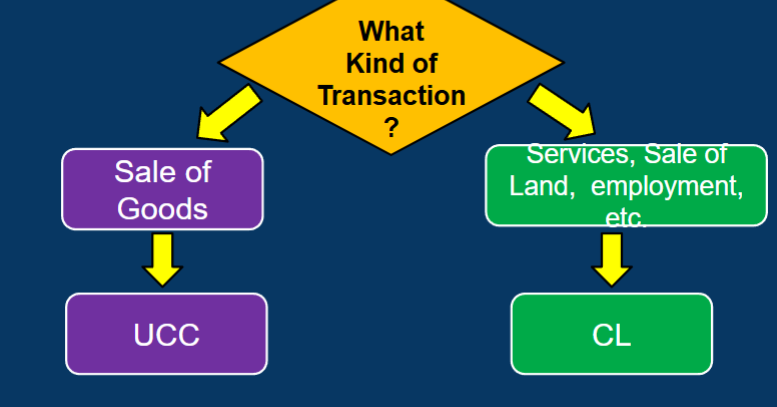
factors of mixed transactions
the language of the contract (Coakley factor)
the nature of the business of the supplier (goods or services) (Coakley factor)
the intrinsic worth of the materials (percentage of value or K) (Coakley factor)
what the complaint is about: goods or services (from Princess)
last shot rule
a party’s assent and acceptance of a counteroffer is implied by conduct that indicates a lack of objection to it. arbitrary
UCC 2-207
used for contracts that primarily concern goods

2 main questions for UCC 2-207
is there a contract
UCC changes the mirror image rule
more favorable to merchants, does not want to break contracts just because they don’t line up
result: there might be a contract if the mirror is broken
what are the terms
the UCC changes the last shot rule
does not want the arbitrary result of common law; wants the information to get as close to what the party intended to do
the battle will not be won by whoever got their paperwork on top
