AP Psych Unit 2.1-2.2
 Call Kai
 Learn
 Practice Test
 Spaced Repetition
 Match
 Flashcards
 Knowt Play
1/74

There's no tags or description
Looks like no tags are added yet.
75 Terms
Perception
Process of interpreting and organizing sensory info, enabling us to recognize meaningful objects and events
IS NOT AUTOMATIC

Bottom-up processing
our brain builds up a perception from small pieces of info

Top-down processing
Uses previous info
Your brain uses what it already knows to interpret info
Letting perceptions guide our sensory experiences
Schema
Mental Framework for understanding the world around us and is used for everything
Starts building from birth

Perceptual Set
a mental predisposition to perceive one thing and not another
Once we orm the wrong idea about reality it becomes more difficult to see the truth (ex: urban legends/ conspiracy theories)
Influenced by experiences, expectations, culture, motivation, and emotion

Context Effects
given stimulus may trigger radically different perceptions, partly because of our differing set, but also because of the immediate context.

Cultural Effects
Your perceptual rules are learned

Motivation and Emotional Effects
Current mood/physical status influences perception

Selective Attention
the focusing of conscious awareness on a particular stimulus

Cocktail Party Effect
Type of selective attention
You either focus your conscious on one voice in a crowded room or focus on your name called to you in a crowded room

Inattentional Blindness
Failing to see visible objects when our attention is directed elsewhere

Change Blindess
Blindness to environmental Change

Gestalt Psychology
Early 1900s, the Origins of Cognitive Psychology

Sensation
process by which our sensory receptors and nervous system receive and represent stimulus energies from our environment
Automatic!

Assimilation
interpreting our new experiences in terms of our existing schemas

Accomodation
Adapting out current schemas to fit in new info

Executive Functions
the higher-level mental processes that allow us to regulate and coordinate our own thought processes
Memory, cognitive flexibility, inhibitory control, how people manage their thoughts and actions

Algorithm
A methodical, logical rule or procedure that guarantees solving a particular problem.
Slow and often impractical, type of formal reasoning

Cognitive Psychologist
Study cognition including logical and illogical ways in which we create concepts, solve problems, make desicions, and form judgements

closure
Our mind doesn't have to see an entire image to perceive it, we fill in the gaps to make the whole picture

Figure + Ground
the organization of the visual field into objects (the figures) that stand out from their surroundings (the ground).

Grouping
the perceptual tendency to organize stimuli into coherent groups

Proximity Grouping
We group things together based on how close they are to one another

Similarity Grouping
We group things together based on how alike they are

Depth Perception
the ability to see objects in 3D although the images that strike the retina are 2D; allows us to judge distance

Visual Cliff
a laboratory device for testing depth perception in infants and young animals

Binocular Cues
depth cues, such as retinal disparity, that depend on the use of two eyes

Convergence
Our eyes tend to move closer together to see objects close to us

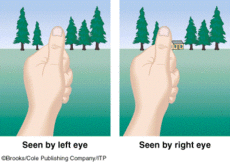
Retinal Disparity
a binocular cue for perceiving depth by comparing images from the retinas in the two eyes, the brain computes distance—the greater the disparity (difference) between the two images, the closer the object.
Monocular Cues
depth cues, such as interposition and linear perspective, available to either eye alone

Horizontal-Vertical Illusion
our perceiving vertical dimensions as longer than identical horizontal dimensions

Relative Clarity
a monocular cue for perceiving depth; hazy objects are farther away than sharp, clear objects
Caused by light passing through more atmosphere to hit the further object

Relative Size
a monocular cue for perceiving depth; the smaller retinal image is farther away (even if both things are the same size)

Texture Gradient
the tendency for textured surfaces to appear to become smaller and finer as distance from the viewer increases

Linear Perspective
A monocular cue for perceiving depth; the more parallel lines converge, the greater their perceived distance.

Interposition
if one object partially blocks our view of another, we perceive it as closer (the object that is blocking)
Anything that is blocked is deemed further away

Perceptual Constancies
tendency to perceive objects as stable and unchanging despite changing sensory info (size, shape, brightness, color)

Light and Shadow
Nearby objects reflect more light to eyes. Given two identical objects, the dimmer one seems farther away

Relative Height
we perceive objects higher in our field of vision as farther away

Color Constancy
perceiving familiar objects as having consistent color, even if changing illumination alters the wavelengths reflected by the object

Perceptual adaptation
If you keep perceiving something for a long time, you get used to that perception

Apparent Motion
2 individual shapes that are switched back and forth rapidly appear to be moving
Stroboscopic Movement
Images in a series of still pictures presented at a certain speed will appear to move (ex: flipbook)
Phi Phenomenom
an illusion of movement created when two or more adjacent lights blink on and off in quick succession
Autokinetic Effect
If a spotlight is projected steadily in a dark room in the same place for a long time, it appears to move

Cognition
all the mental activities associated with thinking, knowing, remembering, and communicating
MEtacognition
When we think about our cognition (thinking about thinking)

Concept
a mental grouping of similar objects, events, ideas, or people

Prototype
a mental image or best example of a category, incorporates the best features associated with that category
The more closely something resembles our prototype, the more rapidly we recognize it an an example of a concept

Schema
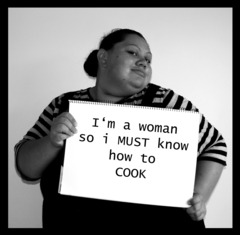
a concept or framework that organizes and interprets information, can lead to bias
Formal Reasoning
slow thinking
Used for specific problems, takes effort and self control bt is reliable
Algorithm, bottom up processing, syllogism, diagnosis, and AI

Heuristic
a simple thinking strategy that often allows us to make judgments and solve problems efficiently; usually speedier but also more error-prone than algorithms

Cognitive Bias
Result of imperfect thinking strategies, leads to misinterpreting info

Representative Heuristic
judging the likelihood of things in terms of how well they seem to represent, or match, particular prototypes, can lead to stereotypes

Informal Reasoning
Fast thinking, is error-prone and automatic, usually relies on intuition and the past

Availability Heuristic
estimating the likelihood of events based on their availability in memory; if instances come readily to mind (perhaps because of their vividness), we presume such events are common

Mental Set
Similar to schema, a way of thinking that has worked before will help you make decisions

Rigidity Mental Set
hard to change, the tendency to fall into established thought patterns

Priming
the activation, often unconsciously, of certain associations, thus predisposing one's perception, memory, or response

Framing Nudge
The way an issue is posed, it will determine what decision you make

Nudge
Framing choices in a way that encourages someone to pick one
Gambler's fallacy
the belief that the odds of a chance event increase if the event hasn't occurred recently

Sunk-cost fallacy
We tend to stick to our original plans due to how much time we've invested in them

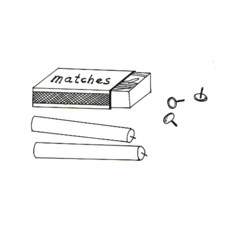
Functional Fixedness
the tendency to think of things only in terms of their usual functions; an impediment to problem solving
Insight
a sudden and often novel realization of the solution to a problem ("ah-ha!" moment)
Confirmation Bias
a tendency to search for information that supports our preconceptions and to ignore or distort contradictory evidence

Fixation
Not being able to see the problem from a different perspective

Intuition
Recognition from experience because something seems familiar, which influences us.
Adoptive!

Hindsight Bias
the tendency to believe, after learning an outcome, that one would have foreseen it

Planning Fallacy
the tendency to underestimate how long it will take to complete a task

Belief Perseverence
clinging to one's initial conceptions after the basis on which they were formed has been discredited

Overconfidence
the tendency to be more confident than correct—to overestimate the accuracy of our beliefs and judgments.

Creativity
the ability to produce novel and valuable ideas
Utilizes divergent and convergent thinking
amage to frontal lobe affects imagination

Divergent Thinking
Coming up with multiple creative ideas

Convergent Thinking
You narrow on a single idea from a bunch
