Chem Experiment 13
 Call Kai
 Learn
 Practice Test
 Spaced Repetition
 Match
 Flashcards
 Knowt Play
1/5

There's no tags or description
Looks like no tags are added yet.
6 Terms
Describe the octet rule in your own words. Describe two cases where the octet rule is broken.
The octet rule is when atoms gain, lose, or share electrons in their outermost shell to reach stability.
Electron-deficient atoms that are stable with fewer than 8 electrons in their valence shell break the octet rule. For example, helium is stable with two electrons in its valence shell.
Elements with d-orbitals can have expanded octets, allowing them to hold more than 8 valence electrons.
A boron atom has three valence electrons, while a helium atom has two valence electrons. Why does boron form electron-deficient compounds, but helium doesn’t?
Helium is stable because its valence shell is full with two electrons. Boron is electron deficient because its valence shell needs 8 electrons to be stable, but it makes 3 covalent bonds, giving it only 6 electrons in its valence shell/
count the valence electrons for O3 and NO-3
Oxygen: group 16 - 10 = 6 valence electrons
6 X 3 = 18 valence electrons in O3
NO-3
O3 = 18 valence electrons
Nitrogen: group 15 - 10 = 5 valence electrons
5 + 18 = 23
overall negative charge = 24 valence electrons NO-3
In the geometry formula AX3E, what do the letters A, X and E stand for?
A: central atom
X: bonded atoms
E: lone pairs
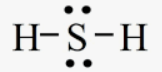
Count the valence electrons in the molecule H2S. Which atom is the central atom? How did you decide? Draw the lewis structure.
hydrogen = 1 valence electron x 2 = 2 Valence electrons
sulfur = group 16 - 10 = 6 valence electrons
2 + 6 = 8 total valence electrons
Sulfur is the central atom because hydrogen can only make one covalent bond
Count the valence electrons in NCl3. Which atom is the central atom? How did you decide? Draw the lewis structure.
Nitrogen = group 15 - 10 = 5 valence electrons
Chlorine = group 17 - 10 = 7 valence electrons x 3 = 21 valence electrons
21 + 5 = 26 valence electrons
Nitrogen is the central atom because it can make more covalent bonds than chlorine.