Leadership test (and feedback for 10 marker)
 Call Kai
 Learn
 Practice Test
 Spaced Repetition
 Match
 Flashcards
 Knowt Play
1/59

There's no tags or description
Looks like no tags are added yet.
60 Terms
define intrinsic feedback
a type of continuous feedback that comes from proprioceptors – nerve receptors found in muscles, ligaments and joints that pick up movement information.
define extrinsic feedback
feedback that comes from external sources – for example, from a teacher or a coach.
define positive feedback
reinforces skill learning and gives information about a successful outcome.
define negative feedback
information about unsuccessful outcome, which can be used to build more successful strategies.
define knowledge of results
a type of terminal feedback that gives the performer information about the end result of the response.
define knowledge of performance
information about how well the movement is being executed, rather than the end result.
Positives of intrinsic feedback and positive example
Quick
Usually done straight after action (during a game)
Good for elite athletes as they know by the kinaesthetic feel if they have done the skill correctly
e.g. A netball player shoots and knows the shot isn't going to go in due to how they flicked their wrist and released the ball
negatives of intrinsic feedback and a negative example
Performer may not have the right mental state and so may be over critical of performance (inaccurate perception)
Some performers may be able to feel and interpret the movements better than others
e.g. A netball player may give a bad pass and not know that they have as they haven't developed the kinaesthetic feel for a good pass yet.
positives of extrinsic feedback and positive example
A coach can give constructive feedback of things you may not have noticed, leading to improvement - as long as the information is accurate and relevant
e.g.A coach tells a netball shooter to bend their legs more when they shoot and so they get more goals in
negatives of extrinsic feedback and negative examples
Inaccurate feedback can affect performance negatively and may result in negative transfer
It can also cause players motivation to drop
e.g. A coach tells a player to keep straight legs when shooting which results in getting less shots in which then leads to demotivation
positives of positive feedback and positive example
Can lead to positive reinforcement and so strengthens the correct S-R bond
Can be very motivating, especially for cognitive stage learners
Build self-esteem and confidence
e.g. A coach praises a goal defence for a good interception so they do those type of interceptions more
negatives of positive feedback and negative example
If undeserved the performer may build inappropriate S-R bonds and so performance may deteriorate
Some performers may not respond well to praise and so may ignore the feedback, hindering performance and learning
e.g. a coach praises a player for contacting another in netball and so they do it more and they get more warnings and sent off more
positives of negative feedback and positive example
Some players are motivated by negative feedback and become more determined
It makes it clear to the performer of all the stuff they need to improve on
Most suited to autonomous players who require further refinement of their skills
e.g. A coach critiques how a netball player holds so they will change it so it becomes stronger and harder to intercept
negatives of negative feedback and negative example
Can be demotivating to the performer especially if cognitive stage of learning or don’t take criticism well
May be detrimental to the learning process if the feedback is inaccurate
A netball coach over critiques a beginner when they miss a shot, demotivating them
positives of knowledge of results and positive example
It is definite how it went - won or lost
Good for setting targets - like I want to come in the top 3 etc.
If it is good it can help build confidence
A netball player may win a match by over half helping them build confidence
negatives of knowledge of results and negative example
Easy to become demotivated if the performer doesn't win or meet target
Easy to become fixated on end result rather than individual performance and so performance may deteriorate
A netball player may lose even though they played well and may feel demotivated even though they played well
positives of knowledge of performance and positive example
Helps the performer focus on individual skills
Easier to improve specific skills
A netball player successfully getting a long shot in.
negatives of knowledge of performance and negative example
Performance may not be representative of final result
Performer may have an inaccurate perception of their skill/performance which may lead to demotivation
A netball player may think they did bad dodge because they are harsh on themselves and so they think they played bad leading to demotivation
why is giving effective feedback important?
Giving effective feedback is important to help the individual accept it and be able to use it to improve their performance and overall success.
For feedback to be effective, what 5 elements are needed?
type of feedback considered
a limited amount of information
immediacy
has the meaning for the individual
facilitates intrinsic feedback
what are the 3 leadership theories?
trait
social learning
interactionist
what does trait theory for leadership assume?
Certain traits produce certain traits of behaviour
These patterns are consistent across different situations
People are born with these leadership traits
what does the trait theory of leadership suggest?
Leaders have innate ability or genetic predisposition to show leadership qualities
This theory believes that leaders are born
Leadership traits are stable and enduring
Claims leaders can lead in whatever situation they are presented with
Argument against this is that people in sport tend to be quite specific in their leadership skills, depending on their particular situation which works against the more generalised approach if the trait perspective
what does the social learning theory of leadership suggest?
Leadership qualities and characteristics can be learned from watching others and copying their actions
Known as vicarious learning
This theory takes into account the environment, which the trait theory does not
what is a strength of social learning theory for leadership?
shows importance of social environment for adopting social leadership qualities, rather than the trait approach that doesn't take the environment into account
what does the interactionist theory suggest about leadership?
Theory states that a leader may have a certain characteristic/qualities that make them a leader which are innate, however they are only shown in certain situations
This theory explains how some leaders are not leaders in everyday life, but when faced with a particular situation they show effective leadership qualities
The name 'interactionist' is key as this theory claims that it's the interaction of innate leadership qualities and the changing environment that make a leader
Some may have traits such as being assertive but this trait isn't always shown, it is only shown if the environment causes this
what does Fiedler’s contingency model of leadership suggest?
Fiedler proposed a model which looked at the way the leader interacts with the situation they find themselves in
Used 2 classifications of leader: task orientated (focus on performance) and person orientated (focus on personal relationship)
what does the effectiveness of the leader depend on according to Fiedler’s contingency model of leadership?
The relationship between the leader and group members
Structure of the task
Leaders power and position of authority
Situation is most favourable if the relationship between the leader and group members if warm and positive, the task is clear and unambiguous and the leader is in a strong position of authority
If a situation is unfavourable, the opposites apply
if the person is more task orientated and person orientated when are they more effective?
Task orientated = more effective in the extremes
Person orientated = most effective in situations that are moderately favourable
what is the model for leadership called?
Chelladurai’s multi-dimension model of sports leadership
what does Chelladurai’s multi-dimension model of sports leadership look like?
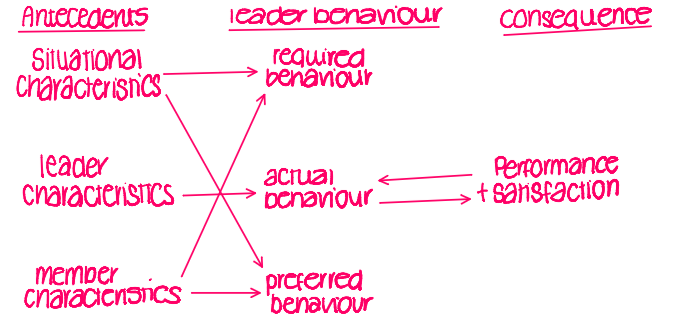
what do situational characteristics mean(Chelladurai’s multi-dimension model of sports leadership)
the environmental conditions
what do leader characteristics mean (Chelladurai’s multi-dimension model of sports leadership)
Style/skills/past experiences/personality
what do member characteristics mean (Chelladurai’s multi-dimension model of sports leadership)
gender/skill level/age of the group
what do required behaviour mean (Chelladurai’s multi-dimension model of sports leadership)
what should/needs to be done by the leader
what does actual behaviour mean (Chelladurai’s multi-dimension model of sports leadership)
what the leader chooses to do
what does preferred behaviour mean (Chelladurai’s multi-dimension model of sports leadership)
what the group wants the leader to do
what does the performance and satisfaction mean (Chelladurai’s multi-dimension model of sports leadership)
Good performance and satisfied members occur when the actual behaviour of the leader matches the required behaviour and the preferred behaviour
what is an example of Chelladurai’s multi-dimension model of sports leadership?
situational characteristic - Outdoor climbing, which is perceived to be dangerous for participants
leader characteristics - an experienced rock climber
member characteristics - all group members are novices in rock climbing
required behaviour - The leader should adopt an autocratic leadership style and give direct instructions to group members because the situation is dangerous and group members are beginners
actual behaviour - The leadership style shown by the leader; in this case, an autocratic approach, giving instructions and making most of the decisions
preferred behaviour - For the leader to be autocratic, making the most of the decisions and telling the group members exactly what they do as they are inexperienced
performance and satisfaction - The leaders actual behaviour matches the required and preferred behaviour and so the group show good performance in learning to climb and experience high levels of satisfaction
when are the elements more effective? (Chelladurai’s multi-dimension model of sports leadership)
More elements of this model that match each other the more effective the leadership is likely to be
does Chelladurai’s multi-dimension model of sports leadership reflect the most popular theory of leadership? why?
yes
This model reflects the most popular theory of leadership which is that people learn to be leaders through social learning and interactions with their environment
what are 3 types of leaders?
autocratic
democratic
Laissez-faire
what are some characteristics of autocratic leaders?
Decisive
Clear authority
Makes all the decisions
Dictatorial
Task orientated
Works quickly
what are some advantages of autocratic leaders?
Good for beginners or large groups
Good for dangerous or complex tasks
Good if not much time available
Good with male athletes
Good if group wants autocratic leader or experts that trust their leader
When groups are hostile and discipline is needed
In early or cognitive stage of learning
Leaders personality is inclined to authoritarian
what are some disadvantages of autocratic leaders?
Athletes don’t contribute different ideas
Can cause frustration
Over reliance on the leader
what are some characteristics of democratic leaders?
Shares decisions
Involves the group members
Goals are more changeable
Person orientated
Works slower than autocratic
what are some advantages of democratic leaders?
Good for individual or small group tasks
Better for female athletes
Appropriate for safe or simple skills
Good with experts
Good for situations where there is no time pressure
Good if group want democratic leader
When groups are friendly and relationships are warm
Activities that require interpersonal communication
Autonomous stage of learning
No danger
Leaders personality inclined to democratic
No constraints of time
what are some disadvantages of democratic leaders?
Too many ideas can lead to lack of agreement
Can be time consuming due to decision making
what are some characteristics of Laissez-faire leaders?
Group makes the decisions
Leader gives very little feedback
Leader makes very few decisions
Takes back seat
what are some advantages of Laissez-faire leaders?
Good when used with developing creatively
Good for working with elite performers
Good for completing assessments
Good if the leader fully trusts the group
what are some disadvantages of Laissez-faire leaders?
Lack of direction and guidance
what are some general characteristics of a leader?
Listener
Good communication skills
Confident
Empathetic
Patient
Respected
Adaptive or flexible
Approachable
Reliable
Being good at the sport or experienced
Clear goal and vision
Good decision maker
Motivated, enthusiastic, persistent and ambitious
what are some examples of roles of a leader?
Captain and Vice-Captain
Coach
Manager
Sports psychologists
Head physios
what are emergent leaders?
one who comes from within a group
what are prescribed leaders?
ones who is brought in from outside the group
what are some advantages of emergent leaders?
Knows the team, how it works and set up already
Already has respect - already shown commitment to the group
what are some disadvantages of emergent leaders?
Team members may not see them as a leader and so may not listen or show them respect
Might just be a popularity contest
Close relationships may make it difficult to assert authority
what are some advantages of prescribed leaders?
Might have more experience
No pre conceived opinions - fresh opinions
Possibly more creative
May have more authority
what are some disadvantages of prescribed leaders?
Doesn't know the team - requires time to learn requirements of team
May not be aware of team culture
what are some things that may make a prescribed leader more successful/respected?
Past experience that’s been successful
Older