Molecular Neuro Exam 1
 Call Kai
 Learn
 Practice Test
 Spaced Repetition
 Match
 Flashcards
 Knowt Play
1/86

There's no tags or description
Looks like no tags are added yet.
87 Terms
Untranslatable Regions
5’ UTR: hairpin, uORF, IRES
3’ UTR: zip code, CPE
upstream open reading frame (uORF)
associates with ribosomes and regulates timing of translation
internal ribosome entry site (IRES)
translational control
ZBP-1
Zip code binding protein (3’ UTR)
Transports actin to axon growth cone during development
Dscam gene
Found in Drosophila
Keep dendrites of the same neuron from interacting with one another
Can produce 38,016 proteins via alternative RNA splicing
Examples of alternative RNA splicing
1 Cassette exon
2 Mutually exclusive exons
3 5’ splice
4 3’ splice
Kinds of RNA
Messenger RNA (mRNA)
Transfer RNA (tRNA)
Ribosomal RNA (rRNA)
Micro RNA (miRNA)
Long Non-coding RNA (lncRNA)
Piwi RNA
miRNA
Post-translational gene regulation
Degrades target mRNA
Origins of mRNA
Intergenic
Intragenic
Transcribed from host gene promoter
Transcribed from intronic promoter
pri-miRNA vs pre-miRNA
pri-miRNA = “primary miRNA” - processed by Drosha/DGCR8 into pre-miRNA
pre-miRNA = may be processed into multiple miRNAs
Role of miRNA in early neurogenesis
Positive AND negative roles in regulation
BAF53a repression
Mediated by sequences within its 3’ UTR
Target of mi-R9* and mi-R124
lncRNAs
Longer than 200 bp and don’t typically encode protein
Possible functions:
Decoy
Scaffold
Guide
Enhancer
Types of lncRNAs
Long intergenic NCRNA: associate with chromatin modifying enzymes
Natural Antisense Transcripts (NAT) - recruit epigenetic modifiers
Overlapping - open chromatin structure
Bidirectional - open chromatin structure, facilitate chromatin modification of target genes
Sense intronic - open chromatin structure, recruit epigenetic modifiers
RMST
lncRNA
Involved in neurogenesis
Inhibits SOX2, prevents it from maintaining neural stem cell identity
EVF2
lncRNA
Required for interneuron development
Regulates Dlx5/6 and Gad1
Transcription factors
Stabilize RNA polymerase on the promoter site of DNA
Histone Methylation
Can promote OR repress transcription
Histone Acetylation
Switches from repressive to permissive chromatin
Condensed vs Uncondensed nucleosomes
Condensed: histone tails largely methylated
Uncondensed: histone tails LARGELY unmethylated, and acetylated
“canonical gene”
one gene-one protein
continuous area on a chromosome that codes for one protein
Establishment of cell identity
Happens early on
Caused by exposure to morphogens, expression of selector genes, and cell:cell interactions
Contact signals in mammals and drosophila
wnt family (wingless), TGFbeta(dpp) and hh(hedgehog)
Hedgehog (hh) signaling from floor plate
specifies motor neuron identity
Does any one marker/selector specify a cell type
NO!!!
Site Specific Recombinase
A protein that triggers a recombination when it binds to two specific DNA sequences
Example: flip recombination targets
RNAseq
the ability to quantify the expression of each gene in a given tissue
tRNA processing steps
removal of leader and trailer sequences,
post-transcriptional modification of bases,
addition of 3-CCA ends
aminoacyl tRNA synthetase (aaRS)
charges tRNA with cognate amino acid,
AA-tRNA synthetase use various chemical features, such as charge, hydrophobicity, size, and shape, to distinguish between different amino acids.
steps of tRNA charging with cognate amino acid
1) Activation of amino acids by attachment of AMP to form an AA-adenylate
2) Transfer of aminoacyl group to 3’ hydroxyl group of ribose of terminal adenosine of the CCA tail of tRNA
Double-sieve model
Allows each AA-tRNA synthetase to charge the correct amino acid (?)
1st sieve: size
2nd sieve: hydrophilicity
Editing site of ribosome
Secondary site which serves as an alternative to the aminoacylation site, important for amino acids that tend to be mis-activated in the aminoacylation site
Increases fidelity of aminoacetylation reaction
Two primary functions of tRNA
1) they decode the mRNA through direct base-pairing interactions
2) they participate in the synthesis of polypeptide, as they carry a chemically reactive amino acid at their 3’ end.
Wobble pairing
occurs at third position of anticodon
allows certain non-Watson-Crick pairing interactions to be accepted by the translational machinery
monosome vs polysome
monosome: single, complete 80s ribosome. preferred in neurites
polysome: multiple ribosomes. preferred in cell soma
40s
small ribosomal subunit
responsible for deciphering mRNA
60s
large ribosomal subunit
mediates formation of peptide bond between amino acids
A site (Aminoacyl)
Ribosome primary binding site that is closest to 3’ end of mRNA
Receives and binds the incoming "charged" aminoacyl-tRNA carrying the next amino acid to be added to the chain.
P site (Peptidyl)
Middle ribosome primary binding site
Holds the tRNA that is currently attached to the growing polypeptide chain.
E site (Exit)
Ribosome primary binding site that is closest to 5’ end of mRNA
Holds the empty (deacylated) tRNA just before it is released from the ribosome into the cytoplasm
Classical vs revised model of ribosome biogenesis and heterogeneity
Classical model: Eukaryotic ribosomal proteins are shipped into the nucleus for assembly into ribosomal subunits within the nucleolus
Revised model: Several individual ribosomal proteins in the ribosome can be replaced by free cytoplasmic ribosomal proteins. Ribosome heterogeneity exists across cells or across cellular compartments
Most tightly regulated step in protein synthesis
Translation initiation
m7G modification
Adding the 5’ cap to mRNA
Recognized by eIF4E, binds to cap structure which is vital for cap-dependent translation
eIF2
Initiation factor
GTP dependent G-protein
Associates with 40s subunit and other initiation factors after binding tRNAmet - this forms 43s initiation complex
eIF4F
Subunits:
eIF4E: binds m7-GTP cap
eIF4A: DEAD-box RNA helicase, unwinds secondary structures on 5’ end of mRNA
eIF4G: scaffolding protein that binds to poly-A binding protein and eIF3 (part of 43S)
Integrated Stress Response Regulators
GCN2 - amino acid deprivation
PKR - viral infection
PERK - endoplasmic reticulum stress
HRI - heme depletion
Effects of phosphorylating eIF2alpha (eIF2 subunit) in the Integrated Stress Response
Inhibits eIF2B → prevents eIF2B from converting eIF2-GDP into eIF2-GTP. This conversion is essential for the initiation of protein translation.
Upregulates ATF4 by limiting availability of the eIF2 ternary complex, which prevents ribosome from stopping at the uORF that precedes ATF4
ATF4 is both a transcription factor and transcription repressor. it both represses CREB genes and upregulates stress response genes
Anabolic Signaling
Increases translation initiation
ERK/MAPK and mTORC1
mTORC1 phosphorylates/inhibits 4E-BP(4E binding protein). This inhibition leaves eF4E free to bind to the 5’ cap and allows for protein translation to initiate
Additionally, both mTORC1 and ERL/MAPK phosphorylate S6K1, which increases 43s formation
Translation Elongation
Occurs in three steps and requires 3 elongation factors:
GTP-bound eEF1A binds to the aa-tRNA and delivers it to the ribosome
Ribosomal peptidyl transferase (composed entirely of rRNA) catalyzes peptide bond formation.
eEF2 catalyzes coordinated translocation of both the ribosome and the mRNA/tRNA complex during protein synthesis

eEF2 regulation
eEF2 is highly regulated
eEF2k - inhibits eEF2 by phosphorylating it
Increased calcium or AMPK activity increases eEF2k activity
ERK phosphorylates and inhibits eEF2
mTORC1 phosphorylates S6K1, which phosphorylates and inhibits eEF2
Causes of ribosome stalling
mRNA defects (ex: truncations within coding sequences and specific mRNA sequences such as poly(A) tracts)
Ribosome rescue factors
Detect molecular signatures of stalling, such as empty A site or ribosome collisions
3 stop codons
UAA, UAG, UGA
Release factors
Required for termination of protein synthesis
Bind to A-site of ribosome
eRF1
release factor
structural mimic of tRNA, identifies stop codons and binds eRF3 and GTP
eRF3
release factor
GTPase activity
triggers hydroysis of bond between completed protein and final tRNA at P-site
ABCE1
Splits ribosome into free 60s subunit and mRNA and tRNA bound 40s subunit
Steady-state proteosome
all proteins present in cell + their interactions
Nascent proteosome
newly synthesized proteins
Local nascent proteosome
specific cell regions, axons/dendrites
Cell-type proteosome
Cell-specific nascent proteins
BCA (bicinchoninic acid) Assay
measure total protein content in sample
candidate POI (protein of interest) approach
Quantitative Mass Spectrometry
measures steady state proteosome
mass/charge ratio
bottom up: more established, can identify a greater number of proteins, and is more sensitive, but can lose information on post-translational modifications (PTMs)
vs
bottom down: provides a more complete picture of the functional, intact protein but is more challenging to perform and has lower throughput.
Radioactive metabolic labeling
Nascent proteome
measures bulk translation
SILAC (stable (non-radioactive) isotope labeling in cell culture)
unbiased nascent proteomics
more modern than radioactive metabolic labeling and does not rely on radioactive materials
relies on incorporation of “light” or “heavy” form of amino acid into new proteins
weakness: peptides cannot be purified/enriched and method cannot capture rapid fluctuations
SUnSET (surface sensing of translation)
measures bulk AND protein of interest translation
puromycin mimics tyrosyl tRNA and occupies the A site when the codon codes for tyrosine.
puromycylated peptides can be identified using Western blot with antibody for puromycin
weakness: proteins generally truncated and nonfunctional
PunchP
Similar to SUnSET
Based on biotinylated puromycin
Involves the isolation of ribosomes followed by labeling, capture and mass-spectrometric analysis of nascent polypeptide chains
NCAT (non-canonical amino acid tagging)
nascent proteome
Azidohomolanine (AHA) fits into the binding pocket of Methionine aaRS then methionyl tRNA gets charged with AHA instead of methionine (Met)
Click chemistry
interaction between azide and alkyne
needs copper as a catalyst
results in formation of a covalent bond (triazole).
FUNCAT
varient of NCAT
utilizes click chemistry
uses a fluorophore-conjugated alkyne that bonds with AHA
especially useful for measuring protein synthesis load at the level of single cells using microscopy.
single-cell but not single-peptide resolution
measuring cell-type specific proteome with NCAT
ANL instead of AHA
ANL is only recognized by endogenous MetRS and is only recognized by mutant tRNA synthetase that is only expressed in target cell-type
Sucrose density gradient
Old technique used for polysomal profiling
continuous sucrose gradient of 15% to 45%.
using a UV detector to measure absorbance across the gradient at 254 nm (the wavelength that is absorbed by hydrocarbons), the gradient can be separated into fractions
heaviest fractions indicate polysomes
Ribosome tagging
cell-type specific translational profile
Express fluorescent/peptide tag for ribosomal subunit in specific cell-type
Perform translating ribosome affinity purification by using an anti-GFP (or HA) antibody to pull down mRNA-polysome complexes followed by mRNA purification and RNA-seq
x-rays/radiation
high mutation frequency
large chromosomal changes (insertion,deletion,inversion)
chemical mutagens
high mutation frequency
unbiased in which genes they affect
missense mutations, nonsense mutations, and frameshift mutations
insertional mutagenesis
ease in cloning genes
biased in which genes the affect
insertion frequency is low for transposons and retroviruses
forward vs reverse genetics
forwards: starts with phenotype and identifies genotype
reverse: starts with genotype and identifies phenotype
diploid screen for recessive mutations
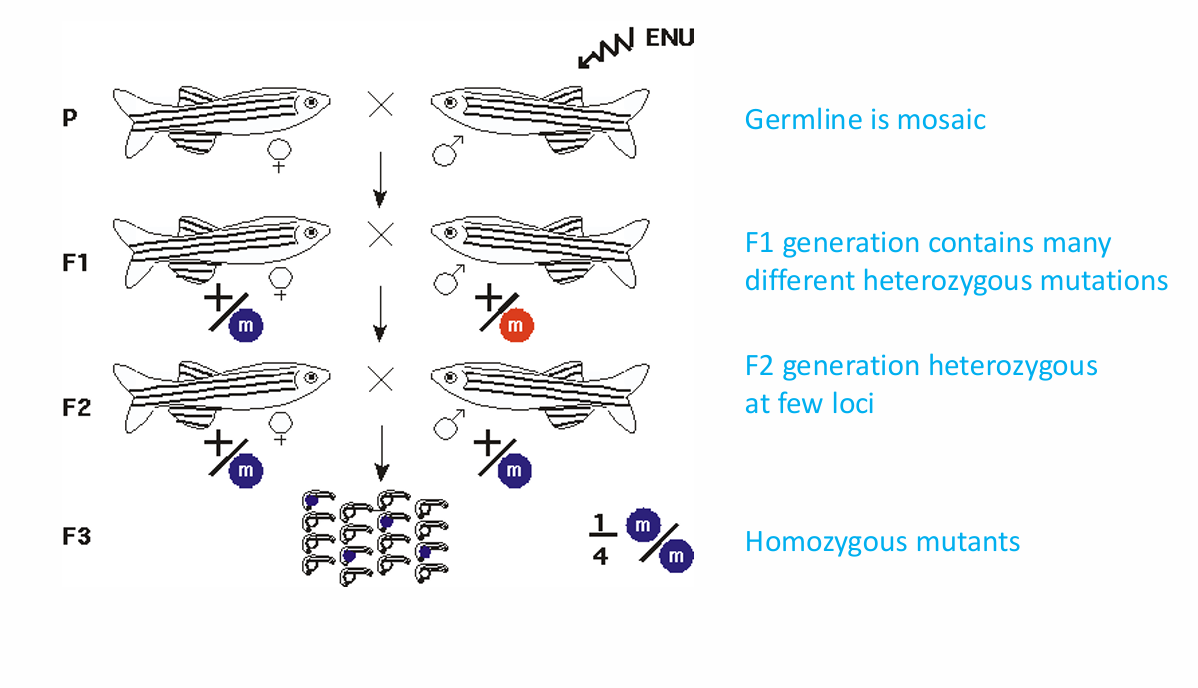
screening approaches
morphology
mRNA/protein expression
fluorescent labeling of live cells
behavioral assays (ex:optokinetic response)
complementary testing to sort alleles
can tell you if mutations are on the same gene

DNA microarray for singlue nucleotide polymorphism detection (SNP)
Loss of heterozygosity
1 copy of a gene is lost