BIOCHEM EXAM 5: Ketone Bodies and FA Synthesis I
 Call Kai
 Learn
 Practice Test
 Spaced Repetition
 Match
 Flashcards
 Knowt Play
1/81

There's no tags or description
Looks like no tags are added yet.
82 Terms
What do anaplerotic rxns do?
replenish certain TCA cycle intermediates, oxaloacetate from pyruvate
In liver, Acetyl-CoA from Beta-Oxidation…
can’t enter TCA in low glucose conditions
What happens to acetyl-CoA from beta oxidation if there's low glucose from prolonged fasting and therefore no pyruvate to replenish oxaloacetate?
the liver uses it to make ketone bodies
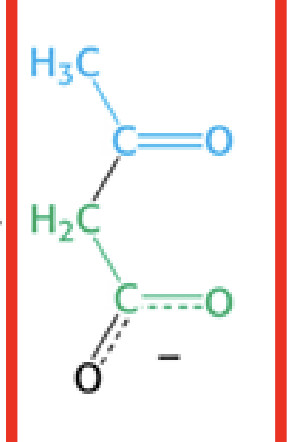
Structure
Acetoacetate
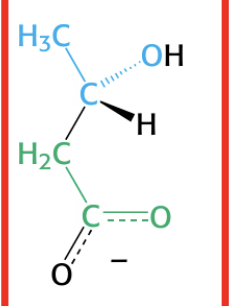
Structure
D-3-Hydroxy-butyrate

Structure
Acetone
What 3 ketone bodies are made?
acetoacetate, acetone, beta-hydroxybutyrate
The 3 ketone bodies are also..
important metabolic nutrients
Where does ketogenesis mostly occur?
liver mitochondria
How many acetyl-CoA are reacted to yield acetoacetate?
3 (and 1 is regenerated)
What enzyme converts acetoacetate to D-3-Hydroxybutyrate?
D-3-Hydroxybutyrate dehydrogenase
How does acetoacetate become acetone?
spontaneous conversion
Why are Alaskan sled dogs masters of ketone body metabolism?
they upregulate all the machinery for the beta-oxidation and ketogenesis
Humans are weird outliers in the…
brain to body mass ratio
What is the human brain to body mass ratio?
7.5
Why is the human brain's large brain-to-body mass ratio a problem during starvation?
The brain uses ~25% of our energy and prefers glucose. Fatty acids cannot easily cross the blood-brain barrier, and beta-oxidation can damage neurons.
What does the liver do during starvation to fuel the brain?
produces ketone bodies
What is the systemic delivery of fuel to brain and other organs?
ketogenesis
The liver produces ketone bodies but…
cannot use them
Why can the liver produce ketone bodies but not use them?
it lacks the neccessary enzyme to convert them back to Acetyl-CoA
What is the name of the enzyme that the liver lacks to use ketone bodies?
SCOT (or Thiophorase)
What does the blood-brain barrier exclude?
FAs
What are the 3 main reasons for glucose homeostasis?
brain, blood, heart
Why are the liver cells not running the TCA Cycle?
liver cells express GLUT that need a higher level of glucose to bring glucose in
How can you conceptualize ketone bodies?
as a water soluble way to ship out Acetyl-CoA from liver to other specific tissues, ESPECIALLY BRAIN
What enzyme converts Acetoacetate → Acetoacetyl CoA?
SCOT (Thiophorase)
What enzyme converts 4C Acetoacetyl CoA → 2 Acetyl-CoA?
Thiolase II
Why is acetone easily lost in the alveoli of the lungs and exhaled out?
it is highly volatile
Exhaled acetone can be detected in…
people undergoing prolonged fasting or caloric restriction
What does the liver do to try to salvage some of the lost acetone?
What is a symptom of diabetic keto-acidosis?
keto breath
Insulin signaling also lets…
GLUCOSE INTO CELLS
No insulin →
No glucose uptake
No glucose uptake →
No glycolysis/TCA or glycogenesis
No glycolysis/TCA or glycogenesis →
No signal to stop beta-oxidation in fat
What happens after blood pH drops (diabetic ket?
coma and death result
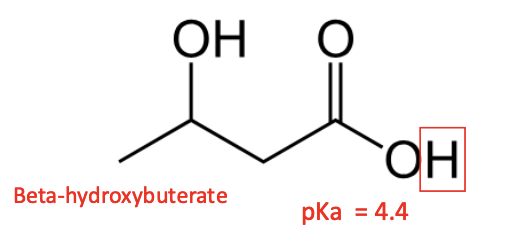
Will it be protonated or deprotonated at physiological pH (7.2)?
deprotonated

Structure
Beta-hydroxybuturate
Ketogenic Diets mimic…
starvation
What does mimicking starvation lead to?
low-insulin/high-glucagon state
What is crucial to the Ketogenic Diet?
you are still getting a normal # of calories from protein and fat
What diseases are the ketogenic beneficial for?
epilepsy and type 2 diabetes & metabolic syndrome
What are the risks and known side effects of the ketogenic diet?
keto “flu”
kidney stones
increased LDL “bad” cholesterol
Adult human beings have little need for…
de novo FA Synthesis
What synthesis is necessary during embryonic development and lactation in mammary glands?
FA Synthesis
FA synthesis requires integration of…
multiple pathways
What 3 pathways are integrated for FA Synthesis?
glycolysis, PPP, TCA Cycle
Where are FAs synthesiszed?
cytoplasm
What bypasses the mitochondrial membrane to carry acetyl groups across?
citrate
What is NADPH?
the major anabolic activated carrier
What 2 ways can NADPH be made?
the PPP or from the oxidation of malate to pyruvate by malic enzyme
FA Synthesis Step 1:
Malonyl-CoA Synthesis

Structure
Acetyl-CoA

Structure
Malonyl-CoA
What coenzyme does Acetyl-CoA Carboxylase require (Step 1)?
Biotin/B7
What is the committed step of FA Synthesis?
Step 1 (due to ATP hydrolysis)
What inhibits Step 1 of FA Synthesis?
palmitate
What promotes Step 1 of FA Synthesis?
citrate
FA Synthesis Step 2:
Activation w/ ACP (Acyl Carrier Protein)
New fatty acid chain primer (one per FA)
acetyl ACP
Chain extender (X per FA, where X is (n/2)-1 = final length)
malonyl ACP
What step of FA Synthesis activates the elongation phase?
Step 2
In BOS, we lose 2 C each repetition
In FA Synthesis, we …
gain 2 C each repetition
FA Synthesis Step 3:
Condensation
2 (Acetyl-CoA) + 3 (Malonyl-CoA) = 5 – 1 (CO2 ) = 4 carbon chain
FA Synthesis Step 4:
Reduction
FA Synthesis Step 5:
Dehydration
FA Synthesis Step 6:
Reduction
What do each of the reduction rxns use up?
NADPH
How many repeats does the reverse sequence require to build a C16 palmitate?
7
What does each repetiton of the reverse sequence consume?
1 Malonyl-ACP and 2 NADPH
What is the final release of FA Synthesis done by?
Thioesterase
In which organisms, are all reverse sequence enzymes independent gene products/ separate proteins?
prokaryotes (bacteria)
What is the primary product of FA Synthesis?
palmitate
What can extend palmitate further?
other enzymes in the ER
In which organisms, are all reverse sequence enzymes from one gene product?
eukaryotes (including humans)
What do enzymes in the ER uses for longer chains (modifying palmitate)?
Malonyl-CoA
What does desaturation (making double bonds) in modifying palmitate?
enzymes in the ER
What is an usual redox rxn?
FA Desaturation
What does desaturation do to a FA chain?
makes them more oxidized
How does FA Destauration start?
oxidation of NADH to initiate the creation of a double bond

Why do we have to steal 2 H atoms from the FA chain to form H2O for this C-C bond, and not during the normal steps of Beta-Oxidation?
bc the creation of this DB is facilitated by the proximity of the Carboxylic Acid Group w/ these highly electronegative oxygens