Protein Digestion in Non-Ruminants
 Call Kai
 Learn
 Practice Test
 Spaced Repetition
 Match
 Flashcards
 Knowt Play
1/55

There's no tags or description
Looks like no tags are added yet.
56 Terms
What is a peptide bond?
A peptide bond is a covalent bond that connects two amino acids. It forms between the carboxyl group (COOH) of one amino acid and the amino group (NH₂) of another amino acid.

How is a peptide bond formed between two amino acids?
A peptide bond forms through a dehydration (condensation) reaction
Forms H2O

What is the difference between peptide bond formation and peptide bond hydrolysis?
Peptide bond formation: Removes water to connect two amino acids.
Peptide bond hydrolysis: Adds water to break the bond connecting amino acids.
What is a dipeptide?
A dipeptide consists of two amino acids connected by one peptide bond.
What is a tripeptide?
A tripeptide consists of three amino acids connected by two peptide bonds.
What is a polypeptide?
A polypeptide is a chain containing more than 10 amino acids connected by peptide bonds
What is the relationship between the number of amino acids and the number of peptide bonds in a linear peptide?
The number of peptide bonds is always one less than the number of amino acids.
What are the products of protein digestion that can be absorbed by the small intestine?
Individual amino acids.
Dipeptides.
Tripeptides.
What is the primary structure of a protein?
The primary structure is the specific sequence of amino acids joined together by peptide bonds.

What is the secondary structure of a protein?
The secondary structure describes local folding patterns of the polypeptide chain that are stabilized by hydrogen bonding.

What is the tertiary structure of a protein?
The tertiary structure is the overall three-dimensional folding of an individual polypeptide chain.
Clustering of hydrophobic regions.

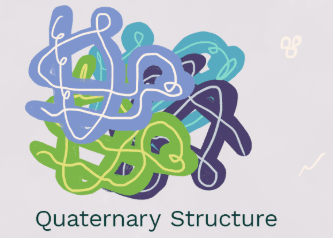
What is the quaternary structure of a protein?
The quaternary structure describes the interactions and organization between multiple polypeptide chains (subunits) that come together to form a functional protein.
Which levels of protein structure are disrupted during denaturation?
Denaturation disrupts the secondary, tertiary, and quaternary structures of proteins.
What causes protein denaturation during non-ruminant digestion?
Hydrochloric acid (HCl) in the stomach creates an acidic environment that denatures proteins.
Why is exposing peptide bonds important during protein digestion?
When proteins are denatured, their structures unfold, making peptide bonds more accessible to proteolytic enzymes. These enzymes can then hydrolyze the bonds and break the proteins into smaller peptides.
What is enzymatic hydrolysis of peptide bonds?
Enzymatic hydrolysis is the process in which proteolytic enzymes use water to break the peptide bonds connecting amino acids.
What are the three major steps of non-ruminant protein digestion?
Denaturation.
Enzymatic hydrolysis of peptide bonds.
Absorption.
Where does protein denaturation occur during non-ruminant digestion, and what causes it?
Protein denaturation occurs in the stomach due to hydrochloric acid (HCl), which decreases the pH and disrupts the protein's three-dimensional structure.
Where does enzymatic hydrolysis of peptide bonds occur?
Enzymatic hydrolysis occurs in both the stomach and the small intestine through the action of proteolytic enzymes.
What is the purpose of enzymatic hydrolysis during protein digestion?
It breaks large proteins into smaller peptides and individual amino acids that can be absorbed by the small intestine.
AFFECTS THE PRIMARY STRUCTURE!!
What protein digestion products are absorbed by the small intestine?
The small intestine absorbs amino acids, dipeptides, and tripeptides.
How are amino acids, dipeptides, and tripeptides absorbed by the small intestine?
They are absorbed through transporters located on the enterocytes
What is the role of enterocytes in protein absorption?
Enterocytes contain transport proteins that allow amino acids and small peptides, including dipeptides and tripeptides, to enter the intestinal cells during digestion.
What is the overall order of organs in non-ruminant protein digestion?
Mouth.
Stomach.
Small intestine.
Absorption through enterocytes.
What happens to dietary protein in the mouth?
Mechanical digestion decreases the particle size of food.
What happens to dietary protein when it reaches the stomach?
HCl decreases stomach pH.
The acidic environment denatures dietary proteins.
The stomach produces pepsinogen, an inactive enzyme precursor.
Pepsinogen is activated into pepsin.
Pepsin begins hydrolyzing peptide bonds.
What is pepsinogen?
Pepsinogen is the inactive precursor of pepsin. It is produced by the stomach and must be activated before it can hydrolyze peptide bonds.
How is pepsinogen activated into pepsin?
Pepsinogen is activated by hydrochloric acid (HCl) or by existing pepsin.
What is pepsin, and where does it function?
Pepsin is an active proteolytic enzyme that functions in the stomach. It hydrolyzes peptide bonds and begins breaking dietary proteins into smaller peptides.
Why is the acidic environment of the stomach important for pepsin activity?
The acidic environment helps activate pepsinogen into pepsin and provides the appropriate conditions for pepsin to function during protein digestion.
What activates pepsinogen, and what enzyme does it become?
Activators: HCl or pepsin.
Active enzyme: Pepsin.
Site of activity: Stomach.
Activity: Endopeptidase.
What activates trypsinogen, and what enzyme does it become?
Activators: Enteropeptidase or trypsin.
Active enzyme: Trypsin.
Site of activity: Small intestine.
Activity: Endopeptidase.
What activates chymotrypsinogen, and what enzyme does it become?
Activator: Trypsin.
Active enzyme: Chymotrypsin.
Site of activity: Small intestine.
Activity: Endopeptidase.
What activates procarboxypeptidase, and what enzymes does it become?
Activator: Trypsin.
Active enzymes: Carboxypeptidase A and B.
Site of activity: Small intestine.
Activity: Exopeptidase.
What is an endopeptidase?
An endopeptidase is an enzyme that hydrolyzes peptide bonds within the interior of a protein or polypeptide chain.
What is an exopeptidase?
An exopeptidase is an enzyme that hydrolyzes peptide bonds at the exterior ends of a protein or peptide chain.
What is enteropeptidase (enterokinase)?
Enteropeptidase is an enzyme produced by enterocytes in the small intestine. Its primary function is to activate trypsinogen into trypsin.
What is the primary function of enteropeptidase?
It activates trypsinogen, an inactive pancreatic zymogen, into active trypsin in the small intestine.
Where is enteropeptidase produced, and where does it function?
It is produced by enterocytes and functions in the small intestine, where it activates trypsinogen.
What hormones are associated with the release of enteropeptidase?
Cholecystokinin (CCK) and secretin.
What is the difference between endocrine and exocrine secretions?
Endocrine: Substances, such as hormones, are released into the bloodstream.
Exocrine: Substances are secreted through ducts into a lumen or onto an epithelial surface.
What are examples of endocrine pancreatic secretions?
Insulin and glucagon.
What are examples of exocrine pancreatic secretions involved in protein digestion?
Pancreatic digestive enzymes, including inactive proteolytic zymogens such as trypsinogen, chymotrypsinogen, and procarboxypeptidase.
What are CCK and secretin?
CCK (cholecystokinin) and secretin are hormones released by cells in the small intestine in response to digestive contents entering the intestinal lumen.
Which intestinal cells are associated with CCK and secretin?
I cells: Associated with CCK secretion.
S cells: Associated with secretin secretion.
What stimulates the release of CCK and secretin?
The arrival of digestive contents in the small intestine stimulates their release.
What is the role of CCK in pancreatic protein digestion?
CCK helps stimulate pancreatic digestive secretions, including the release of pancreatic enzyme-rich secretions into the small intestine.
What is the role of secretin in pancreatic protein digestion?
Secretin stimulates pancreatic bicarbonate secretion. Bicarbonate helps neutralize acidic stomach contents entering the duodenum, creating a more suitable pH for pancreatic digestive enzymes.
What is the purpose of pancreatic bicarbonate secretion by the pancreas?
Bicarbonate neutralizes the acidic contents entering the duodenum from the stomach. This helps protect the intestinal environment and provides a more appropriate pH for pancreatic enzymes.
What are brush border enzymes?
Brush border enzymes are digestive enzymes associated with the surface of the small intestine's enterocytes. They help complete the digestion of peptides into smaller absorbable products.
What are the four brush border peptidases?
Enteropeptidase.
Aminopeptidase.
Dipeptidylaminopeptidase.
Tripeptidase.
What is the function of brush border enteropeptidase?
Enteropeptidase activates trypsinogen into trypsin, initiating the activation of pancreatic proteolytic enzymes.
What is the function of aminopeptidase?
Aminopeptidase cleaves one amino acid at a time from the amino end of an oligopeptide.
What is an oligopeptide?
An oligopeptide is a relatively short chain of amino acids connected by peptide bonds.
What is the function of dipeptidylaminopeptidase?
Dipeptidylaminopeptidase cleaves dipeptides from oligopeptides.
What is the function of tripeptidase?
Tripeptidase cleaves one amino acid from tripeptides.