Plant Ecology 5460 Photosynthesis
 Call Kai
 Learn
Learn Practice Test
 Spaced Repetition
 Match
Match Flashcards
 Knowt Play
1/35

Earn XP
Description and Tags
Photosynthesis section
Name | Mastery | Learn | Test | Matching | Spaced | Call with Kai | Chat |
|---|
No analytics yet
Send a link to your students to track their progress
36 Terms
Photosynthesis: definition and overall chemical equation.
The set of biochemical processes by which plants acquire energy from sunlight and incorporate it with carbon from the atmosphere and water from the soil into organic compounds.
6CO2 + 6H2O —> C6H12O6 + 6O2
Describe the two types of mesophyll cells in dicots.
Palisade mesophyll: Compact cells, has the most chloroplasts.
Spongy mesophyll: cells are loosely packed, has fewer chloroplasts.


Is the image a dicot or monocot?
Describe the main anatomical structures.
Dicot; palisade and spongy mesophyll cells, vascular bundles, stomata, upper and lower epidermis.


Is the image a dicot or monocot leaf?
Describe the main anatomical structures.
Monocot; non differentiated mesophyll cells, stomata, vascular bundles, midrib vein, upper and lower epidermis.

What colors of light does chlorophyll absorb?
Blue (400nm) and red (680nm)
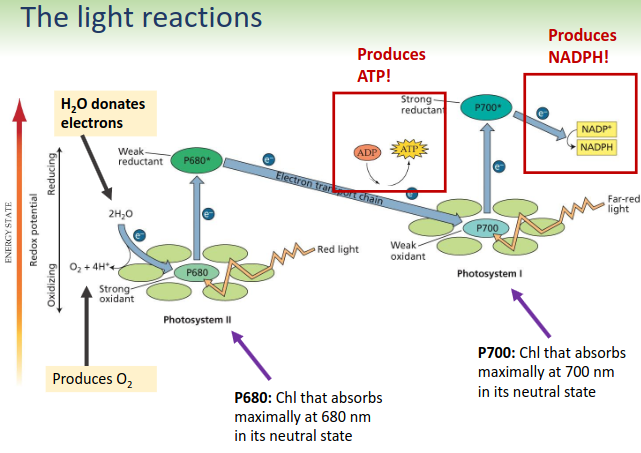
Describe the Z scheme in the light reactions?
Photosystem 2 (P680) is a strong oxidant and can split water to get electrons. Photosystem 1 (P700) is a strong reductant can create NADPH. The two photosystems are connected by the ETC. It is called a Z scheme because of what the schematic looks like.
Describe the proton gradient in the chloroplast.
The stroma has a low H+ concentration; the thylakoid lumen has a high H+ concentration.
Name the complexes in the electron transport chain in order of electron movement.
PS2, plastoquinone, cytochrome bf, plastocyanin, PS1, Ferrodoxin, ATP synthase.
What does each complex do in the ETC?
PS2: uses light energy to oxidize water to release electrons and produce O2.
Plastoquinone: transports e- from PS2 to Cytochrome bf and pump H+ from the stroma to the lumen.
Cytochrome bf: helps plastoquinone pump H+, and transports e- to plastocyanin.
Plastocyanin: transports e- to PS1
PS1: Works with ferrodoxin to reduce NADP+ and create NADPH.
ATP synthase: uses proton motive force to photophosphorylate ADP+ and create ATP..

How do the light and calvin reactions work together?
The light reactions capture energy from sunlight and store it in high energy chemical bonds.
The calvin reactions use the chemical energy captured by the light reactions and CO2 to create organic compounds.
What are the three steps of the Calvin cycle?
1) Carboxylation
2) Reduction
3) Regeneration
Describe the carboxylation step of the calvin cycle.
CO2 combines with RuBP to produce a 3 carbon compound. Catalyzed by RuBisCO. No ATP or NADPH is used in this step.
Describe the reduction step of the calvin cycle?
The 3 carbon product of carboxylation is reduced to a simple carbohydrate. The 3C1P is transformed to a 3C2P molecule using ATP, and then NADPH donates H+ and rearranges the phosphates to create a different 3C1P molecule. This product is used to create starch and sucrose, and in the regeneration step of the calvin cycle.
Describe the regeneration step of the calvin cycle.
RuBP is reformed for another cycle using the 3C1P product from the reduction step, and ATP.
Where does each component of the overall photosynthesis pathway come from and where is it used?
6CO2 + 6H2O —> C6H12O6 + 6O2

Describe Photorespiration?
Photorespiration occurs when RuBisCO binds with O2 (consuming ATP but only producing a 2C intermediate). This process is wasteful because the 2C intermediate must go through a long reaction process that loses CO2 and ATP and includes the chloroplast, peroxisome and mitochondria in order to become a useful intermediary.
What are the conditions that favor photorespiration?
Low CO2 concentrations, high partial pressures of oxygen, and warm temperatures.

Describe the unique anatomy of C4 plants.
C4 plants have Kranz anatomy, which is the arrangement of bundle sheath cells around the vascular tissue. This anatomy facilitates spatial segregation of CO2 from O2 which reduces photorespiration.

How does the C4 pathway reduce photorespiration?
The Kranz anatomy facilitates spatial segregation of transpiration and the calvin cycle, which concentrated CO2 around RuBisCO. There are 2 carboxylation events.
Carboxylation #1: In the mesophyll cell, PEP carboxylates CO2 to produce malate, a 4C storage molecule, which is shipped to the bundle sheath cells. PEP has a higher affinity for CO2 than RuBisCO.
Carboxylation #2: In the bundle sheath cells, malate is decarboxylated back to CO2, which results in a very high concentration of CO2 in the bundle sheath cells. CO2 is carboxylated by RuBisCO as normal. Pyruvate is shipped back to the mesophyll, where it is converted back to PEP.

Mesophyll cell= very low [CO2]
Bundle Sheath cell= very high [CO2]
![<p>Mesophyll cell= very low [CO2]</p><p>Bundle Sheath cell= very high [CO2]</p>](https://assets.knowt.com/user-attachments/8d6bd5d1-b5e4-4e92-89c8-c6c53a2f4f68.png)
Does the C4 or C3 pathway have higher nitrogen-use efficiency and water use efficiency?
C4 has higher NUE = High photosynthetic rates / less RuBisCO (=less N in leaf).
C4 has higher WUE = high photosynthetic rates / similar or lower water loss than a C3 plant.
How does the CAM pathway reduce photorespiration?
CAM pathway uses temporal segregation to concentrate CO2 around RuBisCO. 2 carboxylation events.
Night: Stomata opened, CO2 uptake, H2O loss. Carboxylation #1: PEP concentrates CO2 as malate, which is stored in a large vacuole.
Day: Stomata closed, malate transported to the chloroplast and decarboxylated. CO2 is carboxylated by RuBisCO.

Does the CAM or C4 pathway have higher water use efficiency?
CAM has higher WUE = carbon assimilation in photosynthesis / water loss in transpiration. No water lost during the day, and much less water lost at night due to low VPD.
Can plants use both the CAM pathway and C3?
Yes, some plants are obligate CAM, and some are facultative CAM expressed during drought.
What key point can be drawn from comparing the C3, C4 and CAM pathways?
Each photosynthetic pathway offers advantages and costs under different conditions, each has a tradeoff.
What is phenology and what phenologies do C3 and C4 plants typically have?
Phenology: the seasonal time of life history events.
Spring = usually C3
Summer/Fall = usually C4, some C3.
Describe the geographic distrobution of C4 grasses in the US.
The majority of C4 grasses are in the lower latitudes, with decreasing prevalence at higher latitudes. This pattern follows temperature changes vs latitude- it is hotter in the tropics, promoting C4 pathways as a method of reducing photorespiration; it is cooler at northern latitudes, reducing the need for C4 pathways and making C3 more efficient.

What is:
quantum yield (QY)
Maximum rate of net photosynthesis (A max)
Light compensation point (LCP)
Light saturation point
QY= moles of CO2 fixed per mole of photons absorbed.
A max= max rate of photosynthesis under light saturating conditions
LCP= light intensity at zero assimilation (photosynthesis=respiration)
Light saturation point= light intensity at which max rate of net photosynthesis is achieved.
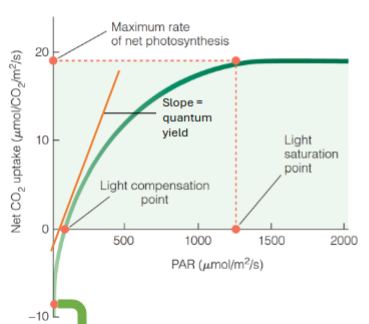
How does photosynthesis respond to light?
How does A max (maximum rate of net photosynthesis) and quantum yield differ between C3 and C4 pathways in response to light?
Photosynthesis increases with light intensity.
C4 plants have a higher A max
C4 plants have a higher quantum yield

How does light responses (A max and QY) vary for sun and shade plants?
Sun plants saturate at a much higher light intensity and have a higher A max
QY only differs between photosynthetic types, not growth conditions.

What happens when plants are exposed to too much light?
1) plants activate the xanthophyll cycle
2) Chloroplasts move to reduce surface area and excess absorption
3) Leaf movement: folding, twisting, mild wilting.
4) Photo-inhibition due to damage to PS2.
What is the photosynthetic response to increased CO2?
1) Increases CO2 inside leaf
2) Decreases stomatal conductance
Photosynthesis increases under elevated CO2 up to a point:
High photosynthetic rates and high amounts of carbohydrates can signal repression of genes for photosynthetic protiens, lower rubisco concentration, and lower stomatal density.
Nitrogen becomes more limiting than CO2.

How does the photosynthetic response to CO2 impact C3 and C4 plants?
C3: higher CO2 around RuBisCo favors carboxylation over oxygenation and reduces photorespiration.
C4: Spatial sgregation concentrates CO2 around RuBisCo. Photosynthesis is not stimulated by additional CO2. Lower CO2 compensation point.

How does photosynthetic responses to temperature affect C3 and C4 plants?
C3: At higher temperatures there is more photorespiration.
C4: Kranz anatomy allows them to function at higher temperatures.
ETC can become unstable at higher temperatures.
Why does photosynthesis decline under water deficit?
Stomata close to prevent water loss through transpiration which reduces CO2 availablity.
Why does elevated CO2 increase canopy temperatures?
Elevated CO2 leads to stomatal closure, which decreases water loss, which decreases evaporative heat loss, which increases temperature.
