AP Biology: Water Properties, Macromolecules, and Data Analysis
 Call Kai
 Learn
Learn Practice Test
 Spaced Repetition
 Match
Match Flashcards
 Knowt Play
1/160

There's no tags or description
Looks like no tags are added yet.
Name | Mastery | Learn | Test | Matching | Spaced | Call with Kai | Chat |
|---|
No analytics yet
Send a link to your students to track their progress
161 Terms
What causes the polarity of water molecules?
Oxygen is more electronegative than hydrogen, causing an unequal sharing of electrons and creating partial negative and positive charges.
What type of bond forms between the hydrogen atom of one water molecule and the oxygen atom of another?
Hydrogen bond
Which two properties of water enable its upward transport in plants during transpiration?
Cohesion and adhesion
What property of water allows aquatic insects to walk on its surface?
High surface tension resulting from cohesive forces between water molecules at the surface
What property of water accounts for milder climate swings in coastal regions?
Water's high specific heat allows it to absorb significant amounts of thermal energy while breaking hydrogen bonds before changing temperature.
How does liquid water insulate aquatic life during freezing months?
Hydrogen bonds in ice lock molecules into an open crystalline structure, making ice less dense than liquid water so it floats and insulates the water below.
What gives liquid water its high solvency ability?
Its polar nature, which allows it to form hydrogen bonds or electrostatic interactions with charged ions and polar solutes.
What drives capillary action in narrow tubes?
Combined adhesive forces between water and the tube walls and cohesive forces between water molecules.
What explains the evaporative cooling effect of sweat on the skin?
High heat of vaporization, requiring significant thermal energy to break hydrogen bonds and transition water from liquid to gas.
What happens to hydrogen bonds in water as temperature increases?
Hydrogen bonds break and reform more rapidly.
How did the red dye reach the leaves of a plant in a colored solution?
Adhesion of water to xylem cell walls combined with cohesion pulling water and dissolved dye upward.
Which substances dissolve easily in an aqueous solution?
Polar monosaccharides and charged ions.
Why must living organisms constantly exchange matter with their environment?
To obtain raw chemical elements required to build new biological macromolecules, store energy, and maintain organization.
Why is carbon considered the backbone of organic life?
It contains four valence electrons, allowing it to form up to four covalent bonds in chains, branches, or rings.
What class of macromolecule contains Carbon, Hydrogen, Oxygen, Nitrogen, and Sulfur?
Protein
Which elements are essential components of all nucleic acids?
C, H, O, N, and P
What element is required for constructing the hydrophilic head groups of phospholipids?
Phosphorus
What type of bond involves the sharing of valence electrons between nonmetal atoms?
Covalent bond
How does a polar covalent bond differ from a nonpolar covalent bond?
Polar covalent bonds involve unequal electron sharing due to electronegativity differences, creating partial charges, whereas nonpolar covalent bonds involve equal sharing.
What are polar covalent bonds?
Bonds involving the complete transfer of electrons, forming charged ions.
What two biological macromolecule classes require nitrogen for their synthesis?
Proteins and Nucleic Acids.
What is phosphorus primarily utilized for by living organisms?
To construct nucleic acids and cell membrane phospholipids.
Why are Carbon, Hydrogen, Oxygen, and Nitrogen classified as essential elements?
They make up approximately 96% of living matter and are required in large quantities to build biomass.
What reaction type connects monomers together to build larger polymers, and what is the byproduct?
Dehydration synthesis; releases a water molecule.
What reaction type breaks covalent bonds between monomers within a polymer?
Hydrolysis.
If a cell joins 25 monosaccharide monomers into a single polysaccharide chain, how many dehydration synthesis reactions occur?
24 reactions.
How many water molecules are produced when 25 monosaccharides are joined?
24 water molecules.
How many water molecules are required to hydrolyze a glycogen polymer composed of 300 glucose monomers?
299 water molecules.
How many dehydration synthesis reactions are needed to synthesize one triglyceride molecule?
3 reactions.
What fundamental chemical process occurs when enzymes break down dietary proteins into free amino acids?
Hydrolysis cleaving covalent peptide bonds using water.
What type of bonds link carbohydrate sugar monomers together?
Glycosidic bonds.
What type of bonds link amino acid monomers into polypeptide chains?
Peptide bonds.
How are nucleotides connected along a nucleic acid strand?
Phosphodiester bonds forming a sugar-phosphate backbone.
How are fatty acids attached to a glycerol backbone in triglycerides?
Ester bonds.
What is the typical ratio of C, H, and O atoms in carbohydrates?
1:2:1.
What are simple sugar monomers like glucose classified as?
Monosaccharides.
What are glucose and fructose classified as due to their identical molecular formula but different structures?
Structural isomers.
What two monosaccharides form sucrose?
Glucose and Fructose.
Which polysaccharides serve as primary short-term energy storage in plants and animals?
Starch (plants) and Glycogen (animals).
How does the branching of glycogen benefit animal cells during energy demands?
It creates numerous accessible endpoints for enzymes to hydrolyze glucose simultaneously.
What type of covalent bond connects glucose units in plant starch?
Glycosidic linkages.
Why is cellulose structurally stronger than starch?
Cellulose consists of linear, unbranched glucose chains arranged in parallel sheets held together by extensive hydrogen bonding.
What monomeric subunit builds chitin?
Modified glucose monomers containing nitrogen functional groups.
What visual clue identifies a chemical structure as a carbohydrate monomer?
A 5- or 6-carbon ring containing carbon and oxygen, surrounded by hydroxyl (-OH) groups.
What key physical property groups lipids together?
They are hydrophobic, nonpolar molecules that dissolve poorly in water.
What characterizes a saturated fatty acid?
It contains only single carbon-carbon bonds throughout its hydrocarbon skeleton.
Why do unsaturated fatty acids with cis-double bonds remain liquid at room temperature?
Double bonds introduce kinks in the carbon chain that prevent molecules from packing tightly together.
What does 'amphipathic' mean in the context of phospholipids?
The molecule possesses both a hydrophilic polar head group and hydrophobic nonpolar fatty acid tails.
How are individual phospholipid molecules oriented in a cell membrane?
Hydrophilic phosphate heads face outward; hydrophobic tails face inward toward each other.
What molecular skeleton is characteristic of steroids like cholesterol?
Four fused carbon rings.
What vital role does cholesterol play in animal cell plasma membranes?
It embeds within the lipid bilayer to stabilize membrane fluidity across temperature variations.
Why do fats (triglycerides) store more energy per gram than carbohydrates?
Fats contain dense hydrocarbon chains rich in nonpolar C-H bonds, yielding high chemical energy when oxidized.
How do trans-unsaturated fatty acids differ from cis-unsaturated fatty acids?
Trans-fatty acids contain double bonds where hydrogens are on opposite sides, producing a straight chain.
What type of molecule is characterized by long chains of Carbon and Hydrogen attached to glycerol?
Triglyceride lipid.
What are nucleic acids made from?
Nucleotides.
What are the three components of every nucleotide monomer?
A 5-carbon pentose sugar, a phosphate group, and a nitrogenous base.
What do the terms 5' and 3' refer to in nucleic acid strands?
The 5th carbon (attached to phosphate) and 3rd carbon (attached to hydroxyl) of the pentose sugar ring.
Where can new nucleotides be added during DNA or RNA synthesis?
To the 3' hydroxyl end of the growing strand.
How does DNA differ structurally from RNA?
DNA uses deoxyribose sugar, contains Thymine, and is double-stranded; RNA uses ribose sugar, contains Uracil, and is usually single-stranded.
What holds the two strands of a DNA double helix together?
Hydrogen bonds between complementary nitrogenous base pairs.
How do purine bases differ from pyrimidine bases?
Purines consist of two fused carbon-nitrogen rings (Adenine, Guanine).
According to Chargaff's rules, which bases pair together in DNA?
Adenine pairs with Thymine via 2 hydrogen bonds; Guanine pairs with Cytosine via 3 hydrogen bonds.
Which DNA sample will require a higher temperature to denature if one has 70% G-C content?
Sample A, because G-C pairs are held together by 3 hydrogen bonds compared to 2 in A-T pairs.
Where is genetic information encoded in DNA and RNA?
In the specific linear sequence of nitrogenous bases.
What are proteins assembled from?
Amino acids.
What groups are covalently bonded to the central carbon of a generic amino acid?
Hydrogen atom, Amine group, Carboxyl group, and a variable R-group.
What does every generic amino acid monomer consist of?
A central carbon atom bonded to a hydrogen atom, amine group (-NH2), carboxyl group (-COOH), and a variable R-group.
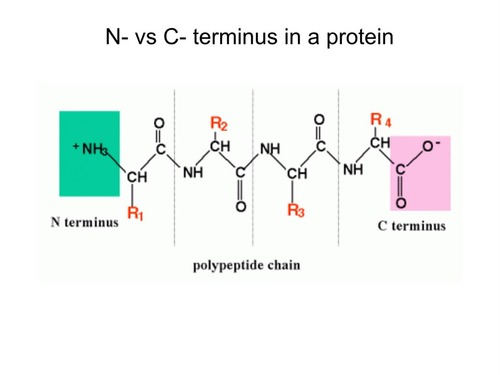
To which terminus are new amino acids added during protein synthesis?
The C-terminus (carboxyl group).
What dictates the chemical properties of an amino acid?
The variable R-group / side chain.
What defines the primary structure of a protein?
The linear sequence of amino acids held together by covalent peptide bonds.
What stabilizes secondary protein structure (alpha-helices and beta-pleated sheets)?
Hydrogen bonds between oxygen and hydrogen atoms along the polypeptide backbone.
What interactions stabilize tertiary protein structure?
Hydrogen bonds, ionic bonds, hydrophobic interactions, and covalent disulfide bridges between variable R-groups.
What is a disulfide bridge?
A strong covalent bond formed between the sulfhydryl (-SH) functional groups of two cysteine residues.
What is the consequence of replacing a cysteine with valine in an enzyme's active site?
The enzyme loses a critical covalent disulfide bridge, disrupting proper 3D tertiary folding and inactivating catalytic activity.
What happens to a protein during denaturation?
Weak non-covalent bonds holding secondary and tertiary structures disrupt, causing the protein to unfold and lose function.
What is the independent variable in an experiment testing water temperature's effect on starch hydrolysis?
Water temperature.
What is the purpose of including a negative control group in a scientific experiment?
To establish a baseline measurement in the absence of the experimental treatment.
What do maintaining pH, enzyme concentration, substrate concentration, and reaction volume represent in an experiment?
Experimental constants.
What does Standard Deviation (SD) quantify?
How spread out individual data measurements are around the sample mean.
What does Standard Error of the Mean (SEM) measure?
The statistical precision of the sample mean as an estimate of the true population mean.
How does increasing the sample size affect the calculated SEM?
SEM will decrease, indicating greater precision in the estimated mean.
What conclusion can be drawn if error bars for two sample means overlap heavily?
There is no statistically significant difference between the means.
What exemplifies a valid scientific claim regarding water properties in plants?
Cohesion and adhesion enable continuous vascular transport of water in plants.
What results in high surface tension in water?
Cohesive hydrogen bonding forces at the liquid-air boundary.
Why does water absorb substantial heat energy?
To disrupt hydrogen bonds before its temperature increases.
Why does ice float on water?
Ice forms an open lattice that makes it less dense than liquid water.
How does water interact with polar molecules and ions?
Water's partial charges interact electrostatically to dissolve them.
What is required for capillary action?
Both adhesion to walls and cohesion between liquid molecules.
What is the effect of evaporative cooling on body heat?
It removes body heat because breaking hydrogen bonds requires high thermal energy.
What happens to molecular kinetic energy with higher heat input?
It increases, causing hydrogen bonds to break and reform rapidly.
How does water move upward in plants?
Via adhesion to xylem cell walls and cohesion pulling the water column.
Why do polar and charged solutes dissolve easily in water?
Due to hydrophilic electrostatic interactions.
What do organisms require from their environment for growth?
Environmental matter to acquire atoms like carbon, nitrogen, and phosphorus.
What allows carbon to form complex molecular structures?
Carbon's 4 valence electrons enable 4 covalent bonds.
What elements are found in proteins?
Carbon, hydrogen, oxygen, nitrogen, and often sulfur.
What are nucleic acids composed of?
Carbon, hydrogen, oxygen, nitrogen, and phosphorus (CHONP).
What do phospholipids require?
A phosphate group containing phosphorus.
How are covalent bonds formed?
When nonmetal atoms share pairs of valence electrons.
What distinguishes polar covalent bonds from nonpolar bonds?
Polar covalent bonds share electrons unequally due to electronegativity differences.
What role does nitrogen play in biology?
It is an essential structural element in amino acids and nitrogenous bases.