digestive tract; secretions
 Call Kai
 Learn
Learn Practice Test
 Spaced Repetition
 Match
Match Flashcards
 Knowt Play
1/116

There's no tags or description
Looks like no tags are added yet.
Name | Mastery | Learn | Test | Matching | Spaced | Call with Kai | Chat |
|---|
No analytics yet
Send a link to your students to track their progress
117 Terms
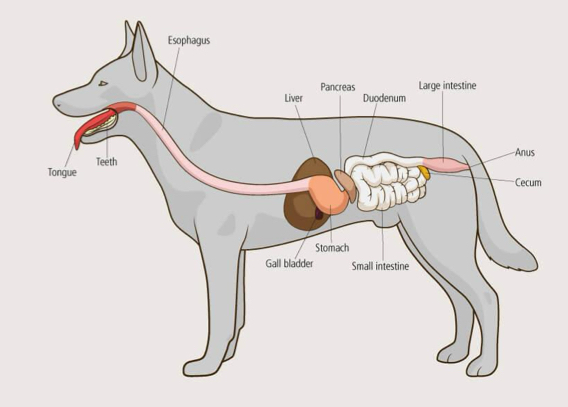
The digestive system of canines can be broken down into what 2 functional sections?
Alimentary canal , accessory structures
What is the alimentary canal?
Tube like structure running continuously from mouth to anus
What does the alimentary canal include?
Pharynx, esophagus, stomach, small intestine, large intestine
What are accessory structures?
Structures that aid in the breakdown and digestion of food
What does the accessory structures include?
Teeth, tongue, salivary glands, gallbladder, liver, pancreas
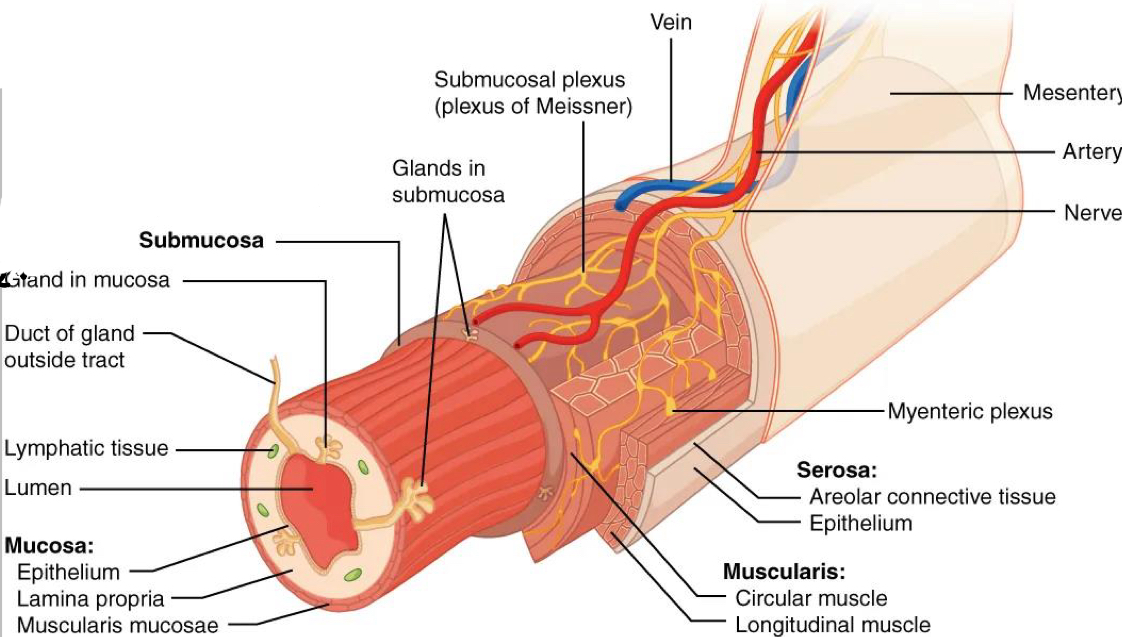
What is the mucosa?
Epithelial layer facilitating mucosal secretions
Inner most membrane
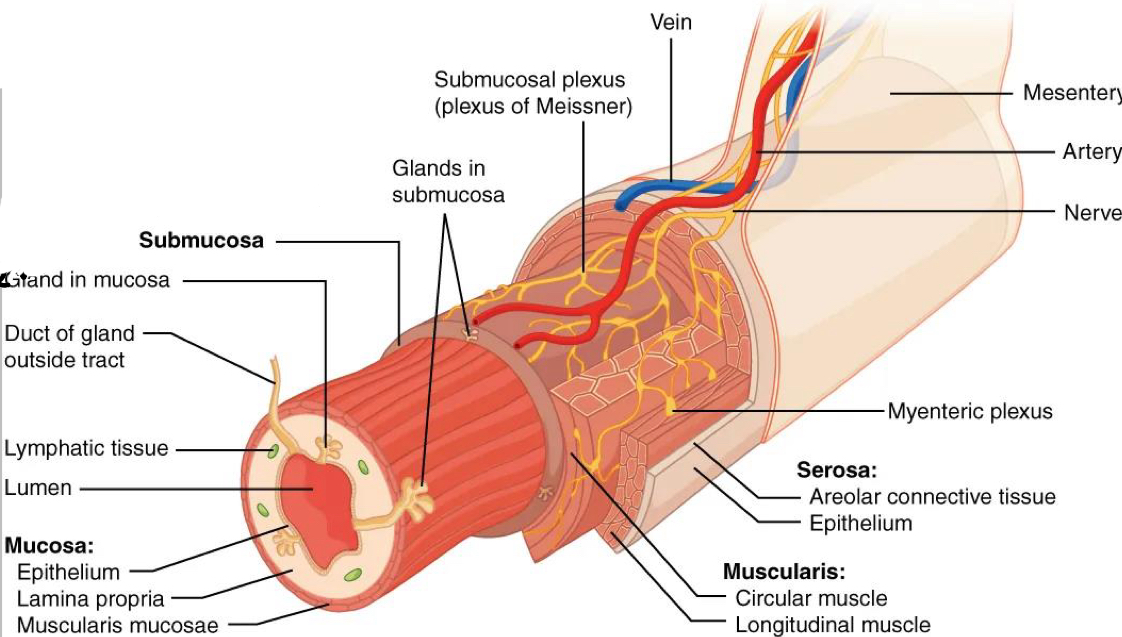
What is the Submucosa ?
Connective tissue layer between the mucosa and muscularis
Provides integrity to digestive system and anchor to glands
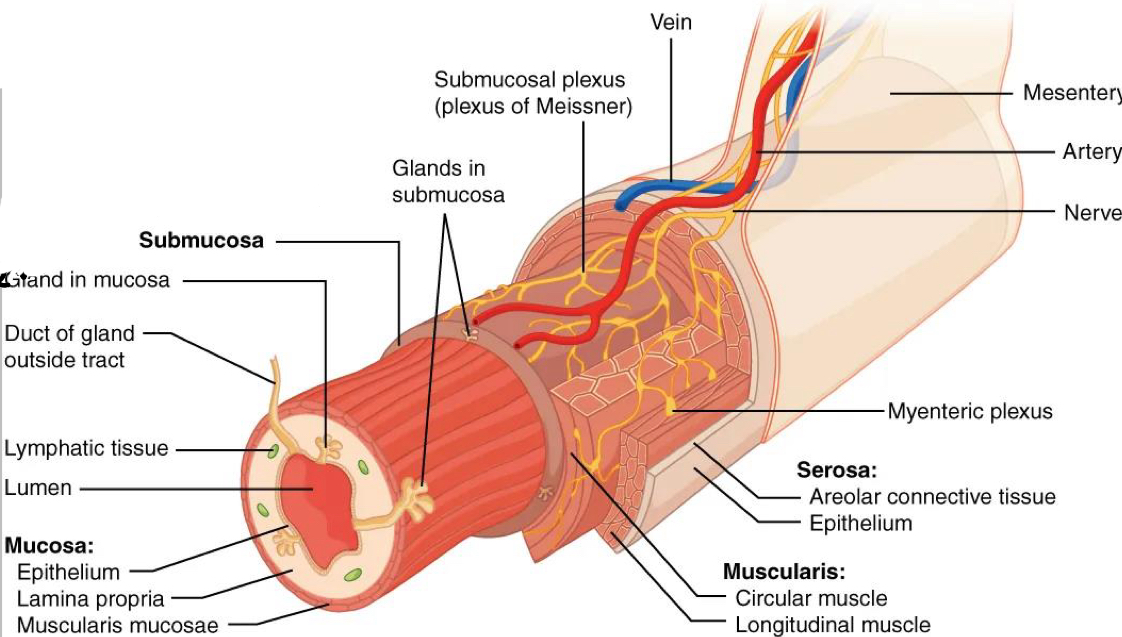
What is the muscularis ?
Smooth muscle layer facilitating peristalsis and mechanical digestion
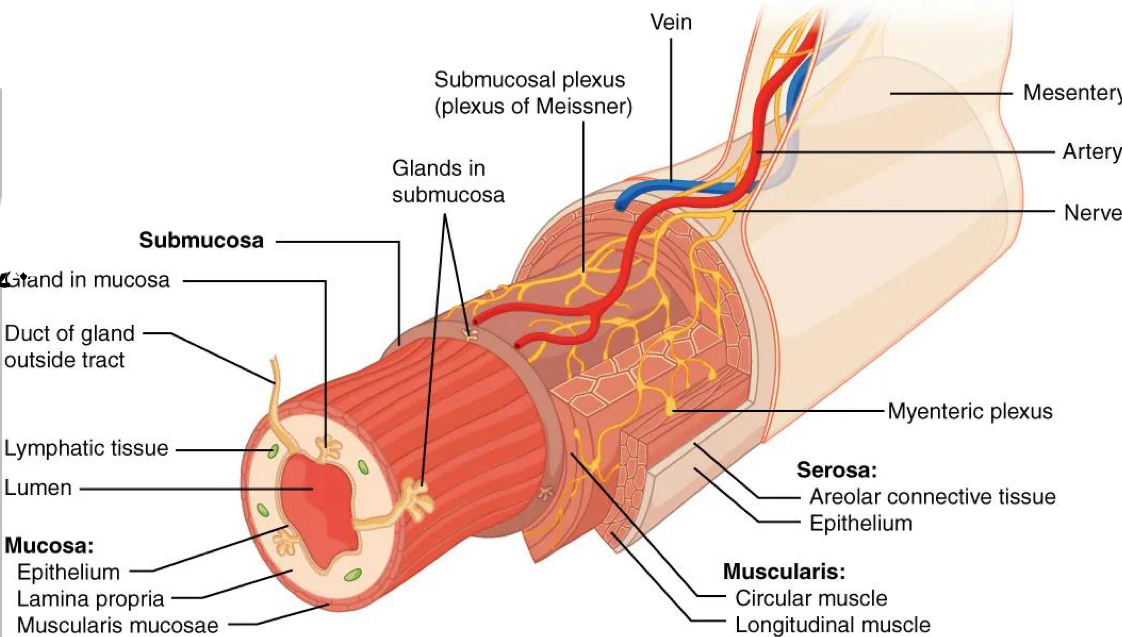
What is the serosa?
Connective tissue layer providing structural integrity and scaffold for blood vessels and nerves
what are the two plexus of the enteric nervous system that allow intrinsic inner action of the alimentary canal ?
Myenteric plexus and Submucosal plexus
What’s a plexus
Dense collection of neuronal cell bodies
What is the myenteric plexus ?
Located in the muscularis layer
Responsible for motility
What is the submucosal plexus ?
Located in the submucosal layer
Regulated digestive secretions
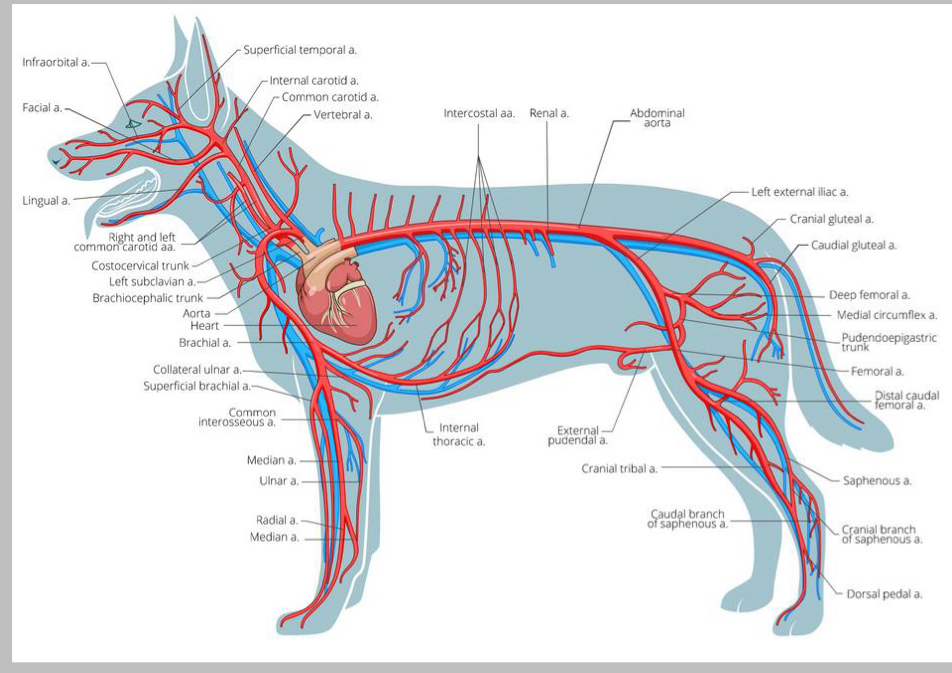
What is venous ?
Hepatic portal system
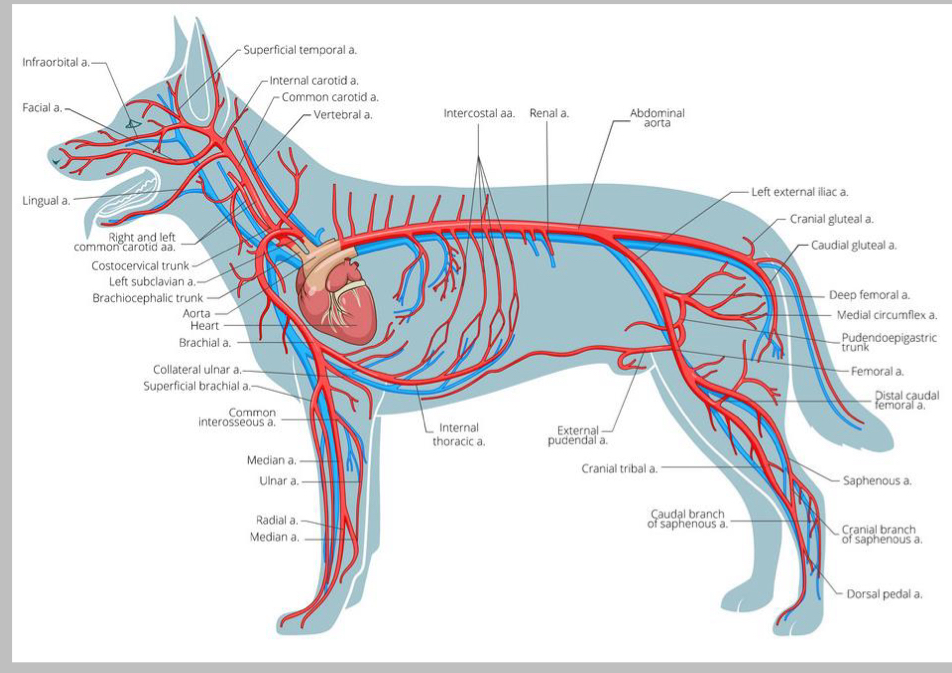
What is anterior alimentary blood supply?
Anterial branches of the aortic and thoracic arches
What is posterior alimentary blood supply?
Arterial branches of the abdominal aorta
What is the accessory system blood supply?
Celiac trunk
What is the small and large intestine blood supply?
Superior and inferior mesenteric arteries
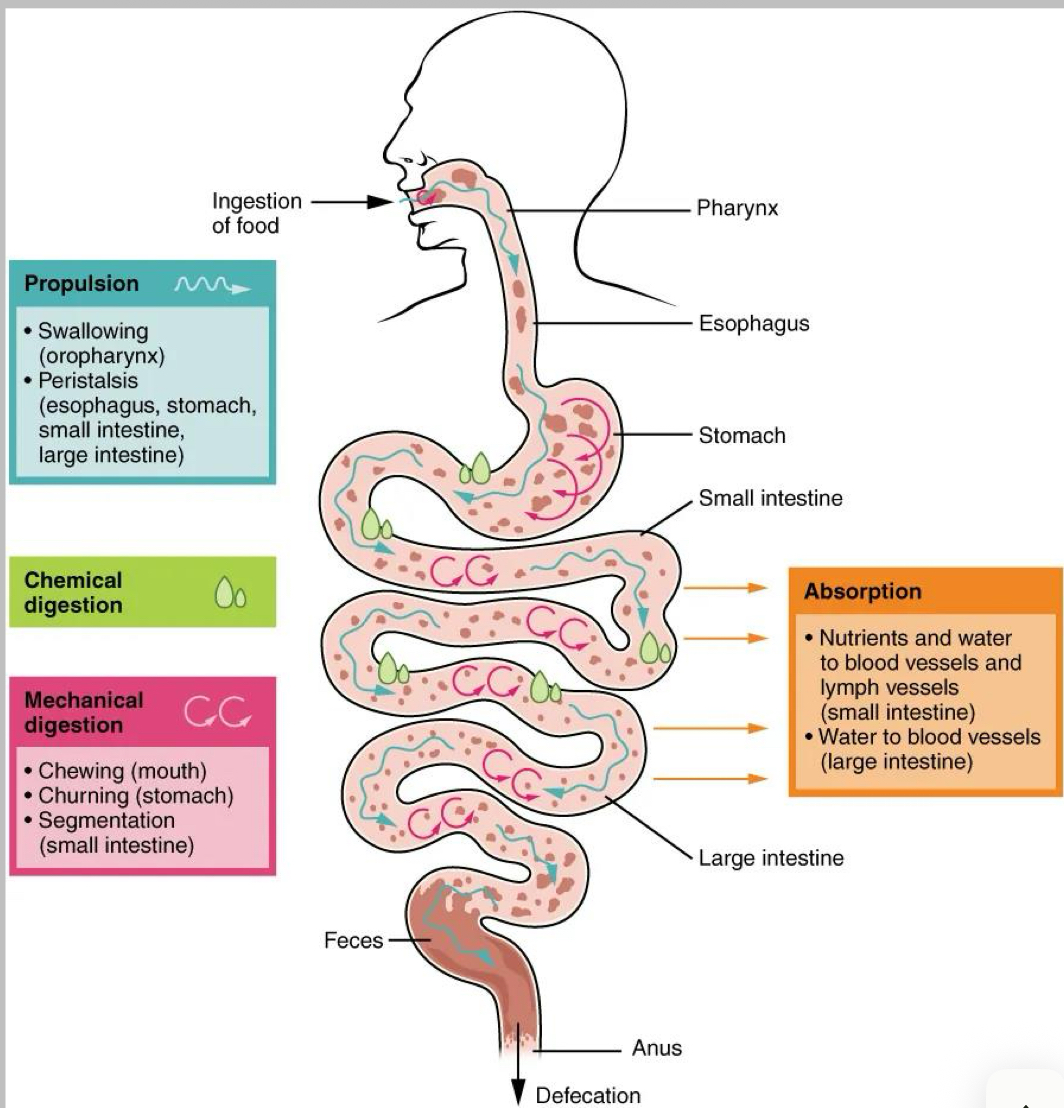
What is mechanical digestion?
Purely physical process that does not change the chemical nature of food
Makes food smaller to increase both SA and motility
Includes mastication or chewing as well as tongue movements that help break food down into smaller bits and mix food with saliva
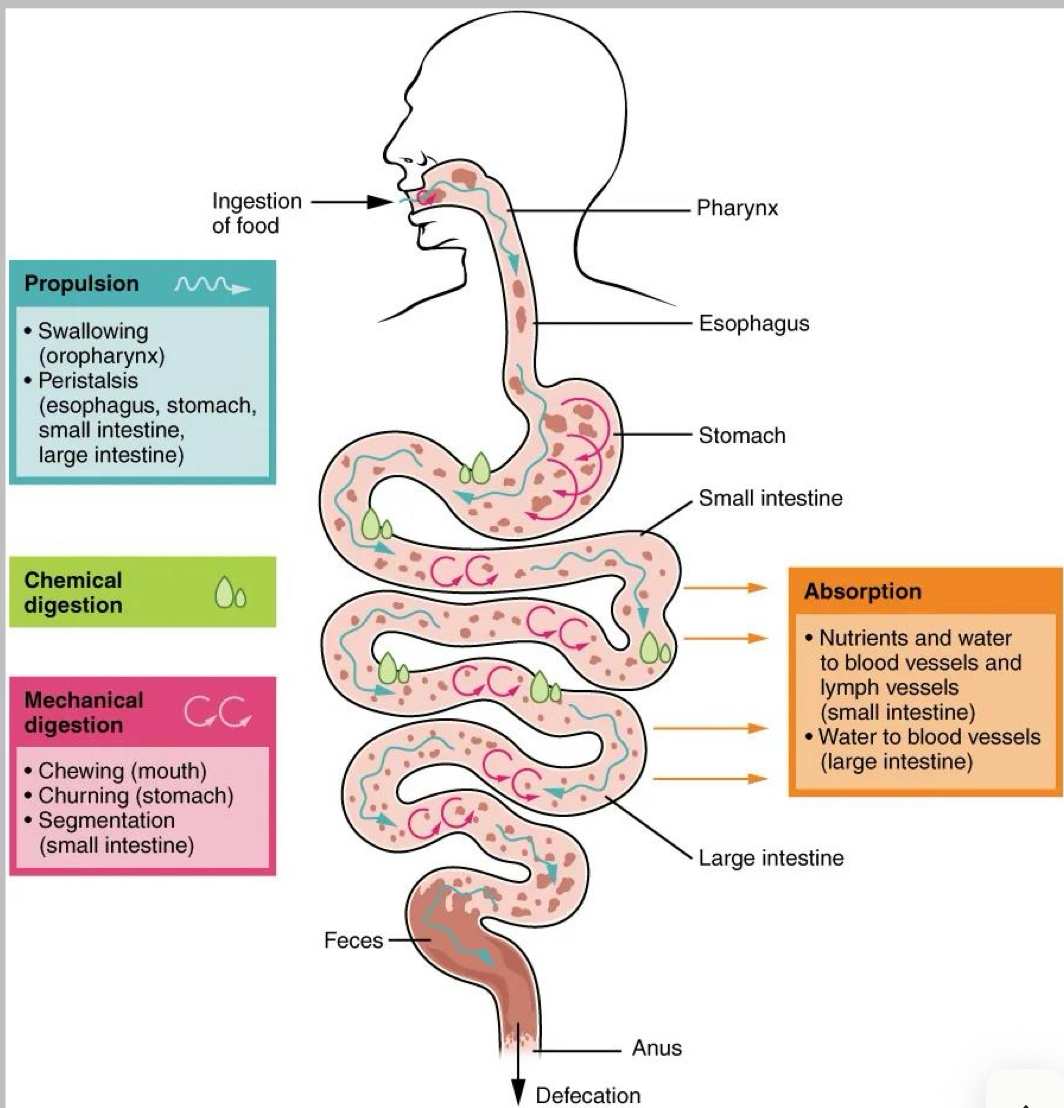
What is chemical digestion?
Starts in mouth, digestive secretions break down complex food molecules into their chemical building blocks (eg proteins into separate amino acids)
These secretions vary in composition but typically contain water, various enzymes, acids and salts
Process completed in small intestine
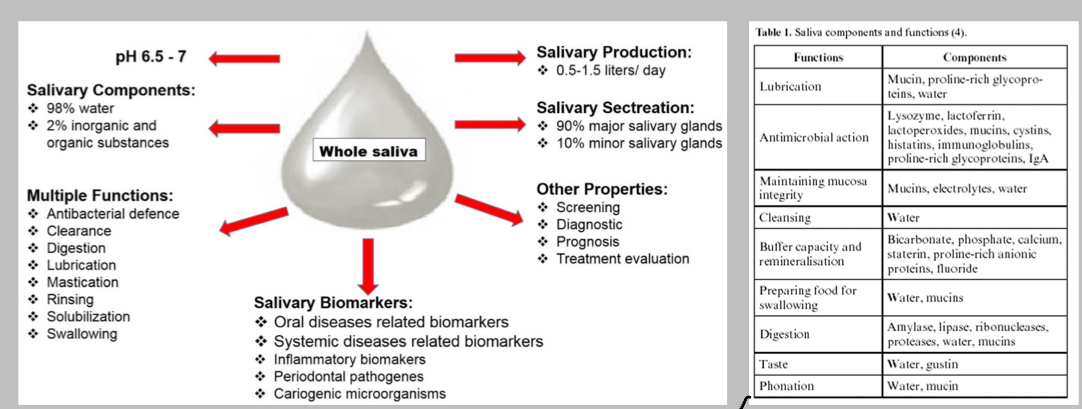
What is phonation?
Making of sounds from oral cavity
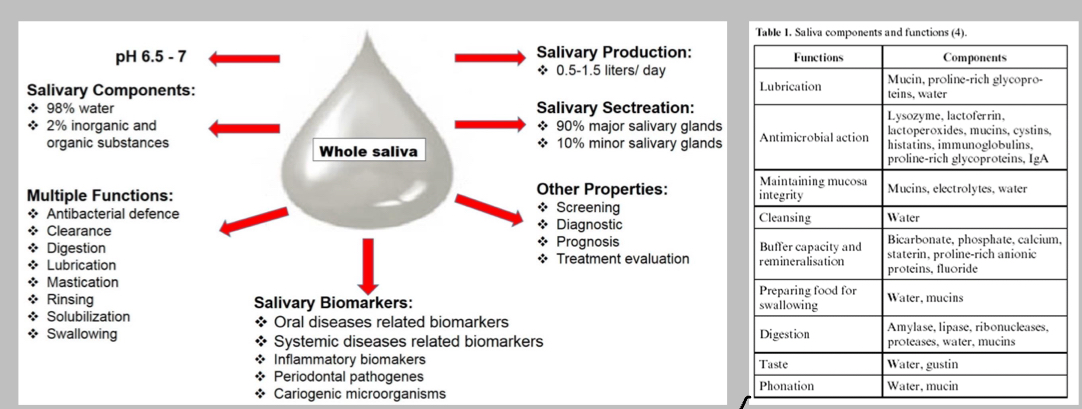
Summarise functions, components and other features of saliva
Summarise
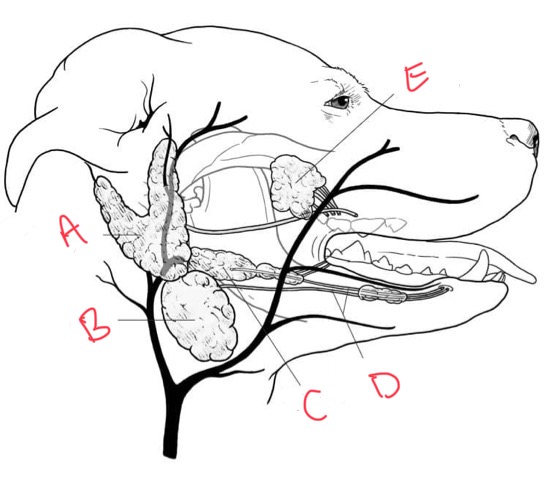
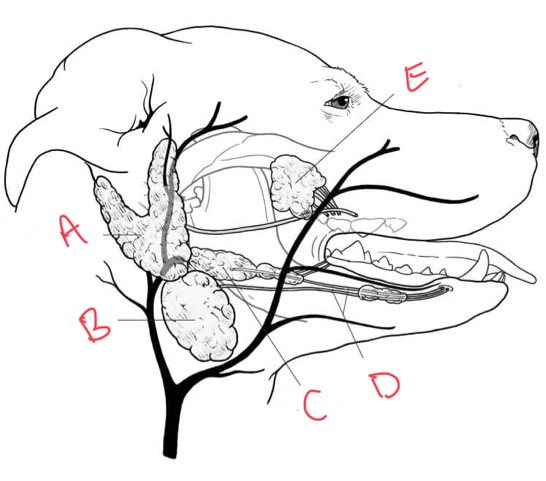
What is A?
Parotid gland
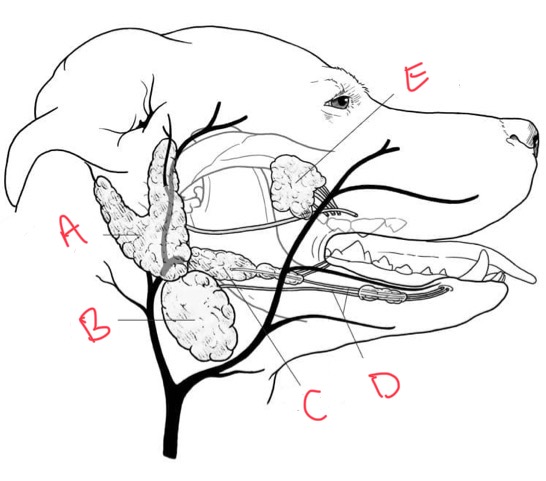
What is B?
Mandibular gland
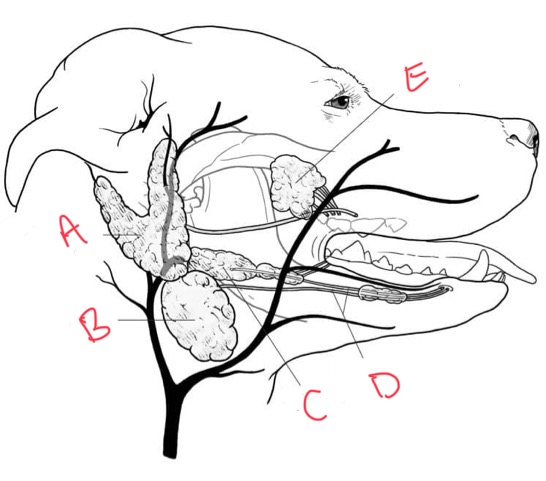
What is C?
Sublingual gland
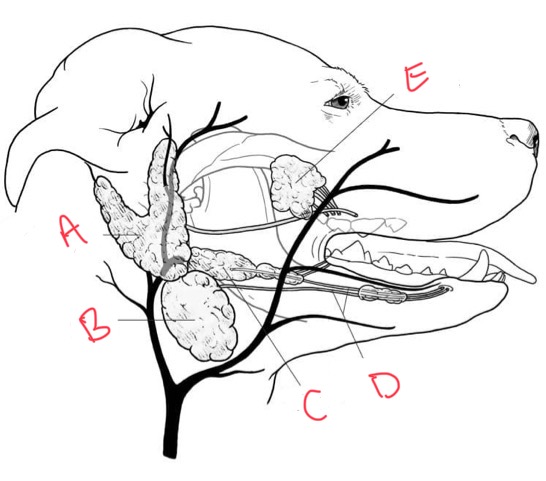
what is D?
Mandibular ducts
What is E?
Zygomatic gland
What are the parotid glands ?
Lie under the ear and behind the vertical ramus of the mandible
Produces watery/serous saliva
What are the mandibular glands ?
Lie in the intramandibular space
Produce viscous / mucus saliva
What are the lingual glands ?
Lie in the base of the tongue
Produce viscous / mucus saliva
What are the salivary glands made up of ?
Secretory acini and ducts
What are two types of secretions ?
Serous ( liquid ) , mucous (viscous)
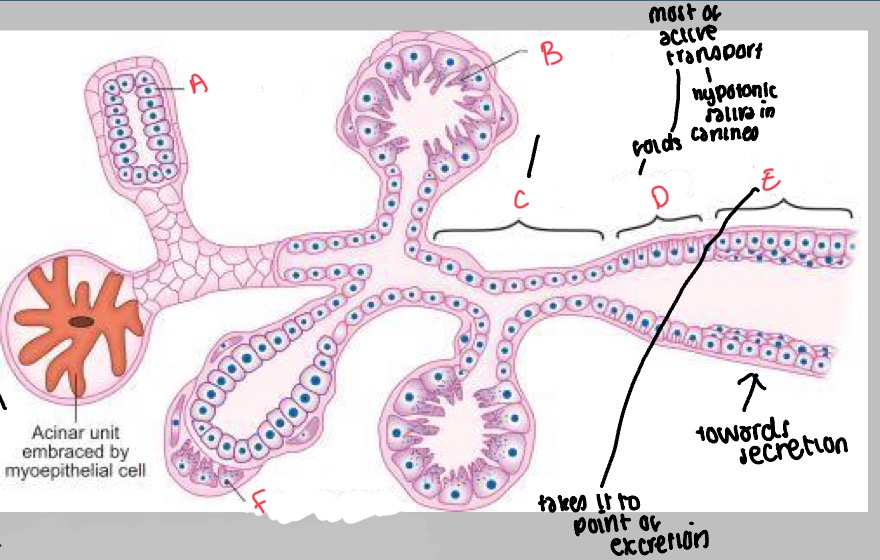
What is A?
Mucous acini
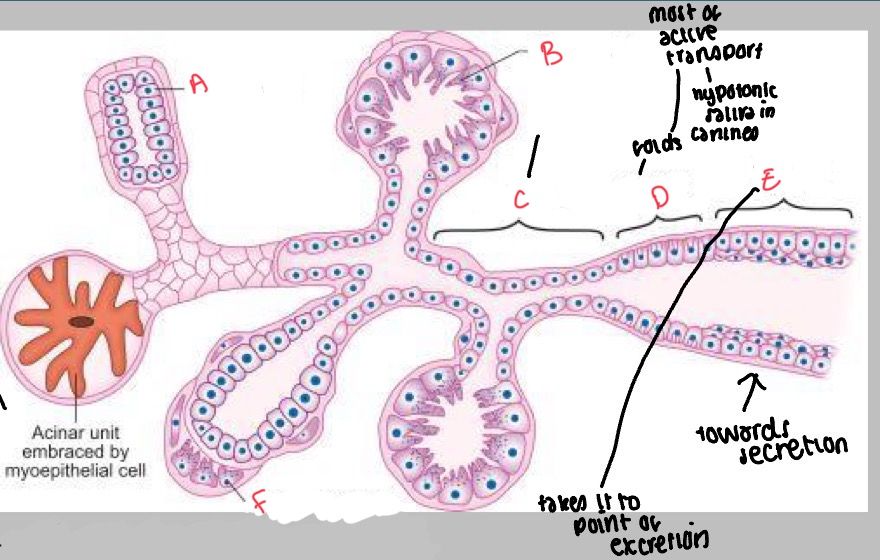
What is B?
Serous acini
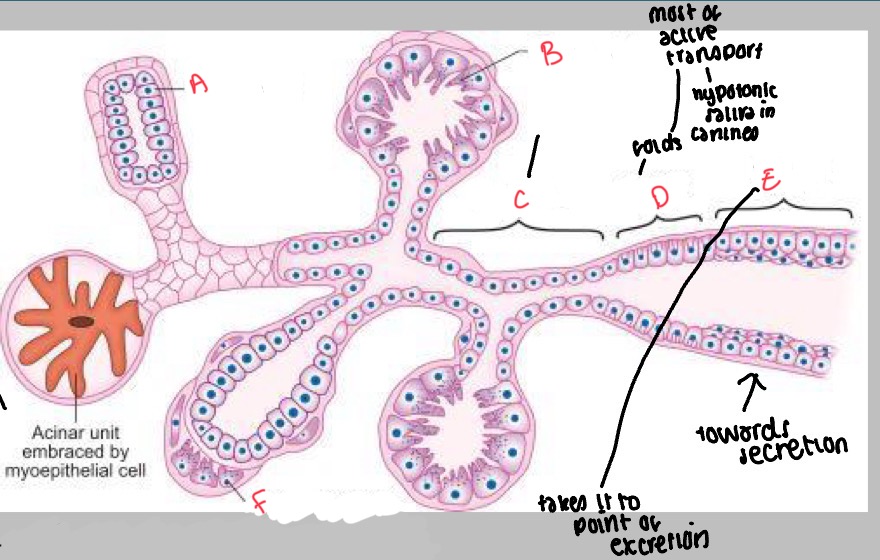
What is C?
Intercalated duct
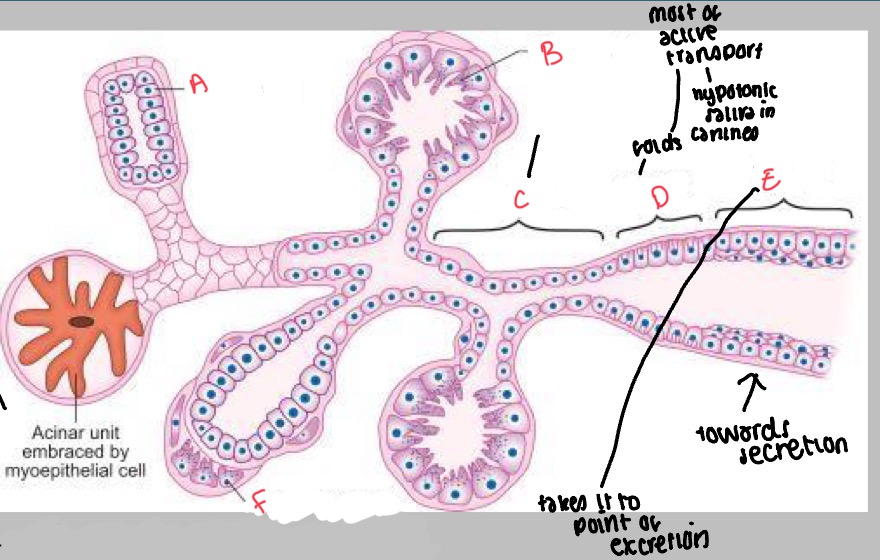
What is D?
Striated Duct
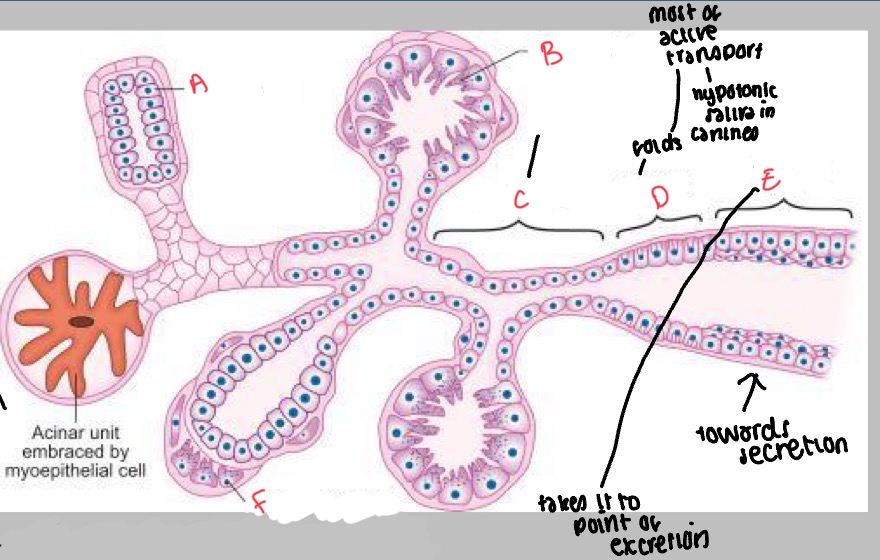
What is E?
Excretory duct
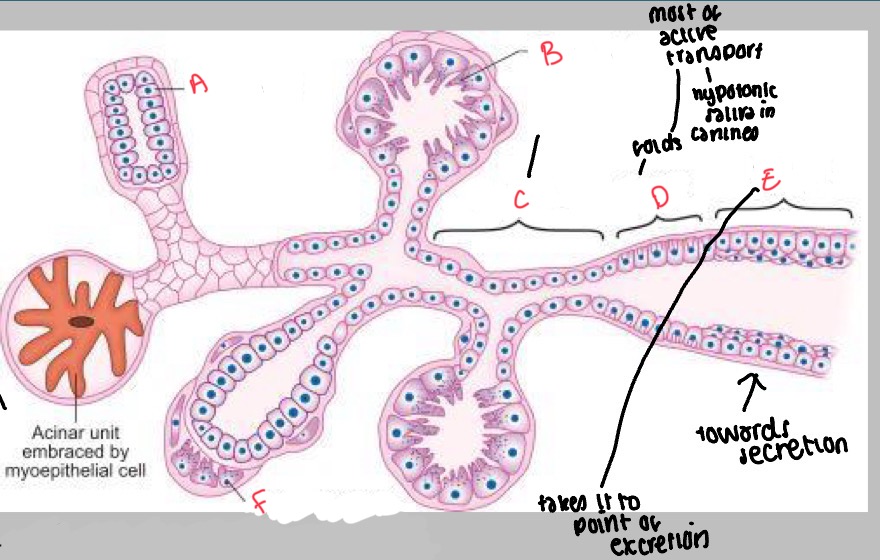
What is F?
Serous demilunes
Where do serous demilunes form?
In mixed acini
What are acini?
They are specialised and produce product of secretion
What shape are demilunes
Half moon shape
The secretory units merge into…. What ducts ?
Intercalated, striated and excretory ducts
What are intercalated ducts ?
Lined by simple low cuboidal epithelium and surrounded by myoepithelial cells
What are striated ducts ?
Folded basal membrane
Enable active transport of substances out of the duct
Water resorption
Ion secretion
Saliva hypotonic
What are excretory ducts ?
Tall columnar epithelium
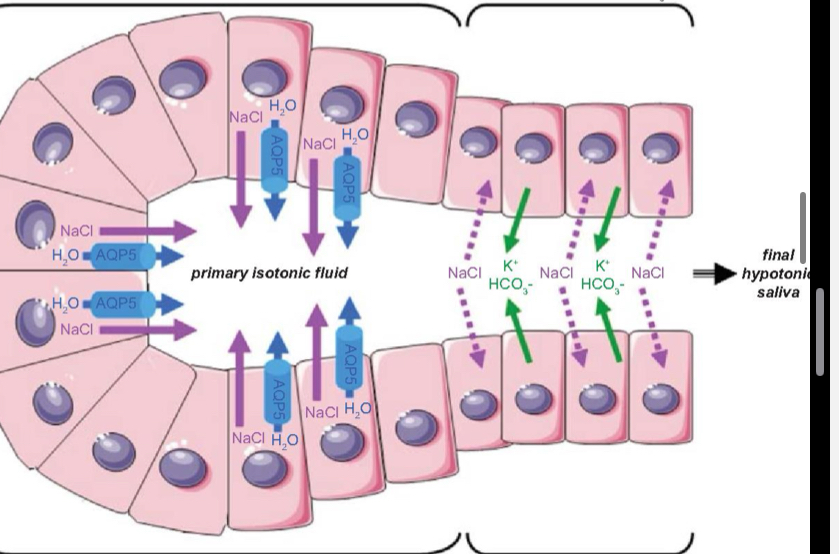
Saliva undergoes a two step secretion, what is this ?
Step 1: acinar, step 2: ductal
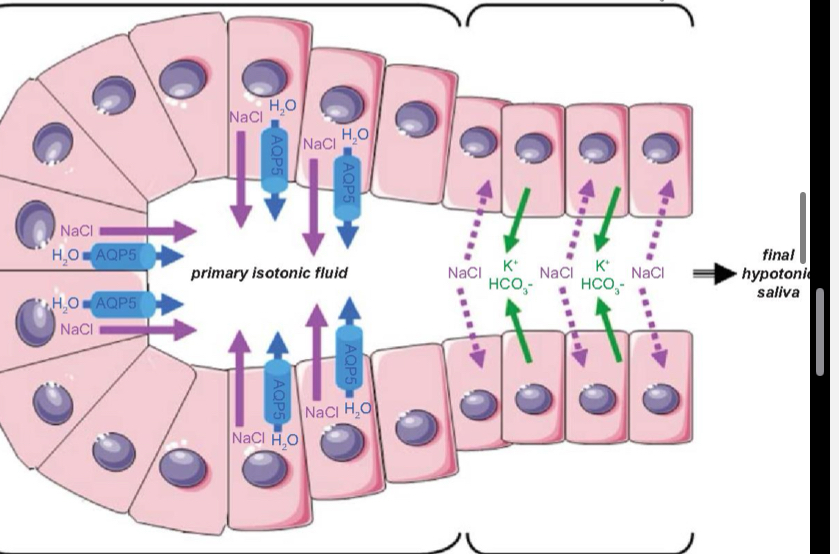
What happens in step 1; acinar of secretion ?
Efflux of NaCl and H2O , isotonic to plasma
(Secretion of a primary isotonic fluid rich in NaCl)
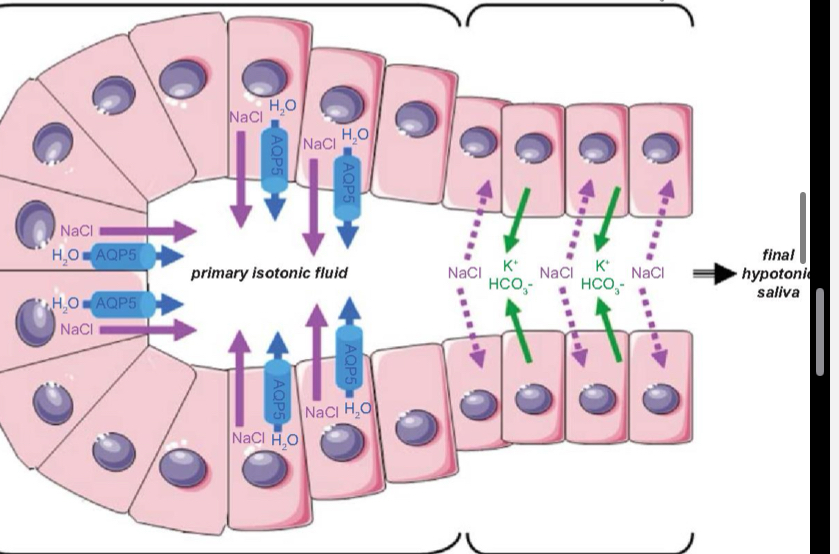
What happens in step 2; ductal of secretion?
Reabsorption of NaCl, causing efflux of of K^+ and HCO3 to salivary area , creating a saliva that is hypotonic to plasma
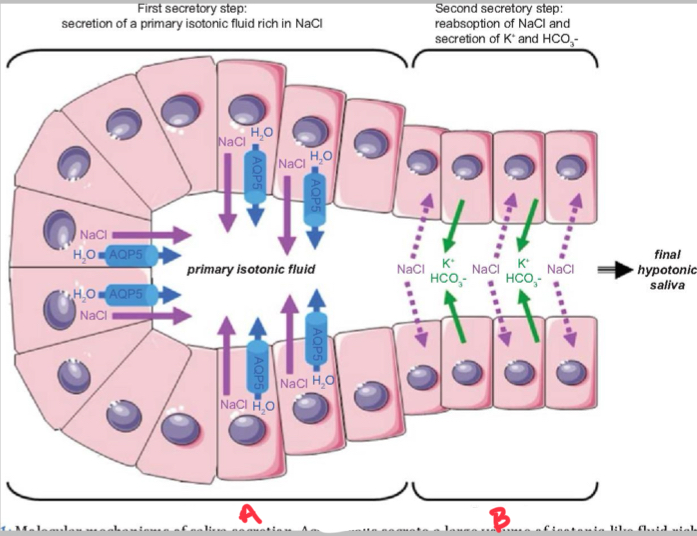
What is A?
Acinar cells
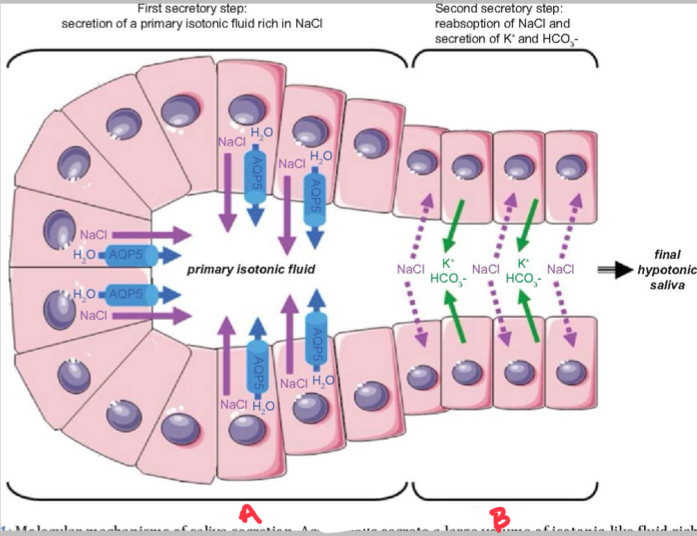
What is B?
Ductal cells
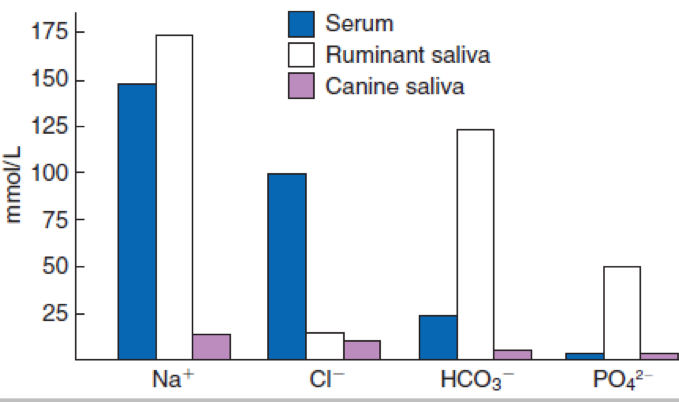
What would we say about monogastric electrolyte composition?
Hypotonic
Osmotic nature draws out lots of fluid
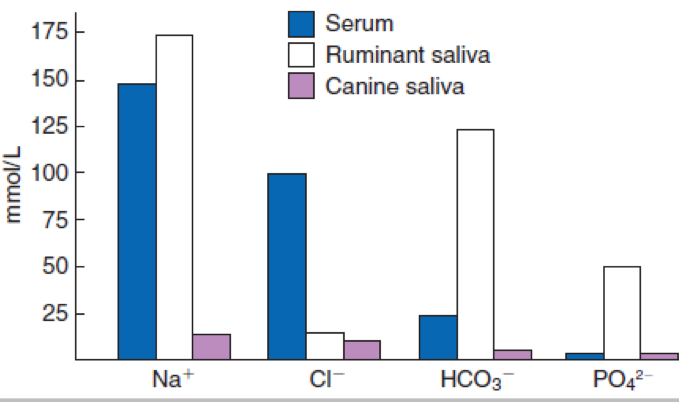
What would we say about ruminant electrolyte composition?
Isotonic, contains lots of bicarbonate and phosphate ions (high concentrations or HCO3-, PO42-, highly alkaline ph) , these buffer/neutralise the acids produce during fermentation in the rumen
Why is ruminant electrolyte composition have high concentrations of highly alkaline ph?
To buffer / neutralise acids produced during fermentation in rumen
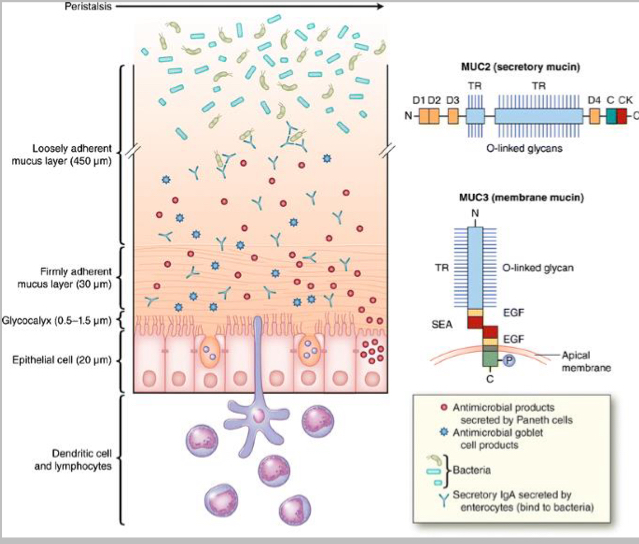
What does mucous consist of ?
Antimicrobial products , secretory immunoglobulins
Why does mucous consist of secretory immunoglobulins?
In order to bind to foreign agents
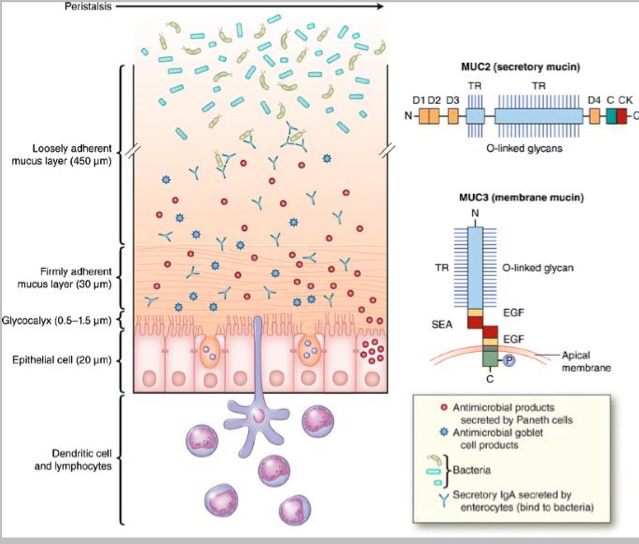
What are the functions of mucous ?
Bind to bacteria, bind to foreign agents, assist with secretion, flag immune system to target
Enable smooth movement of digestive products through the digestive system
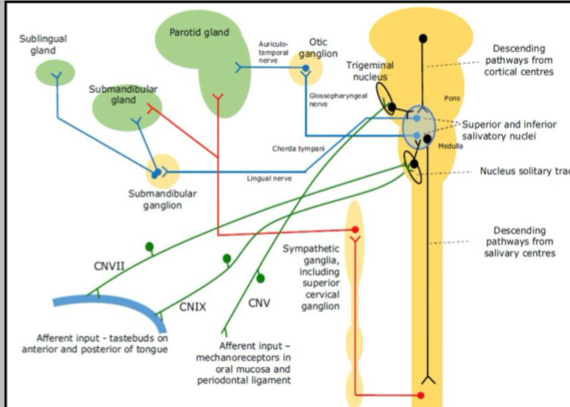
What is production and secretion of saliva controlled by?
The autonomic parasympathetic nervous system
What does autonomic mean?
Do not have conscious control
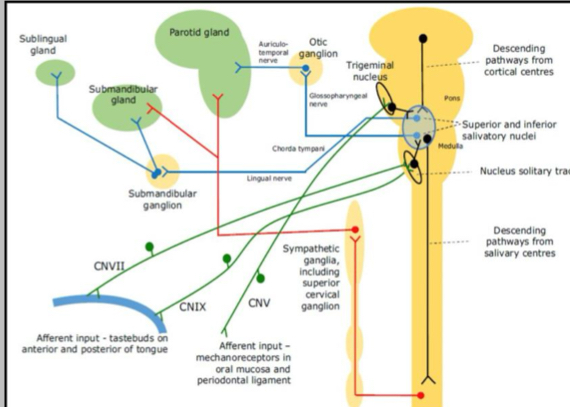
Why does a dog drool before food?
Salivatory nuclei in brain steam stimulated by anticipation of eating
Salivary glands stimulated by lingual nerve (branch of facial and trigerminal nerves) and glossopharyngeal nerve
What do the lingual and glossopharyngeal nerves secrete based on?
Anticipation of food
What is responsible for a carnivore drooling during attack?
Sympathetic input via B-adrenergic (adrenaline) receptors, fighting scenario leads to big rush of adrenaline therefore overproduction of saliva
The stomach is composed of what 4 anatomic regions?
Cardia, fundus, corpus, antrumm
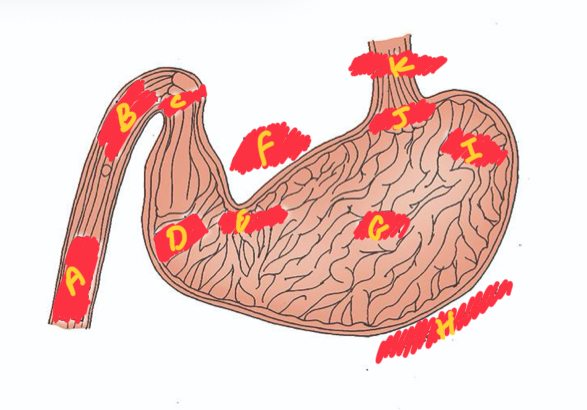
What is A?
Descending duodenam
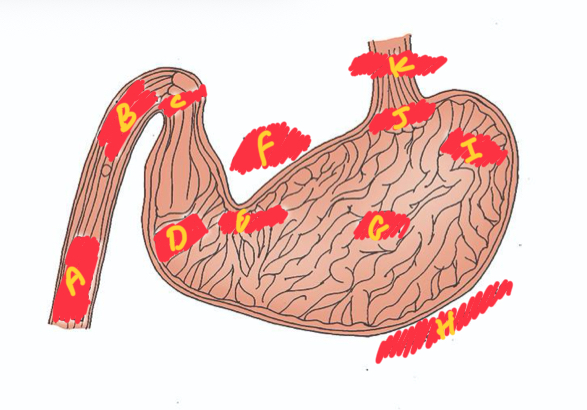
What is B?
Proximal duodenam
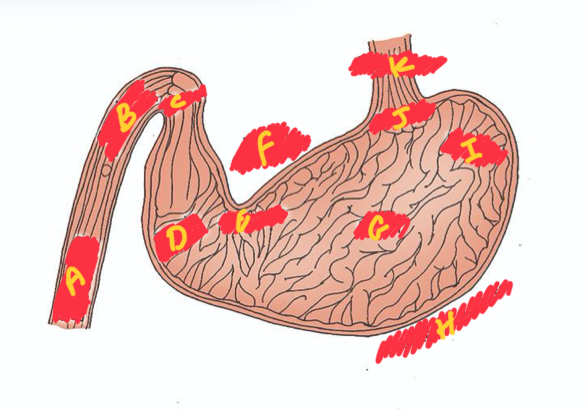
What is C?
Pylorus
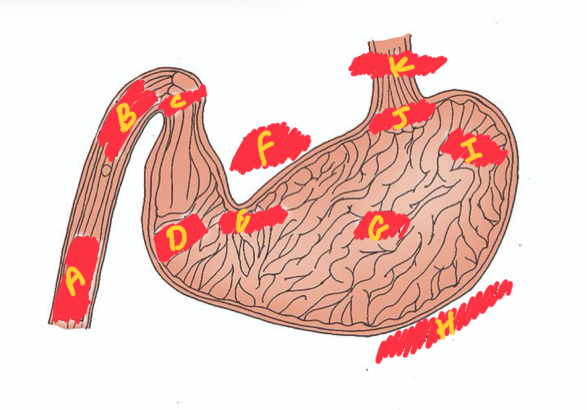
What is D?
Pyloric antrum
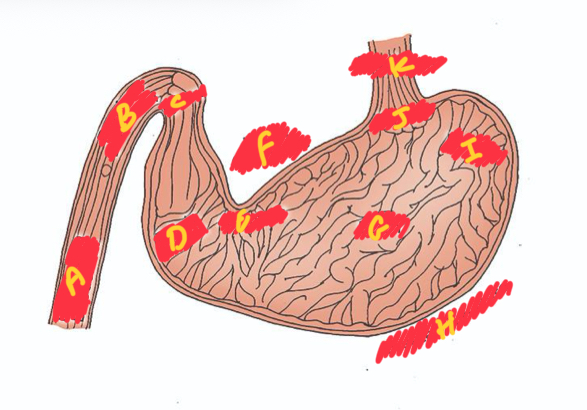
What is E?
Angular is
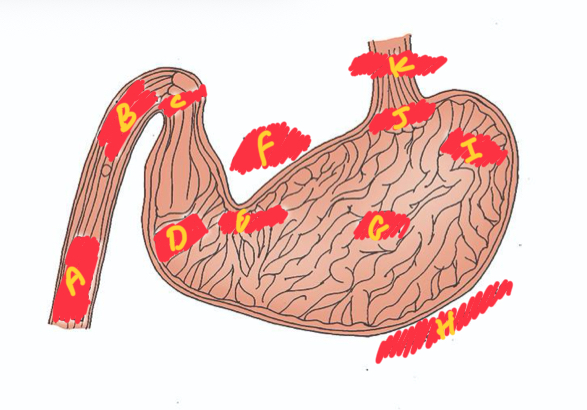
What is F?
Lesser curvature
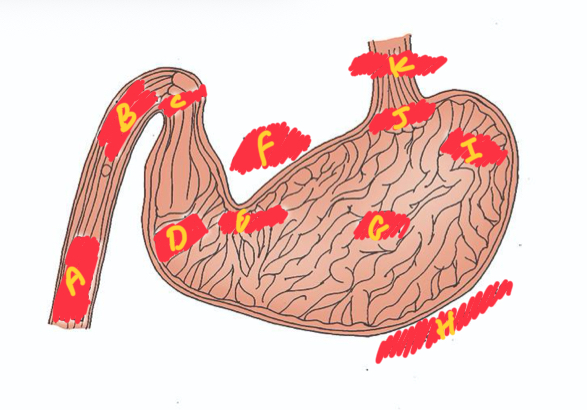
What is G?
Body
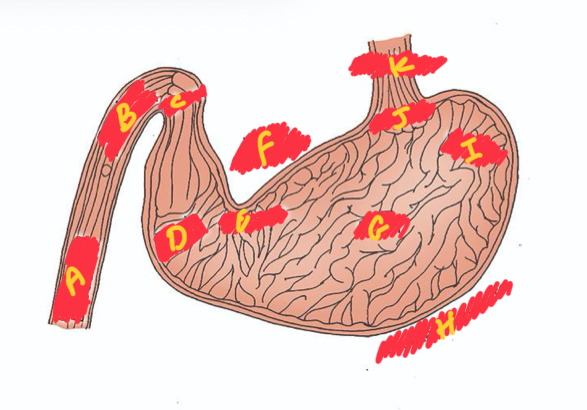
What is H?
Greater curvature
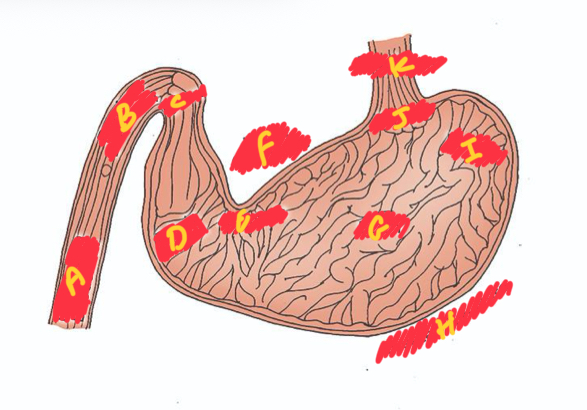
What is I?
Fundus
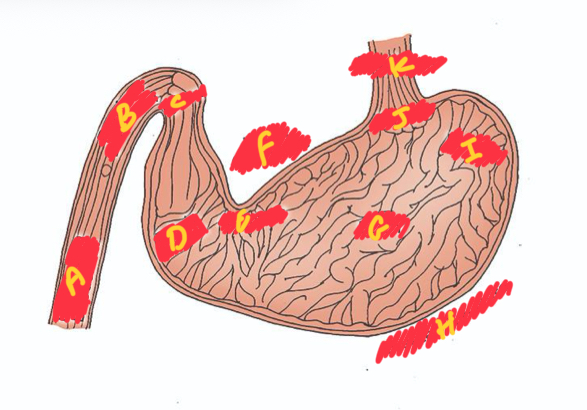
What is J?
Cardia
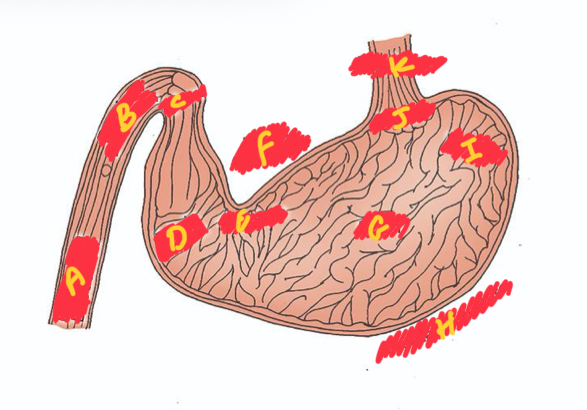
What is K?
Esophagus
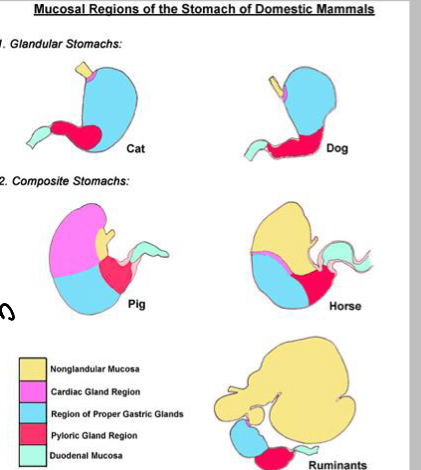
Within the stomach, secretions originate in the glandular regions and divide into 3 mucosa, what are these?
Cardiac , parietal (proper), pyloric mucosa
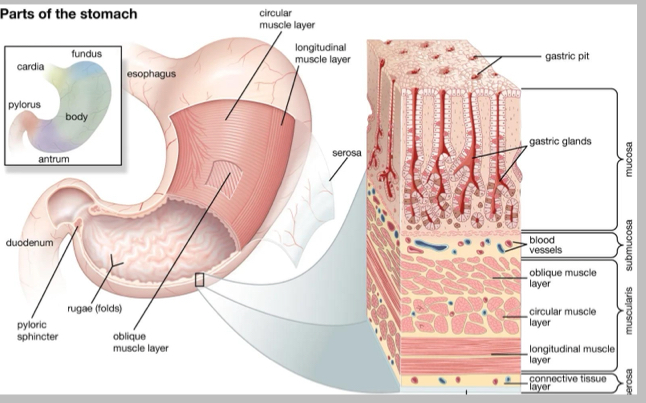
What are some features of the glandular mucosa ?
it has frequent invaginations or pores known as gastric pits
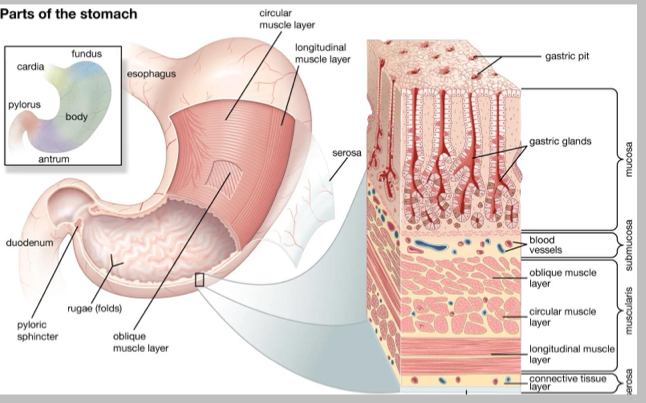
The major surface areas of the stomach as well as the lining of the pits are covered with what?
Surface mucous cells
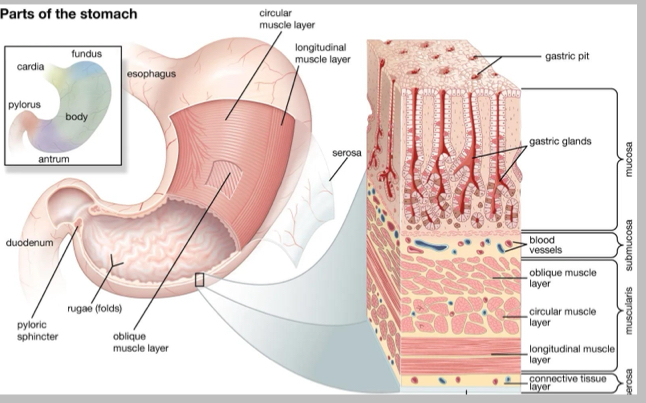
What do surface mucous cells do?
Produce a thick mucous layer that protects the stomach epithelium from the acid gastric juice and mechanical churn of food
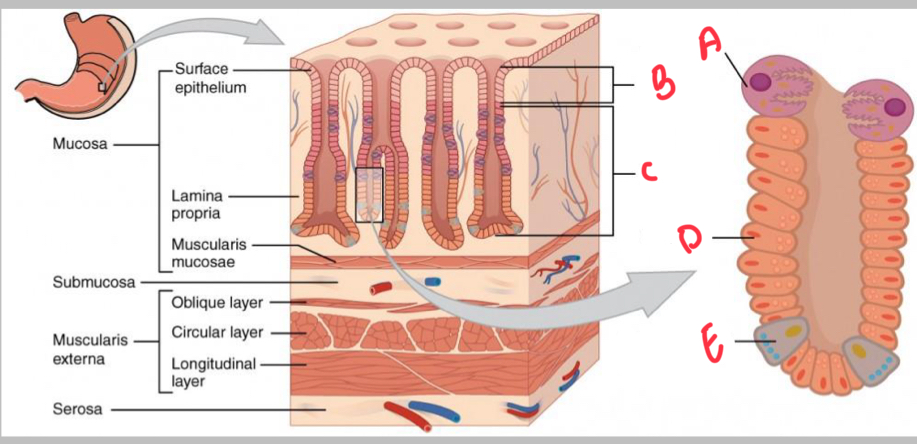
What is A?
Parietal cell
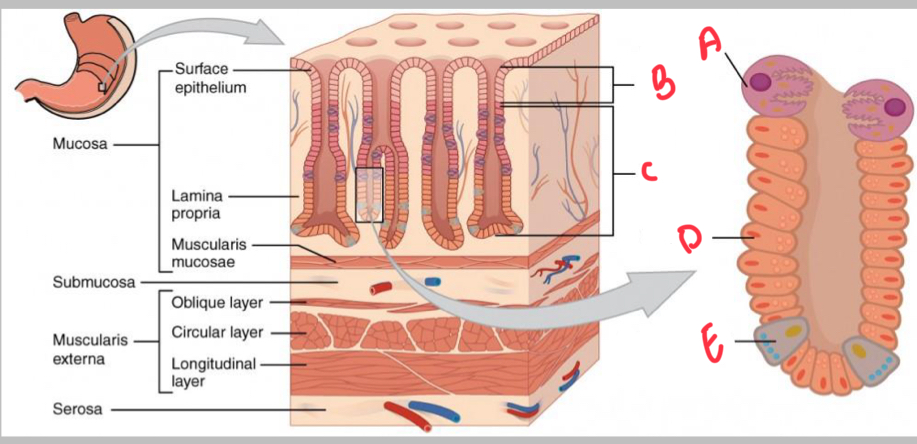
What is B?
Gastric pit
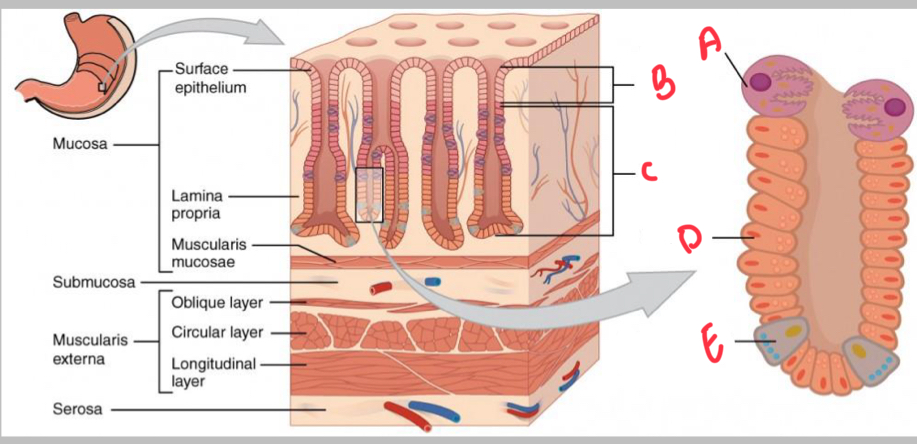
What is C?
Gastric gland
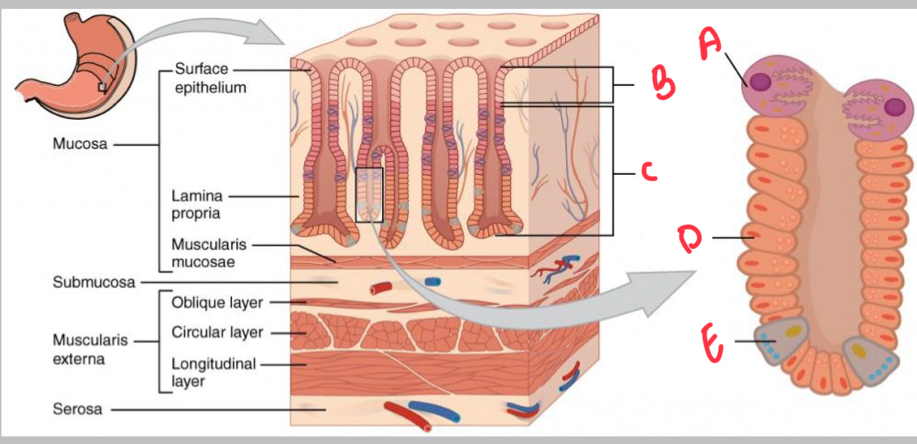
What is D?
Chief cell
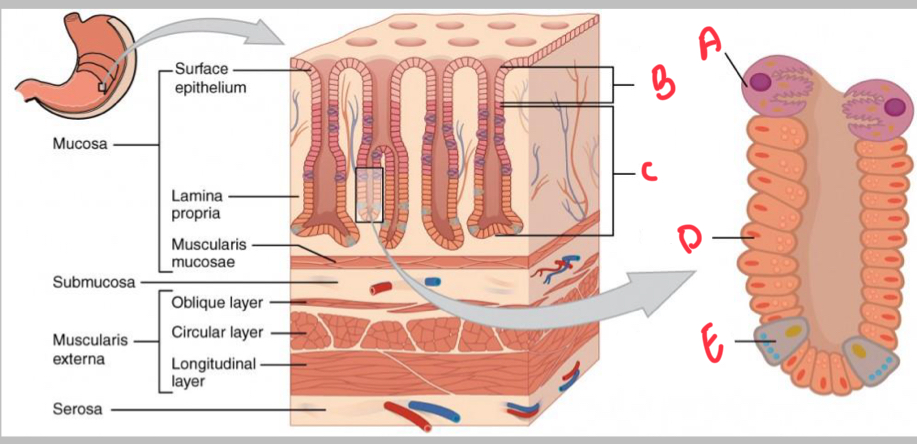
Enteroendocrine cell
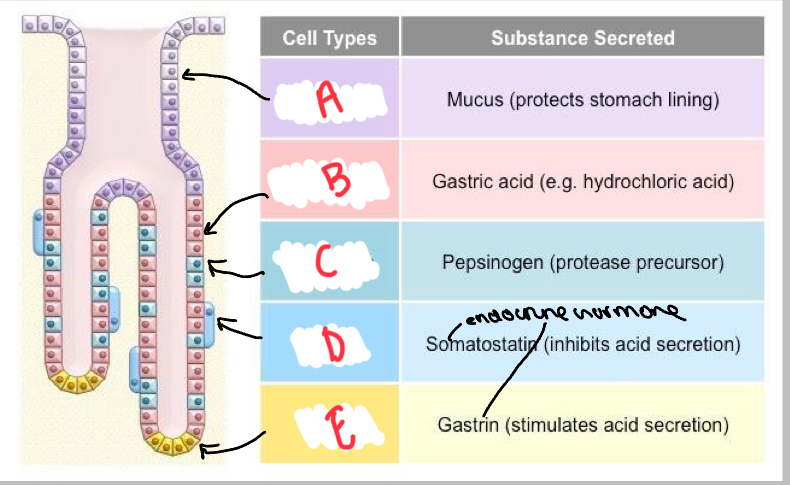
What is A?
Goblet cells
What is B?
Parietal cells
What is C?
Chief cells
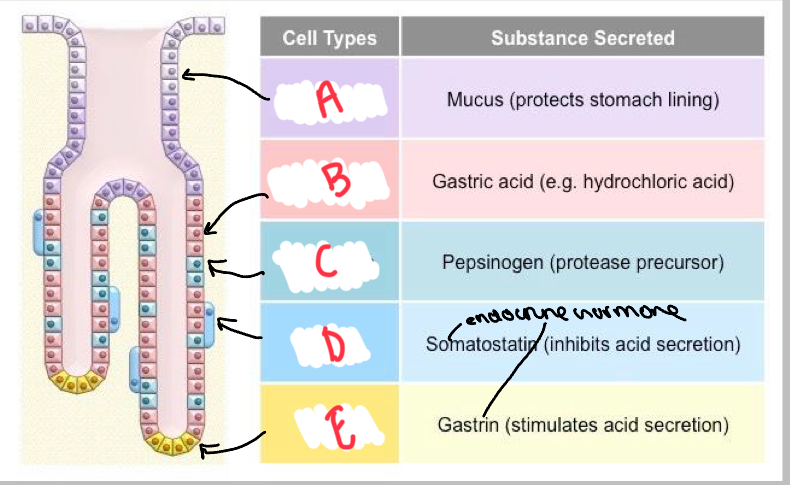
What is D?
D cells
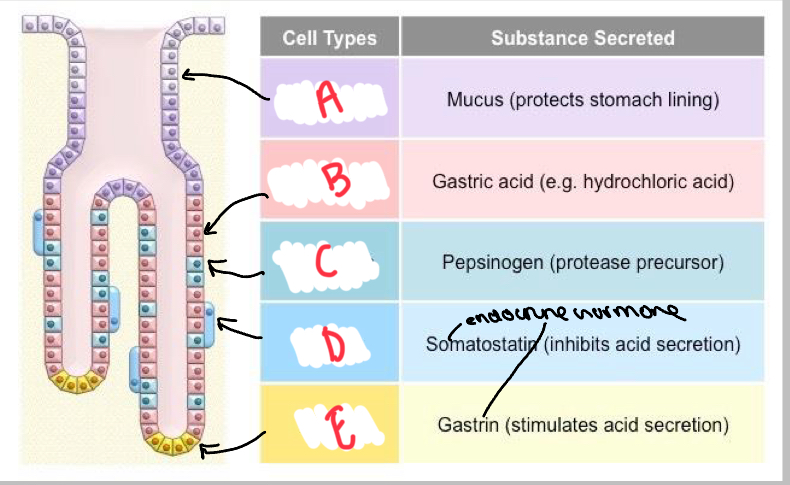
What is E?
G cells
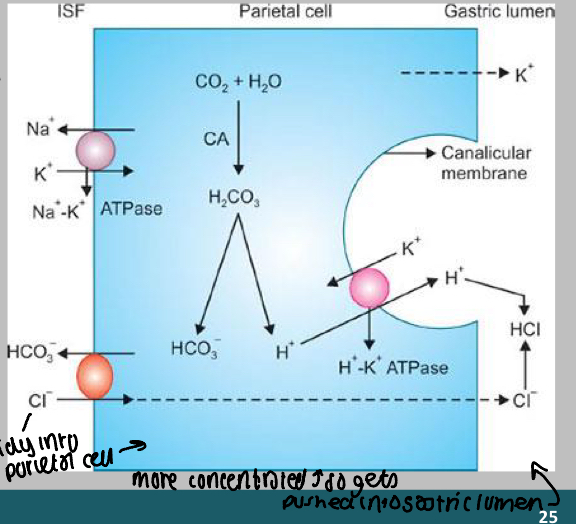
How is HCL formed in the gastric lumen?
Parietal cells secrete H^+ into the gastric lumen via the H^+/K^+ ATPase (proton pump)
Production of H^+ ions in parietal cells caused accumulation of bicarbonate ions (HCO3-)
HCO3- exchanged with Cl- ions in the blood
Cl- shifts across the parietal cell into the gastric lumen to balance electrochemical gradient
Formation of HCl in the gastric lumen
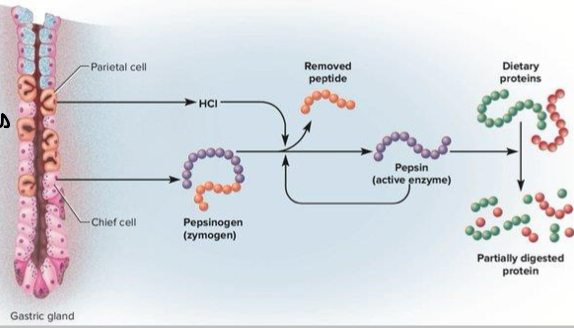
How is digestion and absorption enabled by pepsin?
Chief cells secrete pepsinogen into the gastric lumen
Pepsinogen is activated by HCl creating pepsin, an active digestive enzyme
Pepsin cleaves dietary proteins enabling digestion and absorption
Why is pepsinogen stored inactive ?
Else it would break down proteins in the cell
What is the first stage of gastric secretions?
Cephalic stage
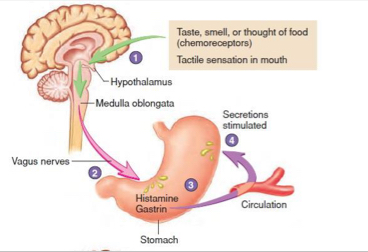
What happens in the cephalic stage ?
Initiates by sights smell and taste of food (stomach expecting to start digesting food)
Hypothalamus driven
Stomach secretions stimulated by vagus nerve via enteric plexus
HCL secreted
Histamine And gastric secreted stimulating further HCl secretions
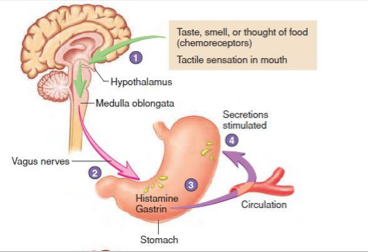
What happens in the gastric phase?
Initiated by arrival of food in stomach
Distension of the stomach stimulate local stretch reflex and vagus nerve
Medial oblongata stimulates vagus nerve increasing gastrin and histamine secretions
Histamine and gastin stimulate further HCl secretions
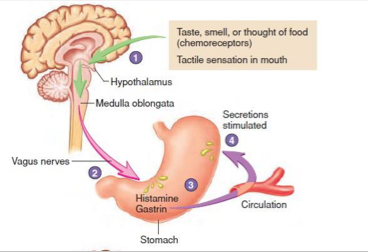
What happens in the intestinal phase?
Initiated by chyme in duodenam with acid ph <2 and lipids, secreted by chemoreceptors
Medulla oblongata stimulated via vagus nerve
Local reflexes activated by H^+ and lipids
Secretion and cholecystokinin released in duodenam
Gastric secretions inhibited
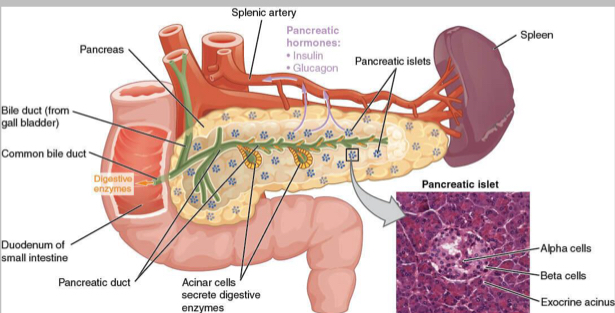
What part of the digestive system is the pancreas?
Accessory
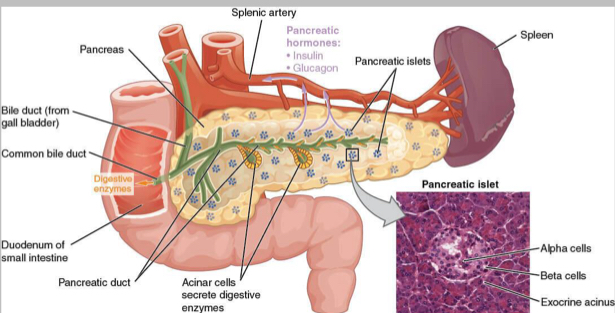
In the pancreas, how much is exocrine gland and how much is endocrine ?
99% exocrine, 1% endocrine
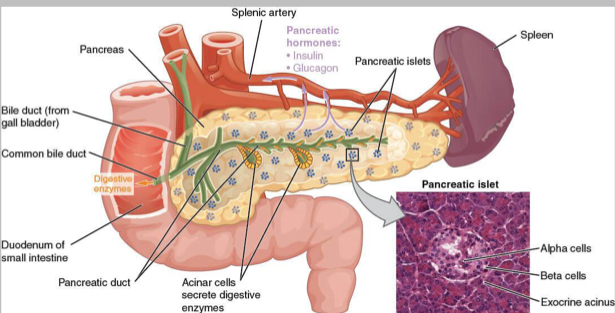
What does the pancreas secrete and where ?
Secretes pancreatic juice into the duodenam through the pancreatic duct
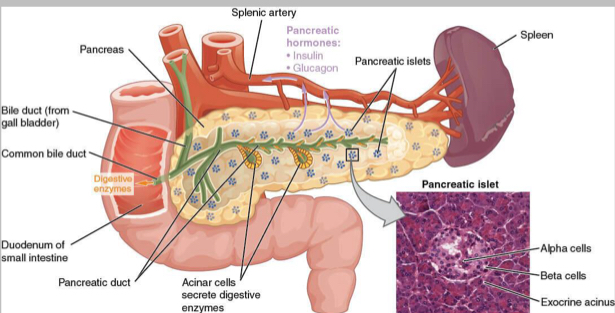
Where does the pancreas digest food ?
In the duodenam
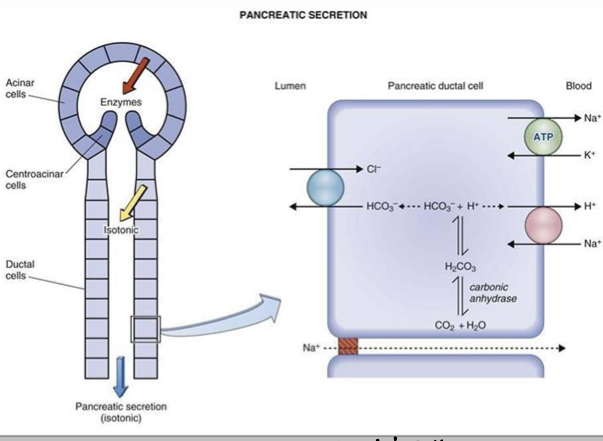
What do acinar cells produce?
Things that break down proteins, sugars, fats etc, such as:
Trypsinogen , chymotrypsinigen, elastase, carboxypeptidase lipase, nucleases, amylase
What do ductal cells produce?
Bicarbonate (HCO3-)