Intro to Organic Chem EXAM
 Call Kai
 Learn
 Practice Test
 Spaced Repetition
 Match
 Flashcards
 Knowt Play
1/55

There's no tags or description
Looks like no tags are added yet.
56 Terms
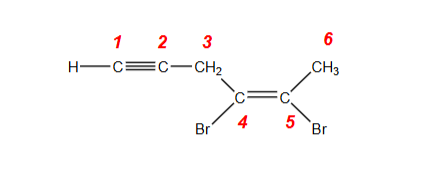
Which of the following statements about the molecule is true?
A. The bond between carbon 1 and carbon 2 consists of two sigma bonds and
one pi bond.
B. There are total of ten sigma bonds in this molecule.
C. The bond between carbon 5 and carbon 6 is sp2-sp3 orbital overlap.
D. The bond between carbon 1 and carbon 2 is sp2-sp2 overlap.
C. The bond between carbon 5 and carbon 6 is sp2-sp3 orbital overlap.
Which of the following statements is true?
A. All L-carbohydrates must rotate plane-polarised light to the left.
B. Alpha amino acids are basic while beta amino acids are neutral pH.
C. The reaction of an alcohol and a carboxylic acid in the presence of acid will
produce an ester.
D. Any molecule containing a nitrogen atom is basic.
C. The reaction of an alcohol and a carboxylic acid in the presence of acid will
produce an ester.
Which of the following statements about boiling points is true?
A. Chloromethane has a higher boiling point than chloroethane.
B. Ethanoic acid has a higher boiling point than propanoic acid.
C. Ethoxy pentane has a higher boiling point than heptanal.
D. Butanamine has a higher boiling point than diethyl ether.
D. Butanamine has a higher boiling point than diethyl ether.
Which of the following statements is true?
A. Carbon hydrogen bonds are polar due to the very different electronegativity
values for the two atoms.
B. In the carbonyl functional group, there is uneven sharing of electrons in the
bond, so that the carbon is slightly negative and the oxygen slightly positive.
C. Hydrocarbons are non-polar and can only participate in dispersion forces.
D. Carboxylic acids are very polar so they are always soluble in water.
C. Hydrocarbons are non-polar and can only participate in dispersion forces.
Which of the following has substances listed correctly from lowest to highest
boiling point?
A. Ethanal, ethanol, ethanoic acid
B. 1-pronanol, 1-propene, propane
C. 1-butanol, 2-butene, diethyl ether
D. 1-butanamine, 1-butanol, butanone
A. Ethanal, ethanol, ethanoic acid
Which of the following pure substances has hydrogen bonding?
i. 3-oxo-2-butanone
ii. 2-aminopropanal
iii. Pentanoic acid
iv. Propyl acetate:
B. (ii) and (iii) have hydrogen bonding.
Which of the following statements about esters is true?
(i) Esters have pleasant, fruity odours.
(ii) Ethanol and pentanoic acid react to form ethyl pentanoate.
(iii) Hydrolysis of butyl hexanoate will form hexanol and butanoic acid.
(iv) The esterification reaction is not reversible.
D. (i) and (ii) are true.
Which one of the following statements is false?
A. The open chain form of D-glucose has four stereocentres.
B. Acid hydrolysis of a cellulose produces glucose.
C. Saponification of a triglyceride produces fatty acid salts and glycerol.
D. The anomeric carbon of a sugar is always given the number 1.
D. The anomeric carbon of a sugar is always given the number 1.
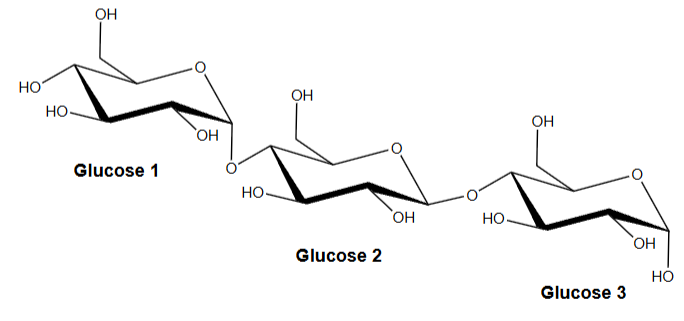
Which of the following statements about the molecule is true?
A. Glucose 1 is bonded to Glucose 2 by -1,4-glycosidic bond that joins an
anomeric carbon to a non-anomeric carbon.
B. Glucose 2 is bonded to Glucose 3 by -1,4-glycosidic bond that joins to the
anomeric carbon atoms.
C. Glucose 3 has an -anomeric carbon.
D. This molecule is an example of a non-reducing sugar.
A. Glucose 1 is bonded to Glucose 2 by -1,4-glycosidic bond that joins an
anomeric carbon to a non-anomeric carbon.

Which of the following statements about the molecule is true?
A. Glucose 2 is bonded to Glucose 3 by -1,4-glycosidic bond that joins an
anomeric carbon to a non-anomeric carbon.
B. It does react with Benedict’s reagent.
C. It does react with Bromine.
D. It is dipeptide.
B. It does react with Benedict’s reagent.
Which of these statements about the molecules is true?
A. Guanine and thymine are both pyrimidines.
B. Adenine and Guanine are both purines.
C. Adenine, thymine and uracil are all pyrimidines.
D. Only the nitrogenous base adenine is a purine.
B. Adenine and Guanine are both purines.
Which of the following is a true statement about enzymes?
A. With an unlimited amount of substrate, enzyme activity always increases.
B. In very acidic conditions, the enzyme’s disulfide bonds are oxidised.
C. Alcohols act as competitive inhibitors, reducing enzyme activity.
D. All enzymes function best at moderate pH levels (around pH 7).
C. Alcohols act as competitive inhibitors, reducing enzyme activity.

Amines can be classified as primary, secondary or tertiary. Which of the above
compounds are tertiary amines?
D. (i) and (iv) are tertiary amines.
Which of the following metals are considered as toxic?
A. Cadmium
B. Cobalt
C. Magnesium
D. Zinc
A. Cadmium
15. Which of the following statements about nucleic acids is true?
(i) Guanine and cytosine form a hydrogen-bonded base pair.
(ii) The secondary structure of DNA is the ‘double helix’.
(iii) RNA contains pyrimidine bases called thymine and uracil.
(iv) In DNA, an N-glycosidic bond connects deoxyribose to a phosphate.
A. (i) and (ii) are true
Which of the following is not an oxidising agent?
A. Hydrogen gas with a metal catalyst
B. Tollens’ reagent
C. Acidified potassium dichromate
D. Ozone gas
A. Hydrogen gas with a metal catalyst
Which of the following products is formed when hydrogen/Pt catalyst is reacted
with 3-ethylpentanoic acid?
A. Primary alcohol
B. Secondary alcohol
C. Tertiary alcohol
D. None of the above
D. None of the above
Which of the following statements about alcohols is false.
A. Primary alcohols are formed by reducing aldehydes with hydrogen gas
and a catalyst.
B. Primary alcohols react with oxidising agents to form secondary alcohols
C. Secondary alcohols can react with carboxylic acids to form esters.
D. Tertiary alcohols can have stereocentres.
B. Primary alcohols react with oxidising agents to form secondary alcohols
Which of the following statements about intermolecular forces is true?
A. In pure ketone solution, the ketone molecules can undergo hydrogen
bonding with each other.
B. Alkenes can undergo dipole dipole interactions unlike alkanes.
C. In water, aldehydes can hydrogen bond with water molecules.
D. Carboxylic acids have strong hydrogen bonding because of the long
hydrocarbon chain.
C. In water, aldehydes can hydrogen bond with water molecules.
Which of the following statements about polymers is true?
A. Condensation reactions need water molecules to act as catalysts.
B. Poly(vinyl chloride) is made by condensation polymerisation.
C. Condensation polymers begin with di-functional molecules.
D. Proteins are examples of polyesters.
C. Condensation polymers begin with di-functional molecules.
3-ethyl-4-fluoro-2-hydroxyheptanal, Structure

2-ethylpentanamide, Structure

propyl benzoate, Structure

2,3-diethyl-1-pentanamine, Structure

2-chloro-3-methylhexenoic acid, Structure
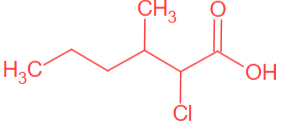

Name?
1-ethoxy butane
or
(ethyl butyl ether)

Name?
3,4-dimethylpentanal

Name?
3-fluoro-1-butyne

Name?
3-methoxyhexanoic acid

Name?
cis-2-methylbut-2-en-1-ol

Name?
N-methylbutanamide
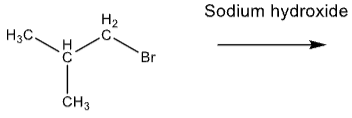
Major organic product?


Major organic product?


Major organic product?

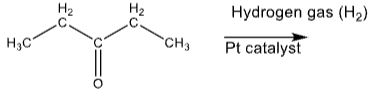
Major organic product?

essential fatty acid definition
Essential fatty acid is one that must be consumed, as the body needs it to function properly but cannot synthesise it internally.
Examples: linolenic acid or linoleic acid

Structure of hydrolysis products of the following reaction


Explain why the following polyunsaturated fatty acid is often described as C18:2 and Omega 6. In other words what do the bolded terms refer to?
C18:2 eighteen carbons long and contains 2 double bonds Omega 6 – the first double bond on the chain from the omega end is on the 6th
carbon
diagram of detergent
Detergent long non-polar tail and benzene-sulphonate ion head

diagram of soap
Soap- long non-polar tail and carboxylic ion head

Explain why all classes of low molecular weight amines are water-soluble
Hydrogen bonding
Why are amine drugs commonly administered in the form of their salts?
The amine salts are much more soluble in water (or the aqueous fluids in the body)

Write an equation to show how the drug dextromethorphan, a cough suppressant, could be made more water soluble.

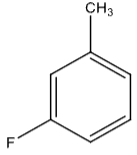
m-fluorotoluene

p-chloroaniline

m-ethylbenzoic acid

o-bromophenol
What is the difference between pyranose and furanose rings?
Pyranose is a six membered sugar ring containing an oxygen.
Furanose is a five membered sugar ring containing an oxygen
What functional groups are found in all amino acids?
Amino group and carboxylic acid
Draw the structure of the amino acid ‘aspartic acid’ at the nominated pH (7,1,11)

Identify and briefly explain three (3) types of interactions (attractive forces or bonds) that cause the tertiary structure of a protein.
Disulfide bonds – where cysteine side chains oxidise to form –S-S- bonds
Salt bridges- where positively and negatively charged side chains attract each other
Hydrogen bonding- where OH and NH side chains attract another for H-bonding
Hydrophobic interactions – non- polar side chains cluster together to exclude
Name the three components of a DNA nucleotide?
Nitrogenous base
Monosaccharide
Phosphate
List the major bases of nucleic acids and place them in the correct classification (Purine, Pyrimidine)

List three differences between DNA and RNA
1. Different nucleotide sugars (Ribose and Deoxyribose)
2. Different bases (Thymine in DNA and Uracil in RNA)
3. RNA single stranded DNA double stranded
The base sequence CATGAAT represents a portion of a single strand of DNA.
Use letters to represent the complementary strand.
By convention, DNA strands are written showing sequence 5’ → 3’. CATGAAT
Complementary strand of the one above, written 3’ → 5’ is GTACTTA
Conventionally represented 5’ → 3’, ATTCATG is the complementary strand
For each element listed, outline the importance or use of the element in the human body, and what happens when there is an excess or a deficiency. (phosphorous, calcium)
