ISO APERTURE SHUTTER
 Call Kai
 Learn
Learn Practice Test
 Spaced Repetition
 Match
Match Flashcards
 Knowt Play
1/21

Earn XP
Description and Tags
AOJ150 Grossmont Quiz2
Name | Mastery | Learn | Test | Matching | Spaced | Call with Kai | Chat |
|---|
No analytics yet
Send a link to your students to track their progress
22 Terms
What 3 things work together to create a perfectly exposed photograph?
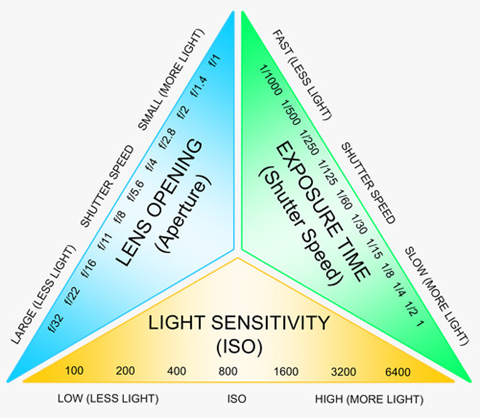
What is exposure?
Exposure is the amount of light that is reaching the sensor.
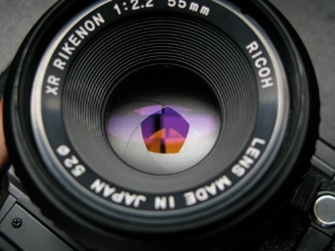
What is aperture?
Aperture is how big/small a lens opens on a camera to let a certain amount of light in.
What is Aperture measured in?
F-stops/F-numbers

What is the standard sequence of full-stop f-numbers from largest opening to smallest?
f/1.4, f/2, f/2.8, f/4, f/5.6, f/8, f/11, f/16, f/22 f/32 f/45 f/64
(Remember: smaller numbers = more light!)
What is the result of a
Small Aperture?
(f/11 to f/22)
Deep Depth of Field; keeps the foreground and background sharp.
What is a result of a
Large Aperture?
(f/2.8)
Shallow Depth of Field; isolates a single piece of evidence, blurs background.
When I change my aperture on my camera, what am I physically changing inside my camera?
You are changing the size of the camera lens opening.

What is shutter speed?
Shutter speed is how fast the camera shutter opens & closes to expose the sensor to light.
What is shutter speed measured in?
Shutter speed is measured in seconds or a fraction of a second.
When I change the shutter speed on my camera, what am I physically changing inside the camera?
When you change the shutter speed, you physically change how fast the shutter closes and opens again.

What is the standard sequence of full-stop shutter speeds from 1 second to 1/1000 of a second?
1s, 1/2, 1/4, 1/8, 1/15, 1/30, 1/60, 1/125, 1/250, 1/500, 1/1000.
(Each stop doubles or cuts the time in half).
Which 3 things control depth of field?
1. Aperture.
2. Distance from camera to subject.
3. Lens focal length.
What is it called when a photograph has a blurry foreground, but the background is in focus?
Depth of Field (DoF)

Which part of the triangle of exposure controls motion in my photographs?
The shutter speed controls motion blur and freezing motion.
What is ISO?
ISO is a camera setting that darkens/brightens photos by making the sensor become sensitive/less sensitive to light.
Define Base ISO
The lowest ISO will always be your base ISO.

What is the standard sequence of full-stop ISO values from base ISO 100 to 6400?
100, 200, 400, 800, 1600, 3200, 6400.
(Each step doubles the light sensitivity.)
Define noise as it pertains to photos.
Noise in photos is how much graininess and color blotchiness a photo contains.

How is ISO measured?
ISO is measured in ISO values or ISO speeds. The number indicates highness/lowness of the ISO.

When I change my ISO in my camera, what am I physically changing inside the camera?
When you change the ISO you’re physically changing the sensor sensitivity.

What happens to your photos when you turn up the ISO?
When you turn the ISO up, the image will become brighter. If you turn it up too much, there will be unwanted image noise.