Unit 4
 Call Kai
 Learn
 Practice Test
 Spaced Repetition
 Match
 Flashcards
 Knowt Play
1/106

There's no tags or description
Looks like no tags are added yet.
107 Terms
What is heart failure (HF)?
A condition where the heart muscle is too weak or stiff to pump enough blood to meet the body's needs for oxygen and nutrients
What is systolic heart failure?
A pumping problem ("can't pump"): the heart muscle becomes weak and cannot squeeze out enough blood during contraction
What is diastolic heart failure?
A filling problem ("can't fill"): the heart muscle becomes stiff and rigid, preventing the ventricles from relaxing and filling with enough blood.
What is ejection fraction (EF)?
The percentage of blood pumped out of the left ventricle with each heartbeat.
what is considered a normal Ejection Fraction (EF) range?
55% to 65%
Note: A normal EF is never 100% because the ventricle does not empty completely
What is an echocardiogram used for in heart failure?
An ultrasound of the heart that measures ejection fraction (EF) and evaluates heart muscle function and valve structures
What is B-type Natriuretic Peptide (BNP), and why does the body produce it?
A hormone released by heart muscles when stretched by fluid overload. It is the heart's "cry for help," trying to make the body urinate out excess fluid.
What is the normal lab value for a BNP blood test?
Under 100 pg/mL. Higher levels indicate heart strain and acute heart failure exacerbation
What memory acronym is used to remember the signs of Left-Sided Heart Failure?
"DROWNING":
Dyspnea,
Rales (crackles)
Orthopnea
Weakness,
Nocturnal paroxysmal dyspnea,
Increased HR,
Nagging cough (pink sputum),
Gaining weight
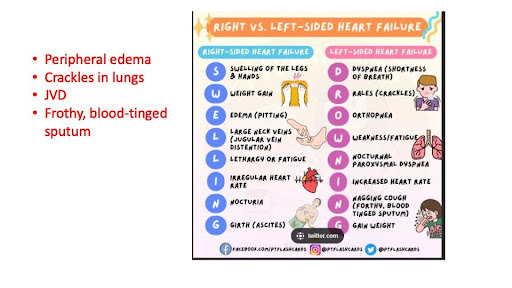
What are the key clinical manifestations (cues) of left-sided heart failure?
Dyspnea (shortness of breath), bibasilar crackles in lungs, orthopnea (difficulty breathing lying flat), paroxysmal nocturnal dyspnea (PND), and a dry/frothy cough.
What memory acronym is used to remember the signs of Right-Sided Heart Failure?
"SWELLING":
Swelling of legs/hands,
Weight gain,
Edema (pitting),
Large neck veins (JVD)
Lethargy/fatigue,
Irregular HR,
Nocturia,
Girth increase (ascites).

What are the main clinical manifestations (cues) of right-sided heart failure?
Dependent peripheral edema, Jugular Venous Distention (JVD), weight gain, ascites (abdominal fluid/increased girth), and enlarged liver (hepatomegaly).
What is pulmonary edema?
A severe, life-threatening emergency where severe left ventricular failure causes fluid to rapidly flood the lung's air sacs (alveoli), choking off oxygen exchange.
What is the classic, hallmark sign of acute pulmonary edema?
Coughing up pink, frothy, blood-tinged sputum.
What is the drug classification and action of Digoxin?
Classification: Cardiac glycoside.
Action: Increases heart squeeze strength (positive inotrope) AND slows down heart rate (negative chronotrope).
What vital sign MUST a nurse assess before administering Digoxin, and what is the hold parameter
Assess apical pulse for 1 full minute. HOLD the medication and notify provider if apical heart rate is below 60 bpm
What are the key signs and symptoms of Digoxin Toxicity?
Yellow/green halos around lights, visual disturbances, loss of appetite (anorexia), nausea, vomiting, confusion, and bradycardia (low HR).
What electrolyte imbalance greatly increases the risk of Digoxin toxicity?
Hypokalemia (low potassium level). When potassium is low, digoxin binds more heavily to heart cells, spiking toxicity risk
What is the drug classification and primary action of Furosemide?
Classification: Loop diuretic.
Action: Inhibits sodium and water reabsorption in the loop of Henle → produces rapid urine output to pull off excess fluid.
What lab values must a nurse monitor closely for a patient on Furosemide?
Serum Potassium, Sodium, and Magnesium (for depletion/hypokalemia) and Serum Creatinine/BUN (for kidney function
What essential safety assessments must a nurse perform before and during Furosemide therapy?
Check BP for orthostatic hypotension, track Daily Weights and strict Intake & Output (I&O), and assess lung sounds and peripheral edema.
What do Intravenous Inotropic Medications (e.g., dobutamine, dopamine, milrinone) do for acute heart failure patients?
They increase heart muscle contractility (squeeze force) and improve tissue blood flow in severe pump failure.
Why is a low-sodium diet critical in heart failure management?
Sodium attracts water → eating sodium causes fluid retention → increases blood volume → increases heart workload and causes edema/congestion.
What are the key clinical manifestations of heart failure in infants?
Failure to thrive (FTT), falling asleep during feedings or too tired to eat, rapid breathing (tachypnea), fast HR, and puffiness around eyes and feet.
What is the primary theory regarding the cause of schizophrenia?
Excess dopamine activity in the brain
highly impacts the meds
What is the genetic risk percentage for developing schizophrenia in identical twins?
50%
What duration of psychotic symptoms differentiates Brief Psychotic Disorder from Schizophreniform Disorder
Brief Psychotic Disorder lasts from 1 to 30 days, whereas Schizophreniform Disorder lasts from 30 days to 6 months.
How long must psychotic symptoms persist to confirm a diagnosis of schizophrenia?
More than 6 months
What is the typical age of onset for the first psychotic episode in males compared to females?
Males : 18–25,
females : 25–35
What distinguishes positive symptoms from negative symptoms in schizophrenia?
Positive symptoms add abnormal experiences (e.g., hallucinations, delusions), while negative symptoms take away normal functions (e.g., blunted affect, avolition).
What is the clinical difference between a hallucination and an illusion?
hallucination : a false sensory perception without an external stimulus,
illusion : misperception of an actual environmental stimulus.
Which type of delusion involves the belief that non-threatening external events or media directly refer to oneself?
Referential delusion
A patient believes their internal organs are rotting away despite normal physical exams. Which type of delusion is this?
Somatic delusion
Which delusion is characterized by a fatalistic belief that life is meaningless or that a major catastrophe is inevitable?
Nihilistic delusion
What speech alteration occurs when a patient echoes or repeats words spoken by another person?
Echolalia
What speech pattern is characterized by indirect answers that dance around the topic but eventually answer the original question?
Circumstantial speech
How does tangential speech differ from circumstantial speech?
Tangential speech veers off topic and never returns to answer the original question, whereas circumstantial speech eventually answers it.
What term describes speech consisting of meaningless rhyming of words?
Clang association
What is the term for invented, made-up words that have meaning only to the patient?
Neologisms
What motor symptom involves repeating or mimicking another person's physical movements?
Echopraxia
What motor phenomenon occurs when a patient's limbs remain in whatever posture an examiner places them in?
Waxy flexibility
What negative symptom describes a complete lack of motivation or drive to initiate tasks?
Avolition
What negative symptom refers to poverty of speech or a reduction in speech output?
Alogia
How should a nurse adapt instructions for a patient experiencing neurocognitive executive function deficits
Provide concise, single-thought, step-by-step instructions.
What is the primary nursing consideration when a patient exhibits concrete thinking?
Avoid metaphors, idioms, or abstract concepts, as the patient will interpret statements literally.
How many months of sx are required to diagnose Generalized Anxiety Disorder (GAD)?
Uncontrolled, excessive worrying occurring for the majority of days for at least 6 months
What behavioral state characterizes mild anxiety?
The patient is alert, aware, and learning is optimal.
what changes occur during moderate anxiety?
the patient sees, hears, and grasps less than previously but can state, "I am anxious now."
How are scores on the HAM-A scale interpreted regarding anxiety severity?
Higher numerical scores indicate higher severity of anxiety.
What overarching behavioral traits characterize Cluster A personality disorders?
Odd or eccentric behaviors
Which three personality disorders belong to Cluster A?
Paranoid, Schizoid, and Schizotypal
What key characteristics distinguish Schizoid Personality Disorder?
Social detachment, preference for solitude, and limited emotional expression (loners).
What key characteristics distinguish Paranoid personality disorder
distrust and suspicion of others
no hallucinations or delusions present
every action by others is driven by an intent
What key characteristics distinguish Schizotypical personality disorder
eccentric behavior
odd beliefs or magical thinking
weird appearance and speech
What key characteristics distinguish antisocial personality disorder
Grandiose
think very highly of themselves
think rules dont apply to them
often break rules
engage in criminal behaviors
What key characteristics distinguish Borderline personality disorder
unstable pattern of behavior
self harm
fear of abandonment
unpredictable and reactive moods
manipulative
unstable relationships
What key characteristics distinguish histrionic personality disorder
Bigger than life pattern of behavior
Attention seeking
easily influenced by others
engages in high risk sexual behaviors
What key characteristics distinguish narcissistic personality disorder
Egotistical
need to be admired
no empathy
entitled
What key characteristics distinguish Avoidant personality disorder
Withdrawn pattern of behavior
timid not solitude
very sensitive to negative feedback
discomfort in social situations
fear of rejection
What key characteristics distinguish dependent personality disorder
submissive pattern of behavior
excessive need to be cared for
fear of separation
hard time making choices
insecure about ability to make choices
What key characteristics distinguish obsessive compulsive personality disorder (OCPD)
Conforming
preoccupied with things being in order
perfectionist / controlling
repetitive checking
What primary nursing focus is indicated for a patient diagnosed with Schizotypal Personality Disorder?
Assist with self-care and self-care deficit activities (ADLs).
Assist with self-care and self-care deficit activities (ADLs).
Dramatic, emotional, or erratic behaviors
Which four personality disorders belong to Cluster B?
Antisocial, Borderline, Histrionic, and Narcissistic
What key nursing intervention is essential when managing a patient with Antisocial Personality Disorder?
Enforce strict, consistent limit setting to prevent manipulative and deceitful behavior
Which personality disorder carries the highest risk for self-mutilation and suicide?
Boderline personality disorder
What overarching behavioral traits characterize Cluster C personality disorders?
Anxious or fearful behavior
Which three personality disorders belong to Cluster C?
Avoidant, Dependent, and Obsessive-Compulsive
What diagnostic duration criterion distinguishes Posttraumatic Stress Disorder (PTSD) from acute stress reactions?
Symptoms persisting for longer than 4 weeks following exposure to a traumatic event.
What are the four primary symptom categories of PTSD?
Intrusive memories, Avoidance, Negative thoughts/mood, and Altered physical/emotional reactivity.
What is the typical timeframe for the onset of Psychosis with Postpartum Onset?
Abrupt onset occurring within days to weeks post-birth.
What drug classification does lorazepam belong to, and what is its primary mechanism of action?
Class : Benzodiazepine
MOA : Increases effects of GABA to produce central nervous system depression.
What are the indications for lorazepam?
Acute anxiety, panic attacks, severe agitation, and alcohol withdrawal.
What are common central nervous system side effects of lorazepam?
Sedation, dizziness, confusion, disorientation, and headaches.
Why is lorazepam prescribed with extreme caution in older adult populations?
Increased risk of severe confusion, over-sedation, motor impairment, and falls.
What risk occurs upon abrupt discontinuation of long-term lorazepam therapy?
Severe withdrawal symptoms
What classification does buspirone belong to, and how does its safety profile differ from lorazepam?
Non-benzodiazepine anxiolytic
lacks CNS depressant effects, has minimal abuse potential, and does not cause sedation.
How long does buspirone take to reach its full therapeutic effect?
2 to 4 weeks
In what clinical scenario is buspirone preferred over lorazepam for managing anxiety?
In what clinical scenario is buspirone preferred over lorazepam for managing anxiety?
What is the primary mechanism of action of haloperidol?
High-potency blockade of dopamine D2 receptors (First-Generation Antipsychotic).
What adverse effect categories are highest risk with haloperidol administration?
Extrapyramidal side effects (EPS), Tardive Dyskinesia (TD), Hyperprolactinemia, and Neuroleptic Malignant Syndrome (NMS).
How does second-generation (atypical) antipsychotic mechanism of action differ from first-generation antipsychotics?
Second-generation agents selectively block dopamine receptors and have greater serotonin receptor binding, improving negative symptoms.
What moderate side effect risk is specific to aripiprazole compared to other atypical antipsychotics?
Akathisia (intense motor restlessness)
How long must oral aripiprazole overlap when initiating long-acting injectable aripiprazole?
2 weeks
What adverse effect profile carries the highest risk for patients taking olanzapine?
Severe metabolic syndrome (significant weight gain, dyslipidemia, hyperglycemia/type 2 diabetes), high sedation, and anticholinergic effects.
What specific administration instruction is mandatory for lurasidone?
Must be taken with food containing at least 350 calories.
Which second-generation antipsychotic is approved for safe use during pregnancy?
Lurasidone
Why does quetiapine require careful dose titration during initiation?
Because it blocks alpha-adrenergic receptors, carrying a very high risk for sedation and severe orthostatic hypotension.
Which antipsychotic is preferred when Extrapyramidal Side Effects (EPS) are a major clinical concern?
Quetiapine
What potentially life-threatening hematologic adverse effect is associated with clozapine?
Agranulocytosis
What mandatory laboratory monitoring must be documented before a provider can renew a clozapine prescription?
Absolute Neutrophil Count (ANC)
What symptoms must a patient taking clozapine be educated to report immediately?
Fever, sore throat, or flu-like symptoms (signs of agranulocytosis infection).
What drug classification does benztropine belong to, and what is its primary psychiatric indication?
Anticholinergic agent; used to treat extrapyramidal side effects (acute dystonia, pseudoparkinsonism) caused by antipsychotics.
What are four classic anticholinergic side effects associated with benztropine?
Dry mouth, blurred vision, constipation, and urinary retention.
What clinical manifestations signal Neuroleptic Malignant Syndrome (NMS) in a patient taking antipsychotics?
High fever (hyperpyrexia), severe muscle rigidity, autonomic instability, and elevated creatine kinase (CK/CPK) levels.
What immediate emergency nursing actions are required if NMS is suspected?
Immediately stop the antipsychotic medication, initiate rapid cooling measures, notify the provider, and transfer to ICU.
What essential clinical feature characterizes Schizoaffective Disorder?
A combination of schizophrenia symptoms occurring concurrently with a major mood disorder component (such as depression or bipolar disorder).
What distinguishes positive (hard) symptoms of schizophrenia from negative (soft) symptoms?
Positive symptoms add abnormal behaviors or perceptions (e.g., hallucinations, delusions), whereas negative symptoms take away normal functions or emotions (e.g., flat affect, avolition).
What drug classification and mechanism of action define aripiprazole
Second-Generation Antipsychotic (SGA) / Atypical; acts by selectively blocking dopamine receptors while binding serotonin receptors.