HK 444 practice quizzes 1 through 2.6
 Call Kai
 Learn
Learn Practice Test
 Spaced Repetition
 Match
Match Flashcards
 Knowt Play
1/99

There's no tags or description
Looks like no tags are added yet.
Name | Mastery | Learn | Test | Matching | Spaced | Call with Kai | Chat |
|---|
No analytics yet
Send a link to your students to track their progress
100 Terms
What are the feet positions included. (BESS)
tandem stance (heel to toe), one-legged stance, narrow stance (feet together) (BESS)
What are the surfaces included. (BESS)
Foam and Firm (BESS)
How is balance scored? (BESS)
Count errors (BESS)
Duration of the test is 20 s. Which of the following should you use to time the 20 s? (BESS)
Timer
During one-legged stance in the BESS test, do they stand on the dominant or non-dominant leg?
Non-dominant
During tandem stance, which leg goes behind the other?
non-dominant
How do you identify the dominant foot?
ask which foot they kick a ball with
Which of the following are errors in the BESS test?
forefoot or heel comes off ground, remains out of proper position for > 5 seconds, move hands off hips, hip frontal angle 30 degrees or more, step/stumble, open eyes
During the BESS test, at the same time, the person opens their eyes, moves their hands off their hips, and takes a step. How many errors is this?
1
During the BESS test, at different times for each event, the person opens their eyes, moves their hands off their hips, and takes a step. How many errors is this? One answer only
3
How many practice trials should the participant receive? YBT
4-6
How many directions are there? YBT
3
Before starting the protocol, the following should be completed: YBT
measure leg length, practice trials
How is balance scored in the YBT?
measure distance in cm that foot can reach
If a person reaches anterioly 90 cm, and their leg length is 90 cm, what is their 'score' on that trial? YBT
100%
If a person scores 120% on the left leg and 100% on the right leg, are they symmetrical or asymmetrical? YBT
asymmetrical
If a person scores 80% on the left leg and 80% on the right leg, are they symmetrical or asymmetrical? YBT
symmetrical
Research has demonstrated that the YBT is helpful for decisions regarding return-to-play in athletes.
True
Overall, many clinical balance tests are
scored by a clinician after watching how the client performs a series of specified movements and subjective (and therefore more susceptible to bias)
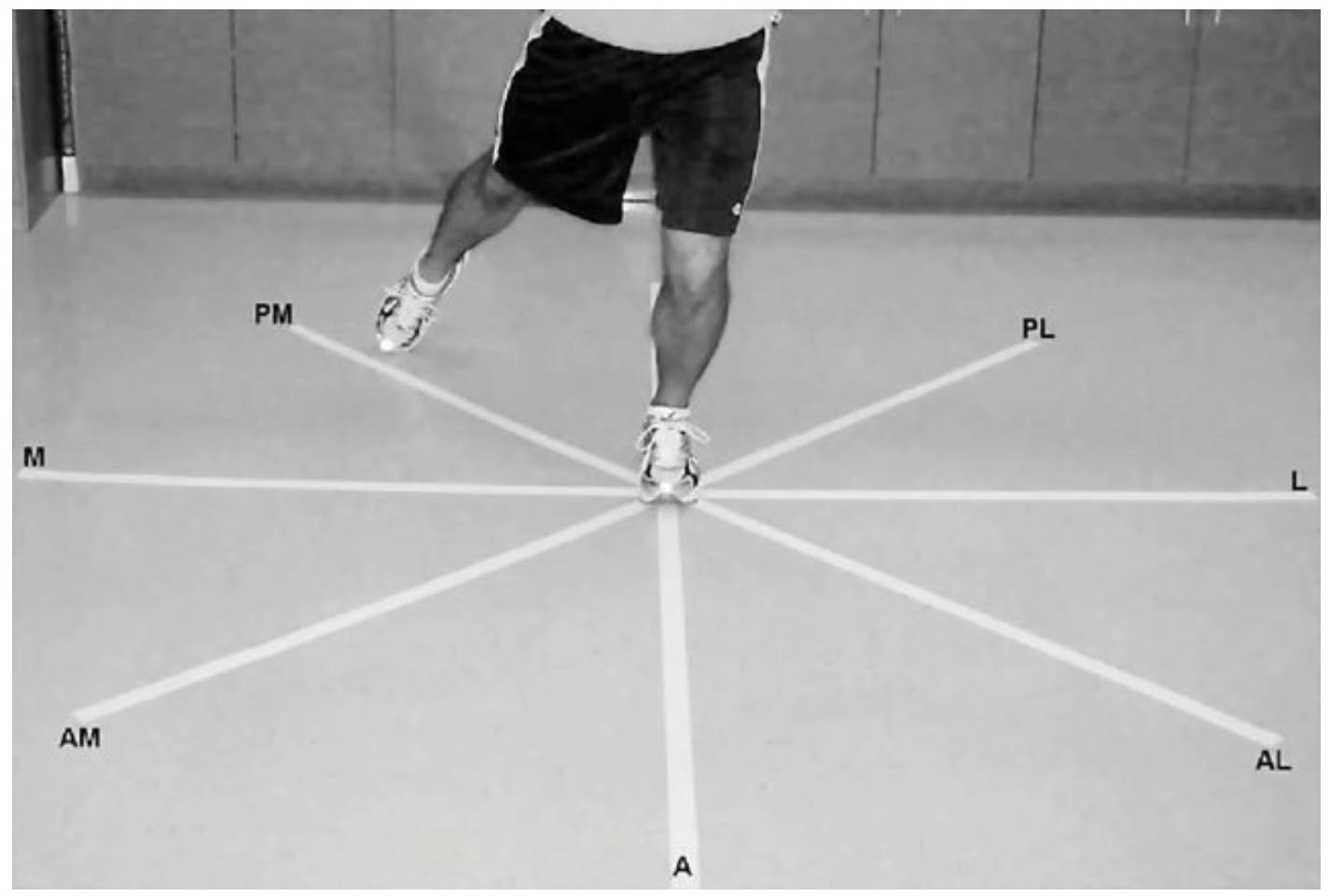
which test is this
SEBT (star excursion balance test)
Which of the following papers recommended a core outcome set for measuring standing balance?
Sibley et al., 2015
Which of the following factors are manipulated and examined in the BESS test?
contributions of various sensory systems (vision, vestibular, touch, proprioception), mechanical contributions (such as size of base of support)
Which of the following tests takes the least amount of time to complete?
TUG

which test is this
ybt

Which of the following tests is associated with this model/framework?
BESTest
Which of the following tests identifies the type of balance problem and identifies the most appropriate treatment?
BESTest
Which of the following factors are manipulated and/or quantified in the BESTest?
anticipatory postural adjustments (i.e., planning for a prescribed movement, such as turning at a piece of tape while walking)reactive postural adjustments (i.e., responding to a perturbation where the timing is unknown, such as a sudden change in posture), contributions of various sensory systems (vision, vestibular, touch, proprioception), mechanical contributions (such as size of base of support), cognitive influences, ROM
Which of the following tests would be most appropriate to test balance on an athlete or young healthy adult?
BESS and YBT and SEBT
Which of the following tests takes the most amount of time to complete?
BESTest
Approximately how many clinical balance tests are currently being used?
60+
Which of the following motivated Sibley et al., 2015, to develop a consensus on a core outcome set of balance tests?
Clinical practice/assessment should be consistent across multiple clinics, Identifying the best balance intervention will be improved if all intervention research uses the same measures of standing balance, There are an excessive number of clinical balance tests, There is a lack of a gold standard for measuring standing balance
Which of the following papers examined the effect of textured insoles on balance?
Park et al., 2023
Which of the following tests would be most appropriate to test balance on an older adult or someone with a disease or disability that affects balance?
FABS, TUG, BBS, BESTest, MiniBEStest
Sibley et al., 2015, recommended a core outcomes set of two clinical tests for measuring standing balance in adults (as a minimum). These two tests are:
mini-BEst
Which of the following tests include stepping over an obstacle?
BESTest, and mini BESTest
In the example theory below, what is considered the “unobservable phenomenon”?
Example theory: People who get cancer have been exposed to cancer-causing agents (e.g., sun, chemicals) and are more genetically susceptible to cancer than others.
genetics and environment
Hypothesis example: Balance will be better when the eyes are closed versus eyes open. Select all that apply.
No DV
Hypothesis example: The change in balance will depend on the type of intervention. What is wrong with this hypothesis? Select all that apply.
No DV, IV, or direction

Which of the following shows good reliability (select all that apply):
C and D
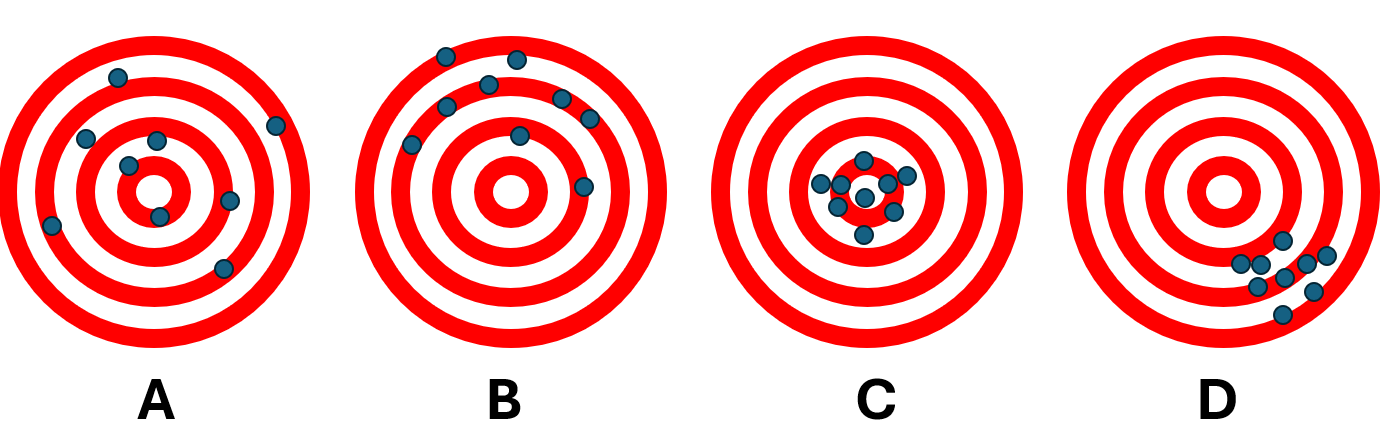
Which of the following shows good validity
C
Hypothesis example: Cognitive scores will improve more with High-intensity-interval-training (HIIT) than longer duration exercise.
There is nothing wrong with this hypothesis
Hypothesis example: RMS (root mean square) of acceleration will be higher when the eyes are closed versus eyes open.
There is nothing wrong with this hypothesis

Test A and Test B were used to see if the tests could be used to distinguish those at high fall-risk (blue distribution on left side of each chart) and those at low fall-risk (orange distribution on the right side of each chart) Which test is more sensitive?
B
What does a theory aim to do?
explain unobservable phenomena and relate them to outcomes

Which of the following shows reliable but not valid:
D

Which of the following shows not reliable and not valid:
B

Which of the following shows low validity and low reliability:
A
Hypothesis example: High-intensity-interval-training (HIIT) is better longer duration exercise.
No DV
What does a theory primarily aim to explain?
Unobservable phenomena and their relation to outcomes

Which of the following shows both reliable and valid:
C
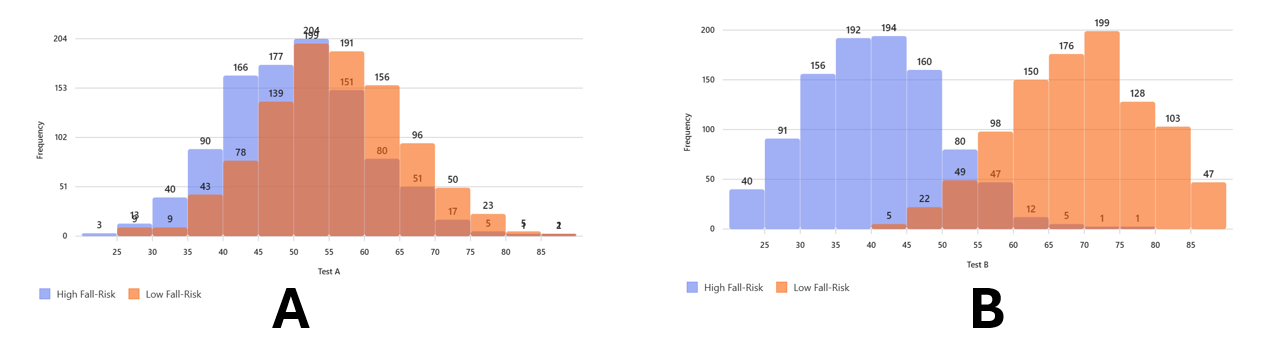
What is the name of these figures?
Histograms
Which of the following are true regarding association between exposure/intervention and outcome? In this example, the outcome is frequency of falls, and the intervention was either balance training or strength training
When the ratio is 1.0, it indicates there is no difference in the fall frequency for balance training vs strength training. The association can be quantified as a ratio (e.g., risk ratio). When the ratio is significantly different from 1.0, it indicates there is a difference in fall frequency between balance training and strength training
Which of the following best describes a theory?
a group of abstract ideas
Hypothesis example: High intensity interval training (HIIT) will improve hte BESS score more than yoga training.
There is nothing wrong with this hypothesis
You conduct the TUG and FAB on 110 older adults.
Based on these scores, you assign each person a score of either high fall-risk (N=10) or low fall-risk (N=100).
For the following year, you track their falls. The results were:4
From the 10 people categorized as high fall-risk: 7 fell (3 did not fall).
From the 100 people categorized as low fall-risk: 40 fell (60 did not fall).
What is sensitivity? Include units.
70%
You conduct the TUG and FAB on 110 older adults.
Based on these scores, you assign each person a score of either high fall-risk (N=10) or low fall-risk (N=100).
For the following year, you track their falls. The results were:4
From the 10 people categorized as high fall-risk: 7 fell (3 did not fall).
From the 100 people categorized as low fall-risk: 40 fell (60 did not fall).
What is specificity? Include units.
60%
You conduct the TUG and FAB on 110 older adults.
Based on these scores, you assign each person a score of either high fall-risk (N=10) or low fall-risk (N=100).
For the following year, you track their falls. The results were:4
From the 10 people categorized as high fall-risk: 7 fell (3 did not fall).
From the 100 people categorized as low fall-risk: 40 fell (60 did not fall)\
what was your overall accuracy?
61 %
The cases that did fall and were categorized as fallers (high fall risk) are called:
True positive
The cases that did not fall and were categorized as fallers (high fall risk) are called:
False positive
You develop an algorithm to analyze data from an accelerometer worn by a person (wearable sensor). Your algorithm detects if the signal indicates if a person has either fallen or not fallen when the signal meets a specified criteria (called an episode).
During six months, there are 200 episodes where the acceleration signal meets the criteria. There were actually 100 falls and 100 not-falls in the 200 episodes.
From those 200 episodes, your algorithm quantified all 200 as falls and none as not-falls. What is your sensitivity? Include units for all answer.
100%
You develop an algorithm to analyze data from an accelerometer worn by a person (wearable sensor). Your algorithm detects if the signal indicates if a person has either fallen or not fallen when the signal meets a specified criteria (called an episode).
During six months, there are 200 episodes where the acceleration signal meets the criteria. There were actually 100 falls and 100 not-falls in the 200 episodes.
From those 200 episodes, your algorithm quantified all 200 as falls and none as not-falls.
What is your specificity?
0%
You develop an algorithm to analyze data from an accelerometer worn by a person (wearable sensor). Your algorithm detects if the signal indicates if a person has either fallen or not fallen when the signal meets a specified criteria (called an episode).
During six months, there are 200 episodes where the acceleration signal meets the criteria. There were actually 100 falls and 100 not-falls in the 200 episodes.
From those 200 episodes, your new algorithm quantified 0 as falls and 200 as not-falls. What is your sensitivity?
0%
You develop an algorithm to analyze data from an accelerometer worn by a person (wearable sensor). Your algorithm detects if the signal indicates if a person has either fallen or not fallen when the signal meets a specified criteria (called an episode).
During six months, there are 200 episodes where the acceleration signal meets the criteria. There were actually 100 falls and 100 not-falls in the 200 episodes.
From those 200 episodes, your new algorithm quantified 0 as falls and 200 as not-falls.
What is your specificity?
100%
Some participants receive additional strength training that is not part of the study protocol.
Intervention Bias
A study showing a new exercise program works is published, while studies showing no benefit remain unpublished.
Publication Bias
Recruiting older adults only from a nursing facility to represent all older adults (nursing facility provides 24-hour nursing and personal care for individuals with ongoing health needs)
Selection Bias
Recruiting older adults only from a senior fitness center to represent all older adults
Selection Bias
Researchers perceive that journals are more likely to publish significant findings than nonsignificant findings, so they don't submit their research.
Publication Bias
Using a hearing-based questionnaire with people who have uncorrected hearing loss.
Measurement Bias
Using the Berg Balance Scale on young adults.
Measurement Bias
Participants in the exercise group receive more attention from researchers than the control group.
Intervention Bias
Conflict of interest bias can affect which of the following?
Selection of participants, measurement of outcomes, publication results
Asking participants to recall falls from the past 12 months, leading to underreporting
Systematic Bias
A participant is momentarily distracted during one test trial
Random Bias
A scale that always reads 2 kg too high
Systematic Bias
Recruiting participants from a gym to study the general population's fitness
Systematic Bias
Motion capture markers are placed slightly differently on different participants
Random Bias
Participants' reaction times vary because they are more or less tired on different days
Random Bias
Which scenario is the best example of conflict of interest bias?
The study evaluating a new balance device is funded by the company that manufactures the device.
Bias results from decisions (by researchers or others) made during dissemination of findings; sub-category of systematic bias.
Publication Bias
Bias that results from odds ratio equal to 1.0
Not a definition of bias
Bias results from reproducible errors; one of the two major sub-categories of research bias.
Systematic Bias
Bias results from random errors; one of the two major sub-categories of research bias.
Random Bias
Bias results from choices made during recruitment of participants; sub-category of systematic bias.
Selection Bias
Bias results from the treatment participants receive; sub-category of systematic bias.
Intervention Bias
Bias results from choices made when quantifying data; sub-category of systematic bias.
Measurement Bias

Funnel plot use
to identify publication bias and identify systematic bias
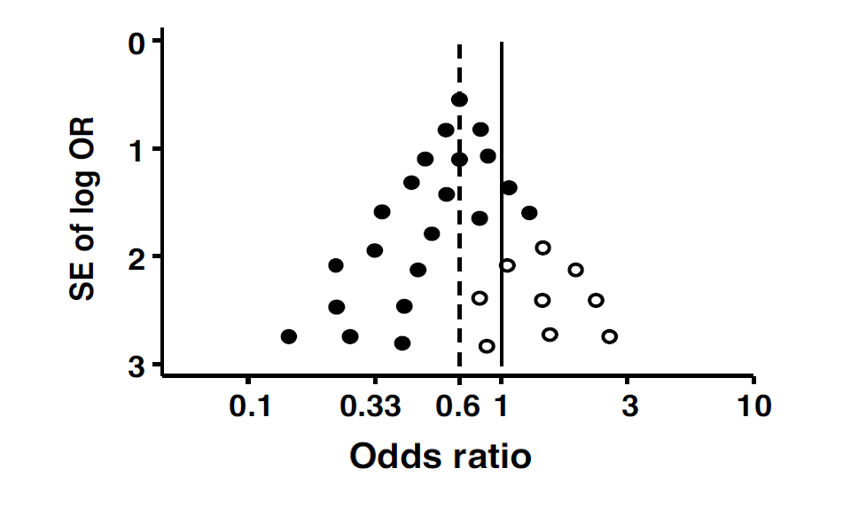
Funnel Plot - horizontal axis represents:
Dependent Variable
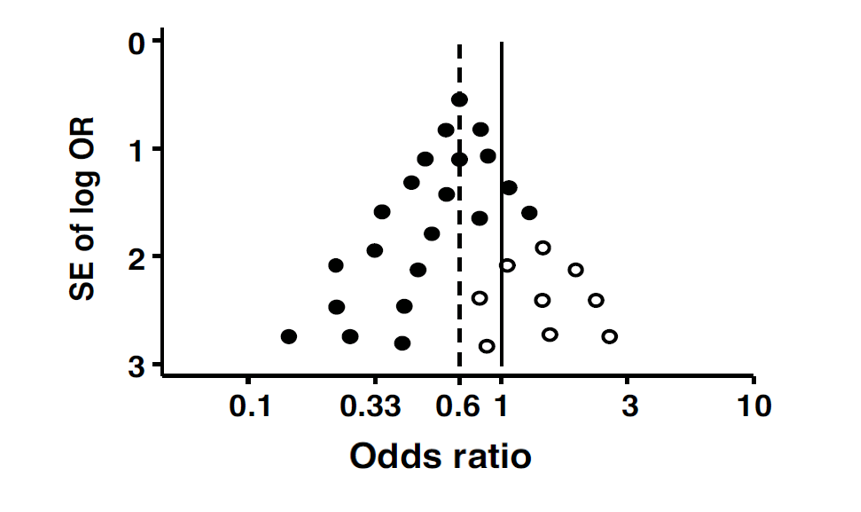
Funnel Plot - this figure indicates publication bias is present.
False

Funnel Plot - each dot represents:
One study

Funnel Plot - vertical axis represents:
Quality of the study

Funnel Plot - this figure indicates publication bias is present.
True
The degree of consistency of a measurement.
reliability
Research has two major sub-categories. One of them is called:
systematic
Participants were expected to attend 10 training sessions. One subject attended 80% of these sessions. This is called:
adherence (or compliance)
A research study is quantifying falls by asking people how many times they have fallen in the past year. This is called:
retrospective
A research study is quantifying falls by asking them to keep a fall diary for the next year. This is called:
prospective
The degree of closeness of a measurement to its true value.
validity
A research study had five people stop participating in the study. This is called:
attrition
Which of the following is most likely a spurious correlation? Spurious correlation: A statistical association between two variables that appears real but is actually caused by a third factor, chance, or another source of confounding rather than an actual causal relationship.
Gray hair and falls