Lecture 5: B cell development 3
 Call Kai
 Learn
 Practice Test
 Spaced Repetition
 Match
 Flashcards
 Knowt Play
1/27

There's no tags or description
Looks like no tags are added yet.
28 Terms

Recap last Lecture

From last lecture
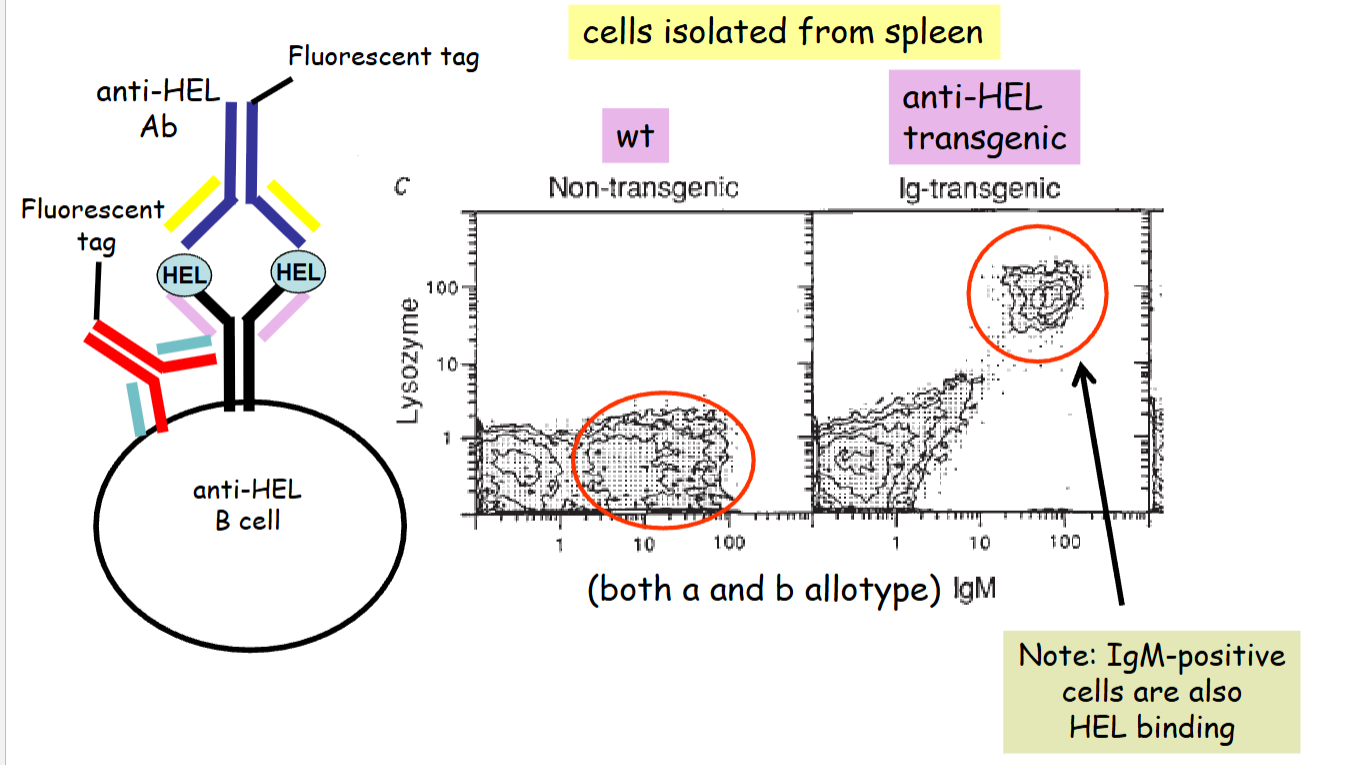
*****from this Graph Do Transgenic B cells bind HEL?
YES the anti-HEL BCR can bind HEL

Explain the Antibody situation. How does it help Flow cytometry detect if this cell can bind HELL
1 Ab = recognizes both a (transgenic) + b (endogenous) allotype BCR receptors
2nd Ab = that recognizes Epitopes on the HEL Ag
Thus only HEL binding receptors will have both Ab 1 + Ab 2 signal

****What is NEGATIVE SELECTION
The process of removing self reactive B cells and preventing them from being activated = prevent autoimmunity
Random Nature of V(D)J recombination results in some B cells expressing BCRs that recognize self antigens
This results in the B cell repertoire being TOLERANT to self antigen
*******Define CENTRAL TOLERANCE
The removal of Self reactive Lymphocytes in PRIMARY lymphoid organs
Bcells (bone marrow)
T cells (thymus)
******What is PERIPHERAL B cell TOLERANCE?
Not all self Ag are presented in the bone marrow
negative selection also occurs in the periphery to remove/inactivate
self- reactive B cells whose Ags are not encountered in the bone
marrow (eg. TISSUE SPECIFIC Ag)
****What are the 3 methods of Removal of SELF REACTIVE B cells?
Clonal deletion
Anergy (functional non-responsiveness)
Receptor editing
***What is an additional method of dealing with self reactive B cells in the PERIPHERY?
also involves regulatory T cells (Tregs) which directly/indirectly limit B cell activation
*******What are factors that determine whether a B cell mounts an immune response (foreign Ag) or become tolerant (self Ag)?
When the B cell see Ag during B cell development
Immature B cell sees Ag = Becomes TOLERANT
Transitional B cells = More likely to become Tolerant
Mature B Cells (Periphery): Encountering Ag favors peripheral activation, provided co-stimulatory signals are present
Infection INCREASES chance of mounting immune response
PAMPs + DAMPs
T-cell Co-stim
****CLONAL DELETION
what is it?
How is the cell eliminated?
Self reactive cells undergo programmed cell death = APOPTOSIS the cell then fragments and is PHAGOCYTOSED
ex. If B cell binds antigen but there are no secondary signal (ie. PAMP/DAMP or T cell costim.) = APOPTOSIS
****Functional ANERGY
what is it?
What occurs?
self-reactive cells become non-responsive to antigen
• impaired signalling when Ag binds BCR
• shorter half-life
• phenotypically different - alter their surface marker expression to reinforce their silenced state
***What is the MARKER of Anergic Phenotype?
Down-regulated IgM
Phenotypically different
****What Determines whether a self reactive cell undergoes CLONAL DELETION or ANERGY?
Strength of BCR signaling
Multivalent self Ag (eg. Membrane bound) = Multiple epitopes = simultaneously engage MANY BCR = STRONG signal = CLONAL DELETION
Monovalent self Ag (eg. Soluble) = Single epitope = engage FEW BCR = WEAKER signal = ANERGY

How can clonal deletion and anergy be studied
aka. What experiment was done to study clonal deletion and anergy?
Anti-HEL BCR transgenic mice to study negative selection
**Why would using the anti-HEL BCR transgenic be useful to study negative selection?
Whole population of cells in the HEL transgenic mouse is HEL specific
ALL B cells have the same specificity
we know what the Ag of the BCR is (HEL)

*****Question: Is HEL seen as a self protein in the HEL transgenic mouse?
How was this tested?
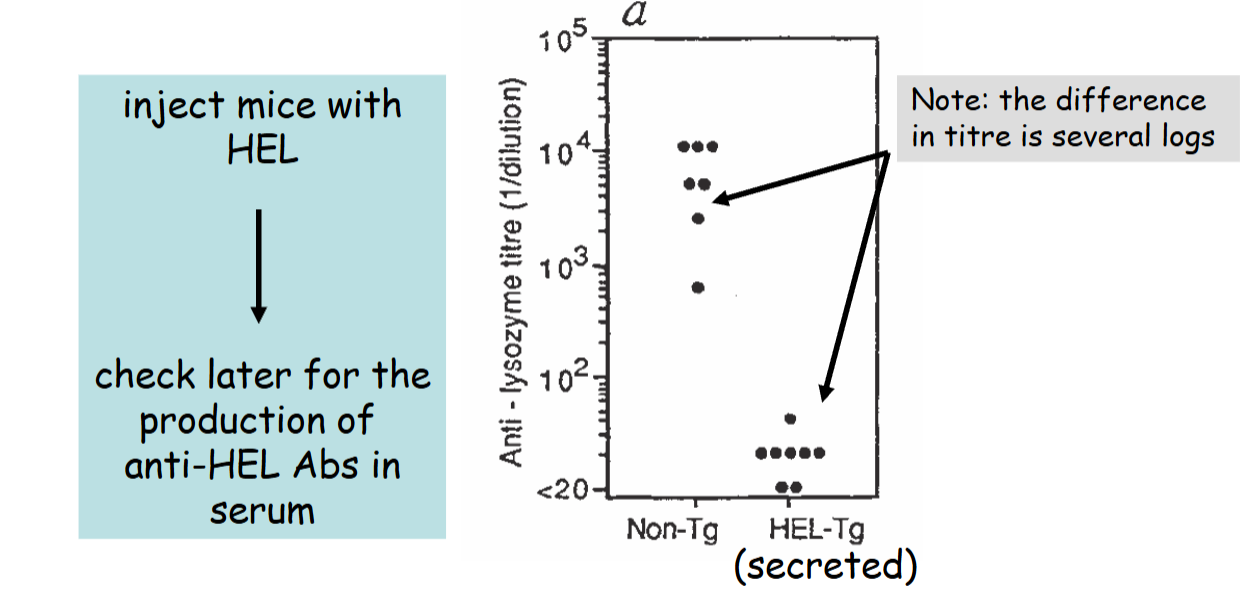
What do the results from this graph show? Aka. What is the conclusion
Created a HEL transgene mouse (mouse that secretes HEL)
BCR/Ab produced are still the wide range in a normal Mouse cell generated using endogenous genes
Conclusion: the HEL transgenics do not respond to HEL
When Hel was injected in to the HEL transgenic mice it did not induce an immune response (aka. No anti-HEL Ab was generated thus that must mean any BCR that did react to HEL were selected against)
TOLERANT to HEL aka. HEL recognized as a self protein
What is a Double transgenic mouse in the HEL experiment?
crossed anti-HEL BCR transgenic mouse with a transgenic mouse expressing soluble HEL (HEL transgenic) to study anergy = DOUBLE Transgenic mouse (carrying both HEL + Anti-HEL transgenes)
In this case unlike the HEL transgenic mouse:
BCR = exclusively Anti-HEL BCR


******What can be concluded from this graph and why?
are B cells in double transgenic mice ANERGIC?
Conclusion: B cells in double transgenic have an anergic phenotype
Double transgenic mice show LOW IgM (Marker of anergic phenotype) + high IgD
Transgenic HEL mice are NOT anergic because their Transgenic BCR (a allotype) show both HIGH IgM and IgD

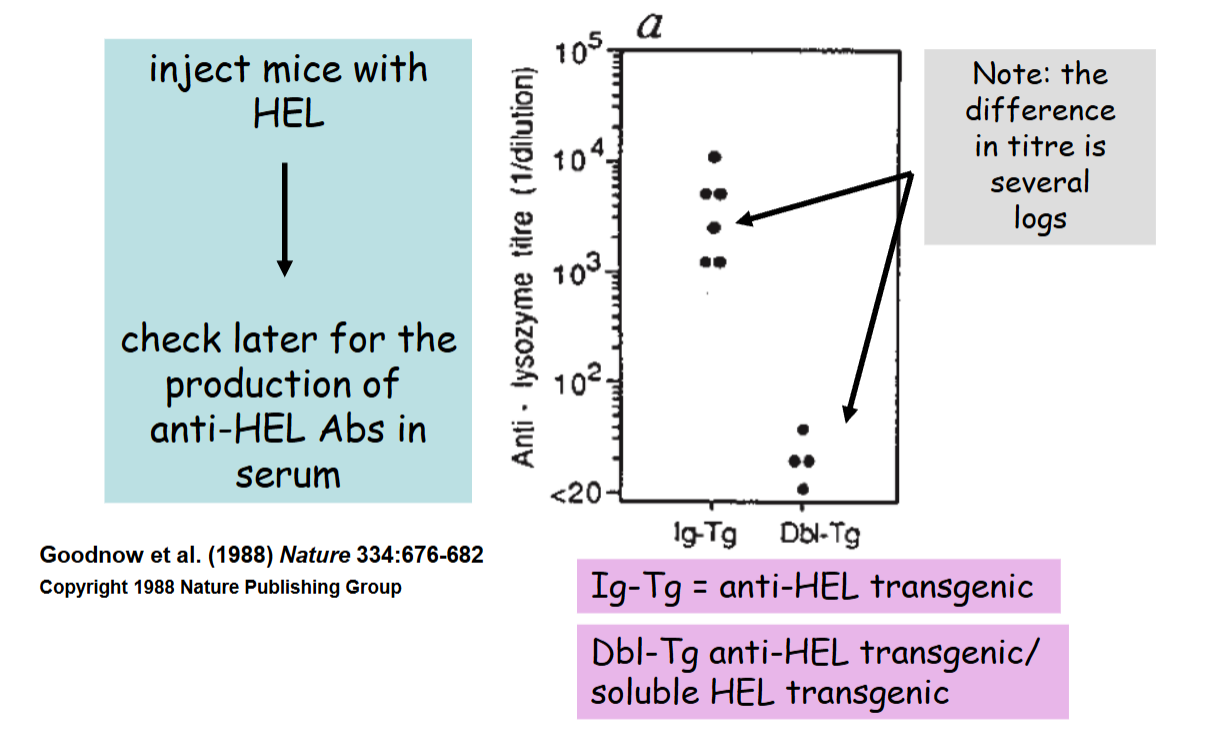
******are Double transgenic B cells truly anergic? aka are they NON responsive?
What is the conclusion of this Graph?
Conclusion: the double transgenics do not make anti-HEL Abs
YES anti-HEL B cells in double transgenic are anergic
No Ab response generated when injected with Hel because Ab are truly anergic

***How could the anti-HEL transgenic system be used to study clonal deletion?
Modify how the HEL Ag is expressed by the mouse to affect the STRENGTH of signal the B cell receives from the antigen
eg. MAKE it multivalent have multiple epitopes aka. Cluster together
*******What is RECEPTOR EDITING
A mechanism to RESCUE self-reactive immature B cells where LIGHT chain gene can undergo further rearrangement in self reactive cells
B cell arrests in development and starts rearranging light chain AGAIN Alternative V + J segments are tried
In HEL/Anti-HEL system where cells should be deleted, a small number of mature B cells are found to express transgenic heavy chain and endogenous light chain

******True or false: Receptor editing can occur an infinite amount of times until a non-self reactive antibody is generated
False
Finite time to generate new functional light chain that results in a non-self-reactive antibody
• if cell cannot, it will die
***********What are CONVENTIONAL vs. NON-CONVENTIONAL B cells?
up until now we have only talked about the development of “conventional” B cells:
“B-2 B cells” or follicular B cells
“non-conventional” B cells = a smaller fraction of the B cell pool in the periphery
B-1 B cells (5% of all B cells in adult mice)
marginal zone B cells
IL-10-secreting regulatory B cells
******Compare between B1 vs. B2 B cells in terms of:
Major sites of mature cells
Source of cells in adults
V region diversity
Requirement for T cell help
Isotypes produced
Memory
Somatic hypermutation
Ag recognized

*******What is the PRIMARY Ig protein expressed on B1 B cells?
Why is this important?
What is so SPECIAL about this production?
IgM- quickly produced to common carbohydrate/lipid structures on bacteria
act as an immediate, frontline defense system long before conventional B-2 cells can launch a tailored adaptive response
Possess the unique ability to spontaneously and continuously secrete IgM without prior exposure to an infection.
T-Cell Independent Readiness: B-1 cells do not need instruction from T-helper cells
